Breaking News
Breaking News
from Washington and beyond

Trump’s U.N. Ambassador Gives Sick Defense of Venezuela Invasion

Mike Waltz says it was our right to invade Venezuela.

Mike Waltz speaks at the U.N. while seated behind the "United States" nameplate.
Spencer Platt/Getty Images

After the United States kidnapped their president and bombed their capital, Ambassador to the U.N. Mike Waltz swears that “there is no war in Venezuela.”

“As Secretary Rubio has said, there is no war against Venezuela or its people. We are not occupying a country. This was a law enforcement operation in furtherance of lawful indictments that have existed for decades. The United States arrested a narco-trafficker who is now going to stand trial in the United States,” Waltz said at an emergency session of the United Nations Security Council on Monday.

If this was just a simple “law enforcement operation,” then why the bombs? Why would the Trump administration consult U.S. oil companies prior to the kidnapping of Maduro? Why would Trump say outright that the U.S. will be running Venezuela?

The indictment Waltz refers to claims that Maduro allowed “cocaine-fueled corruption to flourish for his own benefit, for the benefit of members of his ruling regime, and for the benefit of his family members” and “provided Venezuelan diplomatic passports to drug traffickers and facilitated diplomatic cover for planes used by money launderers to repatriate drug proceeds from Mexico to Venezuela.” Venezuela does not play a major role in trafficking drugs to the United States—and the indictment says nothing about fentanyl, the primary cause of U.S. deaths by overdose.

In his speech, Waltz also emphasized oil, likely the real priority of the Trump administration in this escalation of aggression against Venezuela—not fighting for democracy or stopping drug trafficking.

“You cannot continue to have the largest energy reserves in the world under the control of adversaries of the United States.”

Pete Hegseth Finds New Way to Bully Mark Kelly Over Message to Troops

The defense secretary is still furious that Kelly told troops to follow the law.

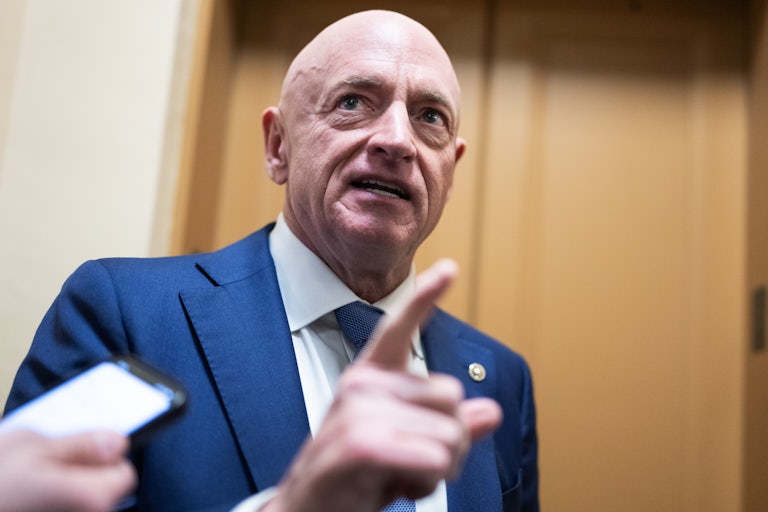
Senator Mark Kelly gestures while speaking to reporters in the Capitol
Tom Williams/CQ-Roll Call, Inc/Getty Images

Pete Hegseth has finally figured out how to extract his petty payback on Senator Mark Kelly: going after his pension.

The defense secretary announced Monday that he’d initiated a Grade Determination Review following Kelly’s appearance in a video alongside fellow Democratic lawmakers to urge members of the U.S. military and intelligence community not to follow illegal orders.

Hegseth said the so-called Department of War would take “administrative action” against Kelly by reducing his military retirement grade, “resulting in a corresponding reduction in retired pay.”

Kelly slammed the Trump administration’s latest tactic to go after its critics. “Pete Hegseth wants to send the message to every single retired service member that if they say something he or Donald Trump doesn’t like, they will come after them the same way. It’s outrageous and it is wrong,” the Arizona Democrat said in a statement Monday. “There is nothing more un-American than that.”

A Grade Determination Review, or GDR, is the process by which the military assesses misconduct or poor performance to determine military retirement benefits, which are calculated based on the highest grade satisfactorily held.

A GDR typically occurs at the time of retirement and is a review of conduct during service—not after. Reviews are typically triggered by administrative disciplinary actions, poor performance evaluations, and criminal behavior or violations of the Uniform Code of Military Justice. In response to Hegseth’s previous threats to court-martial Kelly, a former astronaut and U.S. naval officer, military experts have argued that Kelly was speaking in his role as a civilian senator and had not violated any law.

Hegseth seemed to think he could get around this by issuing a formal Letter of Censure documenting Kelly’s “reckless misconduct” to be “placed in Captain Kelly’s official and permanent military personnel file.”

Hegseth said he would personally oversee the GDR, which would be completed within 45 days.

“Captain Kelly’s status as a sitting United States Senator does not exempt him from accountability, and further violations could result in further action,” Hegseth wrote, claiming yet again that the Arizona lawmaker had violated the military’s rules and committed conduct that “was seditious in nature.”

Mexican President Slams Trump After He Threatens to Invade Them Next

Claudia Sheinbaum is condemning Trump’s operation in Venezuela—and his threat to intervene in Mexico.

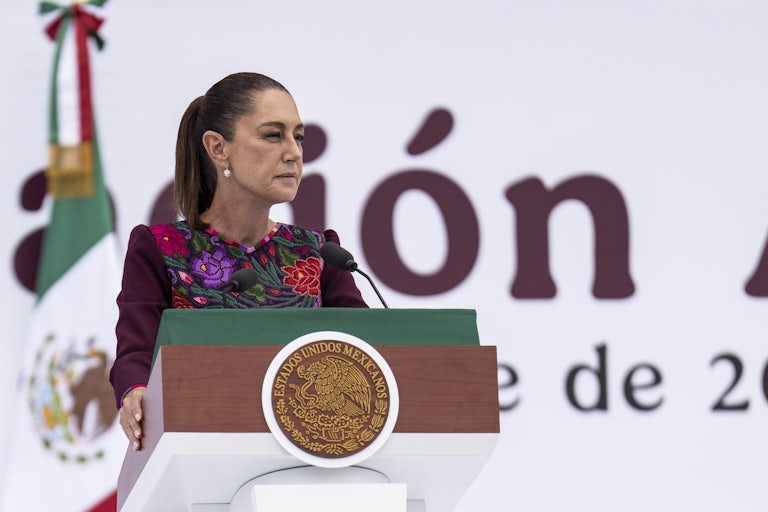
Mexican President Claudia Sheinbaum speaks at a podium.
Cristopher Rogel Blanquet/Getty Images

Mexican President Claudia Sheinbaum has condemned President Trump’s kidnapping of Venezuelan President Nicolás Maduro and his threat to take over her country next. 

“We categorically reject intervention in the internal matters of other countries,” Sheinbaum said at her press conference on Monday. “It is necessary to reaffirm that in Mexico the people rule, and that we are a free and sovereign country—cooperation, yes; subordination and intervention, no.” 

Trump has threatened to both bomb and/or invade Mexico multiple times in his first year back in office, and he reiterated those points this weekend.

“The cartels are running Mexico, [Sheinbaum’s] not running Mexico.…  We have to do something,” he said on Fox News. Trump also threatened the sovereignty of Greenland, Cuba, Columbia, and Iran, naming them as potential next targets in his press conference on Saturday. 

Even still, Sheinbaum seems confident that the United States will not escalate. 

“I don’t believe in an invasion; I don’t even think it’s something they’re taking very seriously,” she said. “On several occasions, he has insisted that the U.S. Army be allowed to enter Mexico. We have said no very firmly—first because we defend our sovereignty, and second because it is not necessary.”

Trump Goes on Wild Spree of Threats Against Rest of the World

Donald Trump warned that Venezuela is just the start.

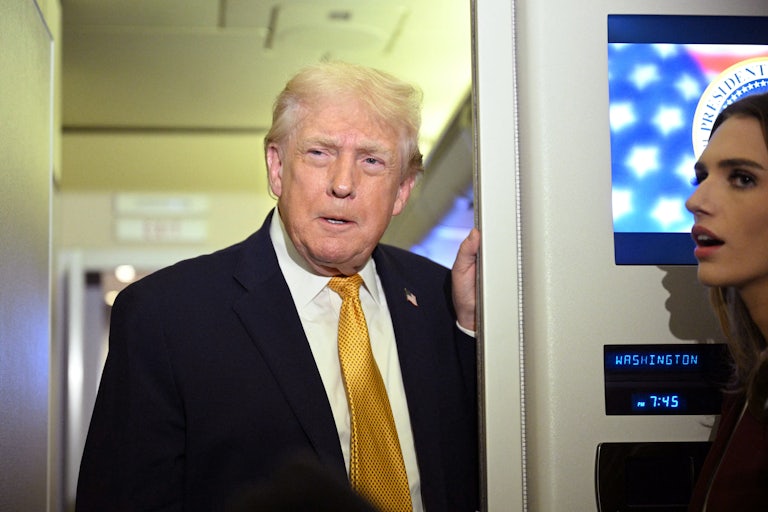
Donald Trump speaks to reporters on Air Force One
Jim WATSON/AFP/Getty Images

It seems that attacking Venezuela was just the beginning for President Donald Trump.

Speaking to reporters on Air Force One Sunday, Trump couldn’t stop musing about ordering more large-scale military strikes on various countries—including some U.S. allies—following America’s military operation to kidnap Venezuelan President Nicolás Maduro.

So how many countries are at risk of imminent attack from the power-mad U.S. president? At least five—but probably more. 

Trump began by turning his attention to Venezuela’s neighbor. “Colombia is very sick too. Run by a sick man, who likes making cocaine and selling it to the United States. And he’s not going to be doing it very long, let me tell you,” Trump said.

“What does that mean, ‘He’s not going to do it very long’?” one reporter asked.

“He’s not doing it very long. He has cocaine mills and cocaine factories; he’s not going to be doing it very long,” Trump replied.

“So there will be an operation by the U.S. in Colombia?” the reporter pressed.

“Sounds good to me,” the president replied. 

Trump has steadily increased tensions with Colombia, accusing President Gustavo Petro of being “an illegal drug leader,” targeting boats departing its shores, and cutting all U.S. aid to the country. Petro, for his part, has hit back, comparing Trump to Hitler.

Shortly afterward, Trump also floated a possible strike on Iran when a reporter mentioned the widespread protests there. “We’ll take a look, we’re watching it very closely. If they start killing people like they have in the past, I think they’re going to get hit very hard by the U.S.,” the president said

Trump then laughed at a reporter who asked if the president had any plans to take action on Greenland. “We’ll worry about Greenland in two months. We’ll worry about Greenland in 20 days,” he said.

Trump noted that the massive island was “covered in” Russian and Chinese ships. “We need Greenland from the standpoint of national security. And Denmark is not going to be able to do it, I’m telling you,” he said.  

Trump’s efforts to take over Venezuela have reignited right-wing fervor for the United States to claim Greenland, sparking Danish Prime Minister Mette Frederiksen to hit back once again at Trump’s repeated threats to annex the territory. 

Trump then turned his attention to his more immediate targets. “Cuba is ready to fall,” he said, claiming that the country had previously received “all of their income from Venezuela.”

“You have to do something with Mexico,” Trump continued. “Mexico has to get their act together, because they’re pouring through Mexico and we’re gonna have to do something. We’d love Mexico to do it, they’re capable of doing it, but unfortunately the cartels are very strong in Mexico.” 

But Trump wasn’t finished. He even went so far as to threaten a second strike against Venezuela “if they don’t behave,” and said that there could be U.S. troops on the ground depending on what the new administration—“if you want to call them that”—decided to do.

Trump Snubs Top Venezuelan Opposition Leader for the Pettiest Reason

Trump is leaving María Corina Machado out of the Venezuela transition plan because he still has a grudge over the Nobel Prize.

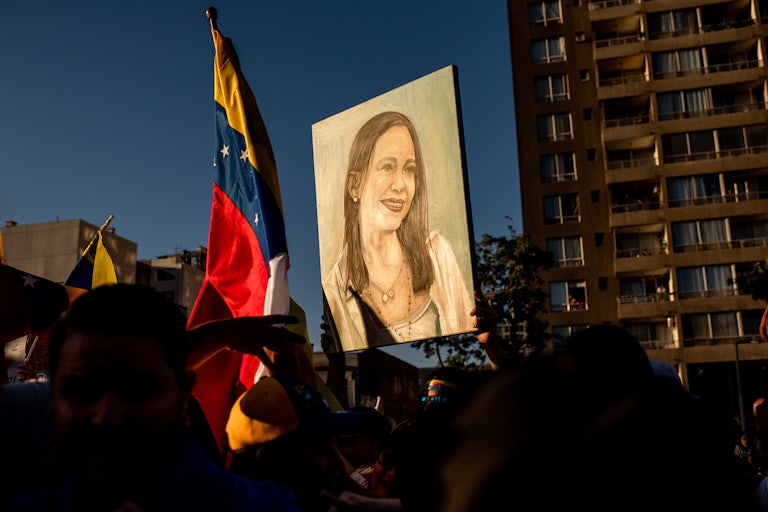
People hold up a painting of Venezuelan opposition leader Maria Corina Machado as well as a Venezuelan flag.
Cristobal Olivares/Bloomberg/Getty Images
An image of Venezuelan opposition leader María Corina Machado at a celebration in Santiago, Chile, on January 3

It seems that Venezuelan opposition leader María Corina Machado dedicated her Nobel Peace Prize to President Trump for nothing.

After Trump’s kidnapping of Venezuelan President Nicolás Maduro and his wife, many looked to Machado as the clear option to fill the vacancy, due to both her work promoting democracy in Venezuela and her close relationship with the Trump administration—most evident in her Peace Prize dedication. But over the weekend, Trump stated that the United States would “run” Venezuela and that he had not been in contact with Machado, even claiming that she didn’t have “the respect within the country” to lead.

“She’s a very nice woman, but she doesn’t have the respect,” he told reporters then.

This snubbing is reportedly a result of Machado not outright refusing the award, which Trump also wanted. Two sources close to the White House told The Washington Post that her decision to accept the Nobel Prize, even despite dedicating it to Trump, set the U.S. president off, leading to this current petty grudge.

“If she had turned it down and said, ‘I can’t accept it because it’s Donald Trump’s,’ she’d be the president of Venezuela today,” one said.