Breaking News
Breaking News
from Washington and beyond

Trump Snubs Top Venezuelan Opposition Leader for the Pettiest Reason

Trump is leaving María Corina Machado out of the Venezuela transition plan because he still has a grudge over the Nobel Prize.

People hold up a painting of Venezuelan opposition leader Maria Corina Machado as well as a Venezuelan flag.
Cristobal Olivares/Bloomberg/Getty Images
An image of Venezuelan opposition leader María Corina Machado at a celebration in Santiago, Chile, on January 3

It seems that Venezuelan opposition leader María Corina Machado dedicated her Nobel Peace Prize to President Trump for nothing.

After Trump’s kidnapping of Venezuelan President Nicolás Maduro and his wife, many looked to Machado as the clear option to fill the vacancy, due to both her work promoting democracy in Venezuela and her close relationship with the Trump administration—most evident in her Peace Prize dedication. But over the weekend, Trump stated that the United States would “run” Venezuela and that he had not been in contact with Machado, even claiming that she didn’t have “the respect within the country” to lead.

“She’s a very nice woman, but she doesn’t have the respect,” he told reporters then.

This snubbing is reportedly a result of Machado not outright refusing the award, which Trump also wanted. Two sources close to the White House told The Washington Post that her decision to accept the Nobel Prize, even despite dedicating it to Trump, set the U.S. president off, leading to this current petty grudge.

“If she had turned it down and said, ‘I can’t accept it because it’s Donald Trump’s,’ she’d be the president of Venezuela today,” one said.
Marco Rubio Crashes and Burns Defending Trump’s Plan to Run Venezuela

What legal authority does the U.S. have to run another country?

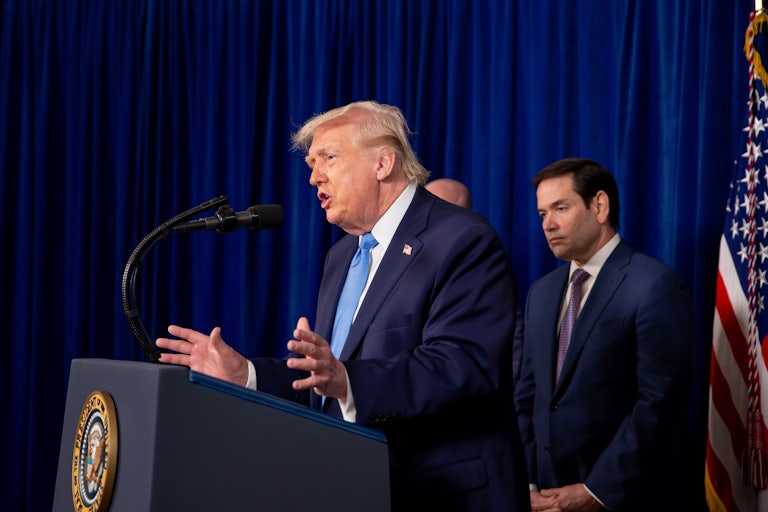
Donald Trump gestures and speaks at a podium while Secretary of State Marco Rubio stands behind him
Nicole Combeau/Bloomberg/Getty Images

Secretary of State Marco Rubio couldn’t provide a single legal rationale for President Donald Trump’s plan to put himself in charge of Venezuela.

Rubio flailed Sunday during an appearance on ABC’s This Week, when host George Stephanopoulos asked him under what legal authority Trump intended to “run” Venezuela.

“Under—well, first of all, what’s gonna happen here is that we have a quarantine on their oil. That means their economy will not be able to move forward until the conditions that are in the national interest of the United States and the interests of Venezuelan people are met. And that’s what we intend to do,” Rubio replied.

He continued to rant that he was “hopeful” this plan would lead to “positive results,” meaning a Venezuela that was not a “narco-trafficking paradise” and had an oil industry “where the wealth goes to the people, not to a handful of corrupt individuals.”

Unfortunately for Rubio, the question hadn’t been, “What are your hopes and dreams?”

“Let me ask the question again,” Stephanopoulos pressed. “What is the legal authority for the United States to be running Venezuela?”

“Well, I explained to you what our goals are and how we’re going to use the leverage to make it happen,” Rubio said. “As far as what our legal authority is on the quarantine are very simple. We have court orders. These are sanctioned boats. And we get orders from courts to go after and seize these sanctions.”

“So, is the United States running Venezuela right now?” Stephanopoulos asked.

“What we are running is the direction that this is gonna move moving forward, and that is we have leverage,” the secretary replied.

Rubio’s mealymouthed answer seemed to suggest that the Trump administration doesn’t plan to produce any legal authority for its reign in Venezuela but instead use sanctions as soft power. However, this explanation completely ignores the fact that the Trump administration just executed a large-scale military operation—without the permission of Congress—to kidnap Nicolás Maduro and is still threatening more strikes on the country.

Shortly after the strike, Trump said he intended for the United States to manage Venezuela “until such time as we can do a safe, proper and judicious transition” of power. Speaking to reporters on Air Force One, Trump confirmed Sunday that the U.S. was currently “in charge” of the South American country.

You Won’t Believe Who Trump Told About Venezuela Attack Ahead of Time

Here’s a hint: it wasn’t Congress.

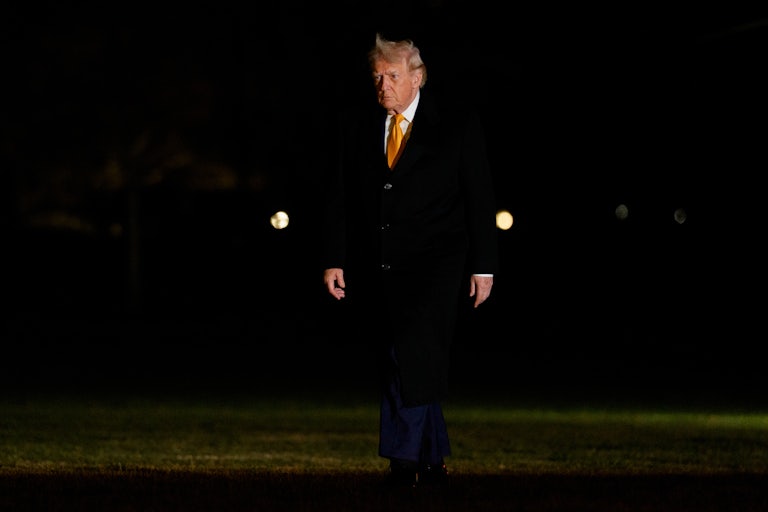
Donald Trump walks outside the White House
Aaron Schwartz/CNP/Bloomberg/Getty Images

No, President Donald Trump didn’t tell Congress before launching a large-scale operation to attack Venezuela and kidnap its president—but he did tell someone.

Speaking to the president on Air Force One Sunday, one reporter asked whether Trump had looped in U.S. oil companies to his plans to oust Nicolás Maduro by force.

“Did you speak with them before the operation took place?” the reporter asked.

“Yes,” Trump replied.

Did you maybe tip them off about what was gonna—?” the reporter continued.

“Before and after. And they want to go in, and they’re gonna do a great job for the people of Venezuela,” the president said. “And they’re gonna represent us well.”

Trump seemed to have no reservations about revealing that his government isn’t a democracy at all—it’s an oligarchy, where companies come first and his constituents don’t matter whatsoever. U.S. oil companies are already cashing in on his brazen constitutional violation.

Shortly after the military operation in Venezuela took place, Trump made clear his intention for oil companies to “go in, spend billions of dollars, fix the badly broken infrastructure, the oil infrastructure, and start making money for the country.” Trump has insisted that “the money coming out of the ground is very substantial,” but it seems that rebuilding the country’s oil industry won’t be cheap or easy.

Not only did Trump not receive authorization from Congress before launching the strike, but Democratic lawmakers now allege that Secretary of State Marco Rubio intentionally misled lawmakers about the administration’s intentions to do so.

Trump Declares U.S. Will Run Venezuela After Regime Change

U.S. oil companies will also be a big part of the transition in Venezuela, President Trump announced. Sound familiar?

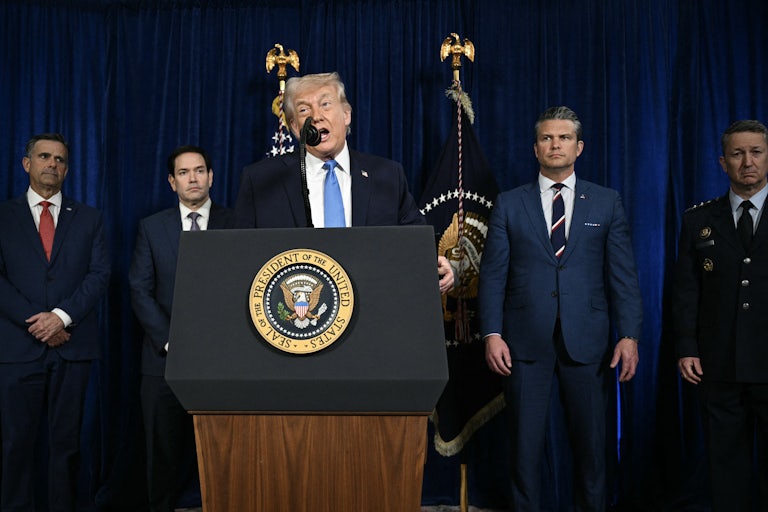
Trump speaks at the presidential podium while CIA Director John Ratcliffe, Secretary of State Marco Rubio, Defense Secretary Pete Hegseth, and Chairman of the Joint Chiefs of Staff General Dan Caine stand behind him in a row.
Jim WATSON/AFP/Getty Images
President Donald Trump, alongside CIA Director John Ratcliffe, Secretary of State Marco Rubio, Defense Secretary Pete Hegseth, and General Dan Caine, chairman of the Joint Chiefs of Staff, speaks to the press following U.S. airstrikes in Venezuela, at Mar-a-Lago, on January 3.

After bombing Venezuela and kidnapping President Nicolás Maduro and his wife in the middle of the night, President Trump has declared that he will “run the country” in the meantime.

“We’re going to run the country until such time, as we can do a safe, proper, and judicious transition,” Trump said at a press conference on Saturday. “So we don’t wanna be involved with having somebody else get in, and we have the same situation that we have for the last long period of years. So we are going to run the country.”

Trump also dedicated a significant portion of the presser to discussing the future of U.S. oil companies in Venezuela, which has the largest oil reserves on the planet. “As everyone knows, the oil business in Venezuela has been a bust, a total bust, for a long time,” he said. “We’re going to have our very large United States oil companies, the biggest anywhere in the world, go in, spend billions of dollars, fix the badly broken infrastructure … and start making money.

Could you imagine if another country sent a team of special agents to kidnap President Trump and his wife Melania from the White House while they slept? And then went on air the next morning saying they’d plug and play someone else as president?

That someone else could very well be María Corina Machado, Venezuelan opposition leader and Nobel Prize winner who has already displayed her eagerness to serve Trump and the U.S. agenda. For now, Trump hasn’t yet signed off.

Was Someone Insider Trading Right Before Trump’s Attack on Venezuela?

A new account on Polymarket was very lucky with some perfectly timed Venezuela bets.

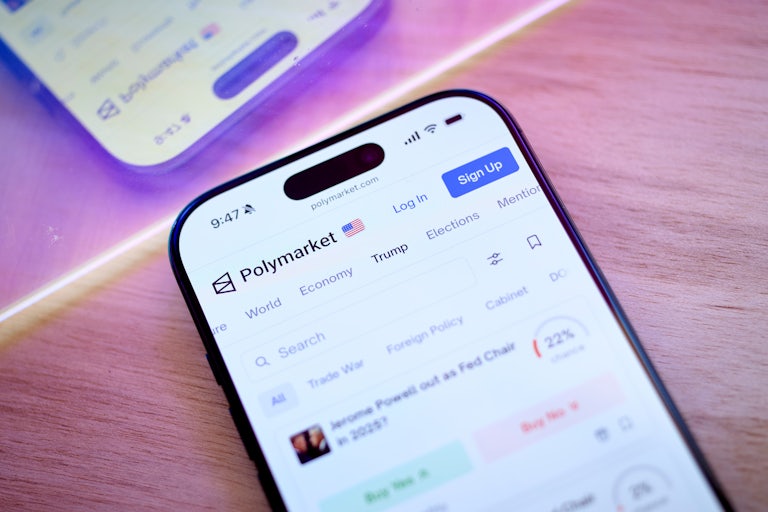
Polymarket on a smartphone
Gabby Jones/Bloomberg/Getty Images

A suspicious new user on the prediction market Polymarket just made bank on the Trump administration’s military strikes on Venezuela.

The account, which was created on December 27, has only bet on two things: the U.S. invading Venezuela, and its president, Nicolás Maduro, being forced out of leadership by January 31. The user bet $35,000 when the market estimated the probability of intervention in Venezuela at only 6 percent.

Thanks to their very lucky bets, they made over $400,000 in less than a day.

Screenshot of Polymarket account and Venezuela bets
Polymarket/Screenshot

The timing of the account’s bets—and its creation—is certainly suspicious. According to reports, U.S. military officials initially discussed bombing Venezuela on Christmas Day, but reversed course after deciding to pursue airstrikes against ISIS in Nigeria instead. In the days following Christmas, officials held off on the attacks due to the weather.

Trump announced his strikes on Venezuela, and his abduction of Maduro and his wife, early Saturday morning. While he did a good job at keeping the attack from being leaked to the media, it seems someone on his team had no problem leaking the news to Polymarket—and making themselves quite a bit richer in the process.

After Venezuela Attack, Trump Says Something Must Be Done About Mexico

Donald Trump is hinting at a military conflict with Mexico next.

Donald Trump and Claudia Sheinbaum
Mandel NGAN/Pool/Getty Images
U.S. President Donald Trump and Mexican President Claudia Sheinbaum

After the U.S. bombed Venezuela in the middle of the night and abducted its president, Nicolas Maduro, President Donald Trump warned that more attacks could be on the way in the region.

Trump hinted at a future conflict with Mexico in particular in an interview with Fox News Saturday morning.

“Your vice president, JD Vance, said that the message is pretty clear: that drug trafficking must stop. So was this operation a message that you’re sending to Mexico, to Claudia Sheinbaum, the president there?” Fox’s Griff Jenkins asked.

“Well, it wasn’t meant to be, we’re very friendly with her, she’s a good woman,” Trump began. “But the cartels are running Mexico. She’s not running Mexico.”

“We could be politically correct and be nice and say, ‘Oh, yes, she is.’ No, no. She’s very, you know, she’s very frightened of the cartels. They’re running Mexico. And I’ve asked her numerous times, ‘Would you like us to take out the cartels?’ ... Something is gonna have to be done with Mexico.”

Trump also told Fox that a “second wave” of strikes could take place in Venezuela and warned Maduro’s supporters will have a “bad future” if they stay loyal to him.

Trump Admits the Real Reason for His Surprise Attack on Venezuela

Donald Trump immediately began talking about Venezuela’s oil, after the U.S. bombed the country and abducted its leader.

Donald Trump speaks in front of an ornate door.
Joe Raedle/Getty Images

Just hours after President Donald Trump bombed Venezuela and abducted its leader, Nicolás Maduro, he began talking about the Latin American country’s oil industry.

Venezuela has the largest proven oil reserves on the planet, with 303 billion barrels worth of crude, or about a fifth of global reserves, according to the U.S. Energy Information Administration. And that fact has clearly been at the top of Trump’s mind.

Appearing in a Fox News interview Saturday morning, Trump was asked what he sees for the “future of Venezuela’s oil industry.”

“Well, I see that we’re going to be very strongly involved in it, that’s all. I mean, what can I say? We have the greatest oil companies in the world, the biggest, the greatest, and we’re going to be very much involved in it.”

This wasn’t the first time that Trump has admitted his war with Venezuela is at least partly motivated by oil. Earlier last month, the U.S. military seized two Venezuelan oil tankers. Asked what would happen to the oil, Trump replied, “we’re going to keep it,” then added: “Maybe we will sell it, maybe we will keep it. Maybe we’ll use it in the Strategic Reserves. We’re keeping the ships also.”

Trump: U.S. Has Abducted Venezuelan Leader After Overnight Bombing

Donald Trump announced the U.S. has abducted Venezuelan President Nicolás Maduro.

Bombing of Caracas
AFP/Getty Images
A fire at Fuerte Tiuna, Venezuela’s largest military complex, after a series of explosions in Caracas on January 3

President Donald Trump announced in the early hours of Saturday that the United States had bombed Venezuela, the most oil-rich country in Latin America, and abducted its president, who is now being flown back to the United States.

“The United States of America has successfully carried out a large scale strike against Venezuela and its leader, President Nicolas Maduro, who has been, along with his wife, captured and flown out of the Country,” he wrote on Truth Social at 4:21 a.m. “This operation was done in conjunction with U.S. Law Enforcement.” He said he will give more details on the attack in a press conference at his Mar-a-Lago estate in Florida at 11 a.m.

Maduro is expected to be flown to New York, where he will face charges in Manhattan federal court.

“Nicolas Maduro and his wife, Cilia Flores, have been indicted in the Southern District of New York,” Attorney General Pam Bondi announced on X Saturday morning. “Nicolas Maduro has been charged with Narco-Terrorism Conspiracy, Cocaine Importation Conspiracy, Possession of Machineguns and Destructive Devices, and Conspiracy to Possess Machineguns and Destructive Devices against the United States. They will soon face the full wrath of American justice on American soil in American courts.”

Trump did so without the approval of Congress, which is supposed to sign off on all acts of war.

“Secretaries Rubio and Hegseth looked every Senator in the eye a few weeks ago and said this wasn’t about regime change,” Democratic Senator Andy Kim said after the bombing. “I didn’t trust them then and we see now that they blatantly lied to Congress. Trump rejected our Constitutionally required approval process for armed conflict because the Administration knows the American people overwhelmingly reject risks pulling our nation into another war.”

Shortly after the U.S. attack, the Venezuelan government accused Washington of an “extremely serious military aggression.”

“Venezuela rejects, repudiates, and denounces before the international community the extremely serious military aggression perpetrated by the current government of the United States of America against Venezuelan territory and people,” the Venezuelan government said.

Steve Bannon Turns on Trump Over His Threat to Iran

Bannon made a stunning comparison amid his fury.

Steve Bannon holds a microphone
Olivier Touron/AFP/Getty Images

The president is apparently taking foreign policy lessons from one of his political nemeses, Hillary Clinton—at least, that’s what one of his biggest first-term acolytes seems to believe.

Trump’s former chief White House strategist Steve Bannon accused his old boss of rifling through Hillary Clinton’s playbook, during a Friday episode of his War Room podcast. Bannon claimed that the president’s recent threats of violence against Iran were practically identical to State Department operations during the Obama administration.

“Aren’t people teasing right now that Samantha Power and Hillary Clinton must’ve somehow gotten invited to the Mar-a-Lago New Year’s Eve celebration, because the president coming out today saying, ‘We’re locked and loaded’—isn’t that straight from the Samantha Powers and Hillary Clinton playbook?” said Bannon.

Trump warned Iranian officials Friday morning that the United States was ready to defend locals protesting the country’s economic conditions, posting on Truth Social that if Iran “violently kills peaceful protesters, which is their custom, the United States of America will come to their rescue.”

At least three people have been reported dead and 17 injured as Iranian security forces clashed with crowds of protesters in the western province of Lorestan. Still more deaths have been reported in several other cities around the country.

“We are locked and loaded and ready to go,” Trump added.

It was not clear if Trump actually intended to follow through on the warning or had any plans in place to do so, but Iran—which backs forces in Lebanon, Iraq, and Yemen—did not take the specter of confrontation lightly.

Responding to Trump’s comments on X, the head of Iran’s Supreme National Security Council, Ali Larijani, wrote that “Trump should know that U.S. interference in this internal matter would mean destabilizing the entire region and destroying America’s interests.

“The American people should know—Trump started this adventurism,” Larijani noted. “They should be mindful of their soldiers’ safety.”

But Trump is no stranger to attacking Iran. In June, the White House joined Israel in striking three of the country’s nuclear facilities. That attack, conducted without the express approval of Congress, damaged facilities in Fordo, Natanz, and Isfahan.

ICE Has a New Recruitment Strategy—and It’s Terrifying

ICE’s $100 million recruitment plan will target the manosphere.

An immigration officer wears a vest that says, "Police ICE"
Christopher Juhn/Anadolu/Getty Images

The powers that be at U.S. Immigration and Customs Enforcement are planning on a massive recruitment drive in 2026—but the people they’re hoping to attract aren’t your typical feds.

The deportation agency has earmarked $100 million for online advertisements over the next year, hoping to draw gun rights advocates and military enthusiasts into its ranks, according to an internal document obtained by The Washington Post.

The agency’s so-called “wartime recruitment” strategy involves a massive hiring spree that aims to take on as many as 10,000 new officers across the country. To do so, ICE is coordinating a sprawling social media campaign to target people who have “attended UFC fights, listened to patriotic podcasts or shown an interest in guns and tactical gear,” reported the Post.

Some of that cash will be directed toward advertisements on Snapchat and the conservative YouTube dupe Rumble, while other portions of the budget will be dosed out for live marketing via livestreamers and right-wing influencers.

The recruitment blitz will also utilize contemporary software such as geofencing in order to beam ICE advertisements directly to devices in certain areas, such as those near military bases, Nascar races, college campuses, or gun and trade shows, according to the 30-page document.

The plan is a far cry from ICE’s typical recruitment methods, which have historically depended on recruitment from local police offices and sheriff departments to locate experienced talent with potential to grow at the federal level. Former ICE director Sarah Saldaña, who spearheaded the department during Barack Obama’s presidency, warned Newsmax that ICE’s latest recruitment tactics could invite applicants who bring “a certain aggressiveness that may not be necessary in 85 percent” of the job.

It’s unclear just how much of the $100 million allotment ICE has already spent, but the Department of Homeland Security has awarded nearly $40 million to a couple of marketing firms to support the public affairs office, according to federal awards data reviewed by the Post.

Regardless, ICE still has plenty of dough to play around with: Congress virtually tripled the agency’s budget this summer when it passed Donald Trump’s One Big Beautiful Bill Act, jumping its appropriations from roughly $9.6 billion to $30 billion. (Meanwhile, the legislature also took a hatchet to Medicaid, gutting billions of dollars from the critical public health care program.)