Breaking News
Breaking News
from Washington and beyond

Trump, 79, Accidentally Reads Marco Rubio’s Private Note Out Loud

Donald Trump continues to bumble around.

Donald Trump reads a note during a meeting with oil executives
SAUL LOEB/AFP/Getty Images

Donald Trump humiliated himself Friday when Secretary of State Marco Rubio tried to slyly pass him a note during a meeting with oil executives, and the president immediately read it aloud.

Trump was in the midst of promising “a very nice return” for executives from Chevron, ConocoPhillips, Exxon, Halliburton, Valero, and Marathon—in exchange for a $100 billion investment in rebuilding Venezuela’s energy sector, when he was suddenly sidetracked by a scrap of paper from Rubio.   

“You’re all gonna do very well—Marco just gave me a note. ‘Go back to Chevron, they want to discuss something,’” Trump read, turning to look at Chevron Vice Chairman Mark Nelson. “Go ahead, I’m going back to Chevron, Mark.”

Rubio grimaced uncomfortably, as Trump patted him on the back. “Thank you, Marco,” he said.

“Was there a question, Mr. President?” Nelson asked.

“Yes, go ahead Marco, what are you saying here?” Trump asked, inspecting the note again.

Energy Secretary Chris Wright jumped in. “Mark, if you could update us on operations on the ground, appropriate approvals, what you might be able to achieve in the next 12 to 18 months—give us a little view from the ground,” he said. 

Nelson launched into a description of Chevron’s ground operations. Chevron is the only oil company currently operating in Venezuela, as part of a joint venture with Petróleos de Venezuela. Wright told CNBC Wednesday that the Trump administration was receiving “daily updates” from Chevron and working closely to “allow their model to grow even more.”

Trump’s gaffe was part of a larger trend of cognitive decline, as the aged president has spent the last year in office appearing to fall asleep during meetings and giving incoherent, confused rants.

Katie Miller Loses It at ChatGPT (Yes, Really) for Wildest Reason

Stephen Miller’s wife accused the bot of being too “woke.”

Katie Miller looks unamused while standing in Trump's gold Oval Office.
Kevin Dietsch/Getty Images

Katie Miller, the wife of Trump adviser Stephen Miller, fumed Friday when ChatGPT didn’t give her the answer she wanted about the ICE shooting in Minneapolis. 

Miller shared a post on X from one right-wing commentator that appeared to show an interaction with ChatGPT, in which a user asked the chatbot “who was responsible” for killing Renee Good. 

“Based on available video and reporting: ICE agents escalated a chaotic stop, gave conflicting commands, and fired as the woman tried to leave,” the chatbot replied. “The responsibility for the shooting lies with the U.S. Immigration Enforcement agent who pulled the trigger.”

That answer wasn’t good enough for Miller, however. “ChatGPT is dangerously woke,” Miller wrote on X. “An AI that wrongly judges an outcome is a threat to the future of nation and world. xAI is the only truth-seeking AI.”

(xAI is Elon Musk’s chatbot that is under fire for making sexualized images of women and children. It has already been used to generate an image of Good’s body in a bikini.)

Surprisingly enough, ChatGPT’s description of the violent shooting was right on the money.

Initial footage of the incident showed Good wave at the agents and urge them to “go around” her vehicle. (Newly obtained video showed that Good wasn’t fully blocking the street, as cars were able to pass her on either side.) ICE agents swarmed her vehicle, pulling on the doors with one officer demanding she “get out of the fucking car!” while another ordered her to leave

When Good attempted to drive away from the group of officers, one ICE agent, Jonathan Ross, who was standing near the front of the vehicle, pulled out his service weapon and shot her once through the windshield, and twice through the driver’s side-window. Ross had a history of escalating arrests with violent tactics. Another new video shows that an unidentified agent said, “Fucking bitch,” after Ross fired.

Miller shared another X post calling ChatGPT a “national security threat.”  She then made another post far more despicable than any of her useless toiling over AI, mocking Good’s wife, Becca, and calling her “another sad Liberal angry at the World because daddy didn’t love her enough.” Having seen how her husband talks, is anyone actually surprised?

Trump Picks the Weirdest Moment to Hype Up His New Ballroom

Big meeting? Perfect time to brag about his vanity project!

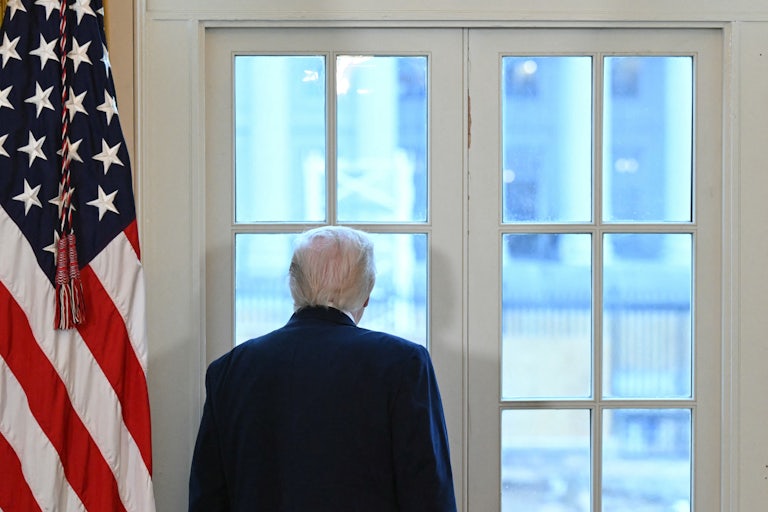
Donald Trump looks out a window in the Oval Office at the construction on the White House
SAUL LOEB/AFP/Getty Images
Donald Trump surveys construction on the White House during a meeting with Big Oil executives.

The president’s myriad disparate interests finally aligned on Friday when he was able to squeeze his recent acquisition of Venezuela’s oil reserves into the same sentence as his White House ballroom project.

“The largest Oil Companies in the World are coming to the White House at 2:30 P.M.,” Donald Trump posted on Truth Social. “Everybody wants to be there.

“It’s too bad that the Ballroom hasn’t completed because, if it were, it would be PACKED,” Trump continued. “We apologize to those Oil Companies that we cannot take today, but Secretary of Energy Chris Wright, and Secretary of the Interior Doug Burgum, will see them over the next week. Everyone is in daily contact.

“Today’s meeting will almost exclusively be a discussion on Venezuelan Oil, and our longterm relationship with Venezuela, its Security, and People,” he noted. “A very big factor in this involvement will be the reduction of Oil Prices for the American People. Additionally, and perhaps most importantly of all, will be the stoppage of Drugs and Criminals coming into the United States of America. Thank you for your attention to this matter!”

It wouldn’t be the first time Trump has used the news of the day to talk about his ballroom. He quickly pivoted to his pet project when asked about the assassination of Charlie Kirk, and reportedly keeps leaving his actual duties to survey the construction.

U.S. forces invaded Venezuela early Saturday, bombing its capital, Caracas, as nearly 200 American troops infiltrated the city to capture its 13-year ruler, Nicolás Maduro.

Trump failed to notify Congress before doing so, but didn’t forget to tip off his friends at America’s biggest oil companies, which stand to gain the most from America’s newfound control over Venezuela’s oil supply—the largest in the world.

The invasion followed months of escalating naval attacks by the U.S. and rhetoric between the White House and Venezuela’s leadership, which saw the Trump administration repeatedly pin U.S. fentanyl deaths on Venezuelan drug cartels despite a resounding lack of evidence.

Meanwhile, East Wing ballroom architect Shalom Baranes revealed Thursday that the president’s plans for the White House were bigger than previously understood. In a meeting with members of the National Capital Planning Commission, or NCPC, Baranes announced that the administration intends to build up the West Wing after it finishes its 90,000-square-foot ballroom project in order to add “symmetry” to the executive mansion.

The architect did not offer a timetable for its completion, and did not say if the West Wing’s proposed growth would add to the redevelopment plan’s $400 million price tag.

This would be—at minimum—the second time that Trump has lied about his construction dreams for the White House. Back when the ballroom was first announced in July, Trump pledged that the development would “be near but not touching” the White House East Wing. He then proceeded to completely raze the FDR-era extension in October, plowing forward without prerequisite approval from the NCPC or the express permission of Congress, both of which were conveniently unavailable at the time due to the government shutdown.

Now it seems that no corner of the White House will go untouched by Trump’s white marble dreams.

“F*cking B*tch”: What ICE Agents Did Right After Minnesota Shooting

Spoiler alert: It was not to rush over and provide Renee Nicole Good medical aid.

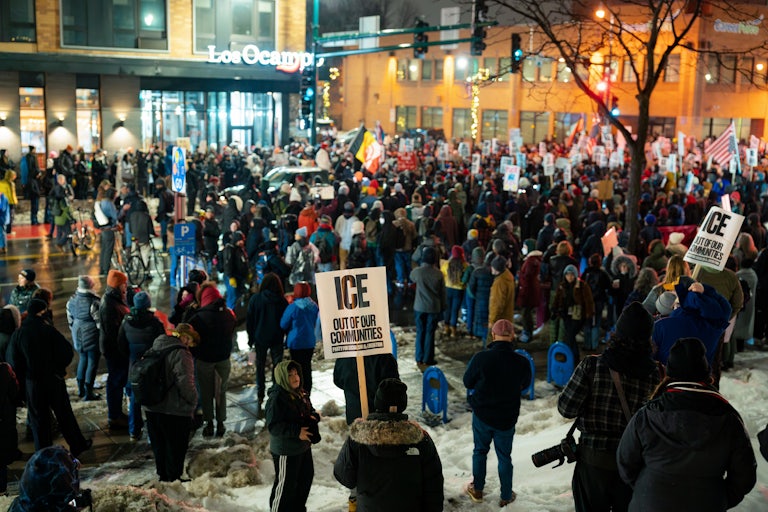
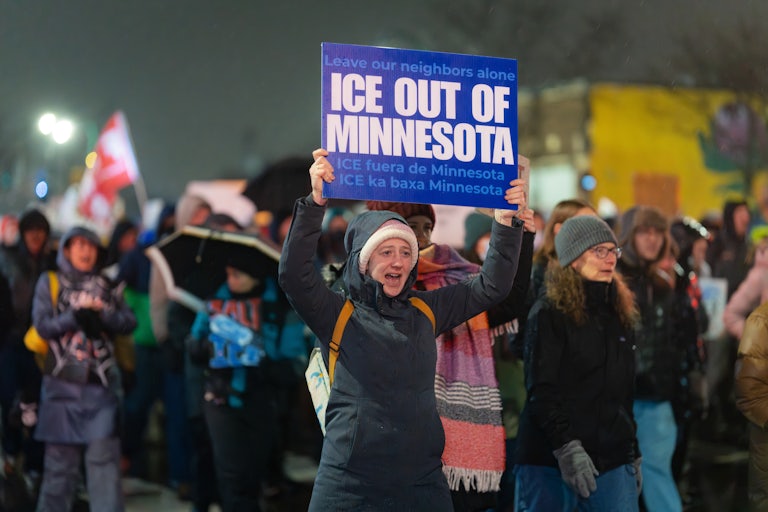
People protest in Minnesota, Minneapolis, after an ICE agent shot Renee Nicole Good dead
Ben Brewer/Bloomberg/Getty Images

A newly released camera perspective of the ICE shooting in Minneapolis has shed additional light on the moments leading up to Renee Nicole Good’s death.

The previously unseen cellphone footage, obtained and published by Allen Analysis Newsroom, depicts a federal agent’s vantage point of the lethal encounter, and captures audio of at least one ICE agent calling Good a “fucking bitch” after they shot and killed her.

The exchange, as captured in the new video, begins with a 360 degree shot of Good’s red Honda Pilot, with the agent walking from the passenger side to the front to the rear of the SUV, presumably documenting the vehicle and its license plates. In doing so, the agent filming captures video of Good’s dog in the backseat, his large, black head hanging out of the open window.

As the agent passes in front of the driver’s side window, Good can be seen and heard telling him: “That’s fine, dude. I’m not mad at you.”

“I’m not mad at you,” she shouts again as he walks behind her car.

The agent’s masked reflection is caught in the glass of the backseat windows as he moves away.

Another woman—presumably Good’s wife, Rebecca Brown Good—is filming the agent while standing next to the rear of the SUV. Her voice can be heard over a long shot of the vehicle’s license plate.

“Show your face,” she said. “It’s OK, we don’t change our plates every morning, so it’ll be the same plate when you come talk to us later. U.S. citizen, former fucking veteran—disabled veteran. You want to come at us? I say you go and get yourself some lunch, big boy.”

Someone can then be heard telling Good to “get out of the fucking car,” when she reverses and then pushes the vehicle forward. As she does so, several shots can be heard. The image loses focus. When the camera stabilizes, Good’s car can be seen careening away.

“Fucking bitch,” an agent said.

In a paltry attempt to defend the agents’ deadly actions, Trump officials have branded Good a domestic terrorist for moving her car, and have suggested that defying the barked orders of masked individuals that evade identification is a crime punishable by death.

Yet other video footage of the incident illustrates that Good did not hit the agent who killed her, identified by the Minnesota Star-Tribune as Jonathan Ross.

Still, within moments of the new video’s release, Vice President JD Vance and White House press secretary Karoline Leavitt breathlessly rushed to mold the clip to their political narrative, excoriating media coverage of Good’s death and claiming that the national outrage is little more than a Democrat-fueled smear campaign.

“The media dishonesty about this officer is an all-time moment in shameless press propaganda,” Vance posted on X Friday.

This story has been updated.

New Details Emerge on ICE Agent Who Shot a Woman in Minnesota

Jonathan Ross in his own words.

People protest ICE's presence in Minnesota after an agent shot dead a woman in Minneapolis
Ben Brewer/Bloomberg/Getty Images

Jonathan Ross, the ICE agent who shot and killed Renee Good, reportedly had a history of escalating arrests with violent tactics. 

Ross, a 10-year law enforcement veteran, was injured in June during the chaotic attempted arrest of Roberto Carlos Muñoz, an undocumented immigrant from Guatemala with prior convictions for criminal sexual conduct, who drove off during a traffic stop in Bloomington, Minnesota. 

Ross and another agent pulled in front of Muñoz’s vehicle to force him to stop. The two officers exited their vehicle and aimed their firearms at Muñoz, demanding he provide documentation, which he did, according to the affidavit. When the officers demanded that Muñoz roll down his window, he refused. Ross pulled out his taser, which he aimed at Muñoz’s chest, and the officers warned Muñoz that they would break the window if he did not comply.

Ross used a spring-loaded window punch to break the rear driver’s side window, and reached in to try and unlock the driver’s side door. Muñoz put the car in drive and dragged Ross roughly 100 yards, while Ross fired his taser “at least twice,” according to the affidavit. The agent later testified that he fired his taser 10 times.  

Eventually, Ross was shaken loose from the window, falling into the street. “The agent suffered serious lacerations on both arms, which required 33 stitches in total to close,” the affidavit said. 

“I was fearing for my life. I knew I was gonna get drug,” Ross said, according to a transcript of his court testimony from December. “And the fact I couldn’t get my arm out, I didn’t know how long I would be drugged. So I was kind of running with the vehicle.”

The claim that an officer was “fearing for their life” is a common phrase used by officers to justify their use of deadly force—and has become a familiar refrain for ICE agents who claim protesters’ vehicles were “weaponized” against them.  

Vice President JD Vance delivered a full-throated defense of Good’s killing Thursday, while botching some of the details of Ross’s backstory. 

Complaining about a CNN headline that described the incident, Vance said: “What that headline leaves out is the fact that that very ICE officer nearly had his life ended, dragged by a car six months ago, 34 stitches in his leg, so you think maybe he’s a little bit sensitive about somebody ramming him with an automobile?” 

Setting aside the fact that it was Ross’s arm, not his leg, that was injured, Vance’s remarks also absurdly suggest that any officer hurt in the line of duty has a free pass to remain in the field and shoot dead civilians if they get scared. That’s exactly why desk duty exists, right?

It’s hard not to see the parallels between Ross’s interactions with Muñoz and Good. Not in the fact that Ross was in any danger from Good, but that in both cases, he drew his weapon in order to threaten his target when they did not immediately comply with his commands. In one case, that decision was deadly. 

The court documents involving Muñoz’s arrest also contained other information about Ross. He described himself as an Indiana National Guard veteran who served in Iraq from 2004 to 2005 before joining Border Patrol. In 2015, he joined ICE and was assigned to the Enforcement and Removal Operations special response team, where he pursued “higher value targets.”