Breaking News
Breaking News
from Washington and beyond

Epstein Emails Reveal How He Tried to Hide His Friendship With Trump

Ghislaine Maxwell reminded Jeffrey Epstein he’d said “not to involve Donald.”

Jeffrey Epstein puts his arm around Ghilsaine Maxwell and his mouth near her forehead as they pose for the camera.
Joe Schildhorn/Patrick McMullan/Getty Images

President Donald Trump was named in more of convicted child sex offender Jeffrey Epstein’s unsealed emails on Friday.

After the Department of Justice released a new trove of emails, social media sleuths and journalists scoured the files for mentions of Trump, who had a long and well-documented friendship with Epstein.

It’s hard to say when that friendship ended, but Trump claimed in 2019 that he hadn’t spoken to Epstein for “15 years.” He has denied being a part of Epstein’s sex-trafficking ring.

But two new emails unearthed by The Bulwark’s Sarah Longwell appear suspicious. On March 22, 2011, Epstein emailed a man named “Nicholas L. Ribis” the following (edited to correct spelling and grammar):

The girl in the new papers that has made all this trouble said she worked at Mar-a-Lago when she was 15, in 1998. I’m virtually positive that is a lie. It was when she was 17, in 2000. Her name is [REDACTED]. Who would I go to verify? I don’t know how Donald would respond?

Epstein’s longtime accomplice Ghislaine Maxwell then replied (edited to correct spelling):

I thought you said not to involve Donald—anyway so now the die is cast—you now have to get her employment record—It will either show she started work in 1999 or 2000, as she was full-time there, and I believe you cannot be a minor and work full-time anywhere, so she had to be at least 16 to be in full-time employment. Perhaps start that way—that alone would kill her allegation that she was 15—as I said, you can’t work full-time anywhere at that age … either that or she gave fake ID to Mar-a-Lago, which is also possible …

Maxwell reminding Epstein that he said “not to involve” Trump in his sex-trafficking scandal is vague, but it could imply that Epstein knew Trump was at least partially involved in the crimes. If so, it’s no wonder that Trump’s DOJ has been periodically removing files that mention the president from the official government database.
Top Trump Official Admits Epstein Files Cover Up Key Evidence

Deputy Attorney General Todd Blanche says you won’t find much on the other men who helped Jeffrey Epstein abuse young women and girls.

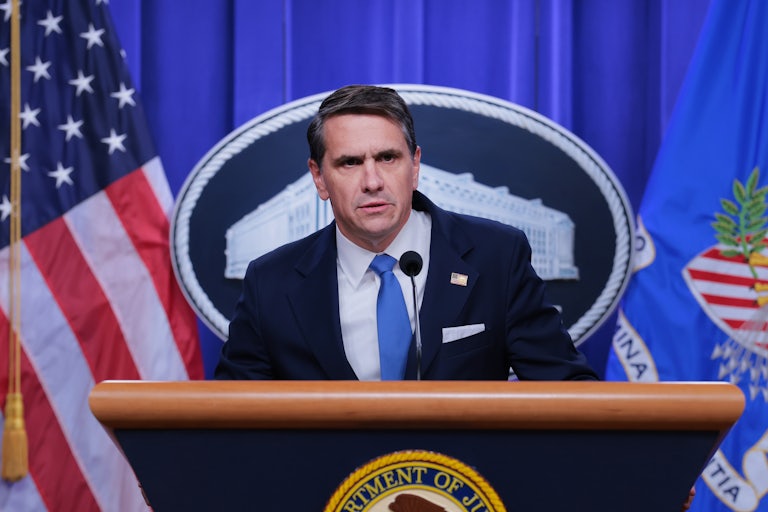
Deputy Attorney General Todd Blanche speaks at a podium
Anna Moneymaker/Getty Images
Deputy Attorney General Todd Blanche speaks about the newest Epstein files released by the Justice Department, January 30, 2026.

Deputy Attorney General Todd Blanche is claiming that, somehow, the Justice Department has no knowledge on the men who used convicted sex offender Jeffrey Epstein’s network to abuse dozens of young women—and it certainly won’t be found in the millions of new documents released on Friday.

“Just to clarify, is the public going to learn the identities of the men who abused the girls with the information you’re releasing?” a reporter asked Blanche at a Friday press conference. “And if not, why not?”

“I mean, you just baked in an assumption into your question that I have never said, and I don’t know to be true,” Blanche replied. “Is the public going to learn about men that abused these girls? What does that mean? I don’t understand what it means.”

“We said in July … if we had information—we, meaning the Department of Justice—about men who abused women, we would prosecute them,” Blanche continued. “There’s a built-in assumption that somehow there’s this hidden tranche of information of men that we know about, that we’re covering up, or we’re choosing not to prosecute. That is not the case. I don’t know whether there are men out there that abused these women.

“I don’t think that the public [is going to] uncover men within the Epstein files that abused women,” he concluded.

It was ridiculous to see a top Justice Department official feign confusion at the most pertinent question that anyone could have asked him at that moment. The department released three million files related to Epstein, who was facing federal charges of sex trafficking of minors when he died. Many of his victims have come forward over the years to talk about how they were abused by Epstein and his friends.

Just this week, Epstein accomplice Ghislaine Maxwell claimed that 29 friends of the late sex trafficker were “protected” by the Justice Department by way of “secret settlements.”

“So Todd Blanche is claiming: They have 6 MILLION *files* (and have released <5% of it in 3M *pages*), [and proved] that Epstein and Maxwell trafficked. But CAN’T prove who they trafficked to,” professor Adam Cochran wrote on X. “How stupid do you need to be, to believe that? Even if you somehow don’t think its Trump, then at the very least Trump’s DoJ is protecting wealthy abusers!”

Representative Ro Khanna, who co-sponsored a bill mandating the release of all unclassified Epstein files, noted that even as millions more documents dropped Friday, the right documents weren’t being released—specifically the “302” files, in which the victims identify their abusers, a convenient group of files to leave unreleased.

“If Blanche believes that there is no coverup, then he should release the 302 files. The 302 files are where the survivors name who these rich and powerful men are,” Khanna responded. “I’ve talked to the survivors. They say that they have named those people in the FBI witness interviews. So if those witness interviews are released, the American people can see for themselves who the survivors named … but if Blanche continues to not release the 302 statements, to not release the prosecution memos—then it’s a cover-up.”

DOJ Briefly Erases Long List of Tips Against Trump in New Epstein Docs

The file was taken down just hours after the Department of Justice released it—and then put back up.

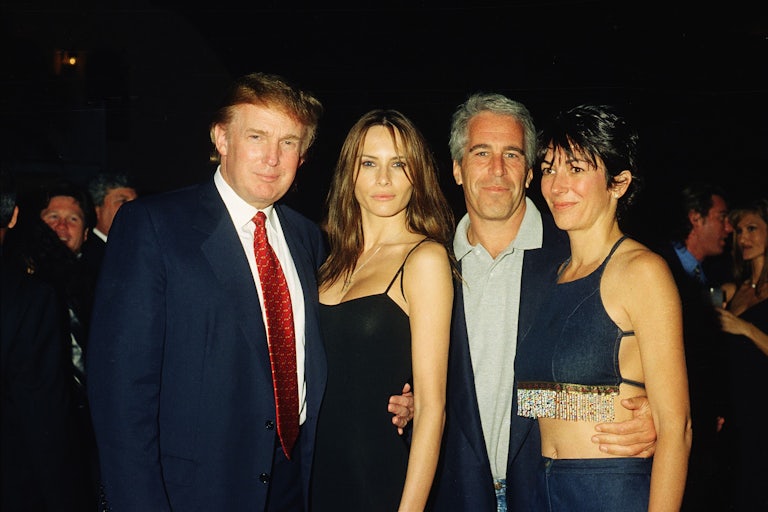
Donald Trump, Melania Trump, Jeffrey Epstein, Ghislaine Maxwell
Davidoff Studios/Getty Images

In the latest part of its Epstein files rollout, the Justice Department released a long list of sexual abuse allegations against Donald Trump. Then it temporarily retracted it.

The DOJ published three million pages of the Epstein files Friday, more than a month past its congressionally mandated deadline. The trove included one particularly shocking document: an FBI tip line record that included previously unreported sex abuse allegations against the president, some of which involved minors.

The tip line includes unsubstantiated and potentially uninvestigated claims of abuse, sometimes by way of secondhand information.

In one such undated line, a self-described friend of one of Trump’s alleged victims submitted a tip.

“[Redacted] reported an unidentified female friend who was forced to perform oral sex on President Trump approximately 35 years ago in NJ,” the top entry of the tip sheet reads. “The friend told Alexis that she was approximately 13-14 years old when this occurred, and the friend allegedly bit President Trump while performing oral sex. The friend was allegedly hit in the face after she laughed about biting President Trump. The friend said she was also abused by [Jeffrey] Epstein.”

The page notes that the friend “was sent to the Washington Office to conduct an interview.”

But just a couple of hours after the DOJ published the tip sheet, the document was removed from the larger document cache.

“Page not found,” read the page that replaced by the original document link. “We are sorry, the page you’re looking for can’t be found on the Department of Justice website.”

The altered webpage is incorrectly dated, as well, suggesting that it was last updated May 30, 2025.

Then, inexplicably, the document was accessible again.

Email messages and signatures attached to the document signal that it was partially censored and transferred between FBI agents in August, when a journalist filed an information request in relation to New York property brothers turned child predators Tal, Oren, and Alon Alexander.

ICE Is Buying Up Mega Warehouses Across America

ICE has a plan to install its mass detention centers in small towns across the country.

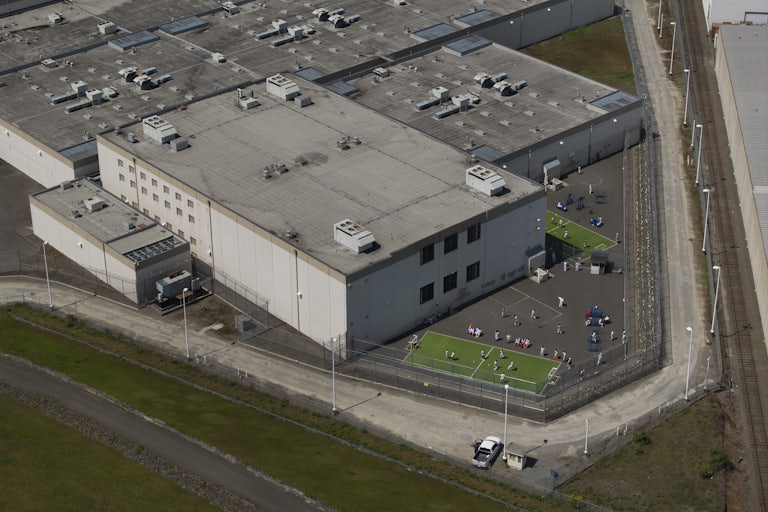
An aerial view of detainees outdoors at an ICE center.
David Ryder/Getty Images
An aerial view of detainees at the Northwest ICE Processing Center in Tacoma, Washington, run by the notorious GEO Group, on May 2, 2025.

Immigration and Customs Enforcement is buying up warehouses across the country to build a massive network of detention centers.

Hundreds of millions of dollars have already been spent to create huge immigrant jails, often in small towns, Bloomberg reports. The agency paid $102 million for a warehouse near Hagerstown, Maryland, and $70 million in cash for a warehouse in Surprise, Arizona.

And that’s just the cost to purchase the buildings—ICE also has to pay to turn them into jails with bathrooms, beds, dining, and recreation facilities. A third warehouse purchase in El Paso, Texas, could be one of the largest jails in the United States when completed, housing 8,500 beds.

ICE plans to use up to 23 warehouses around the country to detain immigrants in even more cities, including in Minnesota, Indiana, Louisiana, Missouri, Mississippi, New Hampshire, New Jersey, Pennsylvania, and Virginia. The new strategy is a shift for ICE and the Department of Homeland Security, which has been relying on many tent camps, such as the notorious “Alligator Alcatraz” in south Florida.

People who live near the proposed jails are pushing back against the plan, with protesters showing up in Hagerstown to protest on January 20 despite freezing temperatures. In Oklahoma City, the owners of a warehouse backed out of a deal Thursday to build an ICE facility, following local backlash to the plan. Similarly, the owners of a warehouse in Salt Lake City announced they had “no plans to sell or lease the property in question to the federal government” after protesters showed up at their offices.

In all, there have been protests or packed public meetings in at least 15 communities where ICE is planning to build a facility, The Washington Post reports. In many places, state and local officials are arguing that these detention centers would be a threat to public safety, strain local infrastructure, and violate zoning laws. And ICE has a history of failing to meet government standards for detention facilities: At one of its tent camps in El Paso, Texas, last September, inspectors found 60 different violations.

ICE’s warehouse plan is full of flaws, but the chief obstacle is the opposition from local residents, which only grows with every negative ICE headline. Will this mega network of warehouse jails get built, and will they even be safe to house thousands of people, including possibly U.S. citizens?

DOJ Prosecutors Want Nothing to Do With Don Lemon’s Arrest

The Department of Justice’s arrest of Don Lemon is already going off the rails.

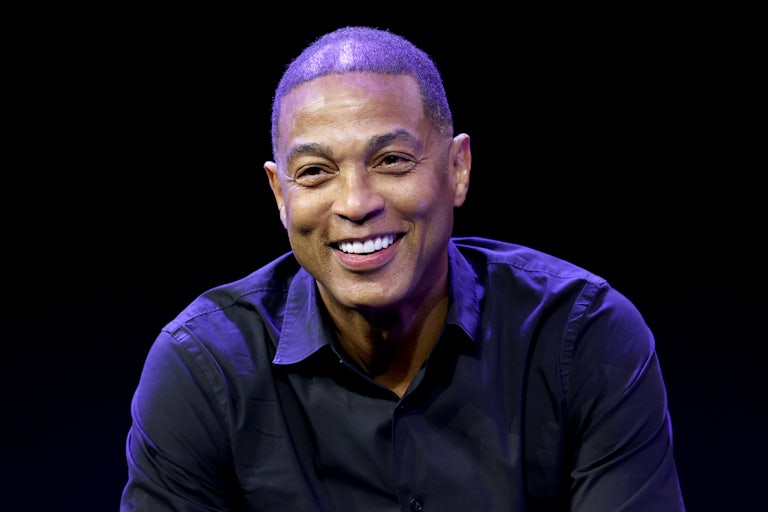
Don Lemon smiles
Arturo Holmes/Getty Images

After a magistrate judge left Attorney General Pam Bondi furious by rejecting a criminal complaint against journalist Don Lemon on January 18, she tried to get her revenge Friday morning. The Department of Justice arrested Lemon in Los Angeles on charges related to his involvement in an ICE protest at a Minnesotan church.

But only a few hours after the fact, the DOJ’s case is falling apart again. MS NOW reported that various DOJ prosecutors in both Minnesota and Los Angeles have refused to be involved in indicting Lemon.

Authorities continue to be vague about why exactly Lemon is being prosecuted. Bondi wrote on X that Lemon—alongside journalist Georgia Fort and two activists, Trahern Jeen Crews and Jamael Lydell Lundy—had been detained “in connection with [a] coordinated attack” on the St. Paul church, but has not said what the charges are. FBI spokeswoman Lourdes Arocho said Lemon was arrested in Beverly Hills “on a federal warrant issued in another district.”

Lemon covered the church protest as a member of the media, a fact he made quite obvious at the time. He interviewed both protesters and the pastor of the church at the event. An appeals judge said of Lemon and his producer’s conduct: “There is no evidence that those two engaged in any criminal behavior or conspired to do so.”

Trump’s idea in prosecuting Lemon, perhaps, is not that he’ll be found guilty but that the DOJ can discourage journalists from reporting on things the president doesn’t like by getting them to waste time and money in legal battles.

“They probably don’t have any expectation that this prosecution will stick,” Matthew Seligman, a legal scholar at Stanford Law School, told The New Republic’s Greg Sargent. “But they do know they will put Don Lemon through the grinder in the meantime.”