Breaking News
Breaking News
from Washington and beyond

Federal Agents Abduct Columbia University Student From Her Dorm

Columbia University’s president said DHS agents misrepresented themselves in order to gain access to the building.

Columbia University campus
CHARLY TRIBALLEAU/AFP/Getty Images

The Department of Homeland Security has kidnapped yet another Columbia University student—and lied to campus public safety officers to get into her building.

Columbia neuroscience undergraduate student Ellie Aghayeva posted “Dhs illegally arrested me. Please help,” on her Instagram story early Thursday morning.

Columbia University President Claire Shipman said federal agents told campus officials that they were looking for a missing person in order to gain access to the building.

“All law enforcement agents must have a judicial warrant or judicial subpoena to access non-public areas of the University, including housing, classrooms, and areas requiring CUID swipe access,” Shipman wrote in a statement. “If law enforcement agents seek entry to non-public areas of the University, ask the agents to wait.… Do not allow them to enter or accept service of a warrant or subpoena.”

DHS claimed that Aghayeva is an “illegal alien from Azerbaijan, whose student visa was terminated in 2016 under the Obama administration for failing to attend classes.”

“The building manager and her roommate let officers into the apartment. She has no pending appeals or applications with DHS,” they continued, ignoring the reports that the officers lied about why they were there.

This comes less than a year after DHS agents abducted Columbia University graduate Mahmoud Khalil. And their methods—lying—are also similar to how they detained Columbia student Mohsen Mahdawi. Both Khalil and Mahdawi are Palestinian.

“ICE has no place in our schools and universities. These activities do not make our city or country safer, but rather drive mistrust and danger,” New York City Council members Julie Menin and Shaun Abreu wrote in a joint statement. “As Columbia College alumni, our hearts are with the community there, and we have been in contact with the University to offer our assistance.”

This story has been updated.
Marco Rubio Accidentally Undercuts Trump’s Main Argument on Iran

Donald Trump insists he is trying to prevent Iran enriching uranium in order to make a nuclear weapon.

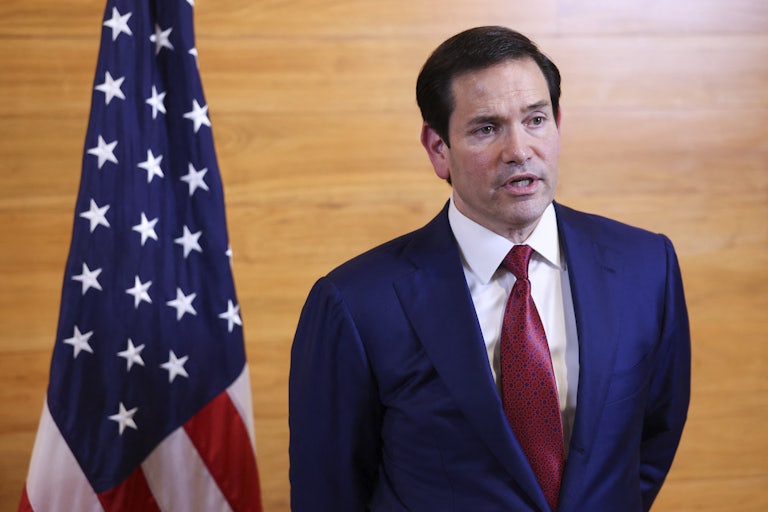
Secretary of State Marco Rubio speaks while standing in an airport departure lounge
Jonathan Ernst/AFP/Getty Images

Trump administration officials just can’t seem to decide whether Iran is actually enriching uranium, as the president threatens to launch a major military strike there.

Secretary of State Marco Rubio revealed that Iran was not currently enriching uranium, while speaking to reporters Wednesday at St. Kitts and Nevis.

“They are in possession—first and foremost, after their nuclear program was obliterated, they were told not to try to restart it, and here they are. You can see them always trying to rebuild elements of it,” he said. “They’re not enriching right now, but they’re trying to get to the point where they ultimately can.”

Rubio’s statement directly contradicted the Trump administration’s main justification to attack Iran—and statements from other U.S. officials.

U.S. Special Envoy Steve Witkoff claimed on Fox News Saturday that Iran’s enrichment level had reached “60 percent.”

“They’re probably a week away from having industrial-grade bomb-making material,” Witkoff warned.

Most nuclear reactors that produce electricity only require uranium that is enriched to between 3 percent and 5 percent. Highly enriched uranium is anything above 20 percent, and weapons-grade uranium is enriched above 90 percent, according to the Center for Arms Control and Non-Proliferation.

After Donald Trump launched a massive bombing campaign on three of Iran’s nuclear facilities in June, Defense Secretary Pete Hegseth and the White House insisted that the United States had “obliterated” the country’s nuclear capabilities. Nine months later, and even MAGA Republicans are struggling to sell the administration’s story that Iran was once again a threat.

Top U.S. military officials, meanwhile, have reportedly warned the White House against dragging the country into war with Iran, arguing that it could entangle America in a prolonged conflict.

How Jeffrey Epstein Worked the South Florida Legal System

A new report published by the Miami Herald reveals how Jeffrey Epstein built up his connections within law enforcement—and how those connections helped him.

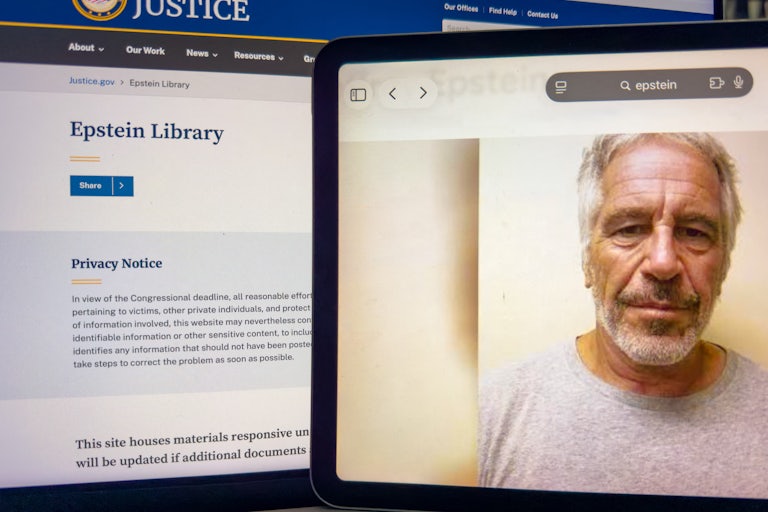
Close up image of a tablet screen displaying a portrait of Jeffrey Epstein beside an official U.S. Department of Justice website page titled "Epstein Library."
Véronique Tournier/Hans Lucas/AFP/Getty Images

It seems that a key provision in the 2008 sweetheart plea deal that gave Jeffrey Epstein his light sentence was proposed by a former federal prosecutor who later regularly corresponded with the sexual predator.

Among the revelations in an extensive report by The Miami Herald is that while insisting on a minimum two-year sentence and a felony conviction for Epstein as part of a plea agreement, former chief federal criminal prosecutor Matthew Menchel also reportedly proposed that Epstein be allowed to enter a plea in state rather than federal court. The ultimate entry of Epstein’s highly favorable plea in state court enabled Epstein to obtain the work release that got him out of jail for periods at a time. 

According to the Herald, Menchel initially discussed this matter not with the lead prosecutor on the case, Marie Villafana, but rather with Epstein’s defense lawyer Lily Ann Sanchez (whom Menchel had once dated). A 2020 report from the Justice Department’s Office of Professional Responsibility stated that Menchel failed to tell his supervisors about his prior relationship with Sanchez, but the OPR concluded that there was no evidence of prosecutorial misconduct by Menchel or any of the federal prosecutors. 

“I told Lily [sic] that a state plea with jail time and sex offender status may satisfy the USA,” Menchel wrote to Villafana in July 2007.

Villafana was incensed, as she had already prepared an 82-page prosecution memo directed to U.S. attorney Alex Acosta and Menchel that suggested a 60-count federal indictment for Epstein, the Herald reported. 

“[I]t is inappropriate for you to enter into plea negotiations without consulting with me or the investigative agencies, and it is more inappropriate to make a plea offer that you know is completely unacceptable to the FBI, ICE [Immigration and Customs Enforcement], the victims and me,” she wrote to Menchel. 

Menchel wrote back: “If the U.S. Attorney [Acosta] or the First Assistant [Sloman] desire to meet with you, they will let you know. Nor will I direct Epstein’s lawyers to communicate only with you. If you want to work major cases in the district you must understand and accept the fact that there is a chain of command — something you disregard with great regularity.”

Menchel left the Miami U.S. Attorney’s Office in August 2007, one month before Epstein’s non-prosecution deal was finished, and was not involved in final negotiations. A few years later, and just months after Epstein had completed his state sentence, he and Menchel began to correspond regularly and “met often for breakfasts, lunches, and dinners,” according to the Herald. Menchel’s lawyers asserted to the Herald that their correspondence was only “​​in the context of potential representation and referrals, none of which ever materialized into any business.” 

The full report reveals just how powerful—and how insidious—Epstein was, and how the system lacked the collective will to mete out a punishment commensurate to his despicable crimes.


UPDATE: Menchel’s attorney, Erica Wolff, wrote to The New Republic to clarify that: Menchel was not responsible for the plea deal; the eventual plea deal agreed to by Acosta was more lenient than the one Menchel recommended; and Menchel did not insist on a state plea.  

Blind Refugee Who Survived Genocide Dies Thanks to Border Patrol

Nurul Amin Shah Alam was found dead after Border Patrol abandoned him miles from home in the middle of winter.

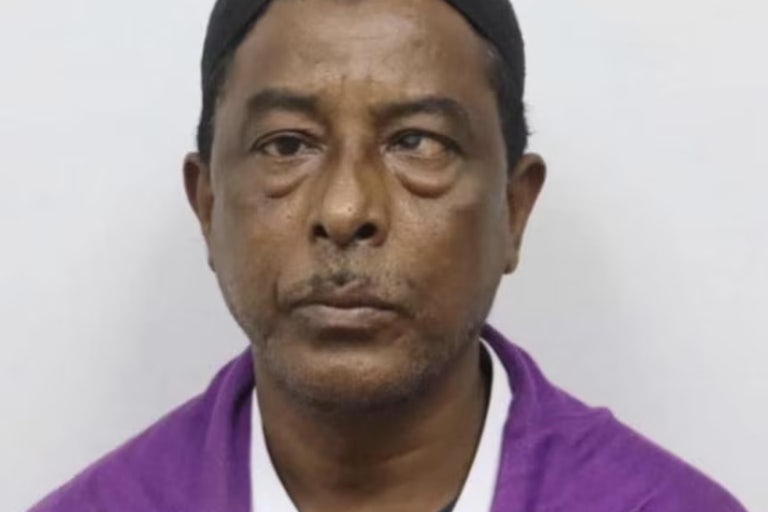
Nurul Amin Shah Alam
Buffalo Police Department
Nurul Amin Shah Alam

A nearly blind refugee was found dead on the streets of Buffalo, New York, Tuesday after Border Patrol officers dropped him off at a Tim Hortons location miles from home last week.

Nurul Amin Shah Alam, 56, who survived the Rohingya genocide in Burma and arrived in the United States as a refugee in December 2024, was found by Buffalo police Tuesday night after they responded to a report of a dead body. He had been missing since February 19 after being released from the Erie County Holding Center on bail. Since an immigration detainer had been placed on him, the Erie County Sheriff’s Office contacted Border Patrol before his release, and agents picked him up that day.  

Shah Alam had been in the holding center for the past year after he was arrested by Buffalo police while walking in his neighborhood with the help of curtain rods he used as walking sticks. He got lost and found his way to a porch of another person’s home as she was letting her dog out. The woman called the police, and Shah Alam, having poor vision and unable to speak English, didn’t respond to police commands to drop the rods.

A scuffle ensued, and his lawyer, Benjamin Macaluso, said that police beat and tased Shah Alam before arresting him. He was then charged with numerous offenses, including assault, trespassing, and possession of a weapon. Macaluso said that Shah Alam’s family didn’t bail him out at the time for fear that he would be detained by ICE and sent out of state. 

Shah Alam had made a plea deal with the Erie County District Attorney’s Office on charges of trespassing and possessing a weapon, which allowed him to “clear” the detainer, Macaluso told the nonprofit news outlet Investigative Post. So the agents dropped him off at the café, seven miles away from where Alam’s family lives on the east side of Buffalo.

Border Patrol claims that’s where Shah Alam agreed to go. After agents realized that Shah Alam wasn’t supposed to be in their custody, they “offered him a courtesy ride, which he chose to accept to a coffee shop, determined to be a warm, safe location near his last known address, rather than be released directly from the Border Patrol station,” a spokesperson for the agency said in a statement.

The statement even had the audacity to claim that a man blind in one eye, with blurry vision in the other, who needed two sticks to walk, “showed no signs of distress, mobility issues, or disabilities requiring special assistance.”

Border Patrol also didn’t notify Shah Alam’s family that they released him. Macaluso and Shah Alam’s family spent the following few days looking for him, and the attorney opened a missing person’s case with Buffalo police Sunday. On Monday, the case was mistakenly closed for hours because a detective thought Alam was actually taken to an ICE facility before being reopened later that day.

Now, a man who survived a genocide has died because of negligence by Border Patrol agents only 14 months after arriving in the U.S. Even before that, he was arrested and held for a year seemingly because of a miscommunication, and despite having legal status, his family justifiably feared that ICE would detain him thanks to the Trump administration’s reputation of ignoring long-standing immigration law. Shah Alam should still be alive, but thanks to failures from local authorities all the way to the federal government, he passed away on a cold Buffalo street without his family. 

DOJ Totally Screws Over Ron DeSantis on Alligator Alcatraz

The Florida governor has been left holding the bill.

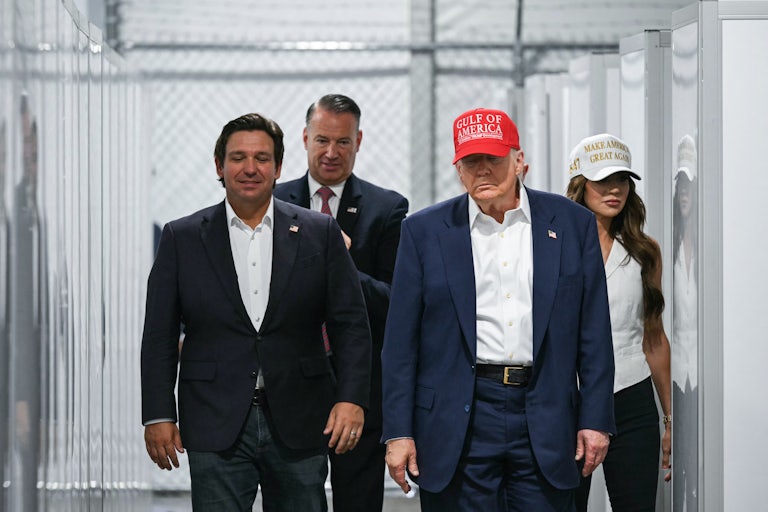
Florida Governor Ron DeSantis, President Donald Trump, and Homeland Security Secretary Kristi Noem tour Alligator Alcatraz.
ANDREW CABALLERO-REYNOLDS/AFP/Getty Images
Florida Governor Ron DeSantis, President Donald Trump, and Homeland Security Secretary Kristi Noem tour Alligator Alcatraz.

Florida Governor Ron DeSantis may be left footing the bill for Alligator Alcatraz—Donald Trump’s wetland-themed concentration camp—so the Department of Justice can sidestep threats from environmental groups that would shut the facility down, according to the Florida Phoenix.

In a filing Tuesday, the Department of Justice clarified that the ICE facility in the Florida Everglades wasn’t eligible to receive federal funding for construction—only for its day-to-day operation.  

“Any potential future federal funding is reimbursement-based, calculated per detainee, and available only for operational costs—not construction or facility modification,” Principal Deputy Assistant Attorney General Adam Gustafson wrote.

“As it likely will be structured, there will be no potential federal funding of the facility’s design, siting, maintenance, or construction, and no federal approval authority over whether the facility is built at all,” he added.

The filing was made as part of an ongoing legal battle brought by the Friends of the Everglades, Earthjustice, and the Miccosukee Tribe, who hoped to block the construction. The groups alleged that the expedited construction of a facility at the Big Cypress National Preserve had been done without complying with federal environment laws and regulations. A lower court had sided with the environmental groups, and the government appealed the decision. 

The government’s appeal hinges on the question of federal funding: If the facility never received federal dollars, then it wouldn’t need to comply with federal laws. 

In a separate filing Tuesday, Florida Attorney General James Uthmeier claimed that the Sunshine State had accepted the “risk” that the FEMA money reimbursement might “not materialize” at all.

But when Alligator Alcatraz was first announced, Homeland Security Secretary Kristi Noem claimed the facility would “in large part be funded by FEMA’s Shelter and Services Program.” The facility would cost $450 million a year to operate. 

If the funds for construction don’t arrive—and it seems like they won’t—the Florida Division of Emergency Management might have to foot more than just the $245 million construction bill. So far, the FDEM has pulled together roughly $406 million to fund the state’s immigration enforcement efforts. 

In September, DHS announced that it had submitted an application for a $608 million grant for Alligator Alcatraz to FEMA and been approved—but that didn’t mean that the money had actually been sent, DOJ lawyers claimed Tuesday. 

FDEM Director Kevin Guthrie said earlier this month that FEMA told him the DOJ had held up the massive reimbursement.