Breaking News
Breaking News
from Washington and beyond

Texas Republicans’ Gerrymandering Hilariously Backfires in Primaries

Democratic voters are fired up.

People stand in line to vote at the University of Texas at Austin.
Kaylee Greenlee/Bloomberg/Getty Images
Voters wait in line at the University of Texas at Austin.

Given the many scandals that have enveloped this country since President Donald Trump began his second term, it’s easy to forget one of the first: Big Don’s call to gerrymander districts in Republican-held states in order to create more congressional seats for the GOP.

Fortunately for Democrats, the president is so unpopular right now that even new districts specifically drawn for Republicans may swing left.

Veteran political strategist Tom Bonier noted Wednesday that Democratic primary voters exceeded their Republican counterparts in four of the five Texas districts that the state legislature redrew last year.

One of these is District 28, which is located on the southwest tip of Texas, and where Democrats outvoted Republicans four to one.

Four to one! The turnout highlights a Southern, largely Hispanic enthusiasm for Democratic candidates that simply wasn’t there during the last presidential election. In Zapata County, also part of district 28, Bonier found that Democratic primary turnout was 143 percent the number of votes Kamala Harris won in 2024.

“It’s hard to overstate how rare it is to see Dem turnout in a midterm primary election exceeding that of a presidential election,” Bonier wrote.

These voters are also mobilizing despite a pronounced funding gap, which will only inspire more Democratic hope for the region. The GOP spent upward of $80 million on Senate primary advertisements in Texas, more than triple the amount spent by Democrats, the advertising analytics firm AdImpact found.
Mike Johnson Says Making Trump Obey Constitution on Iran Would Be Bad

Johnson is urging lawmakers not to support a war powers resolution.

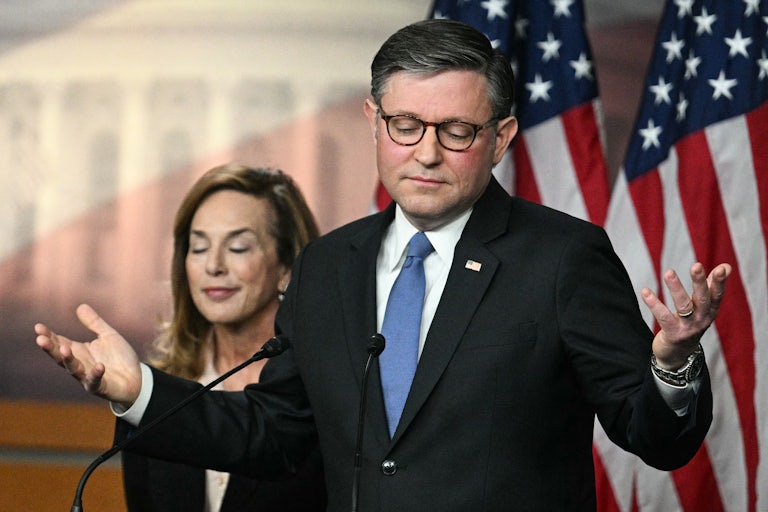
House Speaker Mike Johnson shrugs while standing at a podium
Jim WATSON/AFP/Getty Images

Only Congress has the authority to declare war—but Republican leadership seems content to let Donald Trump do whatever he wants at whim.

The Senate is expected to vote Wednesday on whether to block Trump’s warfare in Iran via a war powers resolution. The bipartisan resolution, introduced by Democratic Senator Tim Kaine and co-sponsored by Republican Senator Rand Paul, would “direct the removal of United States Armed Forces from hostilities within or against the Islamic Republic of Iran that have not been authorized by Congress.”

But not everyone in Congress is prepared to seize the legislative branch’s constitutionally appointed authority.

House Speaker Mike Johnson told reporters Wednesday that restricting his Oval Office ally’s military power through the passage of a war powers resolution “would be a terrible, dangerous idea.”

“It would empower our enemies, it would kneecap our own forces, it would take the ability of the U.S. military and the commander in chief away from completing this critical mission to keep everybody safe,” Johnson said.

The Republican House leader added that Iran had attacked three U.S. embassies in the days since U.S. bombs fell on the country.

“Those are sovereign territories of the U.S. They have declared war on us,” Johnson said. “I don’t believe in the semantics.… We’re not at war right now. We’re four days into a very specific, clear mission and operation—Operation Epic Fury—that has two components, as you know.

“Everybody has explained,” Johnson said.

But nobody in Washington has explained the rationale for going to war with Iran with any modicum of clarity, leaving even those in Trump’s Cabinet confused about the intended messaging. State Secretary Marco Rubio, for instance, had to eat his own words Tuesday evening after the president disagreed with his depiction of the war. Rubio had initially suggested to reporters on Monday that Israel had forced Trump’s hand, forcing the U.S. to strike first due to intel that indicated Iran would retaliate with force against American interests if Israel followed through on its plans to attack.

By the next day, Rubio was stuttering in front of cameras that he had never said anything of the sort. Mike Waltz, the U.S. ambassador to the U.N., claimed later that day that Rubio’s point-blank comments had been “taken out of context.”

So far, six U.S. soldiers have been killed in the conflict, as have more than 20 Iranian officials, including Supreme Leader Ayatollah Ali Khamenei. Eighteen American soldiers have also been seriously injured. More than 1,000 Iranian civilians have been killed, including 176 children, dozens of whom were at a girls’ school in the country’s south.

More than a dozen countries have been roped into the conflict since the U.S. began bombing Iran—including France, the U.K., and Greece—effectively destabilizing the entire region while disrupting global markets and oil production.

Meanwhile, U.S. forces may not be able to keep their defenses up: Military officials have stressed since Sunday that fighting Iran has already drastically depleted America’s missile defense systems.

In a closed-door meeting with lawmakers Tuesday, Defense Secretary Pete Hegseth and Chairman of the Joint Chiefs of Staff Gen. Dan Caine reportedly said that Iran’s Shahed attack drones had proved a more difficult problem than initially predicted.

One source told CNN that the U.S. has been “burning” through long-range precision-guided missiles over the last four days.

Newsom Compares Israel to “Apartheid State” as He Blasts War on Iran

Even California Governor Gavin Newsom is now questioning U.S. aid to Israel.

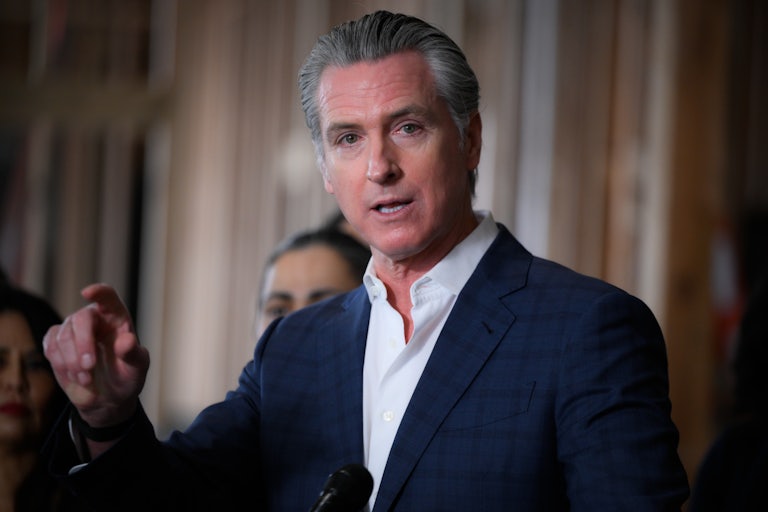
California Governor Gavin Newsom speaking
Tayfun Coskun/Anadolu/Getty Images

California Governor Gavin Newsom, a contender for the Democratic presidential nomination in 2028, has questioned U.S. military support for Israel and called it “sort of an apartheid state.” 

Pod Save America podcast host Jon Favreau interviewed Newsom Tuesday at an event promoting the governor’s memoir and asked him, “Do you think, looking down the road, that the United States should consider maybe, you know, rethinking our military support for Israel?”

In his response to the former Obama administration staffer, Newsom took his strongest stance on Israel to date. 

“It breaks my heart, because the current leadership is walking us down that path where I don’t think you have a choice about that consideration,” Newsom said. He criticized Israeli Prime Minister Benjamin Netanyahu and referred to the expansion of West Bank settlements having people “talking about it appropriately as sort of an apartheid state.” He went on to criticize Israel’s role in the current war on Iran.

“We’re talking about regime change?” Newsom said. “For two years, they haven’t even been able to solve the Hamas question in Israel.”

Newsom has made no secret of his presidential ambitions, touring the country to increase his national profile. Less than two months ago, he went on conservative commentator Ben Shapiro’s podcast and refused to call Israel’s massacre of Gaza a genocide, saying he was “crystal clear on my love for Israel.”

So what does Newsom actually believe? Does he genuinely believe that the U.S. needs to stop military support for Israel, or is he pandering to reach the voting majority, who, according to a recent Gallup poll, sympathize with Palestinians more than Israelis? With the presidential primaries only two years away, Newsom’s views will face plenty of challenges in what will probably be a crowded Democratic field.  

Noem Stumbles Over ICE Chief’s Comment on Minnesota Domestic Terrorism

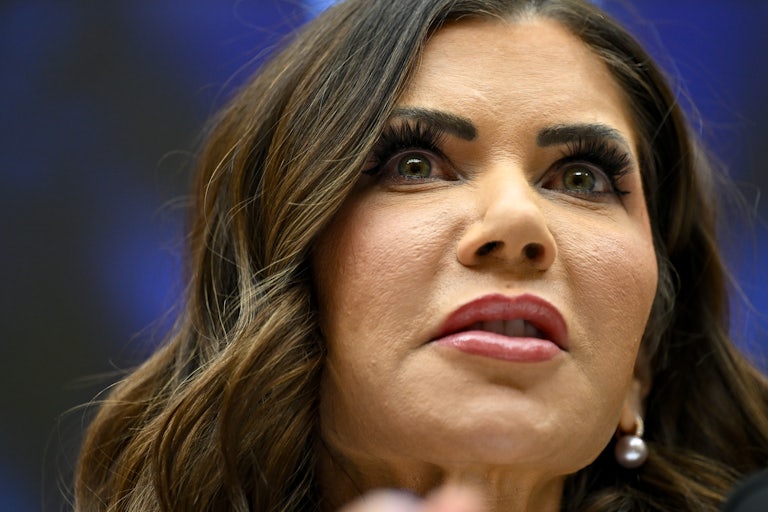
Kristi Noem refused to say Alex Pretti and Renee Good were not domestic terrorists.

Homeland Security Secretary Kristi Noem speaks during a House hearing
Graeme Sloan/Bloomberg/Getty Images

Roughly two months after their deaths, Homeland Security Secretary Kristi Noem still isn’t ready to publicly acknowledge that Renee Nicole Good and Alex Pretti were not domestic terrorists.

ICE agents shot and killed the two U.S. citizens in different instances over the course of January. In the immediate aftermath of the dual homicides, Noem and other officials within the Trump administration attempted to spin the narrative of their deaths to quell public backlash. To do so, they smeared Pretti, an ICU nurse who worked with veterans, and Good, an award-winning poet and mother, as “domestic terrorists” intent on killing federal officers.

But time away from the brutal killings has not changed Noem’s tune. In a heated exchange with Representative Jamie Raskin during a House Oversight Committee hearing Wednesday, Noem not only refused to apologize to the Americans’ families for her subordinates’ gross abuse of force, but blatantly sidestepped any attempt to revise her language.

“Madame Secretary, based on what you know today, were Renee Good and Alex Pretti domestic terrorists?” asked Raskin.

“Congressman, what happened in Minnesota in those two incidents was an absolute tragedy,” Noem said.

“Were they domestic terrorists as you said to the country?” Raskin said.

“My condolences to their families, because I know their lives will never be the same after that happened,” Noem said.

“Is that an apology for what you said?” pressed Raskin.

“We, in those instances, offer as much information as we can—” Noem continued.

“Madame Secretary, based on what you know today, were Renee Good and Alex Pretti domestic terrorists?” Raskin repeated.

“As you know, there’s ongoing investigations that are being led by the FBI—” Noem started, before Raskin interrupted to clarify that Noem “did not wait for the investigation” when she made her initial comments.

“You proclaimed they were domestic terrorists at the time. Why did you do that?” asked Raskin.

“And you didn’t wait to attack our law enforcement officers,” Noem spat back. “Our ICE officers and our HSI officers that day risked their lives to protect that scene so the evidence could be used in the investigation. Because those violent rioters that were there—”

“So you’re proud of the fact that you called them domestic terrorists?” Raskin pushed. “Is that what you’re telling America?”

“HSI officers put their lives on the line to protect that scene,” Noem continued.

“Yes, they do,” Raskin agreed, reminding Noem that she “told a lie” about Pretti and Good. “Do you regret that?”

“I offer my condolences to those families,” Noem repeated blankly.

“Based on what you know today, were Renee Good and Alex Pretti domestic terrorists?” Raskin asked.

“There’s ongoing investigations,” Noem said.

“So you still don’t know? You think that’s an open question?” Raskin pressed.

“I would think you would still want there to be open investigations into this situation,” Noem said.

“Well you stated the conclusion two hours after they were killed that they were domestic terrorists. I wanted to give you an opportunity to correct the record, not just for their family but for everyone in America who believes in the truth and fairness and honesty,” Raskin continued. “You know, your acting ICE Director Todd Lyons came before Congress. He said he had no knowledge whatsoever that Alex Pretti and Renee Good were domestic terrorists. None! This is your guy, he said. He admitted that was wrong. Why won’t you do that?”

But Noem would not explain herself. She then had no apparent defense for her agency when Raskin asked her to clarify her position on existing laws that are supposed to prevent federal immigration officers from killing and abusing American citizens.

Progressives See Massive Gains in North Carolina Primary

Democratic voters rejected ICE and AIPAC.

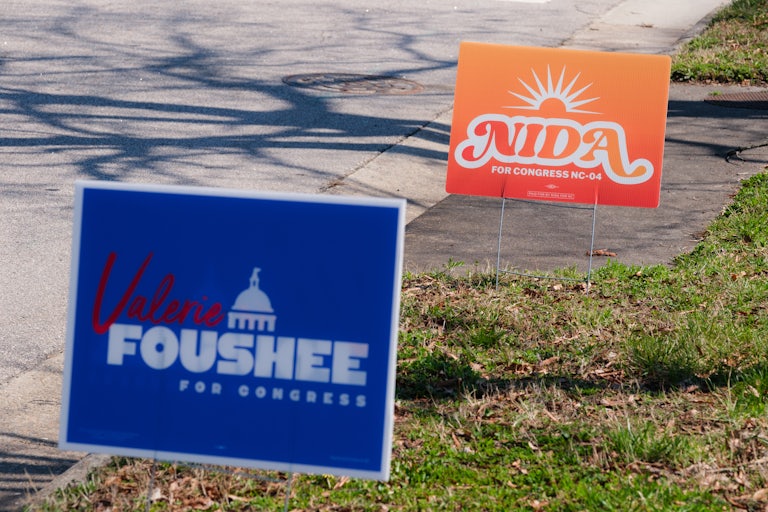
Signs for Democratic congressional primary candidates Valerie Foushee and Nida Allam in North Carolina
Cornell Watson/Bloomberg/Getty Images

More primaries, more gains for progressives candidates.

In North Carolina—a contentious swing state that Donald Trump won with 51 percent of the vote in 2024—a Democrat who has represented the state’s 106th district for over a decade was trounced by her progressive challenger on Tuesday.

State Representative Carla Cunningham saw her support base wither away after she was the only Democrat to vote in favor of a Republican bill that required local law enforcement to record inmates’ citizenship status and detain noncitizens for longer periods if requested by ICE.

She gave a fiery speech on the House floor at the time, quoting unnamed “social scientists” while arguing that “all cultures are not equal.” She added that noncitizens should “adapt to the culture of the country they wish to live in.”

Not too surprising that Cunningham was primaried after such comments, but her opponent, the Reverend Rodney Sadler’s immense margin of victory should give progressives hope and show the lack of support for Immigration and Customs Enforcement even within swing states. Sadler received 70 percent of the vote to Cunningham’s 22 percent.

In North Carolina’s 4th district, incumbent Democrat Valerie Foushee is locked in a dead heat with progressive challenger Nida Allam. Foushee was favored to win and continues to hold a slight advantage, leading Allam by about 1,000 votes with 99 percent of votes in, but Allam could request a recount if the vote remains close.

Allam is less than half Foushee’s age, and is running solidly to the left of the incumbent. She has called for abolishing ICE (Foushee has said she would rather defund the agency) and is frequently critical of Israel’s genocide in Gaza. She has bashed Foushee for accepting donations from the notorious pro-Israel lobby AIPAC in past campaigns. The incumbent then changed her tune last summer, saying she would not accept AIPAC money during the current election cycle.

The race became the most expensive primary in state history, with $2.4 million from outside groups being spent on Foushee and $1.8 million on Allam. Foushee still attracted controversy over reports that AIPAC funneled money to her through third parties.