Breaking News
Breaking News
from Washington and beyond

Top Trump Official Asks What the Big Deal Is if ICE Goes to the Polls

The Trump administration seems serious about sending ICE agents to monitor election sites.

Deputy Attorney General Todd Blanche points a finger while seated in a chair on the CPAC stage.
Shelby Tauber/Bloomberg/Getty Images
Deputy Attorney General Todd Blanche at CPAC, on March 25

Deputy Attorney General Todd Blanche advocated for sending Immigration and Customs Enforcement agents to polling places, in the clearest proof yet that the Trump administration plans to use the overfunded and undertrained police force to suppress the vote.

Blanche made the comments in a speech at the popular conservative conference CPAC on Thursday. “Why is there objection to sending ICE officers to polling places?” he said. “Illegals can’t vote. It doesn’t make any sense.”

Federal law prohibits government forces from patrolling poll sites unless “such force be necessary to repel armed enemies of the United States.” Nonetheless, top Trump officials have balked when asked if ICE would be deployed for the midterms.

In February, White House press secretary Karoline Leavitt called a question on the subject “silly” and “disingenuous” while declining to actually answer.

Other right-wing freaks—cough, Steve Bannon, cough—have been all in on the idea for some time. And as Trump’s polling numbers continue to nosedive, it would be surprising if he didn’t do everything he could for his party to remain in power. Earlier this year, the president remarked that Republicans should “nationalize the voting.”

Critics worry that the presence of ICE agents at polling stations could deter Americans from voting, even if all their documents are in order. The agency has already killed two American citizens in 2026, and detained over 170 in 2025.

The idea that noncitizens are consistently voting in American elections is a myth Trump has successfully convinced his base is true. Funnily enough, most high-profile attempts at voter fraud have come from his own supporters.

Trump’s Reckless War Is Throttling New Homes and New Jobs

As long as the war continues, ordinary Americans will have a tougher time.

Plywood and wood framing are visible on a home still under construction, with a "Cordova New Homes Coming Soon" sign visible in front of the house frame.
Frederic J. BROWN/AFP/Getty Images
A new house under construction in Alhambra, California, on March 19

President Donald Trump’s reckless war with Iran is literally costing Americans their future by driving up mortgage rates and sapping the already dismal job market.

The average 30-year fixed mortgage rose to 6.38 percent this week, after steadily climbing for the past four weeks since Trump launched his military campaign in Iran, CNN Business reported Thursday. It was the largest single-week increase since Trump’s Liberation Day tariffs shocked the economy last April.

In February, mortgage rates slipped below 6 percent for the first time in three years, before the spiraling conflict in the Middle East rattled the global economy.

Mortgage rates are tied to the 10-year Treasury yield as well as concerns about inflation. Last week, the yield on a 10-year Treasury note rose to 4.39 percent, its highest rate since July. Trump’s recent contradicting statements about a potential ceasefire in Iran have only driven yields higher to 4.44 percent on Monday, threatening home sales as spring arrives. Concerns about rising inflation have only deepened as the Strait of Hormuz remains shuttered. At the same time, foreclosure rates are also increasing in another troubling sign for homeowners.

Meanwhile, financial services firm Goldman Sachs has estimated that the global oil shock will cost the United States an estimated additional 10,000 jobs per month until the end of the year—and that’s if the war ends after six weeks. As energy prices surge, consumers are expected to cut back on discretionary purchases, like travel, hospitality, and retail, and put off long-term purchases like buying a house. Currently, there aren’t many signs that the war will resolve anytime soon. This prediction comes after the U.S. gained practically no jobs in 2025, and data from February revealed a shocking spike in unemployment.

Clearly, Trump’s war is already having dire economic consequences for average Americans, and those factors won’t be easily reversed.

Trump Admits He Told Top Official to Ignore the Courts

The president’s attack on the judicial system is getting even more blatant.

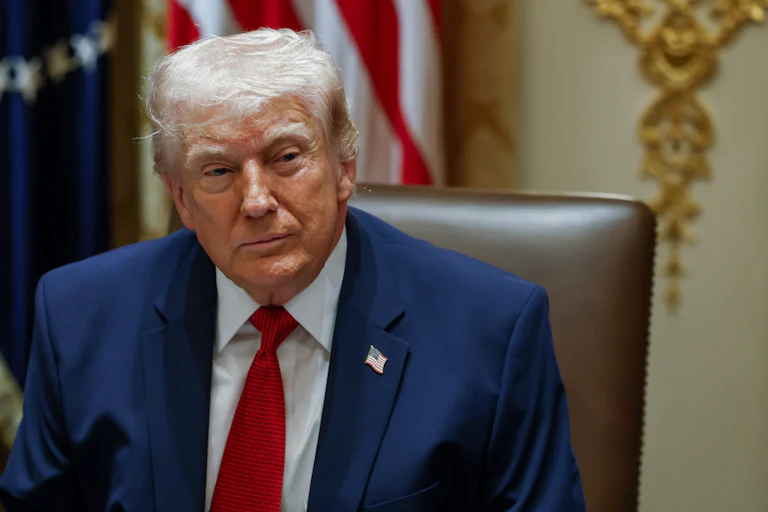
President Donald Trump at his Cabinet meeting
Will Oliver/EPA/Bloomberg/Getty Images

An hour into his Thursday Cabinet meeting, Donald Trump made a remark that should infuriate every American who has been stuck paying high prices for foreign products.

Referring to Minnesota and California, Trump said: “I spoke with Russell Vought. I said, ‘Russell, don’t send them any money.’ He said, ‘But we have a court order that we have to.’ Can you believe it? … Justice Roberts doesn’t like when I say it, but the judges are really hurting this country.”

The “court order” mentioned by Vought, the director of the Office of Management and Budget, refers to a ruling that the Trump administration must refund companies that were taxed for shipping foreign goods into the U.S.—plus interest.

The order was handed down by a judge with the Court of International Trade, and came after the Supreme Court ruled that the tariffs Trump imposed early in his second term were unconstitutional.

Trump has previously suggested the government would not refund the companies and instead try to litigate the decision. “We’ll end up being in court for the next five years,” he said.

The amount of taxpayer money the Trump administration owes these companies increases by $700 million every month. And when the companies aren’t getting their refunds, research shows they’re passing the tariff costs on to consumers.

Yet the Trump administration continues to stall, claiming it doesn’t have the technical capabilities to process the refunds and whining, as Trump did on Thursday, about the judges making it return what is owed.

Trump Wants to Gut Another Room in the White House

How much of the “people’s house” is he going to destroy?

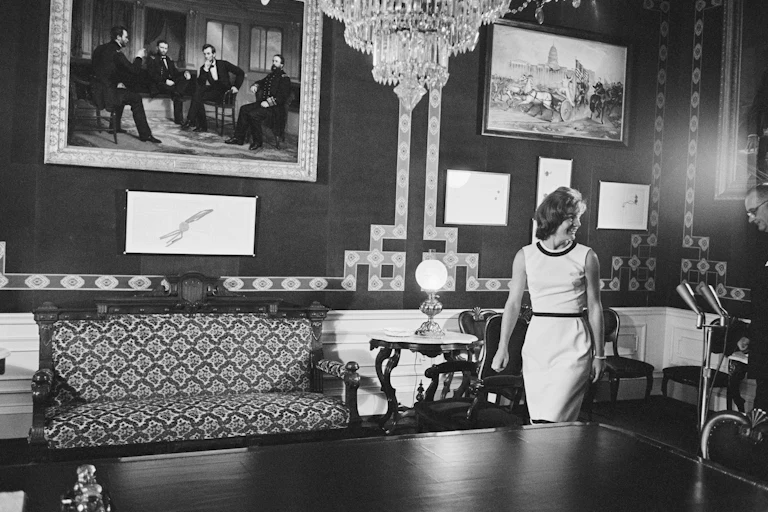
Jacqueline Kennedy in black-and-white walks into the White House Treaty Room with a picture of President Lincoln and three other people on the wall, as well as a table and sofa. A chandelier is hanging from the ceiling.
Bettmann/Contributor/Getty Images
First lady Jacqueline Kennedy walks through the newly restored White House Treaty Room in 1967.

President Trump wants to turn the White House Treaty Room—traditionally reserved for ambassadors and foreign dignitaries—into a spare suite bedroom with a bathroom attached.

The New York Times reported Thursday that Trump floated his latest home improvement project on February 6 while giving a White House tour to a small group of people from the Committee for the Preservation of the White House and the Commission of Fine Arts. He wants the room used by presidents from Ulysses S. Grant to George W. Bush to be a one-bed, one-bath. It’s unclear why exactly the White House would need another guest room.

“President Trump is the builder-in-chief with an extraordinary eye for detail and design, and his bold vision will be imprinted upon the fabric of America and be felt by generations to come,” White House spokesperson Davis Ingle told the Times. “His successes will continue to give the White House the glory it deserves.”

This would be the latest in the slew of White House renovation projects that Trump has unnecessarily undertaken. He turned the Rose Garden into a concrete patio and put tacky gold flourishings throughout the White House, including the Oval Office. And of course, he has already demolished the East Wing in preparation for his true pet project, a 90,000-square-foot grand ballroom. While Trump is quick to tout his prowess as a “builder,” it becomes more and more clear that he thinks the White House is just another one of his estates.

Trump Funneling Money for His Board of Peace From State Department

Taxpayer dollars are being diverted to President Trump’s corrupt “Board of Peace.”

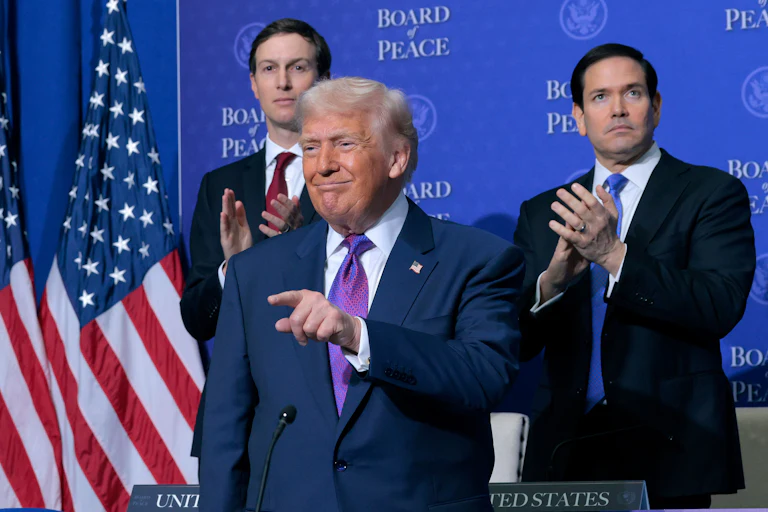
Jared Kushner and Secretary of State Marco Rubio clap as President Trump points and smiles at the inaugural meeting of the Board of Peace.
Chip Somodevilla/Getty Images
President Donald Trump, Jared Kushner, and Secretary of State Marco Rubio at the inaugural meeting of the Board of Peace at the U.S. Institute of Peace on February 19, in Washington, D.C.

The State Department is reallocating $1.2 billion in foreign aid funding to President Donald Trump’s war criminal–filled Board of Peace, Semafor first reported Thursday.

Officials took $1 billion from international disaster assistance, $200 million from peacekeeping operations, and $50 million from international organizations, in order to finance the president’s slush fund posing as a peace plan for Gaza. In reality, the Board of Peace has not transferred any money to Gaza (despite saying it will), nor has it disclosed how it will spend any of its funding to promote international peace. The whole thing is seemingly a farce to carry out Jared Kushner’s master plan to turn Gaza into a strip of luxury hotels.

Trump previously announced the U.S. would give $10 billion in total to the board, which he assured taxpayers is “a very small number when you look at that compared to the cost of war.” Countries seeking permanent members on the Board of Peace are required to pay $1 billion for their spot.

On Thursday, Democratic Senator Catherine Cortez Masto introduced a bill that would take $1 billion of the Board of Peace’s funding and redirect it to the Low-Income Home Energy Assistance Program, amid skyrocketing gas prices from Trump’s war in Iran.

“Instead of giving President Trump a $1 billion blank check to fund a ‘Board of Peace’ that has offered no transparency about how it is investing its money, let’s focus on helping American families afford their monthly power bill,” Cortez Masto said in a statement.

Like many of Trump’s insane foreign policy stunts, the apparent transfer of funds was done without congressional approval. In a properly functioning government, the president actually wouldn’t be allowed to take billions of dollars in the midst of a partial government shutdown to fund an experimental pet project.