Breaking News
Breaking News
from Washington and beyond

Meet the 26-Year-Old Ex-Receptionist Overseeing Trump’s Ballroom

Chamberlain Harris was Trump’s receptionist. Now she’s in charge of a multibillion-dollar project.

Trump holds an architectural rendering in front of a man who seems exasperated
Photo by Alex Wong/Getty Images
Trump shows off a rendering of his new ballroom in front of NATO’s secretary general.

President Donald Trump was so desperate to stack the commission overseeing the construction of his ballroom with allies that he tapped his 26-year-old assistant to serve as its newest member—even though she has absolutely no expertise in art at all.

Chamberlain Harris, deputy director of Oval Office operations, was reportedly picked to join the Commission on Fine Arts, which is charged with advising the federal government on the art, design, and architectural development of Washington.

When Congress first established the Commission on Fine Arts, some 100 years before Harris was even born, lawmakers decreed that the members should be “well-qualified judges of the fine arts.” By all accounts, Harris is not one.

Harris, who served as Trump’s executive assistant when he was out of office, received a bachelor’s degree in political science in 2019 from the University of Albany with minors in communications and economics, according to an archived copy of her résumé on her LinkedIn profile. A quick search of the Scholar’s Archive at SUNY Albany turns up a 2019 honors thesis titled, “Missing the Mark: Obama and Trump’s use of similar communication strategies.”

Several former fine arts commissioners told The Washington Post that they could not recall a commissioner in the panel’s history who had less experience in fine arts than Harris.

So, what qualifications does Harris have? She may not know art—but she does know Trump.

“She understands the president’s vision and appreciation of the arts like very few others, and brings a unique perspective that will serve the Commission well,” said White House communications director Steven Cheung. “She will be a tremendous asset to the Commission of Fine Arts and continue to honorably serve our country well.”

Harris is expected to be sworn in on Thursday, when the commissioners are slated to review the latest plans for the ballroom.

In December, a federal judge ordered Trump to run decisions for the construction of a new White House ballroom through the Commission of Fine Arts. There was only one problem: The president fired all six members in October in order to clear the way for a slew of changes to the nation’s monuments. Ahead of the commission’s first meeting to discuss the ballroom, Trump embarked on a three-week hiring spree in January to refill the positions with sycophants willing to green-light his major construction project.

Since the project was initially announced last year, the price tag for Trump’s behemoth ballroom has ballooned to $400 million. Luckily for Trump, there is no shortage of shadowy billionaires and major corporations just clamoring to foot the bill.

Trump’s CFTC Tries to Stop States From Regulating Prediction Markets

The Commodity Futures Trading Commission is moving to block states’ legal challenges to platforms like Polymarket and Kalshi.

Michael Selig testifies in the Senate.
Eric Lee/Bloomberg/Getty Images
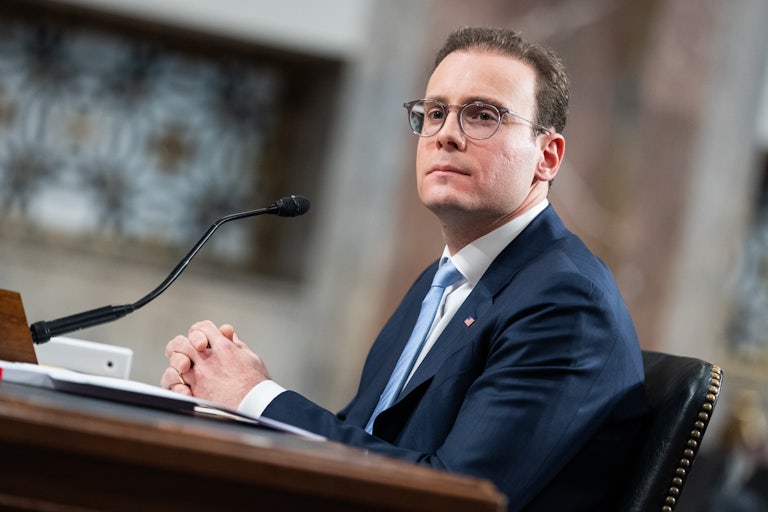
Michael Selig testifies before the Senate as the nominee for Commodity Futures Trading Commission chairman, on November 19, 2025.

President Trump is moving to protect prediction markets like Kalshi and Polymarket as nationwide backlash against them grows. 

“Over the past year, American prediction markets have been hit with an onslaught of state-led litigation. In response, the CFTC has today filed a friend-of-the-court brief to defend its exclusive jurisdiction over these derivative markets,” Commodity Futures Trading Commission Chair Mike Selig said in a video on X Tuesday. “Prediction markets aren’t new.…  They provide useful functions for society by allowing everyday Americans to hedge commercial risks like increases in temperature and energy price spikes. They also serve as an important check on our news media.”

Selig published a Wall Street Journal op-ed on February 16 titled “States Encroach on Prediction Markets,” noting that the CFTC has always had authority over prediction markets and will work to stop states’ legal attacks.

To many, prediction markets are legalized, freewheeling virtual gambling at best and perfect fronts for insider trading at worst.

“Mike, I appreciate you attempting this with a straight face, but I don’t remember the CFTC having authority over the ‘derivative market’ of LeBron James rebounds,” Utah Republican Governor Mike Cox said. “These prediction markets you are breathlessly defending are gambling—pure and simple. They are destroying the lives of families and countless Americans, especially young men. They have no place in Utah. Let me be clear, I will use every resource within my disposal as governor of the sovereign state of Utah, and under the Constitution of the United States, to beat you in court.”

Independent journalist Joon Lee chimed“Trump-appointed chairman of CTFC says they will go to court to protect the national legality of prediction markets. Does not mention sports makes up 90% of bets placed on prediction markets. Also not mentioned: Trump Jr is an investor in Polymarket and a paid advisor to Kalshi.”

“Thank you, Chairman,” one X user wrote sarcastically. “Debt, depression and suicide rates among young men is a very small price to pay for our God-Given Right to wager on who will get engaged in the current season of Love Is Blind.” 

Two-Month-Old Baby Detained by ICE Ends Up in Hospital

The baby was being held at Dilley Detention Center in Texas.

Aerial photo of the South Texas Family Residential Center in Dilley, Texas
Moisés ÁVILA/AFP/Getty Images
The South Texas Family Residential Center in Dilley, Texas, on January 28

A 2-month-old baby at an ICE detention center in Texas had to be hospitalized late Monday night because a doctor wasn’t available at the facility.

Juan Nicolás, held at the South Texas Family Residential Center in Dilley, 71 miles from San Antonio, has been suffering from respiratory problems for nearly half of his life— the one month he has spent in detention with his mother. Over the weekend, Nicolás was reportedly choking on his own vomit and had a medical episode at 3 a.m. Sunday.

Texas Representative Joaquin Castro has been pushing for Nicolás’s release, having visited the CoreCivic-run facility late last month and noticing that its on-site clinic was empty and unstaffed in the afternoon that he was there.

“His life is in danger,” Castro said in a live Instagram video Monday afternoon, noting that a 7-year-old girl had been released from Dilley but not Nicolás. “They couldn’t take him to a doctor, because there weren’t any doctors in the early morning hours at Dilley.”

Univision’s Lidia Terrezas reported that Nicolás was taken to the hospital, but there have been no updates on his condition. He’s being held with his mother at a South Texas hospital, guarded by armed federal agents. It’s better than the facility in Dilley, which is known to be unsanitary. Mothers reportedly have issues getting clean water for formula, and measles shut down the facility over two weeks ago. Despite Castro’s best efforts, there’s no word on whether Nicolás will have to go back to Dilley if and when he recovers.

Univision’s Lidia Terrezas confirmed that Nicolás was taken to the hospital, but didn’t have any  updates on his condition. He was initially held with his mother at a south Texas hospital, guarded by armed federal agents. It’s better than the facility in Dilley, which is known to be unsanitary. Mothers reportedly have issues getting clean water for formula and measles shut down the facility over two weeks ago. 

In an update Tuesday afternoon, Castro posted that Nicolás has bronchitis, according to his mother, and was unresponsive at some point in the last few hours. He was still discharged from the hospital at about midnight Tuesday. Nicolás’s mother still had to appear before an immigration judge Tuesday, who told her that she will be deported, but didn’t say when or to where. 

“Both Juan and his mom are back at Dilley and their future remains uncertain. We are all deeply concerned that Juan and his mom will be deported and that Juan’s health will continue to deteriorate,” Castro posted. “His life is in danger because of ICE’s monstrous cruelty. I will continue to provide updates and we will keep fighting to protect them.”  

This story has been updated.

Trump Energy Secretary Boasts About Billions in Stolen Oil

Energy Secretary Chris Wright touted his boss’s “out-of-the-box” diplomacy for stealing Venezuelan oil.

a protester holds up a sign reading "no blood for oil"
David McNew/Getty Images
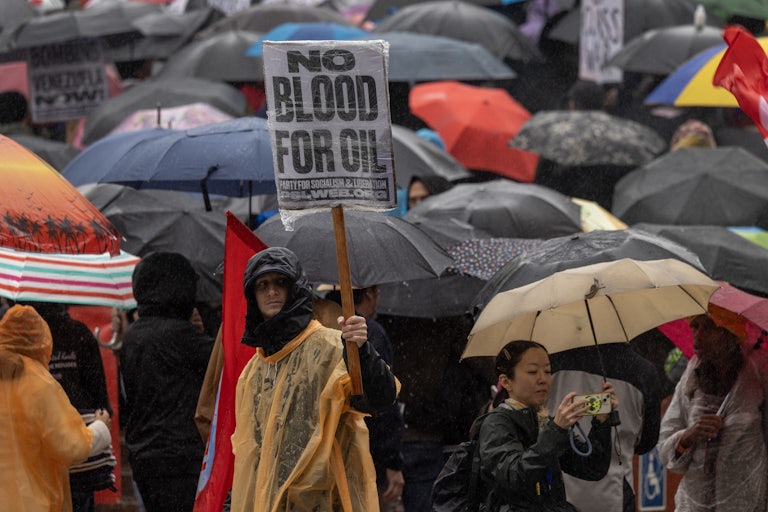
Protesters in Los Angeles in January decry the administration’s campaign against Venezuela.

Energy Secretary Chris Wright is attempting to repackage America’s illegal efforts to seize and sell Venezuela’s oil as an act of “out-of-the-box” diplomacy. Some might just call it piracy. 

Speaking on Fox News Tuesday, Wright boasted that the United States had already sold an “enormous amount” of the oil it took from Venezuela after it mounted a deadly military strike to kidnap the country’s president, Nicolás Maduro.  

“We’ve sold about a billion dollars of oil so far. We’ve recently signed agreements to sell about another $5 billion of oil in the next several months. So you’re talking well north of $10 billion a year,” Wright said.

“This is a win all around and a transformation of a country without any American soldiers on the ground, and without any American taxpayer dollars. This is way out-of-the-box, ground-breaking Trump diplomacy,” Wright said. 

To be clear, what President Donald Trump did in Venezuela was more akin to armed robbery than diplomacy. 

Wright didn’t fully explain where the money was actually going—or the oil. The secretary claimed that some of the money would go back to help “establish a free press and a representative government” in Venezuela. Meanwhile, the seized oil was a “specific kind of crude” American refineries were built to process, and could bring down the production cost of asphalt, he said. 

Speaking to NBC News last week, Wright claimed that the U.S. deposited $500 million from initial oil sales in an account in Qatar in order to keep the money away from Venezuela’s creditors—like China, Russia, and a slew of international oil bondholders and oil companies. “Now we have an account at the U.S. Treasury. The money won’t go to Qatar anymore,” the secretary said.

Wright also claimed that the oil had mostly gone to U.S. refineries and countries in Europe—but without oversight from Congress there is simply no way to know what deals are being made, or whether the money will actually make it back to Venezuelans in the throes of a widespread hunger crisis

Report: ICE Officials Ignored Clear Warning Signs Before Killings

ICE officials were well aware that their officers were using force in reckless and inappropriate ways before an officer shot Renee Nicole Good to death in Minneapolis.

a car crashed into a telephone pole after ICE officers murdered its driver
Stephen Maturen/Getty Images
Nicole Good’s car after she was shot multiple times by an ICE officer in Minneapolis.

Smashed windows, Tasers, and death: The warning signs were there, but officials at Immigrations and Customs Enforcement did not heed them.

Top officials at the deportation agency knew as early as March that their officers were using more force against civilians than ever before, Politico reported Tuesday.

The upward trend for both lethal and nonlethal force was documented in internal emails obtained by the liberal-leaning watchdog nonprofit American Oversight through Freedom of Information Act requests, revealing that top officials were well informed of the violence under their purview months before federal officers shot and killed Renee Nicole Good and Alex Pretti.

One March 20 email notified Caleb Vitello, the former acting director of ICE, that the agency had recorded 67 use-of-force incidents within the first two months of Trump’s term. That was nearly four times higher than the year before, when the agency reported just 17 incidents, according to Politico.

Vitello received a similar notice days earlier flagging near-identical rates for the first two weeks of March, which noted that use of force had quadrupled during that timespan compared to 2024.

Some of the reported violence included a March 10 instance in which officers smashed a woman’s car windows in order to grab an undocumented immigrant. In another instance, officers’ use of a Taser caused an individual to vomit and need medical assistance. At least one person was recorded dying from an encounter with immigration officers.

Yet the Trump administration has tried to frame the escalation as a nonissue or, worse still, completely nonexistent. The Department of Homeland Security has insisted that officers are demonstrating “incredible restraint” in their roles, and that their actions are still consistent with the expectations set in their training.

That’s in spite of the fact that AI-induced slip-ups have “sent many new recruits into field offices without proper training,” according to law enforcement officials who spoke with NBC News last month.

And the agency’s seemingly endemic violence will likely only be exacerbated by the Trump administration’s slapdash recruitment tactics, which involve a “wartime recruitment” hiring spree that aims to take on as many as 10,000 new officers in the coming year. Part of that strategy includes spending millions on social media advertisements targeted at gun rights advocates, UFC enthusiasts, and manosphere podcast audiences.