Supreme Court Hands Trump Stunning Loss Over Tariffs
The Supreme Court has struck down Donald Trump’s tariffs.

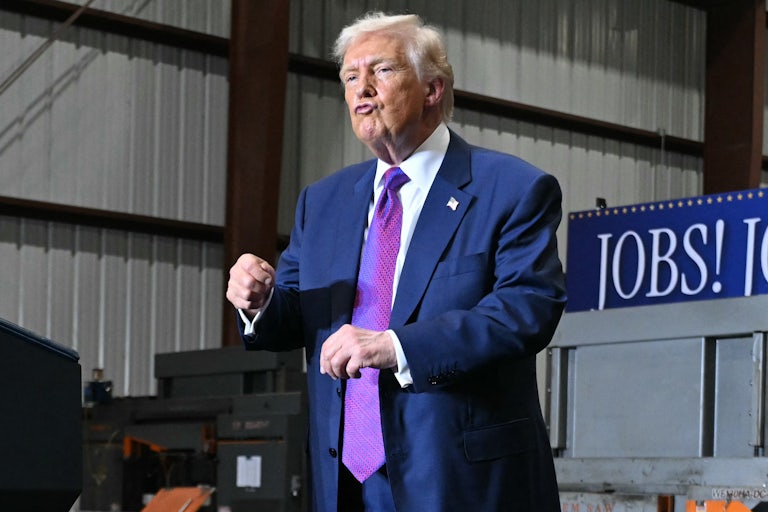
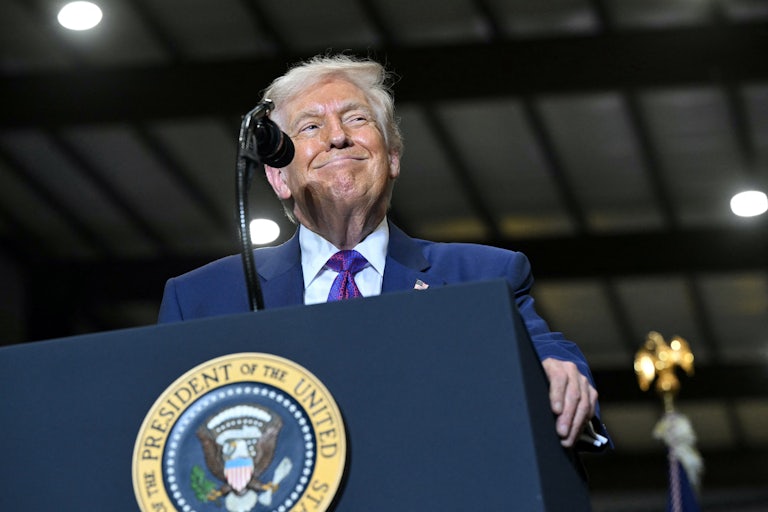
The Supreme Court ruled Friday to undo Donald Trump’s illegal Liberation Day tariffs, taking away the president’s favorite toy after he used it to hit his allies.
In the court’s 6–3 majority opinion, Chief Justice John Roberts wrote that Trump’s invocation of an emergency in order to impose tariffs under the International Emergency Economic Powers Act was a massive overreach of Congress’s authority and flew in the face of decades of precedent.
“There is no exception to the major questions doctrine for emergency statutes. Nor does the fact that tariffs implicate foreign affairs render the doctrine inapplicable. The Framers gave ‘Congress alone’ the power to impose tariffs during peacetime,” Roberts wrote. “And the foreign affairs implications of tariffs do not make it any more likely that Congress would relinquish its tariff power through vague language, or without careful limits.
“Accordingly, the President must ‘point to clear congressional authorization’ to justify his extraordinary assertion of that power,” Roberts wrote. “He cannot.”
Roberts was joined by Justices Sonia Sotomayor, Elena Kagan, Neil Gorsuch, Kentanji Brown Jackson, and Amy Coney Barrett. In his concurring opinion, Gorsuch wrote, “Whatever else might be said about Congress’s work in IEEPA, it did not clearly surrender to the President the sweeping tariff power he seeks to wield.”
Conservative Justices Clarence Thomas and Brett Kavanaugh both wrote dissenting opinions, and Justice Samuel Alito and Thomas joined Kavanaugh’s.
Trump imposed his so-called “reciprocal tariffs” in April 2025 using the International Emergency Economic Powers Act, a rule that allows the president to regulate commerce in case of a national emergency—but doesn’t actually include the word “tariff.”
The Trump administration initially claimed that the “reciprocal tariffs” were simply a tool to negotiate improved trade deals with other countries in order to promote domestic manufacturing and thwart drug trafficking.
But it quickly became clear that the deals were neither binding nor permanent. In reality, Trump’s tariffs were intended to be ever-changing, a whip to extend across the world at his whim. The results? Trump has hurt U.S. manufacturing, driven up prices, and strained relationships with U.S. allies.
Trump claimed in mid-January that should the Supreme Court rule against his tariff policy, the U.S. would be forced to “pay back … Hundreds of Billions of Dollars” in investments made by companies and countries hoping to avoid his steep tariffs.
“When these Investments are added, we are talking about Trillions of Dollars!” Trump wrote. “It would be a complete mess, and almost impossible for our country to pay.”
Trade Representative Jamieson Greer told The New York Times on January 19 that in the case of an unfavorable decision, Trump planned to simply ignore the ruling. He would impose a new set of tariffs that will “start the next day” in order “to respond to the problems the president has identified.”
This story has been updated.