Breaking News
Breaking News
from Washington and beyond

“He’s Gone”: Alex Jones Says Trump Is Done For

The once-loyal MAGA stooge is urging the Republican Party to move on.

Alex Jones gestures and speaks into reporters' microphones
Joe Buglewicz/Getty Images

Some of Donald Trump’s biggest supporters now believe he has no political future.

Alex Jones, the bankrupt host of InfoWars, claimed that Trump is “done” and too sick to remain in the Oval Office.

“When your ankles swell up three times the size they were before, that means heart failure,” Jones said on an episode of the Alex Jones Show Tuesday. “And he does look sick. He does babble and sound like the brain’s not doing too hot. And so, we just cut bait on Trump, and we just mobilize against the Democrats. And we mobilize against the neocons, we primary them, and we just fight even harder.”

Jones noted that there was a new conservative wave taking over the country that has involved a “Christian reawakening” that Trump has nothing to do with.

“Trump is just a minor figure in all of that now,” Jones said. “We need to be sad about Trump. This is not funny, this is not good, but he’s gone. And that’s it.”

Jones went on to compare Trump to his own grandfather, who Jones said was “not there” in the last year of his life due to dementia.

He also suggested that members of Trump’s Cabinet, including Defense Secretary Pete Hegseth, were “freaked out” about Trump’s health but too loyal to speak out.

“We need to pray for other people to be awakened … because we’re in so much danger,” Jones said.

The 79-year-old president has repeatedly claimed that he is in pristine condition, brushing off public alarm over his deteriorating body, but several health scares over the last several months have sparked questions over his ability to remain in office.

The large bruises on his hands—often covered with ill-matched makeup—have become a near routine fixture on the president’s aging body as they shift from hand to hand. The White House has blamed the superficial injuries on handshaking and aspirin, though doctors have suggested that the bruises could be a warning sign of something more serious.

Other symptoms of Trump’s deteriorating condition have been more concerning, such as the sagging mouth and drooping expression he sported in September during 9/11 memorial ceremonies, causing some onlookers to suggest that the president could have suffered a stroke.

The next month, Trump spent hours at Walter Reed Medical Center. The White House refused to disclose the reason, but eventually Trump let slip that he had received MRI scans, the results of which he said came back “perfect.” At least one former White House physician questioned the timeline of Trump’s appointment, pointing out that his four-hour visit to the hospital was far longer than would be required by an MRI test. Trump later revealed he might not have gotten an MRI at all, but something “less than” that.

Trump has also appeared discombobulated and lethargic during critical meetings with world leaders. Over the course of the last year, Trump has fallen asleep roughly a dozen times during critical public appearances. It has happened during Cabinet meetings, in the middle of bombastic military parades, while meeting leaders of critical allies, and even during the Pope’s funeral.
Want to Be a White House Intern? Be Ready to Answer These Questions.

The internship, clearly geared to make more Trump stooges, is unpaid.

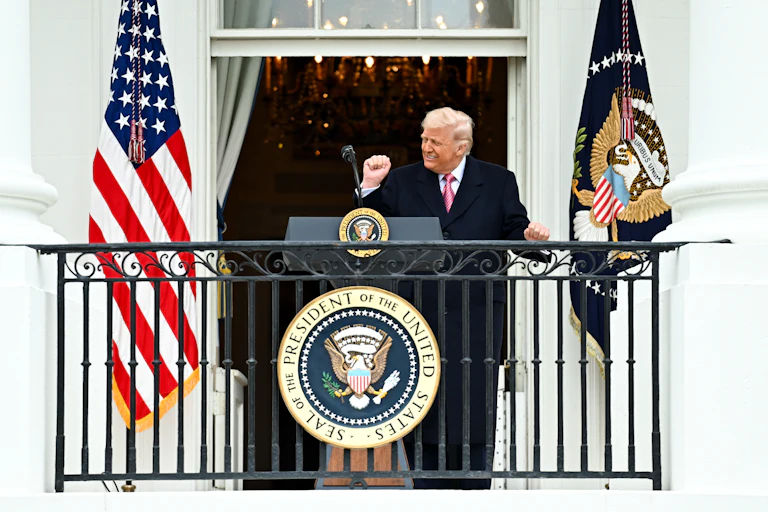
Donald Trump dances at a podium on a White House balcony
Graeme Sloan/Bloomberg/Getty Images

As the U.S. job market continues to crumble, Donald Trump’s White House is looking to hire a new batch of sycophant interns—but won’t pay them for their devotion or their time.

The White House Internship Program offers young Americans full of vim and vigor a full-time, 10- to 12-week stint working in person for one of the many offices of the White House. One need only glance at the application’s short-answer questions to get a sense of exactly who the White House is hoping to enlist.

“Describe how President Trump’s vision for the country has influenced your decision to apply to the White House Internship Program,” read one prompt.

“In your view, which current Cabinet Secretary do you most admire and believe best demonstrates effective leadership?” asked another.

Should one select the labor secretary accused of using government funds for a birthday party and having an alleged affair with her security guard, or the trigger-happy Christian nationalist waging Trump’s reckless war in Iran? Maybe one could choose the secretary of state who wants to take over Cuba in clown shoes? How about the hapless secretary of transportation, or the clueless director of intelligence? There are just too many great options! How will one ever decide?

Notably, the posting for the White House’s internship program made no mention of payment or a stipend, while during President Joe Biden’s administration, White House interns were paid a stipend of $750 per week. A June 2022 press release announcing the paid internships stated that unpaid federal internships had been a “barrier to hardworking and talented students and professionals.”

“This significant milestone of paying White House interns will help remove barriers to equal opportunity for low-income students and first-generation professionals at the beginnings of their careers and help to ensure that those who receive internships at the White House—and who will be a significant part of the leadership pipeline across the entire federal government—reflect the diversity of America,” the press release said.

The White House’s apparent move back to unpaid internships is a pretty bad look considering the fact that Trump has laid waste to the U.S. job market and decimated the federal workforce. If these kids are looking for full-time jobs, they’ll probably have to look elsewhere.

CDC Forced to Pause Rabies Testing Thanks to RFK Jr.

Mass layoffs, hiring freezes, and resignations thanks to Robert F. Kennedy Jr.’s agenda have shut down the crucial testing program.

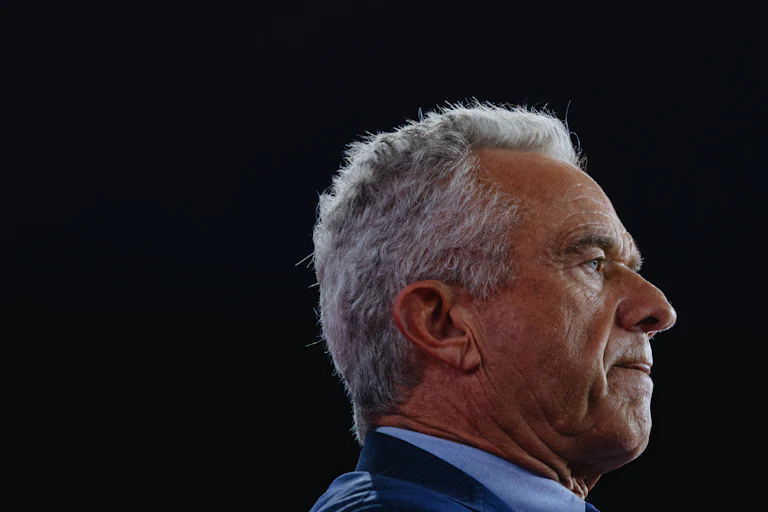
Robert F. Kennedy Jr. stands in profile
Shelby Tauber/Bloomberg/Getty Images

The Centers for Disease Control and Prevention announced Wednesday that it had suspended diagnostic testing for a slew of viruses, including for rabies and a group of pox viruses that encompasses smallpox and mpox.

The CDC has provided diagnostic testing for decades, offering federal testing services for dozens of illnesses to state and local public health laboratories that are unable to do so independently.

The agency began a review of its offered tests in 2024, but the current climate at the CDC under Robert F. Kennedy Jr.—who has hacked away at staffing and deprioritized peer-reviewed medicine—has challenged staffers’ ability to provide such assistance.

“By July, the rabies team will be down to just one person with the clinical expertise to advise state and local officials, and the pox virus team will have none,” reported The New York Times.

Other tests were discontinued entirely by the CDC as of Wednesday morning. That included testing for the parasite that causes leishmaniasis, immune response testing for measles, antibody testing for Epstein-Barr Virus (a herpesvirus known to cause cancer), and respiratory panels for SARS-2 and influenza types A and B, among others.

Public health experts expressed concern over the dwindling testing resources, especially on the cusp of major events that would bring millions of people—and foreign illnesses—to the U.S., such as the World Cup and the 2028 Los Angeles Olympics.

“In relative peacetime of no major outbreaks, no major pandemics, it’ll be fine,” Jill Taylor, the former director of the Wadsworth Center, New York state’s public health laboratory, told the Times. But “if we have an emergency all of a sudden, God help us,” she added.

Andrew Nixon, a spokesman for the Department of Health and Human Services, told the newspaper that the CDC expects some of the listed tests to become available again in the coming weeks, though he did not specify which tests would resume.

“In the meantime,” Nixon told the Times, “CDC stands ready to support our state and local partners to access the public health testing they need.”

Kennedy has almost single-handedly transformed HHS over the last year, replacing independent medical experts on the CDC’s vaccine advisory panel with a hodgepodge of vaccine skeptics. He also overhauled the child vaccination schedule without notifying his staffers, a decision that could potentially affect vaccine access and insurance coverage for millions of American families in the coming years.

He is running DHS with practically zero relevant experience. He has not worked in medicine, public health, or the government—rather, he is guided only by a pocketful of conspiracies that America’s foremost health experts have already thoroughly debunked, and his off-the-wall notions about health have thus far proved disastrous for the agency.

As a result, Americans have unilaterally lost confidence in the nation’s public health agencies since Kennedy took over, according to a survey from the Annenberg Public Policy Center of the University of Pennsylvania published last month.

Supreme Court Justices Ask Where in Constitution Trump Is Getting This

The Supreme Court doesn’t seem to be buying the Trump administration’s argument for overturning birthright citizenship.

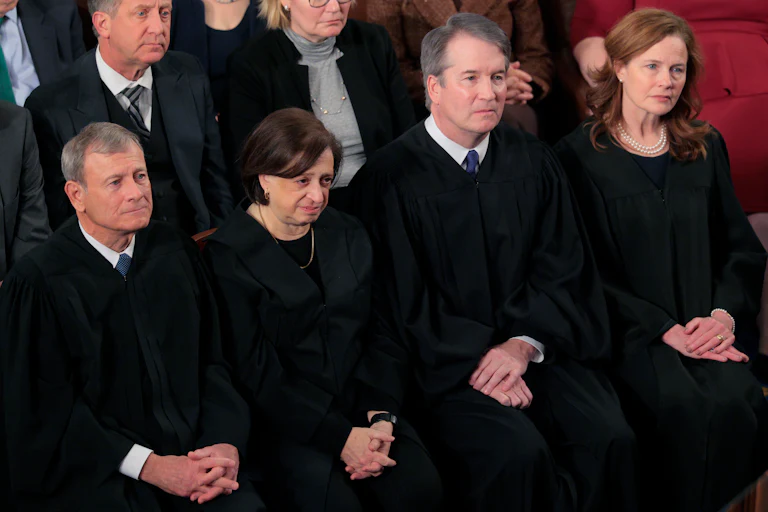
Supreme Court Chief Justices John Roberts, Elena Kagan, Brett Kavanaugh, and Amy Coney Barrett at President Trump’s State of the Union address, February 24
Graeme Sloan/Bloomberg/Getty Images
Supreme Court Chief Justices John Roberts, Elena Kagan, Brett Kavanaugh, and Amy Coney Barrett at President Trump’s State of the Union address, February 24

Donald Trump’s legal case against birthright citizenship is not being received well by conservative justices on the Supreme Court.

During oral arguments Wednesday, Solicitor General John Sauer, whose job is to defend the government in the high court’s cases, ran into resistance from Chief Justice John Roberts.

“We’re in a new world now … where 8 billion people are one plane ride away from having a child who is a U.S. citizen,” Sauer tried to argue. Roberts quickly shot that point down.

“Well, it’s a new world. It’s the same Constitution,” Roberts replied.

Later, Justice Amy Coney Barrett, appointed by Trump in 2020, pressed Sauer about an argument he made in a reply brief to the court that the Fourteenth Amendment to the Constitution, which grants citizenship to everyone born in the U.S., applies to the children of slaves brought unlawfully to the U.S. in defiance of laws against the slave trade.

“You can imagine that their parents were not only brought here in violation of United States law, but were here against their will and so maybe felt allegiance to the countries where they were from, and you say that the purpose of the Fourteenth Amendment was to put all … newly freed slaves on equal footing, and so they would be citizens,” Barrett said. “But that’s not textual, so how do you get there?”

Sauer’s response was to claim that nineteenth century antebellum law said that while bringing slaves into the country was unlawful, their presence in the country wasn’t against the law. It’s a weird argument to make considering that the Trump administration is trying to deny citizenship to the children of undocumented immigrants and those without permanent residency.

The Trump administration’s case is flimsy, and that became evident during oral arguments. In another instance, Sauer stumbled over a question from Justice Neil Gorsuch about whether the Trump administration considers Native Americans birthright citizens under the executive order in question. Trump himself seemed upset with how the arguments went, attending at first but leaving the proceedings halfway through, and then venting, incorrectly, on Truth Social that “we are the only Country in the World STUPID enough to allow ‘Birthright’ Citizenship!” Perhaps he shouldn’t have tried to directly challenge the Constitution.

Trump’s Economy Is Most Unpopular It’s Ever Been, Brutal Polls Show

Donald Trump’s approval ratings somehow continue to drop.

Donald Trump sits at his desk in the Oval Office
Brendan SMIALOWSKI/AFP/Getty Images

Donald Trump’s approval rating on the economy has hit some horrendous—and historic—new lows.

Speaking on CNN’s The Odds Wednesday, chief data analyst Harry Enten reported damning numbers for the Trump administration’s handling of the economy.

“This is no April Fools’ joke, this is a disaster. All these numbers are a disaster for President Trump,” Enten said.

Trump’s approval rating on inflation had dropped to 72 percent, according to Enten’s poll, putting him on par with Presidents Joe Biden and Jimmy Carter, two other commanders-in-chief whose terms were marred by high inflation. At about the same point in their presidencies, Biden had a 68 percent approval rating on inflation, and Carter had a 68 percent approval rating overall.

“When you have Joe Biden and Jimmy Carter on the board, and you’re matching them or slightly exceeding them, you know it’s bad,” Enten said.

CNN News Central’s John Berman pointed out that inflation had been far higher under Biden and Carter.

That may matter a little less in Trump’s case, considering the fact that the president has repeatedly claimed to have “defeated” inflation entirely. Meanwhile, the economy in Trump’s first year back in office saw rising inflation, very little GDP growth, and practically no job growth.

More than two-thirds of Americans disapproved of Trump’s handling of gas prices, as his reckless war in Iran has shuttered global energy trade through the Strait of Hormuz and sent gas prices skyrocketing to $4 per gallon within only a few weeks. Trump’s 76 percent disapproval rating dwarfed Biden’s highest all-time disapproval rating on gas prices, which was only 72 percent.

Trump’s disapproval rating on the economy was greater than the highest disapproval ratings for two-term presidents at about this time in their second terms. His disapproval rating on the economy was 69 percent, while George Bush was at 57 percent, and Barack Obama at 56 percent.

Enten called it: “The worst of all time at this point in term number two.”

Read more about Trump’s economy:

Trump Flips Out After Leaving Supreme Court Early

The Supreme Court appears skeptical of the Trump administration’s arguments on repealing birthright citizenship—and the president is pissed.

President Donald Trump departs the White House
Shawn Thew/EPA/Bloomberg/Getty Images
President Donald Trump departs the White House to head to the Supreme Court, April 1, 2026.

President Trump broadcast his anger Wednesday as the Supreme Court appeared to doubt his executive order repealing birthright citizenship.

“We are the only Country in the World STUPID enough to allow ‘Birthright’ Citizenship! President DONALD J. TRUMP,” he wrote on Truth Social shortly after oral arguments concluded.

The U.S. is of course not the only country in the world with birthright citizenship. After breaking precedent and attending oral arguments in person, Trump ended up leaving early when it began to look like the Supreme Court wouldn’t rule in his favor.

Multiple justices on the court appeared skeptical of the Department of Justice’s case. Chief Justice John Roberts, Neil Gorsuch, and Amy Coney Barrett all pushed back on Solicitor General D. John Sauer’s arguments.

At one point, Roberts expressed confusion regarding Sauer’s argument that Trump’s executive order makes sense because children of ambassadors and hostile enemies already don’t have access to birthright citizenship.

“Then you expand it to the whole class of illegal aliens who are here in the country,” Roberts said. “I’m not quite sure how you can get to that big group from such tiny and sort of idiosyncratic examples.”

The solicitor general tried to point to birther tourism as an example of how things have changed since the Fourteenth Amendment. “It’s a new world,” Sauer said.

“It’s the same Constitution,” the chief justice replied.

Trump was in the room for this exchange—and others that likely only further frustrated him after his nightmare week with the judiciary.

DOJ Lawyer Face-Plants on Native Americans and Birthright Citizenship

The Department of Justice just had a shocking exchange before the Supreme Court.

Demonstrators hold signs in support of birthright citizenship outside the Supreme Court.
Kent Nishimura/AFP/Getty Images
Demonstrators rally in support of birthright citizenship outside the Supreme Court on April 1.

The Trump administration’s lawyer, Solicitor General John Sauer, admitted before the Supreme Court Wednesday that he hadn’t thought too much about one of the big questions in President Donald Trump’s attempt to repeal birthright citizenship: What happens to Native Americans?

Supreme Court Justice Neil Gorsuch, who has carved out a niche for himself by carefully considering Indian law, asked Sauer if Native Americans today would be considered birthright citizens under the Trump administration’s test.

“I think so?” Sauer replied, clearly unsure. “I mean, obviously they’ve been granted citizenship by statute.”

“Put aside the statute; do you think they’re birthright citizens?” Gorsuch said again.

“No, I think the clear understanding that everybody agrees in the congressional debates is that the children of tribal Indians are not birthright.”

“I understand that’s what they said,” Gorsuch said. “But your test is the domicile of the parents, and that would be the test you’d have us apply today, right?”

“Yes, yes,” Sauer said.

“Are tribal Indians born today birthright citizens?” Gorsuch asked yet again.

Ah, I think so, if they were lawfully domiciled here,” Sauer replied. “I’m not sure—I have to think that through.”

“I’ll take the yes,” Gorsuch said.

The Trump administration clearly hasn’t considered the implications of the executive order Trump signed on his first day in office repealing birthright citizenship. That a DOJ lawyer can’t explain whether Native Americans would be U.S. citizens in Trump’s vision is certainly unsettling.

Trump Threatens to Leave NATO—but There’s One Big Problem

President Trump has renewed his threat to leave NATO as his Iran war doesn’t go to plan.

President Donald Trump speaks outside a plane
Roberto Schmidt/Getty Images

Donald Trump’s threat to leave NATO has one very big hurdle: approval from Congress.

The president told The Telegraph Wednesday that he is weighing an exit from the 1949 compact, saying it is “beyond reconsideration.” He later clarified to Reuters that he planned to mention his dissatisfaction with NATO countries such as France, Poland, the U.K., and others refusing to join the war in Iran during a live address to the country Wednesday night.

“I’ll be discussing my disgust with NATO,” Trump said. When Reuters asked him if he was considering withdrawing from the organization, he said: “Oh, absolutely, without question. Wouldn’t you do that if you were me?”

“They haven’t been friends when we needed them,” Trump added. “We’ve never asked them for much … it’s a one-way street.”

The U.S. joined NATO in 1949 after the Senate ratified the North Atlantic Treaty, and is considered a core founding member of the organization. The National Defense Authorization Act of 2024 made it harder for a future president to leave NATO, requiring a two-thirds Senate majority or a bill passed by both houses of Congress.

The only way Trump could unilaterally leave NATO is to invoke presidential authority over foreign policy. Republicans in Congress would then probably refrain from challenging Trump’s decision in court, possibly leading to NATO’s downfall without its most powerful member.

“I hope that amid the emotions surrounding the president of ​the United States today, a moment of calm will come,” Polish Defense Minister Władysław Kosiniak-Kamysz said Wednesday. “And why? Because there is no NATO without the United States, and it is in our interest that this calm comes. But there is ‌also no ⁠American power without NATO.”

On Thursday, Secretary of Defense Pete Hegseth declined to commit to NATO’s collective defense provision, refusing to say whether the U.S. would defend its allies if they were attacked by another country, such as Russia.

“As far ​as NATO is concerned, that’s a decision that will be left to the president. But I’ll just say a lot has been laid bare,” Hegseth said at a press conference Tuesday. “You don’t have much of an alliance if you have countries that are not willing to stand with you when you need them.”

That would seem to foreshadow doom for NATO, and further unravel America’s long-standing alliances with European countries. Trump may not realize it, but that would make the U.S. a much weaker country.

Iran Immediately Shuts Down Trump’s Ceasefire Talk Claims

Donald Trump also insisted that he wouldn’t make peace until the Strait of Hormuz was reopened.

Donald Trump gestures and speaks while sitting at his desk in the Oval Office
Aaron Schwartz/CNP/Bloomberg/Getty Images

Donald Trump’s plan for Iran is changing by the minute.

Iran’s newly installed leadership immediately refuted Trump’s claims that the country was open to a ceasefire, informing state media Wednesday morning that the idea was “false and baseless.”

Iran’s revolutionary guard issued a separate statement with regard to the Strait of Hormuz, writing that the oil passageway “is firmly and decisively under the control” of Iranian forces.

“This strait will not be opened to the enemies of this nation through the ridiculous spectacle by the president of the United States,” the revolutionary guard wrote.

The notice came moments after Trump boasted online that Iran had requested a ceasefire, which the U.S. leader insisted would not happen unless the strait opened up to trade.

“Iran’s New Regime President, much less Radicalized and far more intelligent than his predecessors, has just asked the United States of America for a CEASEFIRE!” Trump wrote Wednesday morning. “We will consider when Hormuz Strait is open, free, and clear. Until then, we are blasting Iran into oblivion or, as they say, back to the Stone Ages!!!”

It is possible that Trump’s morning remarks were in response to Iranian President Masoud Pezeshkian, who suggested Tuesday that his country had the “necessary will” to end the war but would first need guarantees that the conflict would not repeat itself. Pezeshkian is not new to his presidential role, nor is he the new Supreme Leader of Iran—that would be Mojtaba Khamenei, the son of previous Supreme Leader Ali Khamenei, who was assassinated in February by a U.S.-Israeli joint operation. The junior Khamenei is considered even more extreme, and has been described as his father “on steroids.”

The White House’s stance Wednesday was even more bewildering in light of comments that Trump had made the night before. He claimed he was entirely uninterested in the strait and was considering backing out of Iran even while the waterway remains closed, effectively delaying the conflict for a future administration.

“We will be leaving very soon, and if France or some other country wants to get oil or gas, they will go up through the strait, the Hormuz Strait, and will be able to fend for themselves,” Trump said. “But we have nothing to do with that. What happens in the strait—we aren’t going to have anything to do with it.

“There is no reason for us to do it,” he said.

Situated between Iran and the United Arab Emirates, the Strait of Hormuz is the single most important energy transit point in the world, funneling approximately one-fifth of all crude oil shipments. In 2024, the U.S. imported roughly 500,000 barrels of crude oil per day through the strait, accounting for about 7 percent of total U.S. crude imports, according to the U.S. Energy Information Administration.

The price of oil and gas has skyrocketed in the weeks since the war began. On Tuesday, gas prices eclipsed $4 a gallon across the nation, hitting Americans in their wallets.

Trump’s New Move to Target Antifa Alarms Counterterrorism Experts

President Trump is looking to suppress all resistance.

Donald Trump at his desk in the Oval Office
Brendan SMIALOWSKI/AFP/Getty Images

While the United States inflicts death on Iranian civilians and devastates Cubans with its oil blockade, President Trump is busy trying to classify antifa—a leaderless group that has become an umbrella term for any kind of anti-fascist resistance—as a counterterrorism threat. 

Puck News reported Tuesday that the administration is pushing to add the group to the National Intelligence Priorities Framework, which the intelligence community has used to prioritize its targets—and determine who to spy on—since 9/11. That framework is traditionally made up of groups like Al Qaeda, the Taliban, and ISIS. Now a vague group that even law enforcement and counterterrorism experts” have struggled to define may share equal status to them. “They’re putting antifa on the list and bumping them up in the queue in a way that doesn’t correspond to threats,” a national security official told Puck.

The vagueness seems to be the point. By painting this broad brush, they can cast anyone in their way—regardless of any kind of connection to “antifa”—as a literal domestic terrorist, opening the door to repression of the highest order.