Breaking News
Breaking News
from Washington and beyond

Trump Labor Secretary Caught Using Govt Funds for Her Birthday Party

The birthday party was “renamed” in order to avoid greater scrutiny about using public funds.

Lori Chavez-DeRemer holds onto her purse as she stands in the Capitol.
Anna Moneymaker/Getty Images
Secretary of Labor Lori Chavez-DeRemer departs after President Donald Trump’s State of the Union address at the Capitol on February 24.

Secretary of Labor Lori Chavez-DeRemer is under investigation after having been caught using taxpayer funds for personal reasons, including to throw herself a birthday party.

Last year, shortly after Chavez-DeRemer was sworn in, she and her senior staff wanted to have a birthday party at the Department of Labor’s headquarters at the Frances Perkins Building, The New York Times reports. But when staff worried about using the department’s funding, DeRemer and her staff decided to call it a swearing-in celebration.

The party went ahead with dozens of political staffers as guests, who sang “Happy Birthday” to Chavez-DeRemer, who then blew out the candles on a birthday cake. After the party, her chief of staff, Jihun Han, sent a memo to the entire department threatening “serious legal consequences” against any staffers who spoke with the press.

Weeks afterward, Chavez-DeRemer told the House Appropriations Committee, “I did not have a birthday party.” Ultimately, though, the Times obtained a photo from a party guest showing Chavez-DeRemer blowing out the candles on her birthday cake.

The party is just one glaring example of alleged misconduct by Chavez-DeRemer. She is now under investigation by the department’s inspector general, former Republican Representative Anthony D’Esposito, for misusing department funds, including to travel around the country on personal trips, and other misconduct, such as an alleged affair with someone on her security team.

Thanks to her jet-setting, the secretary herself doesn’t spend much time at the office, with Deputy Labor Secretary Keith Sonderling running the department day-to-day. Han and her deputy chief of staff, Rebecca Wright, have been placed on leave during the investigation. On top of that, Chavez-DeRemer’s husband is barred from Labor Department headquarters for allegedly sexually harassing female staffers.

When Donald Trump nominated Chavez-DeRemer for the post, she was a controversial pick for Republicans, who saw her as too pro-labor for a GOP congresswoman from Oregon, and some Democrats were cautiously optimistic. But now, it seems she fits into the endemic corruption of Trump’s White House, and should consider herself lucky her own misdeeds went unnoticed until now.
Trump’s First Administration Shut Down Investigation Into Epstein

The state of New Mexico was investigating Jeffrey Epstein’s ranch, but then the Department of Justice intervened.

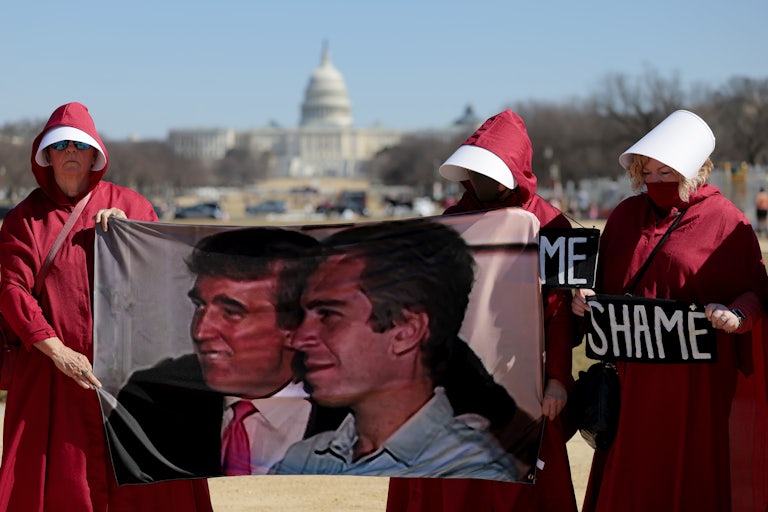
Protesters dressed as handmaids hold up a photo of Donald Trump and Jeffrey Epstein and signs that say, "SHAME" outside the White House
Heather Diehl/Getty Images

The state of New Mexico attempted to investigate Jeffrey Epstein’s state residence in 2019. Then the Trump administration got involved.

Epstein’s Zorro Ranch, located roughly 30 miles south of Santa Fe in the high desert, was rumored to be a hotbed of illicit activity. Some of the notorious child sex offender’s victims, including Virginia Giuffre, claimed they were trafficked at the New Mexico estate, and emails issued by ranch staffers allege that at least two girls were killed and buried under the building by Epstein’s order, according to documents made public by the Justice Department via the Epstein files. Epstein even contemplated turning the estate, which he purchased in 1993, into a headquarters for genetic engineering experiments.

Yet somehow, the property—dubbed “Playboy Ranch” among locals—has never properly been investigated, according to New Mexico officials.

A report by The New York Times, published Monday, revealed that state officials had every intention to do so—until the first Trump administration intervened in 2019. The government ordered New Mexico to turn over its probe to federal prosecutors, but then they closed the case, according to recently unsealed records obtained by the Times.

Last month, New Mexico lawmakers voted unanimously to pursue another investigation into Zorro Ranch, creating a bipartisan “truth commission” to examine the site’s history. New Mexico Attorney General Raúl Torrez also ordered his office to reopen the criminal investigation into Zorro Ranch, demanding “immediate access to the complete, unredacted federal case file.”

“We need to find out how he was able to operate without any accountability,” Andrea Romero, the leader of the truth commission, told the Times. “We have to understand what allowed this to happen.”

The sequence of events isn’t too dissimilar to what occurred between FBI agents and New York detectives in the immediate aftermath of Epstein’s death. Five days after the sex trafficker was arrested at a New Jersey airport in July 2019, the FBI “directed” New York law enforcement to cease its Epstein investigations, including the Manhattan District Attorney’s Office and the NYPD’s Special Victims Unit, according to FBI emails recently released by the Justice Department as part of the congressionally mandated disclosure of the federal government’s Epstein investigation.

That directive was allegedly an attempt to prevent “competing cases” and quell internal anxieties that the public—and the FBI’s international partners in the U.K.—would be mixed up by news reports of multiple investigations from different agencies. But as evidenced by New Mexico’s Zorro Ranch predicament, not every lead was fully inspected by Donald Trump’s first administration.

“Let’s Just Do It”: How Netanyahu Convinced Trump to Bomb Iran

Here’s the real reason Donald Trump went to war with Iran.

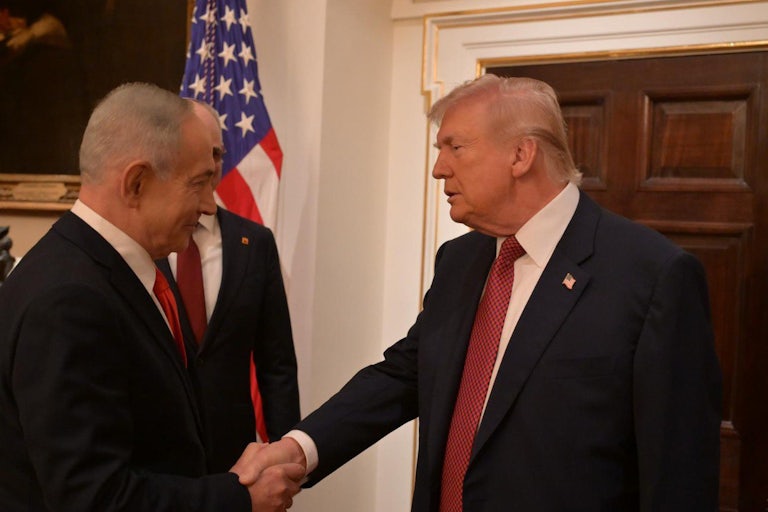
Donald Trump and Israeli Prime Minister Benjamin Netanyahu shake hands at the White House
Avi Ohayon/GPO/Anadolu/Getty Images

In contrast to President Donald Trump’s vacillating rationale, it appears the United States did not go to war with Iran to wipe out its nonexistent nuclear program, respond to a nonsensical threat to American elections, or implement a poorly conceived regime change.

We did it because Israel asked us to.

In retracing Trump’s unilateral (and illegal) decision to go to war, it’s clear that Israeli Prime Minister Benjamin Netanyahu spent months lobbying the White House, and Trump’s aides did little to dissuade the president from joining in on the attack, The New York Times reported Monday.

Netanyahu knows a lot about illegal wars. The Israeli military’s American-backed genocide in Gaza has claimed the lives of more than 70,000 Palestinians. Now the two superpowers have launched a new campaign that has already killed more than 550 people in Iran, including dozens of school-age girls.

Discussion about a military strike on Iran began in December, when Netanyahu visited the president’s residence at Mar-a-Lago. Netanuyahu asked Trump’s permission to launch strikes on Iran’s missile sites in the coming months.

In January, Trump threatened to strike Iran in order to stop the government’s massacre of protesters, promising that help was “on the way!” But Netanyahu reached out to Trump asking him to delay the strike until the end of the month. He argued that the U.S. wasn’t ready to go to war, and Trump agreed.

As January crept on, Netanyahu kept regular contact with the White House, including Trump, Vice President JD Vance, Secretary of State Marco Rubio, and special envoy Steve Witkoff. Eventually, the U.S. military presented an expansive list of options for military action.

Netanyahu visited Trump again on February 11, as the U.S. was set to resume negotiations over Iran’s nuclear program. But the prime minister was there to ensure the president was ready to go to war, the Times reported.

There was little pushback among White House officials.

During a meeting in the situation room on February 18, Vance—who had previously spoken against U.S. intervention—said that if the U.S. did launch a military campaign in Iran, it should “go big and go fast,” people familiar with his remarks told the Times. The same day, Israel raised its alert level, indicating that a joint attack was imminent.

In that same meeting, Gen. Dan Caine, chairman of the Joint Chiefs of Staff, warned that a larger effort to topple the regime could lead to significant American casualties, an argument that was widely circulated to the press. Trump claimed that reports of Caine’s reluctance were “100 percent incorrect.”

Diplomacy, it seems, was never really an option. Negotiations spearheaded by Witkoff and Jared Kushner presented a kind of ruse to give Trump time to oversee a massive military buildup in the Middle East.

Speaking to Times Sunday, Trump said, “Toward the end of the negotiation, I realized that these guys weren’t going to get there. I said, ‘Let’s just do it.’”

After the U.S. and Israel launched their initial volley of strikes that killed Ayatollah Ali Khamenei, Iran’s supreme leader, Netanyahu gushed that Trump had helped him realize his dream: “This coalition of forces allows us to do what I have yearned to do for 40 years,” he said.

DOJ Misspells Voters, Emergency, and United States in New Filing

The Department of Justice is getting increasingly sloppy with its actions in court.

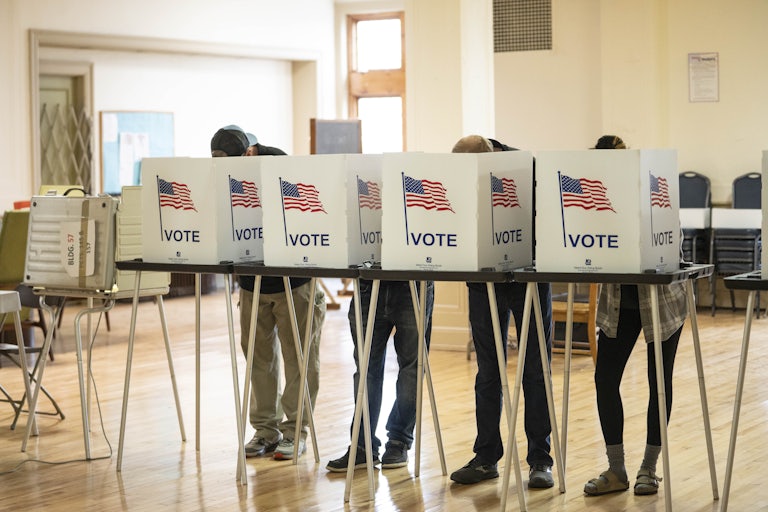
Detroit voters at the polls inside Central United Methodist Church on November 5, 2024.
Sarah Rice/Getty Images

The Justice Department filed an emergency motion to the 6th District Court that was rife with basic spelling errors, including spelling voters as “votors,” United States as “United Staes,” and emergency as “emeregency.”

The DOJ filed an emergency appeal Friday after a Michigan judge refused to force the state of Michigan to hand over access to sensitive voting records that includes each voter’s date of birth, address, and more. The DOJ has now sued 30 states seeking access to voter rolls.

This isn’t the first time the DOJ has displayed basic incompetence in court. Last April, DOJ lawyers misspelled United States  in their case against the wrongly deported Kilmar Abrego Garcia. In October, former prosecutor Lindsey Halligan listed New York Attorney General Letitia James’s address as “Brooklyn, New Jersey” instead of New York in a court filing. And just last week, the DOJ sued New Jersey Governor Mikie Sherrill, but misspelled her name over and over again.

“These are the people who want access to your voting records and who my team fights in court every day,” Democracy Docket’s Marc E. Elias wrote.

Trump Now Has a Giant, Crusty Rash on His Neck

Donald Trump’s mysterious bruise is spreading—and getting worse.

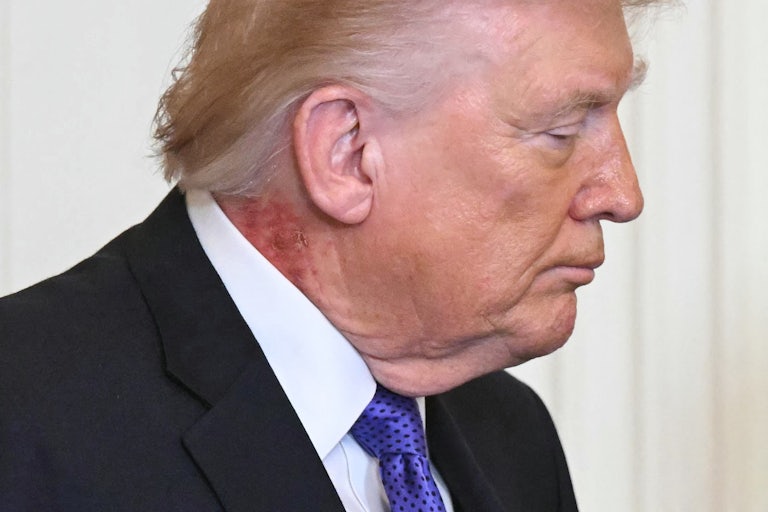
Donald Trump looks to the side. A mysterious, scabbed rash is visible on the side of his neck.
SAUL LOEB/AFP/Getty Images

President Donald Trump appeared to have a large red rash on the back of his neck Monday.

While speaking at the White House about his illegal war with Iran, Trump was spotted with a dark red patch of skin peeking out from under his collar. In a photograph taken by AFP photographer Saul Loeb, a large scab is visible.

It wasn’t immediately clear what caused the red mark. Possible causes of a red rash could include contact or atopic dermatitisalso known as eczema—psoriasis, or heat rash. It could also be caused by shingles.

A statement from Captain Sean Barbarella, a Navy emergency physician serving as the president’s doctor, claimed that Trump was using a “very common cream on the right side of his neck, which is a preventative skin treatment prescribed by the White House doctor.”

“The president is using this treatment for one week, and the redness is expected to last for a few weeks,” he said.

Trump’s right hand also appeared discolored in another photograph by Loeb.

Screenshot of a tweet
Screenshot

Since July, Trump has been repeatedly spotted with a large bruise on the back of his right hand—except for a few instances when it inexplicably switched to his left hand. The president has gotten good at hiding it from the public—either with makeup or careful hand placement—but the 79-year-old president can’t hide everything, and cameras don’t lie.

The White House has claimed that his seemingly permanent injuries are the result of Trump shaking too many hands and taking too much aspirin. But doctors have theorized that the president’s discolored hands could be a sign of something much worse.

Now it seems the president is suffering from yet another physical ailment.

This story has been updated.

Trump Brags About Gold Drapes While Discussing Iran War Plans

This is the man we’re supposed to trust with another U.S. war in the Middle East?

Donald Trump looks up and points at the drapes next to him, while standing at the presidential podium in the White House.
SAUL LOEB/AFP/Getty Images
President Donald Trump speaks during a Medal of Honor ceremony in the East Room of the White House on March 2.

President Donald Trump began raving about curtains and his new ballroom while talking about his war plans for Iran on Monday.

At a ceremony to award the Congressional Medal of Honor to three U.S. military service members, Trump discussed how his attacks on Iran are going, saying that he doesn’t “get bored.” But then the president quickly went off topic to talk about the curtains and his ballroom project in the White House, making it the second time in one day he’s pivoted from Iran to renovations.

“See that nice drape? When that comes down right now you see a very, very deep hole, but in about a year and half from now, you’re gonna see a very, very beautiful building. And there’s your entrance to it right there,” Trump said, pointing to gold curtains behind him. “In fact, I think I’ll even, I’ll save money on the doors because you can’t get more beautiful than that. I picked those drapes in my first term. I always liked gold, but I think we can save a lot of money. I just saved, I just saved curtains.

“It’ll be spectacular, it’ll be the most beautiful ballroom. I believe it’s because I’ve built many a ballroom. I believe it’s going to be the most beautiful ballroom anywhere in the world,” Trump said, before going on to rant about how his wife, Melania, doesn’t like the construction.

It’s clear that Trump doesn’t take his job seriously, even after countless Iranian civilians and at least three U.S. service members have been killed in this war he decided to start, with many more likely to follow. Somehow, he still is devoting a ton of attention and energy to the pointless ballroom that he demolished the White House’s East Wing to build. Meanwhile, there appears to be no plan for what to do with Iran after killing its leader, Ayatollah Khamenei, and no clear end to the war in sight. But hey, at least we’re getting a nice questionably funded ballroom, right?

Trump Accidentally Reveals His Iran War Wasn’t Necessary

Donald Trump claimed Iran was building nuclear weapons, but he fell short of proving the U.S. was actually under threat.

Donald Trump stands during a Medal of Honor ceremony at the White House
Kyle Mazza/Anadolu/Getty Images

Iran had to be attacked because the U.S. was “very nearly under threat” by its advanced weapons systems, according to the president.

Addressing the war for the first time during a Medal of Honor ceremony on Monday, Donald Trump claimed that Iran’s “pursuit of nuclear weapons” posed an immediate threat to the American public—even though he declared last year that his June attacks on Iran’s nuclear facilities had “completely and totally obliterated” the country’s nuclear program.

“The United States military continues to carry out large-scale combat operations in Iran to eliminate the grave threats posed to America by this terrible, terrorist regime,” Trump said Monday.

“In addition, the regime’s conventional ballistic missile program was growing rapidly and dramatically, and this posed a very clear, colossal threat to America and our forces stationed overseas. The regime already had missiles capable of hitting Europe and our bases, both local and overseas, and would soon have had missiles capable of reaching our beautiful America.

“An Iranian regime armed with long-range missiles and nuclear weapons would be an intolerable threat to the Middle East, but also to the American people,” Trump continued. “Our country itself would be under threat, and it was very nearly under threat.”

So far, four American soldiers have been killed in the conflict, as have more than 20 Iranian officials, including Supreme Leader Ayatollah Ali Khamenei.

Trump has yet to formally speak to the American people about the war—a major departure from his predecessors, who almost universally recognized the need to justify the need for military intervention with an immediate speech to the public. Woodrow Wilson did so the same day he asked Congress to declare war against Germany during World War I, while Franklin D. Roosevelt gave a national address hours before the country declared war during World War II.

Even Harry Truman, who proceeded with the Korean War without the authorization of Congress—much like Trump—delivered a radio address to the American public shortly after he ordered U.S. air and naval forces to assist South Korea.

The current Middle East mobilization is the Trump administration’s second attempt to destroy Iran’s nuclear program, which the White House has claimed is for weapons development. The first attack took place on June 22.

At the time, Trump celebrated that the strike had eviscerated Iran’s nuclear program, publicly rejecting a battle damage assessment by the Pentagon that determined that the impact of the missile barrage on the larger program was minimal and had only set Iran’s nuclear program back by a few months. The White House has thus far failed to explain the discrepancy, or why it needs to spend more taxpayer funds attacking a site that purportedly has already been demolished.

Before the June attack, Iran had argued that it was seeking uranium for peaceful purposes, such as expanding its nuclear energy program. The nation has undergone years of nuclear site inspections by the International Atomic Energy Agency, and mere weeks before the U.S. bomb strike had allowed the agency’s inspectors to remain in the country, according to the U.N. entity.

Trump scrapped a potential nuclear deal with Iran during his first term, pulling out of the Joint Comprehensive Plan of Action in May 2018.

Trump Warns “The Big One” Is Still Coming for Iran

Donald Trump is ready to make it a whole lot worse for Iran.

Donald Trump raises his fist while standing outside
Mandel NGAN/AFP/Getty Images

President Donald Trump is warning that “the big one” is still coming for Iran.

CNN’s Jake Tapper on Monday recounted a nine-minute phone call with Trump, including a chilling message from the president for the people of Iran.

“Right now we want everyone staying inside, it’s not safe out there,” Tapper quoted Trump as saying. “And then the president said, ‘It’s about to get even less safe.’”

“We haven’t even started hitting them hard. The big wave hasn’t even happened. The big one is coming soon,” Tapper quoted Trump as saying.

Trump’s statement indicates that he intends to escalate the conflict, not de-escalate, and suggests he intends to do so without congressional authorization, let alone any semblance of popular support.

Tapper’s reporting comes as U.S. officials announced that their illegal war in Iran was only in its nascent stage, having already claimed the lives of more than 550 people, including dozens of school-age girls.

U.S. Central Command confirmed Monday that a fourth U.S. service member died due to injuries sustained in the operation. In a prerecorded video posted Sunday about three U.S. soldiers killed in the attack, Trump said, “Sadly, there will likely be more before it ends. That’s the way it is.”

Speaking to Tapper, Trump reportedly posed yet another made-up timeline for the military campaign: four weeks. But the U.S. was already ahead of schedule, he claimed.

Defense Secretary Pete Hegseth bragged Monday that the United States and Israel would not be bound by the rules of engagement, and did not comment on how long the campaign would last.

Trump Reveals His Inspiration for Iran Bombing Campaign

President Trump says he wants to do exactly what he did in Venezuela.

Donald Trump speaks at his State of the Union address
Kenny Holston/Pool/Getty Images

President Trump wants to use his kidnapping of Venezuelan President Nicolás Maduro as a template for his current plan for regime change in Iran.

Fox News’s Brett Baier reported this development after speaking with the president on Monday morning.

“He said there is a plan. He points to Venezuela as a template,” Baier said. “Which means to me that, going in, they had some sense on the ground of what was coming next.”

These situations are already quite different, with the U.S. and Israeli bombing campaign in Iran having continued for more than 48 hours. And Venezuela didn’t strike back. Moreover, the only semblance of a plan in Venezuela has been a plug-and-play regime change, the success of which has yet to be determined. And what happened to “freeing” Iranians?

“This makes no sense. It is actually insane. Did we bomb Venezuela for days? Weeks? What parts of the Iranian dictatorship does he plan on keeping in control of Iran—as per the Venezuela template??? Let me repeat: Insane,” one X user commented.

Another massive difference here is that Maduro’s government was left largely intact in Venezuela, in the hands of second-in-command Delcy Rodríguez.

“So the plan is: Regime change, by keeping regime in place. Admin told Trump this won’t work in Iran given 3 pronged regime: religious, military & administrative. Killing Supreme Leader to just replace him with tougher hardliner won’t work,” wrote another X user. “One size fits all isn’t a policy. It leads to quagmires.”

“Begs the question: Who is the Delcy Rodríguez of Iran and are they still alive?” MSNOW’s Jesse Rodriguez posited. Probably not.

“The attack was so successful it knocked out most of the candidates,” Trump said to ABC News’s Jonathan Karl on Sunday. “It’s not going to be anybody that we were thinking of because they are all dead. Second or third place is dead.”

DOD Panics That Iran War Will Use up All U.S. Air Defense Supplies

Pentagon officials are worried about the operation lasting “more than a few days.”

Defense Secretary Pete Hegseth frowns and gestures with both hands while speaking at a podium
Alex Wong/Getty Images

Attacking Iran has severely diminished America’s air defense supplies, a predictable outcome that has Pentagon officials panicking mere days into the conflict.

Donald Trump declared war on Iran without congressional approval early Saturday. He has so far failed to provide a timeline—or clear reason—for U.S. involvement, stressing military leadership in the process.

“The mood here is intense and paranoid,” one person familiar with the situation told The Washington Post Monday.

In the weeks leading up to the explosive hostilities, Trump’s top military adviser—Joint Chiefs Chairman General Dan Caine—warned the White House against such an attack, arguing that it could entangle America in a prolonged conflict.

“There is concern about this lasting more than a few days,” another source told the Post, adding that it often takes several air defense interceptors to stop an incoming missile. “I don’t think people have fully absorbed yet, like, what that has done with stockpiles.”

Representative Adam Smith, the House Armed Services Committee’s ranking member, warned that the war would only serve to further strain U.S. munitions supplies.

“At this point, it’s on. It’s not like we can say: ‘Hey, Iran, we’re out of missile defense systems now so we’re going to pause for a moment. Is that OK?’ It will stretch our ability to defend everything that we need to defend,” Smith told the Post, describing the American resources as “stretched thin.”

Despite his criticism of the offensive, Caine acquiesced to the president’s whims. Over the last month, he assembled the largest military presence in the Middle East since the U.S. invasion of Iraq in 2003, a hardware collection across a web of U.S. bases that includes numerous ships—including naval destroyers and aircraft carriers—and more than a dozen jets in the region, reported CNN.

So far, four American soldiers have been killed in the conflict, as have more than 20 Iranian officials, including Supreme Leader Ayatollah Ali Khamenei.

The current mobilization is the Trump administration’s second attempt to destroy Iran’s nuclear program, which the White House has claimed is for weapons development. The first attack took place on June 22.

At the time, Trump celebrated that the strike had “completely and totally obliterated” Iran’s three nuclear sites, publicly rejecting a battle damage assessment by the Pentagon that determined that the impact of the missile barrage on the larger program was minimal and had only set Iran’s nuclear program back by a few months.

The White House has thus far failed to explain the discrepancy, or why it needs to spend more taxpayer funds attacking a site that has already been eviscerated. In fact, as of Monday morning, Trump still has yet to address the American people regarding the war—a major departure from his predecessors, who immediately recognized the need to justify the case for military intervention.

Before the June attack, Iran had argued that it was seeking uranium for peaceful purposes, such as expanding its nuclear energy program. The nation has undergone years of nuclear site inspections by the International Atomic Energy Agency, and mere weeks before the U.S. bomb strike had allowed the agency’s inspectors to remain in the country, according to the U.N. entity.

Trump scrapped a potential nuclear deal with Iran during his first term, pulling out of the Joint Comprehensive Plan of Action in May 2018.

Fewer than one in three Americans trust Trump a “great deal or quite a bit” to make good decisions with America’s military, according to an Associated Press-NORC Center for Public Affairs Research poll published Thursday. Just 27 percent said so, while 56 percent of respondents said they trust the president “only a little or not at all.”