Breaking News
Breaking News
from Washington and beyond

Karoline Leavitt Lashes Out Over Question on Trump’s Morality

Reporters asked how Donald Trump could claim the moral high ground after threatening to wipe out Iran’s “whole civilization.”

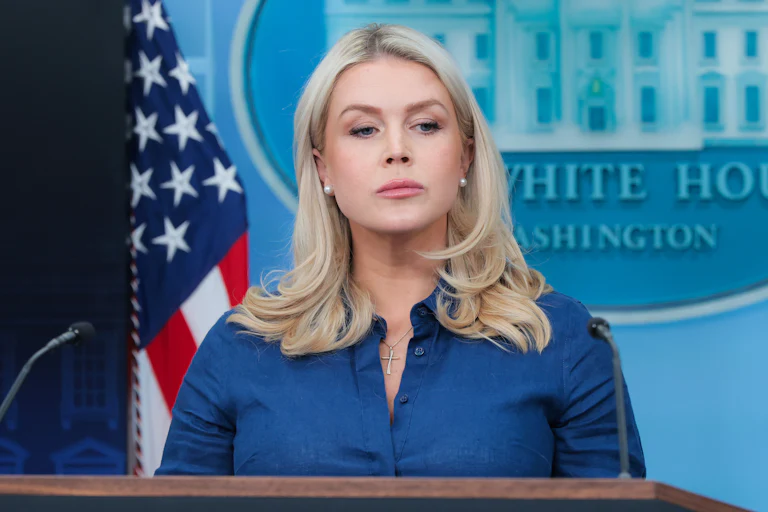
Press secretary Karoline Leavitt speaks at a podium during a White House press briefing
Heather Diehl/Getty Images

White House press secretary Karoline Leavitt threw one of her patented tantrums Wednesday in her first appearance since Donald Trump’s deranged threat to wipe out Iran’s “whole civilization” if it did not agree to his terms.

Andrew Feinberg, a journalist with The Independent, asked Leavitt how Trump could claim the U.S. was fighting a just war after such extreme rhetoric.

“When the U.S. invaded Iraq in 2003, George W. Bush said in a message to the Iraqi people that the military campaign was directed ‘against the lawless men who rule your country and not against you,’” Feinberg said. “Yesterday, the president threatened to destroy Iran’s civilization.… Not the Iranian government, but the Iranian civilization. The Iranian people. The U.S. has been a moral leader for most of its history by fighting wars against other governments, not against civilizations. How can the president claim that America can ever have the moral high ground if he’s threatening to destroy civilizations?”

Leavitt shot back, using all the jingoism she could muster: “Andrew, I think you should take a look at the actions of this president over the course of the past six weeks, and the actions of the brave men and women in the United States military.… The president absolutely has the moral high ground over the Iranian terrorist regime, and for you to even suggest otherwise is frankly insulting.”

Leavitt then called on a different reporter over Feinberg’s protestations. Feinberg could be heard saying, “With all due respect, Karoline …” a handful of times before giving up, as it became clear that Leavitt wasn’t going to let him speak again.

Leavitt received a similar question later in the conference when a reporter asked what her understanding of Trump’s “a whole civilization will die tonight” post was.

“I think it was a very, very strong threat from the president that led the Iranian regime to cave to their knees and ask for a ceasefire and agree to reopening the Strait of Hormuz,” Leavitt replied.

“It was a very strong threat that led to results. And as the secretary of war stated at the Pentagon this morning, it was not an empty threat by any means. The Pentagon had a target list that they were ready to hit go on at 8 p.m. last night, if the Iranian regime had not agreed to open the Strait, which they did. I think that’s something we should all be grateful for.”

“Does he see the United States as a moral leader in the world given that he’s—” the reporter pressed before Leavitt cut her off.

“I was asked this exact same question by your colleague … and I think again, the insinuation by anyone in this room that Iran somehow has the moral high ground over the United States of America is insulting,” Leavitt said.

In addition to Leavitt misrepresenting some facts here—the Strait of Hormuz is again closed after Israel attacked Lebanon Wednesday morning, per Iranian reporting—the fact that the White House is actually praising the president’s threat to exterminate an entire nation is as cruel as it gets. But would you expect anything less from such a bloodthirsty regime?
Bombshell Report Reveals Trump Was Begging for Iran to Join Ceasefire

This contradicts everything the president has said about the war.

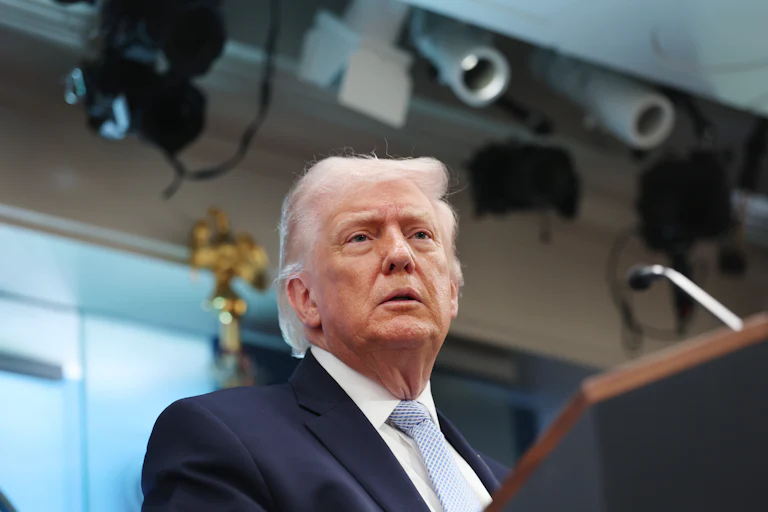
President Donald Trump
Anna Moneymaker/Getty Images

Recent reporting from the Financial Times reveals it was President Trump, not the Iranian government, who was begging for a ceasefire.

FT reports that the Trump administration had been privately pushing for a ceasefire for weeks to alleviate the economic strain caused by Iran’s control of the Strait of Hormuz, and depending on Pakistan for mediation. Pakistani Army Chief Asim Munir was communicating with Iranian officials, special envoy Steve Witkoff, Vice President JD Vance, and Trump himself even after the president threatened to wipe out Iranian civilization on Tuesday.

According to the five people familiar with the diplomatic back channel, Trump had been asking for a ceasefire since as early as March 21, when he first threatened to bomb Iran’s power plants.

This contradicts virtually everything the Trump administration has claimed about Iran—that Trump’s constant bombings and threats of extinction caused a wounded, demoralized Iranian regime to limp to the negotiating table, desperate for a deal with the U.S.

“They are begging to make a deal, not me. They’re begging to make a deal,” Trump said less than two weeks ago. “And anybody that saw what was happening over there would understand why they wanna make a deal.… They are begging to work out a deal.”

Peace talks between the U.S. and Iran are expected to take place in Islamabad on Friday, although the speaker of Iran’s parliament has claimed the U.S and Israel have already broken the parameters of the already fragile ceasefire.

The Weirdest Detail in Iran’s Ceasefire Agreement

You won’t believe how Iran wants tolls on the Strait of Hormuz to be paid.

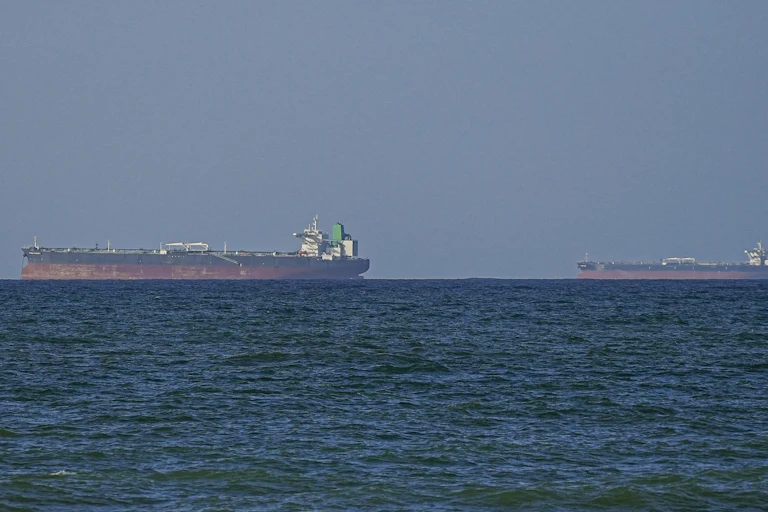
Vessels in the Strait of Hormuz
Shadi J. H. Alassar/Anadolu/Getty Images
Vessels in the Strait of Hormuz

Iran expects to make even more money off of a potential peace deal with the White House.

Beyond the 10-point peace plan that Donald Trump already signaled he was open to, Iran additionally expects countries to pay $1 per barrel of oil that passes through the Strait of Hormuz, reported the Financial Times Wednesday. Tehran demanded that the fee be paid in cryptocurrency, and that importers notify Iranian authorities about the content of their ships ahead of their arrival.

“Once the email arrives and Iran completes its assessment, vessels are given a few seconds to pay in bitcoin, ensuring they can’t be traced or confiscated due to sanctions,” Hamid Hosseini, a spokesperson for Iran’s Oil, Gas and Petrochemical Products Exporters’ Union, told FT.

The email requirement is a preventative measure to thwart the influx of weapons into the country, according to Hosseini.

“Iran needs to monitor what goes in and out of the strait to ensure these two weeks aren’t used for transferring weapons,” said Hosseini. “Everything can pass through, but the procedure will take time for each vessel, and Iran is not in a rush.”

But Iran is no stranger to cryptocurrency. The country has built a $10 billion internal crypto economy in recent years, relying on the digital assets as a means to circumvent international sanctions, according to a Yahoo! Finance report published last month.

The price of Brent crude, a global oil benchmark, fell to $96 dollars per barrel in the wake of the fragile ceasefire arrangement, a staggering drop from its high of nearly $112 on Tuesday.

Iran’s 10-point peace plan includes various demands for an immediate end to the regional violence, including proposals for a permanent end to the war, guarantees that Iran and its allies would not be attacked again, an end to Israeli strikes on Hezbollah in Lebanon, and a halt to all regional attacks.

The multipoint deal also seeks the lifting of all U.S. and international sanctions on Iran, and the imposition of a new $2 million toll per ship through the Strait of Hormuz, a vital oil tradeway situated between Iran and Oman.

Trump claimed Wednesday that he planned to turn the Hormuz toll into a “joint venture” that the U.S. would jointly benefit from. It is not clear if Iran is open to that possibility.

Meanwhile, a senior Iranian official told Reuters that the strait could be reopened as soon as Thursday or Friday—so long as it is “limited” and “under ‌Iran’s ⁠control.”

Netanyahu Declares Ceasefire Is “Not the End” as Iran War Spirals

Israeli Prime Minister Benjamin Netanyahu is destroying Trump’s ceasefire deal—and he’s proud of it.

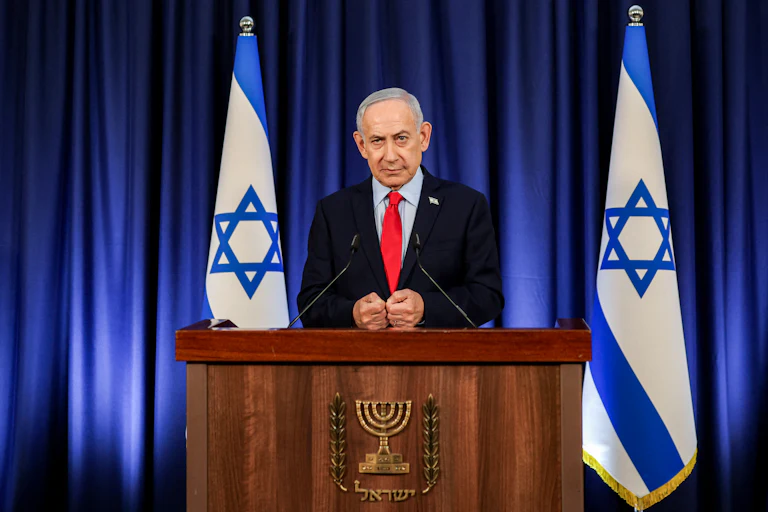
Israeli Prime Minister Benjamin Netanyahu
Ronen Zvulun/POOL/AFP/Getty Images

Israeli Prime Minister Benjamin Netanyahu declared Wednesday that the U.S.-Iran ceasefire agreement is “not the end of the campaign,” as he launched the largest wave of attacks in Lebanon since the start of the war.

“Let me be clear: We still have objectives to complete, and we will achieve them—either through agreement or through renewed fighting,” Netanyahu said in a televised statement. “We are prepared to return to combat at any moment required. Our finger remains on the trigger. This is not the end of the campaign, but a step along the way to achieving all our objectives.”

His statement is sure to assuage the fears of warmongers complaining that the ceasefire will prevent the U.S. from killing more innocent Iranians.

This comes amid Iranian media reports of Iranian air defense activity and explosions in Tehran, Isfahan, and Kerman. Israel also launched an unprecedented wave of attacks in Lebanon, with 100 airstrikes in 10 minutes, injuring nearly 300 people.

“The conditions for a ceasefire between Iran and the United States are clear and explicit: America must choose either a ceasefire or the continuation of war through Israel; both cannot coexist,” Iranian Foreign Minister Abbas Araghchi wrote on Telegram. “The world is witnessing the killings in Lebanon. Now the ball is in America’s court, and global public opinion is watching to see whether this country will fulfill its commitments or not.”

White House Can’t Explain Who Exactly Is Bombing Iran After Ceasefire

Does Trump even care about this ceasefire holding?

White House press secretary Karoline Leavitt
Anna Moneymaker/Getty Images

The White House didn’t have an answer Wednesday to apparent violations of the ceasefire between the U.S. and Iran.

At a press conference, Trevor Hunnicutt, White House correspondent for Reuters, pointed out to White House press secretary Karoline Leavitt that air defenses in Iran had been activated, with explosions reported in cities across the country, including Isfahan, despite the ceasefire.

“Who is bombing Iran right now?” Hunnicutt asked Leavitt. Caught off guard, she initially stumbled before responding, asking if those reports were “as of a few minutes ago.” Hunnicutt said yes.

“Obviously, I’ll have to go back and check with the national security team. I’m standing out here with all of you. But I will do that, and we will get you an answer, OK?” Leavitt said, adding that while she couldn’t verify those reports, she wanted to check with the experts in the White House.

“I would just say, and I would echo what the vice president said this morning, this is a fragile truce; ceasefires are fragile by nature. We’ve seen this with respect to the 12-day war with Iran and Israel last year,” Leavitt continued, referring to JD Vance’s comments in Hungary earlier in the day. “It takes time sometimes for these ceasefires to be fully effectuated, and one of the results of Operation Epic Fury is that we completely dismantled Iran’s command and control center, which makes it difficult for them to pass messages up and down the chain, and so we understand that.”

But Hunnicut wasn’t asking about Iranian strikes, but rather bombings in Iran, making Leavitt’s point about the Iranian chain of command moot. Israeli and American commanders certainly shouldn’t have communication issues, and the fact that Iran is still being bombed despite a ceasefire raises questions about who is violating it.

Israel continued to bomb Lebanon Wednesday, claiming that the country was not part of the deal (eventually with Trump’s acquiescence) despite Iran and mediator Pakistan saying otherwise. Is Israel still attacking Iran despite the deal, or is Trump promising one thing while doing another?