Breaking News
Breaking News
from Washington and beyond

Core Inflation Rate Jumps to Its Highest in Years Thanks to Iran War

Republicans just got some terrible inflation news ahead of the midterms.

Grocery cart with potatoes, cream cheese, carrots, and more
Soeren Stache/picture alliance/Getty Images

Inflation is at its highest level in three years thanks to President Trump.

Prices are up 3.5 percent compared to last year, the biggest year-to-year increase in three years, the Commerce Department said Thursday. Much of this is attributable to gas prices due to the war in Iran. But even with fuel and food subtracted, inflation is still up by 3.2 percent, above the Federal Reserve’s 2 percent target.

The rising prices outweigh the modest 0.6 percent gain in U.S. workers’ incomes, the department’s report said. Any tax refunds that Americans receive are also being blunted by higher gas and food prices.

Federal Reserve Chair Jerome Powell said Wednesday that cuts to interest rates are unlikely to happen for months due to the war. In contrast, last year, the Fed cut rates three times. Usually, the central bank prefers to keep rates unchanged, or it raises them to combat inflation.

All of this doesn’t bode well for the party in power. Trump and the GOP campaigned in 2024 on lower prices and against high inflation, but thanks to a war of choice and the president’s whimsical tariffs, the economic gains created by President Biden have been wiped out. Many voters who thought otherwise are now starting to open their eyes, and Republicans’ only hope might be blatant attempts to choose their own voters.
Trump’s Sinister Plan for State’ Voter Rolls Exposed

Administration officials allegedly sought to weaponize voter data to influence elections.

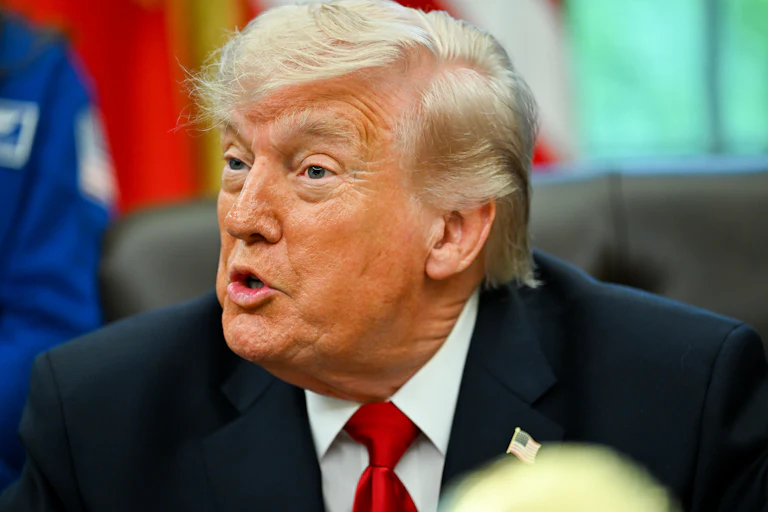
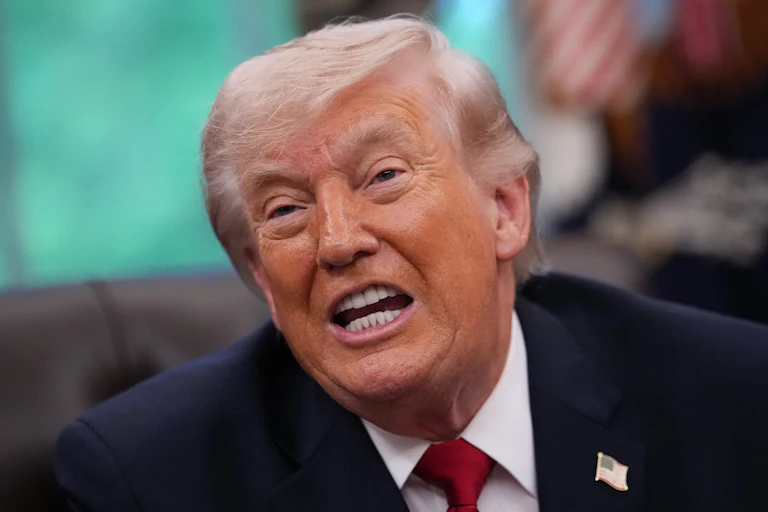
Donald Trump speaks while sitting at his desk in the Oval Office
Andrew Harnik/Getty Images

Trump administration officials arranged to share sensitive voter information with an outside group keen on undermining America’s electoral process.

Documents first obtained by advocacy nonprofit Democracy Forward via public records requests reveal correspondence between DOGE personnel and a key organization that fueled the 2020 election conspiracy, detailing how voter data would be transferred between the two entities.

The documents offer a clear trail of Trump administration officials working to share sensitive voter data with an external party in a covert arrangement.

While the messages were heavily redacted by the government prior to their release, at least one email illustrates the general tone between the unnamed organization and the government body as they shared password-protected information related to U.S. elections: “We live for this!” the conspiracy group wrote.

Most of the names and entities involved in the information exchanges were also redacted. Yet the emails showcase how government officials moved to exchange sensitive federal data with regard to election-related activity.

“The Trump-Vance administration continues to hide what it is doing with Americans’ personal data, who it has unlawfully shared it with, and why,” Democracy Forward President and CEO Skye Perryman told Democracy Docket.

Earlier this year, the Trump administration admitted to a similar scheme conducted by DOGE. In January, the Social Security Administration revealed via court filing that Elon Musk’s underlings had engaged in unauthorized communications and data planning with election-denial groups. The administration did not name the outside groups involved, but at least one stands out in the crowd.

Mere weeks into Donald Trump’s second term, election-denial group True the Vote appealed to federal employees at Musk’s slash-and-burn temporary advisory body.

Their original message was public, pasted to their website in early March 2025: “Given DOGE’s mandate to enhance governmental efficiency and your recent insights into federal data discrepancies, we urge you to extend your investigative rigor to the nation’s voter registration systems.”

“True the Vote stands ready to assist in this effort,” the group added.

True the Vote vehemently denied any involvement in the scandal at the time of the SSA admission.

The scheme could be a porthole into the Trump administration’s recent machinations, which involve an unprecedented effort to access state voter rolls nationwide and, with them, sensitive voter data on tens of millions of Americans.

The Justice Department has so far filed lawsuits against 30 states in an attempt to force the data’s release before midterms. More than a dozen Republican-led states, including Alaska, Arkansas, Indiana, Louisiana, Mississippi, Nebraska, Ohio, Oklahoma, South Carolina, South Dakota, Tennessee, Texas, and Wyoming, have already handed over the data voluntarily or have promised to do so.

Judges across the country, however, have tossed the DOJ’s various cases, blocking the extraction in Rhode Island, California, Massachusetts, Michigan, and Oregon. A Trump-appointed judge also tossed the case in Arizona, ruling that detailed voter registration rolls are “not a document subject to request by the Attorney General” under federal law.

Republicans Begin Their Power Grab After Voting Rights Act Ruling

Republicans nationwide are beginning the push to redraw congressional maps—and erase Black representation.

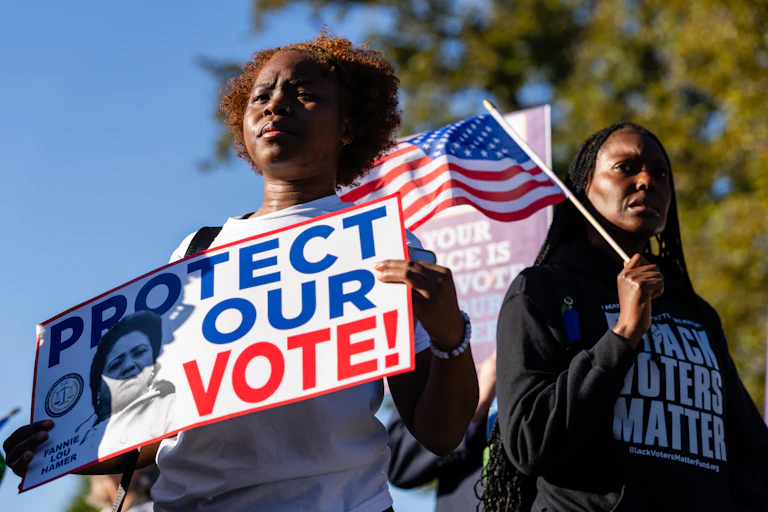
Black demonstrators outside the Supreme Court. One holds up a sign that reads "Protect Our Vote" and another holds an American flag and wears a shirt that says "Black Voters Matter."
Eric Lee/Bloomberg/Getty Images
Demonstrators outside the Supreme Court on October 15, 2025

Republican-run states across the South are rushing to redraw their congressional districts and blunt the voting power of their Black residents after the Supreme Court’s ruling gutting the Voting Rights Act Wednesday in Louisiana v. Callais.

The court voted 6–3 to throw out Louisiana’s congressional map and get rid of its only Democratic (and majority-Black) district. One day after the ruling, the state’s Republican governor, Jeff Landry, announced in a joint statement with Louisiana Attorney General Liz Murrill that the May 16 primary elections would be suspended to get a newly redrawn map in place.

“The State is currently enjoined from carrying out congressional elections under the current map,” Landry and Murrill said in their statement. “We are working together with the Legislature and the Secretary of State’s office to develop a path forward.”

Meanwhile, hours after the court decision, Florida passed a new congressional map redrawn by Republican Governor Ron DeSantis in the hopes of giving Republicans four more seats in Congress.

Mississippi Republican Governor Tate Reeves announced Wednesday that he would call the state legislature for a special session on congressional redistricting, which had been paused in anticipation of the court’s ruling. He celebrated the decision in a post on X, taking a shot at reproductive rights at the same time.

“First Dobbs. Now Callais,” Reeves posted. “Just Mississippi and Louisiana down here saving our country!”

Alabama’s Republican attorney general, Steve Marshall, said after the ruling that his state “will act as quickly as possible to apply this ruling to Alabama’s redistricting efforts,” taking aim at Alabama’s two Democratic (and majority-Black) districts.

Senator Marsha Blackburn of Tennessee, who is running for governor, posted a proposed congressional map of the state on X, colored entirely red and eliminating the state’s lone Democratic and majority-Black district.

“I urge our state legislature to reconvene to redistrict another Republican seat in Memphis,” Blackburn posted. “It’s essential to cement @realDonaldTrump’s agenda and the Golden Age of America.”

X screenshot Marsha Blackburn @VoteMarsha I urge our state legislature to reconvene to redistrict another Republican seat in Memphis. It's essential to cement @realDonaldTrump ’s agenda and the Golden Age of America. I've vowed to keep Tennessee a red state, and as Governor, I'll do everything I can to make this map a reality. (map of red Tennessee)

In South Carolina, Republican legislators are openly discussing the possibility of redrawing their districts, welcoming the court’s decision.

“I was happy to see it. Uh, you know, I, I have, um, I’ve long advocated that we need to treat people equally, not based on the color of their skin, melanin content, anything like that, and, and people don’t vote based on their skin color, so that’s. That’s been my position,” Republican state Representative Jordan Pace, who had previously submitted a redrawn map of the state’s 6th congressional district in anticipation of the Supreme Court ruling, told local TV station WLTX.

Hastily redrawn congressional maps will certainly face legal challenges, but the Supreme Court has now set a new precedent by striking down the 60-year-old Voting Rights Act. With the midterm elections just over six months away, courts will also be reluctant to rule on election law. If any of these new maps are in place by November, Donald Trump and the GOP may not lose the House of Representatives.

This story has been updated.

Ex–Mob Prosecutor Debunks Trump’s Main Claim in James Comey Indictment

Donald Trump insists that “86” is a mob term for killing someone.

Donald Trump speaks while sitting at his desk in the Oval Office
Graeme Sloan/Bloomberg/Getty Images

President Donald Trump’s outrageous claim that former FBI Director James Comey tried to put a mob-style hit out on him with a photograph of seashells is already falling apart.

Trump has claimed that “86” is a “mob term” for ordering a hit on someone, meaning that when Comey posted a picture of seashells arranged on the beach in North Carolina to read, “86 47,” he was calling to “86,” or kill, the forty-seventh president.

Speaking on CNN’s The Source Wednesday, Elie Honig, a former federal prosecutor, challenged Trump’s claim, arguing that mobsters just don’t talk like that.

“There was a point in my life where I spent the better part of my waking hours either talking face-to-face with real-world mobsters, or listening to them talk to each other over wiretaps, body wires, or bugs,” Honig said. “I dealt with all five families: Gambino, Genovese, Bonanno, Lucchese, and Colombo. I dealt with bosses, underbosses, consigliere, capos, soldiers, associates, all the way down the line.”

“Never, ever. Not once did I hear any real-world gangster use the term ‘86’ to refer to a murder or anything, and God knows these guys had colorful lingo, but never that phrase,” Honig said. “I don’t know where the president’s getting this from. He said from some movie. They don’t use that term in The Godfather, The Sopranos, or Goodfellas. Maybe some old-timey movie, but that’s not reality.”

Honig also pointed out that when CNN’s Kaitlan Collins had pressed Trump earlier Wednesday on whether he really felt his life was in danger, the president had replied: “Probably, I don’t know.”

“Right there, that’s an acquittal,” Honig said. “Because prosecutors have to believe beyond a reasonable doubt that the victim believed that his life was in jeopardy.”

The brief indictment against Comey, listing charges that include making a threat against the president and transmitting it in interstate commerce, does not include this mobster argument. Rather, it claims that “86” was a symbol that a “reasonable recipient who is familiar with the circumstances would interpret as a serious expression of an intent to do harm to President Trump.”

But clearly there is nothing reasonable about Trump’s Mafia fiction—least of all any actual danger.

Janet Mills Pulls out of Senate Race Over Lack of Funding

Mills has trailed behind Graham Platner in the polls—and apparently also in fundraising.

 stands in partial profile to the camera during a campaign event
Sofia Aldinio/Bloomberg/Getty Images
Maine Governor Janet Mills

Maine Governor Janet Mills withdrew her campaign to represent the state in the U.S. Senate on Thursday.

Mills was the establishment Democratic favorite to replace Senator Susan Collins, a Republican who has held the seat since 1997. But she severely lagged in the polls behind progressive candidate Graham Platner.

In a statement released Thursday, Mills explained that her exit from the race boiled down to basic resources, specifying that she lacked the campaign funds to continue campaigning.

“While I have the drive and passion, commitment and experience, and above all else—the fight—to continue on, I very simply do not have the one thing that political campaigns unfortunately require today: the financial resources,” Mills said. “That is why today I have made the incredibly difficult decision to suspend my campaign for the United States Senate.”

Mills’s late entrance into the race last year hampered her fundraising abilities, and raised questions about her hunger to represent Maine in Washington. Within the first three months of 2026, Mills had raised just $2.7 million, a paltry sum for an establishment favorite expected to have the party’s wealth behind her. Mills’s fundraising efforts were eclipsed by Platner’s campaign, which raised $4.6 million in the same period.

Her withdrawal is a stunning loss for the national Democratic Party, not only as a sign of her waning popularity within the state, but also for the waning popularity of the national establishment that endorsed her.

For nearly two decades, New York Senator Chuck Schumer has selected the party’s Senate candidates with little opposition. That is no longer the case. Schumer’s political apparatus also faces contention in the midwest, where his preferred Senate candidates are facing tough primary competition in Iowa, Michigan, and Minnesota.

The race to contest Maine’s Senate seat has also sparked a debate on age, challenging ideas about which generation of candidates should be representing the breadth of America. Platner, a Marine and Army veteran-turned-oyster farmer, is 41 years old. Mills, who has represented the Pine Tree State since the 1980s, is 78.

This story has been updated.

Amid All the Other Chaos, Congress Focuses on a Hasan Piker Bill

A Democrat and Republican representative have decided this is the appropriate use of taxpayer resources in this current moment.

Hasan Piker
Noushad Thekkayil/NurPhoto/Getty Images

Despite all of the other issues in the country, Congress wants to waste its time on a bill condemning Hasan Piker.

Democratic Representative Josh Gottheimer and Republican Mike Lawler on Wednesday introduced a resolution to target “the rise of antisemitic, hate-filled rhetoric disseminated by prominent online personalities, including Hasan Piker and Candace Owens, and calling on social media platforms and public leaders to take stronger action against hate.”

“Piker has openly applauded Hamas’ terrorism, downplayed the mass rape of civilians on October 7th, and dehumanized Orthodox Jews as ‘inbred,’” Lawler said in a statement, taking many of those statements out of context. “Owens has trafficked in vile conspiracy theories, promoted blood libels, and platformed Holocaust deniers. With an audience of millions, they have a responsibility to confront hatred and bigotry in every form, not to amplify it to the masses. So if they won’t call it out, I will.

“I get that speaking up is not easy,” Gottheimer said. “But our constituents didn’t elect us to always take the easy path. That’s what principled leadership is all about.”

Piker, who has built a large following as a left-wing influencer on the Twitch streaming platform, has come under fire from pro-Israel advocacy groups like AIPAC as well as centrist organizations like Third Way for alleged antisemitic rhetoric in his anti-Zionist, pro-Palestinian advocacy, despite his repeated condemnations of attacks on Judaism and the Jewish people. Owens, while criticizing Israel from the right, has engaged in openly antisemitic rhetoric, such as, “Jewish people control the media.”

Regardless, amid a war with Iran, a struggling economy, and numerous other legislative priorities in Congress, a symbolic resolution attacking two influencers can hardly be seen as a bipartisan priority for Congress. The resolution is not likely to deter any bigotry, either.

Trump Admits He’s Not Sure James Comey Was Trying to Kill Him

The confession undermines the Justice Department’s entire indictment against the former FBI director.

Donald Trump in the Oval Office of the White House
Graeme Sloan/Bloomberg/Getty Images

President Donald Trump’s indictments against his perceived political enemies are getting so flimsy, even he’s not sure he believes in them.

On Wednesday, CNN’s Kaitlan Collins asked Trump about the Department of Justice’s most recent target: former FBI Director James Comey, whom Trump already tried and failed to throw in jail last year. (That case was thrown out after the courts discovered Trump’s prosecutor had been illegally appointed. Brilliant move, Mr. President.)

This recent indictment is built on a photo Comey posted on Instagram last year, in which seashells on a beach were arranged to write out “86 47.” The term “86” is often used in the restaurant industry to get rid of or cancel a dish, so the DOJ is jumping to the very reasonable conclusion that this constituted a threat to Trump’s life.

Collins asked Trump whether he actually thought Comey was threatening his life with the post.

“Well if anybody knows anything about crime, they know ‘86,’” Trump said. “It’s a mob term for ‘kill ’em.’ You ever see the movies? … I think of it as a mob term. I don’t know.”

Trump then began talking about mobsters before Collins wisely cut him off: “Do you really think your life was in danger?”

“Probably, I don’t know,” Trump replied. “People like Comey have created tremendous danger, I think, for politicians and others. You know, Comey is a dirty cop. He’s a very dirty cop. He cheated on the elections.”

Entertaining as Trump’s rambling monologues are, “Probably, I don’t know,” isn’t going to hold up in court. Comey can very easily defend himself by arguing his seashell art just meant he wanted to be rid of the president.

Even some congressional Republicans have expressed reservations about the Comey indictment, as it becomes clear average Americans care little about Trump’s revenge tour. North Carolina’s Thom Tillis, who serves on the Senate Judiciary Committee, expressed skepticism that the Comey case held water.

“I’ve used ‘86’ a lot of times,” Tillis told The Washington Post. “I’ve never said it with the intent of killing somebody.”

Representative Troy Nehls called the case “a stretch,” adding, “you can indict anybody for anything.”

Hegseth’s Own Words on Illegal Military Orders Come Back to Bite Him

Pete Hegseth accused a Democratic representative of making a “partisan point.” Then she revealed whom she was quoting.

Defense Secretary Pete Hegseth gestures and speaks during a House committee hearing
Kevin Dietsch/Getty Images

Defense Secretary Pete Hegseth’s blind loyalty to the Trump administration has put him at odds with his own beliefs.

During a House Armed Services Committee hearing Wednesday, New Hampshire Representative Maggie Goodlander asked Chairman of the Joint Chiefs of Staff Gen. Dan Caine if he agreed with a statement that America’s “military won’t follow unlawful orders.” Without hesitation, Caine answered: “I do.”

Hegseth, however, was quick to pick a bone with the benign principle—an inclination that immediately morphed into a liability for the Pentagon chief as he tripped over what turned out to be a quote from his own mouth.

“Mr. Hegseth, do you agree with that statement?” asked Goodlander.

“I do, but understand what you’re insinuating is a partisan point,” said Hegseth.

“I’m not, I’m actually quoting you directly, Mr. Hegseth, from April 12, 2016, and I appreciate that on the record you’ve clarified this important principle,” Goodlander said.

At the time, Hegseth had told an audience that he believed there “had to be consequences for abject war crimes.”

“That’s why the military said it won’t follow unlawful orders from their commander-in-chief. There’s a standard, there’s an ethos. There’s a belief that we are above so many things that our enemies or others would do,” Hegseth said in footage uncovered by CNN.

But Hegseth’s belief system has obviously morphed in the decade since. Last November, six Democratic members of the House and Senate—a coalition of veterans and former national security professionals that included Goodlander and Senator Mark Kelly—urged U.S. service members not to “give up the ship.”

In a video statement posted to Facebook, the bloc repeated that America’s military and intelligence communities “can” and “must … refuse illegal orders,” echoing Hegseth’s prior remarks. They made no reference to disobeying the Trump administration directly, only reminding people to uphold the Constitution.

The White House did not take the missive in stride. Instead, Donald Trump called for the coalition’s execution, writing on Truth Social that their behavior was “punishable by DEATH!”

Hegseth then attempted to censure Kelly, claiming that the retired U.S. Navy captain should not be afforded the same First Amendment protections as the general population. A judge did not agree, and the case was tossed in February.

Hegseth Accuses Troops of Lying as He’s Faced With Facts on Iran War

Defense Secretary Pete Hegseth couldn’t explain why his version of events doesn’t line up with that of troops in the Middle East.

Defense Secretary Pete Hegseth testifies in Congress, speaking animatedly
SAUL LOEB/AFP/Getty Images
Defense Secretary Pete Hegseth testifies before the House Armed Services Committee, on April 29.

Defense Secretary Pete Hegseth is continuing to lie about an Iranian drone strike that killed six U.S. service members in early March, and now he’s lashing out at the survivors of the blast too.

After the missile struck the troop base, the defense secretary minimized the incident, calling the missile a “squirter” that “happened to hit a tactical operations center that was fortified.”

But a month later, multiple anonymous survivors of the blast talked to CBS, and claimed Hegseth was fibbing. As Representative Pat Ryan of the House Armed Services Committee put it on Wednesday:

One of our surviving soldiers told CBS “painting a picture that one squeaked through is a falsehood.” Another said the unit was “unprepared to provide any defense for itself. It was not a fortified position.” Another survivor said the building’s protection “was about as weak as one gets.” Secretary Hegseth, that is obviously a direct contradiction of what you said from the Pentagon podium the next day. Are you saying these soldiers, our soldiers, who survived this horrific attack, are lying?

Hegseth dodged the question. “Before the commencement of the conflict, we put in maximum defensive posture—”

“That’s a direct contradiction to what they said,” Ryan replied.

“Can I speak, or are you just going to monologue falsehoods all over the place?” Hegseth said.

“It’s not a falsehood.”

“We moved 7,500 troops off of the—”

“Reclaiming my time. Stop! … I’m reclaiming my time on behalf of these survivors. You just said what they said is a falsehood.”

“There’s a much larger picture at play here,” Hegseth tried to argue, speaking about the efforts of the U.S. to move troops to safety in the region. “We knew there could be a tragic moment where one could get through. Of course, that’s the consequence of conflict.”

Ryan pointed out he still hadn’t answered the question.

“Don’t play games with raising your voice and pointing your finger,” Hegseth said.

“I’m not playing games,” Ryan replied. “I want to finish with one more quote from a survivor.… ‘Telling the truth is important. And we’re not going to learn from these mistakes if we pretend these mistakes didn’t happen. Secretary Hegseth, those soldiers hold the truth. Those soldiers are braver than you are. They are asking for accountability, and they deserve accountability. I’m asking for the same.”

Hegseth’s lies about attacks on U.S. troops should be a massive story, similar to how the Pentagon is reportedly covering up recent casualties in the Middle East. But with all the madness in the world right now, it’s easy to get distracted by whatever scandal pops up next. Kudos to Ryan—a veteran himself—for bringing the incident back to light.

Trump Tries to Goad Artemis II Astronauts Into Bashing NATO With Him

The astronauts appeared stunned as Donald Trump complained about NATO.

Donald Trump speaks while sitting at his desk in the Oval Office. He is flanked by the astronauts from the Artemis II mission.
Andrew Harnik/Getty Images

The crew of NASA’s Artemis II visited the White House Wednesday to celebrate their successful mission around the moon, but they ended up roped into one of the president’s diatribes against NATO.

The astronauts were visibly uncomfortable flanking Donald Trump behind the Resolute Desk as he tossed questions their way regarding the country’s participation in the strategic alliance.

“What do you think of that, Jared? Sending help after we win the war?” Trump said, turning to address NASA administrator Jared Isaacman (Isaacman is the third administrator of the agency since January 2025).

Trump then looked behind him, waving his open hand at the astronauts.

“I don’t want to get you guys involved, but I can imagine what you’re thinking,” Trump chortled.

But no one at the desk was laughing with him. Instead, the astronauts looked pained:  grimacing, pursing their lips, and turning away from the president as he continued to take questions from reporters.

Trump has long criticized America’s membership in the international military alliance. He regularly baselessly insists that other members have failed to pay their dues and argues that the U.S. has been shortchanged by other NATO countries, even though that’s not how the alliance operates.

The Cold War–era organization has “no ledger that maintains accounts of what countries pay and owe,” according to former Obama staffer Aaron O’Connell, who explained to NPR in 2018 that “NATO is not like a club with annual membership fees.”

Nonetheless, Trump has continued to verbally attack America’s closest allies, accusing NATO members of being “cowards” and “terrible” for refusing to assist in his blockade of Iran’s Strait of Hormuz. 

On Tuesday, King Charles of Britain spoke before a joint session of the U.S. Congress, compelling the American people—and their representatives—to support the NATO alliance. In doing so, the king reminded the country that there has only ever been one time in history when NATO’s Article 5 has been invoked: the global mobilization to support America in its military offensive against Afghanistan after 9/11.

Despite the king’s heavy messaging, Trump told reporters Wednesday that he “loved the speech,” though he specified that his opinion on NATO—and America’s potential withdrawal—was unchanged by the royal’s remarks.

It is unclear who in the Western world benefits from the dissolution of NATO. John Bolton, Trump’s first-term national security adviser and a policy hawk who also served under Ronald Reagan’s administration, has said that the consequences of exiting the alliance could be dire. America’s withdrawal from the pact could effectively be the death of NATO, leaving behind a fractured and significantly weakened European alliance, while devastating America’s international credibility as an ally.