Breaking News
Breaking News
from Washington and beyond

Trump Prepares to Dump Pete Hegseth Over Midterms Destruction

Donald Trump has settled on his scapegoat for the sweeping election losses.

Donald Trump speaks to Defense Secretary Pete Hegseth as they sit next to each other at a conference table
Aaron Schwartz/Bloomberg/Getty Images

President Donald Trump may soon give Secretary of Defense Pete Hegseth the axe after Republicans lost massively in Tuesday’s midterm elections.

CBS News reports that the president has been asking advisers if Hegseth should keep his job due to the Iran war going so poorly, a fact that swayed many voters. NBC’s exit polls showed that 74 percent of voters saw the Iran war as a crucial or major factor in how they voted. Hegseth was already in the hot seat before the midterms, with many in Congress calling for his impeachment, including outgoing Republican Representative Thomas Massie.

Hegseth was reportedly hoping Tennessee Senator Marsha Blackburn would be elected the state’s governor so that she could appoint him to fill the seat. That way, he could have a graceful exit and avoid the mess of being impeached or fired. Blackburn did win her race, but Hegseth would still face competition from other hopefuls such as Republican Representative Tim Burchett, who campaigned for Blackburn.

If Hegseth goes, one of CBS’s sources said that Florida Governor Ron DeSantis could be a possible replacement, and could get a speedy confirmation by the lame-duck Republican Senate before the end of the year.

Trump hasn’t made his decision yet, however, and some of CBS’s sources in the White House think that he might direct blame at other military leaders, such as Admiral Brad Cooper, head of U.S. Central Command, or Chairman of the Joint Chiefs of Staff General Dan Caine. White House spokesperson Anna Kelly said in a statement that Hegseth had Trump’s full confidence, praising military efforts in Venezuela and the Iran war while also touting Hegseth’s attacks on “DEI and woke ideology.”

Speaking to reporters Wednesday, Trump gave Hegseth a vote of confidence, saying outside of the White House, “I think he’s doing a very good job.”

When asked if he wanted Hegseth to fill Blackburn’s Senate seat, Trump said, “I actually think he’d be very popular if he did that, but I haven’t heard that at all.”

Republicans Tried to Rig the Maps. It Backfired Big-Time.

Republicans dummymandered themselves into some major midterm losses.

Democratic voters celebrate in South Carolina
Democratic voters celebrate.
Bill Clark/CQ-Roll Call, Inc/Getty Images
Democratic voters celebrate.

Republicans tried to upend Democratic election odds by redrawing congressional districts across the country, but even that wasn’t enough to dam the blue wave.

Despite making new maps to boost Republican candidates in Florida, North Carolina, Ohio, Texas, Alabama, and Utah, voters in those states by and large still chose Democrats to represent them.

For more than a year, local legislators in the Lone Star State were explicitly pushed by Donald Trump and his allies to forgo tradition and create a new congressional map for the 2026 election. State Republicans complied, carving up five historically Democratic districts into supposedly MAGA-friendly inventions.

But the plan backfired spectacularly. Republicans lost four of the five supposedly GOP-friendly seats they had created, as well as another two of their own.

Alabama voters also rejected the state GOP’s gerrymandering efforts, opting to send Democratic Representative Shomari Figures back to Congress.

Earlier this year, Governor Ron DeSantis redrew 20 of Florida’s 28 U.S. House districts. At the time, four newly created districts were expected to turn red. But they didn’t, and Florida Democrats remain poised to retain their targeted seats. Representatives Jared Moskowitz, Kathy Castor, and Debbie Wasserman Schultz were able to fend off Republican challengers, while first-time candidate Pia Dandiya outcompeted Republican nominee Casey Askar. The results for Florida’s 9th congressional district have not yet been called, though Democratic Representative Darren Soto has a slight lead.

Democrat Ben McAdams turned the tide in Utah’s redrawn first congressional district, besting Republican nominee Riley Owen by a margin of 47 points.

Ohio voters not only stuck to their Democratic incumbents despite similar redistricting efforts, but the liberal party also gained two more House seats (with potentially a third on the way, according to the Ohio Capital Journal). Democrats won big in Ohio’s gubernatorial and Senate races too, electing Dr. Amy Acton and Sherrod Brown, respectively.

Democrats enjoyed a landslide victory in North Carolina, despite voting under a new map that should have easily handed an additional House seat to Republicans by massively reconfiguring congressional districts 1 and 3. At the time of publication, just four out of 14 races have been called by the Associated Press, though Democratic Representative Don Davis was leading by more than 4 percent with 99 percent of the district votes counted.

Voters outright rejected a new congressional map in Missouri, where Republican leadership had prematurely decided to rely on a redistricted map during its primary election in August, effectively stripping many Missourans of the opportunity to elect their congressional nominees. The courts ultimately ordered Missouri to use the state’s original 2020 congressional map for Tuesday’s election. After the votes were tabulated, Democrats had gained an additional House seat.

Meanwhile, in Louisiana, the top two performers in the state’s 6th House district are headed to a December runoff race. They include Democrat Chauna Banks and Republican Blake Miguez.

But it wasn’t a unanimous Democratic victory. Tennessee’s decision to carve up Memphis into three separate congressional districts effectively thwarted the city’s historically Democratic vote. At the time of publication, Republicans were projected to win in three of four House races in Tennessee, while Democratic nominee Victoria Broderick peeled ahead by just fractions of a percentage point in Tennessee’s 4th congressional district.

Trump Brags About Ballroom in First Speech Since GOP Election Wreckage

Republicans were just obliterated this election. Donald Trump doesn’t care.

President Donald Trump signs a large piece of steel, which includes other signatures as well.
President Donald Trump signs the last piece of steel to be used in construction of the White House ballroom during an event on November 4, one day after Republicans lost Congress in the midterm election.
Andrew Harnik/Getty Images
President Donald Trump signs the last piece of steel to be used in construction of the White House ballroom during an event on November 4, one day after Republicans lost Congress in the midterm election.

President Trump’s first public speech after a disastrous, resounding midterm election defeat was about the White House ballroom, as he offered the American people deranged ramblings about the only thing he actually seems to care about.

“I doubt there’s a ballroom in the country [with] a 50-foot ceiling,” Trump said outside the construction site of his ballroom on Wednesday, just barely more than 12 hours after Democrats took control of both the House and the Senate in a resounding rejection of his administration’s policies and ideology.

You’d think a president would offer words of encouragement to his party or righteous anger in such a desperate moment. Instead, Trump went full lame-duck mode. “There has never been anything built like this, and it’s for the country, and it’s free, we got it free of charge, thank you very much.… When it’s completed it’ll be the best anywhere in the world.”

The president appeared with Interior Secretary Doug Burgum.

“Why does Trump spend time on the White House? Well, first of all, it’s very little time. Second of all, I like it. It’s good. For me it’s relaxing.… I love construction,” Trump continued. “That’s what I do, I like beautiful things.”

Trump went on to speak about the ballroom’s kitchen, staircase, roof, and marble veining.

It’s incredible that Trump—who seemed particularly calm at the event—can simply act like nothing happened, after his own unpopular decisions in office resulted in a midterm sweep that could cripple the Republican Party for the next decade. His own vice president, JD Vance, admitted that their war on Iran, the cost of living, inflation, and the administration’s close relationship with Israel lost them the election. But rather than address any of that, the president would prefer to talk about buttresses.

JD Vance Throws Trump Under the Bus for Republicans’ Election Wipeout

Vance is doing his best to break from Trump after Republicans’ devastating losses this election.

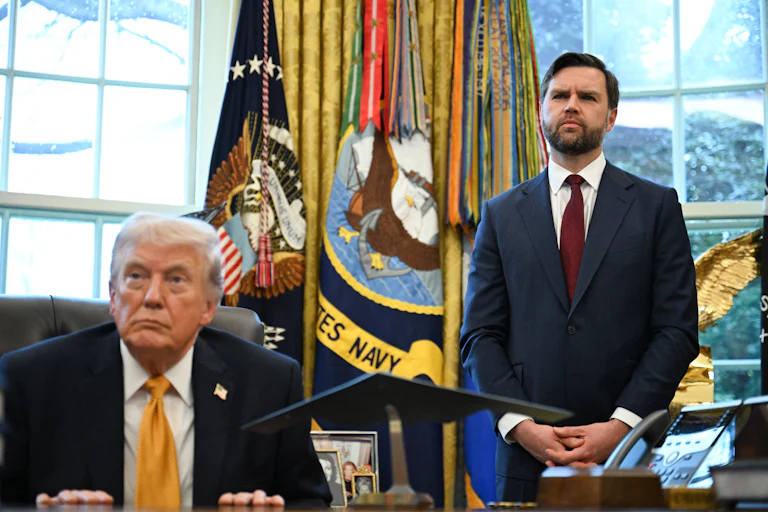
Donald Trump sits at his desk in the Oval Office of the White House as JD Vance stands next to him
ANNABELLE GORDON/AFP/Getty Images

Vice President JD Vance is desperate to save himself from the blue wave—even if that means letting President Donald Trump drown.

Just hours after Democrats seized control of Congress and swept state elections across the country, Vance promptly threw the president under the bus.

“The reason we lost is the war. The president himself said so last night,” Vance wrote in a lengthy post on X Wednesday, blaming the Iran war without mentioning Trump by name.

“If you’d like to argue it was worth it, that losing the Senate for the next 6 years was worth it, then do so. Argue it was a worthwhile cost to pay. Agree or disagree, that’s at least honest,” he wrote. “But everyone knows why we lost. And any honest conversation about where we go from here must start there.”

In the early days of Trump’s military onslaught, Vance had expressed some reluctance about the president’s war plans. But that quickly gave way to the spineless sycophantism we’ve come to expect from the vice president.

In his post on Wednesday, Vance claimed that Republicans’ main problem is that many people who supported Trump in the 2024 presidential election had flipped to support Democratic candidates.

Vance claimed that a pollster—”one of the smartest people I know in politics”—found that voters would return to supporting the GOP if they ended the war in the Middle East, focused on the cost of living and inflation, “put America First,” and changed the U.S. relationship with Israel.

Trump’s eight-month-long “six week war” in Iran has proven to be a major political liability. His military campaign has resulted in the deaths of 22 U.S. service members, and hundreds more injured. Trump’s war is responsible for the deaths of thousands of Iranian civilians, including 120 schoolchildren. The president also oversaw the destruction of multiple U.S bases in the Middle East, a series of deadly military morale issues, and the depletion of the U.S. weapons stockpile, leaving the country more vulnerable to foreign threats.

The war effort has already cost American taxpayers an estimated $47.1 billion. That’s enough to pay for one year of Medicare coverage for 5.84 million people, based on previous figures from the Center for American Progress. That doesn’t include the skyrocketing price of gas and consumer goods thanks to the war.

In the words of Dwight D. Eisenhower: “Every gun that is made, every warship launched, every rocket fired signifies, in the final sense, a theft from those who hunger and are not fed, those who are cold and are not clothed.” It seems that Vance is finally catching on to just how damaging this war has been.

Democrats Take Over Total Control in Four States With Trifecta Power

Democrats have secured a trifecta in four states this election—winning both chambers of the state legislature and the governor’s seat.

Wisconsin State Capitol
Jordan McAlister/Getty Images

Democratic candidates flipped control of multiple state legislatures on Tuesday, clinching electoral trifectas in Wisconsin, Minnesota, Michigan, and Pennsylvania.

It was a wildly successful night for Democratic candidates in Congress, but Americans also voted to install Democrats in their state governments across the country.

In Wisconsin, Democrats flipped both the state’s Assembly and Senate. In the state’s Senate, Democrats flipped to an 18–15 majority, an exact inverse of the chamber’s current makeup. In the state Assembly, Democrats secured a 53–46 majority. And Democratic candidate David Crowley was elected to the governor’s office, securing the party an electoral trifecta for the first time in 16 years.

In Minnesota, Democrats clinched majorities in both chambers of the state legislature. In the House, the Democratic-Farmer-Labor Party has won 72 of 134 seats thus far, surpassing the 68-seat majority. In the state’s Senate, the DFL party held onto its 34-seat majority. When coupled with DFL nominee Senator Amy Klobuchar’s victory in Minnesota’s gubernatorial race, Democrats have achieved trifecta control of the state’s government.

In Michigan, Democrats flipped the state’s House of Representatives. In the 110-seat House, Democrats ousted at least five Republican incumbents to secure at least 50 seats. In the 38-member state Senate, Democrats ousted two GOP incumbents, growing their majority from 20 to 23 seats. Democratic candidate Jocelyn Benson was elected to the governor’s office, securing the Democrats’ electoral trifecta in the state.

In Pennsylvania, Democrats also achieved a trifecta by flipping the state’s Senate for the first time since 1993. Ahead of the election on Tuesday, Republicans held a 27–23 majority in the 50-seat state Senate. Democrats flipped three seats on election night. Democrats also increased their majority in the state’s House of Representatives from 103 to 111 seats.

In North Carolina, Democrats flipped control of the state’s House of Representatives for the first time since 2010. As of Wednesday morning, Democrats held 66 seats in the 120-seat House. They needed to flip 12 seats to retake a majority, and by the time all the votes are counted, it’s possible they will have flipped 20. Going into the election, Republicans were just one seat short of a supermajority in the chamber.

As if that wasn’t enough, a few other states appeared to still be on their way to turning their state legislatures blue.

In Texas, the House races remained too close to call on Wednesday morning, but the Democrats were closing in on control of the lowest chamber for the first time since 2003. As of Wednesday morning, Democrats needed to flip at least 14 seats but had already flipped six seats, and they were leading in at least a dozen more Republican-held districts. Meanwhile, Republicans maintained control of the state Senate.

In Arizona, Democrats were poised to take control of the state legislatures for the first time in 60 years and potentially achieve yet another electoral trifecta for the Democratic Party.