Newsletter
Fighting Words
What got me steamed up this week

Why the Media Narrative on Donald Trump’s Legal Woes Is Wrong

Political pundits are ignoring the poll numbers on independent voters.

Trump at the closing arguments
Shannon Stapleton/Pool/Getty Images
Trump at the closing arguments in the Trump Organization civil fraud trial in New York City on Thursday

Sometime this month, New York Supreme Court Justice Arthur Engoron will decide how much Donald Trump should pay in penalties in the fraud case brought by New York State Attorney General Letitia James. Engoron has already ruled that Trump did commit fraud, so now it’s just a matter of the money. Engoron has been decidedly unimpressed by Trump’s lawyers’ arguments throughout the proceeding, so it seems reasonable to think Engoron will come close to, match, or maybe even exceed James’s request of $370 million.

According to Lisa Rubin of MSNBC, speaking on Morning Joe Friday morning, the very theatricality of Trump and his attorneys’ denials can be a factor in the judge’s determination—that is, if Engoron determines that Trump and his lawyers’ lies are egregiously flamboyant and obvious, that can help dictate the penalty amount. Rubin predicted that the amount would be “in the hundreds of millions” of dollars and that perhaps Engoron would drop the nuclear penalty on Trump and his family—barring them from doing business in New York again.

Meanwhile, as Engoron is deliberating, another trial is about to begin. The E. Jean Carroll defamation trial will open next Tuesday, the day after the Iowa caucuses. Last year, a jury found that Trump had lied about not sexually abusing Carroll years ago, and awarded her $5 million. Trump appealed. Last summer, the judge in the case clarified, amid intense media debate and speculation, that Trump did in fact “rape” Carroll.

Meanwhile, on the political front, Trump will win Monday’s Iowa caucuses. The following Tuesday, January 23, New Hampshirites will go to the polls. One poll that got a ton of attention showed Nikki Haley within seven points of Trump. She has some momentum, but in the polling averages, Trump still has a double-digit lead. And he’ll be coming off a massive win in Iowa. So let’s say for the moment that Trump wins New Hampshire handily too.

The media narrative with respect to the Trump lawsuits will be what it has been, except on steroids: Trump’s legal woes only help him. That’s true with respect to Republican voters. But there are a lot of reasons to think that that piece of conventional wisdom will be dead wrong when it comes to other voters.

First of all, New Hampshire may well prove this point. Independents can vote in New Hampshire primaries and have a history of being cranky and unpredictable. Now let’s assume that Trump doesn’t win the Granite State handily—he wins it narrowly or maybe even loses. If that happens, Haley will be succeeding on the strength of those independent voters. And that will constitute a big and important switch that’s worth paying attention to.

In 2016, independents made up 42 percent of the electorate in the state’s GOP primary, and Trump cleaned up among them: He got 36 percent of the independent vote, while his closest competitor, John Kasich, got 18 percent.

If Trump loses independents in New Hampshire to Haley—even if he still wins overall—that will be a big sign that the Trump show isn’t playing well beyond the MAGA base. We’d have to wait until the results to see what these voters say about why they didn’t vote for Trump. But it’s hardly a stretch to think that Trump’s legal problems have to be part of the story.

The media aren’t paying attention to this at all. Case in point: Last week, there was a Washington Post/University of Maryland poll that got a lot of attention. In its write-up, the Post highlighted the fact that three years after January 6, Republicans were if anything more loyal to Trump, not less. The rest of the media largely followed that lead, so the story of that poll became yet another “Trump can get away with anything” story.

But other results from the poll that got a lot less attention told a different story. The survey asked people if the Justice Department, in charging Trump for insurrection, was holding him accountable as it would anyone else or was targeting him unfairly. A comfortable majority, 57 percent, said he was being treated fairly. That’s the exact percentage of independents who said the same, compared to 90 percent of Democrats and 20 percent of Republicans.

In other words: The Republican base, as is so often the case in these kinds of polls, is a total outlier that distorts the overall results. What does this tell us? I think it’s clear. As the primary “drama” winds down, and as the courtroom drama heats up—and both of these are likely to happen in early March—we’ll see the trials start to take more of a toll on Trump. If the Jack Smith insurrection trial proceeds as originally planned on March 4 (that’s now in abeyance pending resolution of a Trump appeal), Trump’s remaining and mathematically meaningless primary wins are going to get a lot less attention than what’s going on in that Washington courtroom.

Don’t buy the narrative that none of this hurts Trump. It will. He’s not being persecuted. He’s a scumbag who did lie about his property values, who did rape Carroll, who did lead an insurrection, who did take classified documents (he doesn’t dispute this—he just says he was allowed to do anything he pleased), and God knows what else. Republicans may not care. But I think real Americans do.
This article first appeared in Fighting Words, a weekly TNR newsletter authored by editor Michael Tomasky. Sign up here.

Latest From Politics

Americans Don’t Care About Democracy? Well, Democrats—Make Them Care

What Biden needs to tell American voters today—and every day until the election

Rebecca Noble/Getty Images
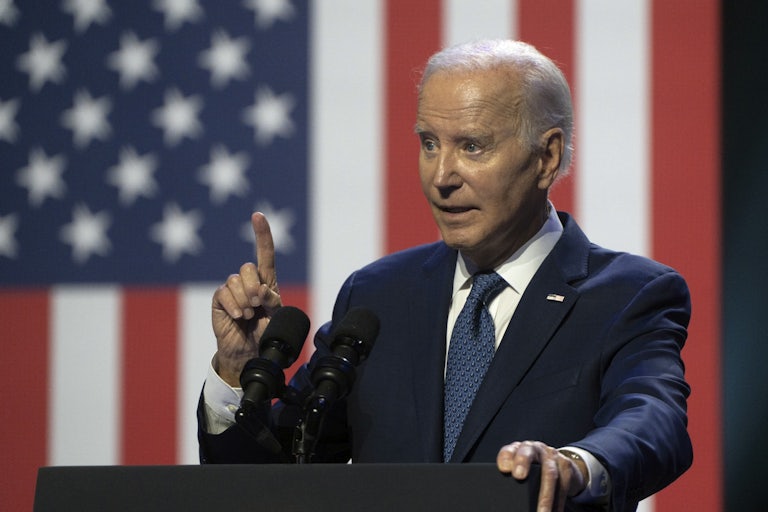
Biden speaking at the Tempe Center for the Arts in Arizona on September 28

President Biden will give what they’re billing as the first speech of his reelection campaign today, and in it, he will attack Donald Trump by name as a historic threat to democracy. An aide told The Washington Post that Biden “is going to be very straightforward on what happened, the truth of what happened, and the role that Trump played in that.”

The speech will arrive, as we approach the third anniversary of the insurrection, in about as bleak a context as we could imagine. Trump leads Biden in most head-to-head polls, albeit just by a point or two. And Republicans are apparently rallying to Trump. A Post poll released earlier this week had some gob-smacking findings showing that Republicans are far less concerned about January 6 than they were right after it happened, and they weren’t very bothered then.

We’re in a surreal hall of mirrors. Trump keeps suffering legal defeat after legal defeat. He’s being tossed off state ballots. His lawyer all but admits he led an insurrection. A new House report details nearly $8 million he made from foreign governments while serving as president. And for now, none of it matters.

This campaign will be about a lot of things, as all campaigns are. But the main question will come down to this and this alone: Will a majority or plurality of Americans use their vote—that is, employ the peaceful means of democracy’s most essential right—to put a violent fascist back in charge of this country?

That the answer isn’t a clear “no” is terrifying. But here’s the thing. Some would argue that the fact that the answer isn’t a clear “no” means that Biden and Democrats shouldn’t emphasize the issue because it’s not a clear winner. I say the opposite is the case. Emphasize the issue and make it a winner. If polls today show that not enough people care about democracy, don’t just follow the polls. Change the polls. Make them care.

Republicans understand this dynamic and have for years. The classic recent example is the Iraq War. After the 9/11 attacks, no one outside a handful of neoconservatives thought they justified waging war on Iraq. But over the course of 2002, the Bush White House changed public opinion. They did it largely through lies, but they did it. By the time the United States invaded Iraq, majorities supported it.

Trump has changed polls too. Pre-Trump Republicans believed a lot of bad things, and I’m certainly not sugar-coating that GOP—which, after all, laid down and gave itself over to Trump. But they did still believe in the general integrity of the American electoral system. No one was urging Mitt Romney to dispute the 2012 election results. Romney conceded on election night (or very early Wednesday morning, technically), and everyone moved on. But by 2016, Trump was saying that he would respect the results “if I win.” And that was all it took. The polls, at least among Republicans, changed and changed dramatically.

Democrats historically don’t do this. When the polls are on their side—as when, for example, George W. Bush tried to privatize Social Security in 2005—they’re as swashbuckling as Blackbeard. (That was one case where the GOP/right-wing media onslaught failed conspicuously to change the polls.) But when the polls aren’t on their side, they’re about as swashbuckling as Caspar Milquetoast.

If they want to make this democracy argument—and I think they’re right to do so—and if they want to win it—and they must—this habit has to change. They need to be mapping out a plan now that stage by stage will lay out an argument to voters (swing voters especially) that by Election Day will have them terrified at the prospect of Trump getting back into the White House. This can, and must, start with January 6. But then, by late spring say, and especially by the fall, the argument should be almost entirely about the future. Attack ad after attack ad simply need to take Trump’s own words, and the words of his people in leaks to media outlets, about how they’re going to impose authoritarianism in his second term. I would anticipate too that, by the fall, Trump will have said as much many times on the hustings, handing the Democrats fresh and irrefutable fodder.

Obviously there are other things the Democrats need to do. They are positioned to win millions of votes on the question of abortion rights. They have to press an economic argument the best they can, and as I wrote Monday, if some economic predictions are right, that could be less of a challenge than it seems like it will be today.

But there is a deep moral and ethical question at the center of this election unlike any other of my lifetime. Will Americans use the tools of democracy to hand their country to a democracy destroyer? They won’t if Democrats refuse to accept the “people don’t care about democracy” argument and make them care.

Latest From Politics

“Just Like the Ones I Used to Know...”

A Fighting Words quiz on several centuries’ worth of Christmas music.

GraphicaArtis/Getty Images

1. According to Billboard, this is the oldest English-language Christmas carol, dating back to the 1650s:

A. “Silent Night”

B. “Lo, How a Rose E’er Blooming”

C. “God Rest Ye Merry, Gentlemen”

D. “The Holly and the Ivy”

Answer: C, “God Rest Ye Merry.” Read this article. I really like that song. And notice that no, it’s not “God Rest Ye, Merry Gentlemen.” One of the most important commas in all of commadom.

2. There is a theory these days holding that “O Come, All Ye Faithful” was written with secret political intent, as a rallying crying for what cause?

A. The Stuart Restoration of 1660

B. The attempted Stuart retaking of the throne in 1745 under “Bonnie Prince Charlie”

C. The consolidation of the Austrian Empire in 1804

D. Napoleon’s return from exile in Elba in 1815

Answer: B, the Bonnie Prince Charlie episode. So says Bennett Zon, the head of the Music Department at Durham University. What, you know better?

3. According to a 2015 tally by FiveThirtyEight, what is the most covered Christmas song of all time?

A. “Silent Night”

B. “White Christmas”

C. “Jingle Bells”

D. “Have Yourself a Merry Little Christmas”

Answer: A, “Silent Night.” Followed by “White Christmas,” second, and “Jingle Bells,” third. “Have Yourself” was seventh.

4. According to a 2021 YouGov poll, what do Americans think is the worst Christmas song of all time?

A. “Baby, It’s Cold Outside”

B. “Grandma Got Run Over by a Reindeer”

C. “All I Want for Christmas Is My Two Front Teeth”

D. “Santa Baby”

Answer: D, “Santa Baby.” It nosed out “Grandma” by one percentage point, so, within the margin of error. Still, it was liked overall by 68 percent–32 percent. Great trivia here: It was co-written by Phil Springer, who, first of all, is still alive (!) and second of all went on to write songs with Utah GOP Senator Orrin Hatch, who was something of a tunesmith. And there’s more politics to this: The co-composer was Joan Javits, the niece (I think) of longtime liberal Republican New York Senator Jacob Javits. And I don’t see what’s so bad about it. It’s a fine song.

5. And according to a 2021 ranking by SmoothRadio.com, what is the best country Christmas song of all time?

A. “Jingle Bell Rock,” by Bobby Helms

B. “Blue Christmas,” by Elvis Presley

C. “Rockin’ Around the Christmas Tree,” by Brenda Lee

D. “Christmases When You Were Mine,” by Taylor Swift

Answer: C, “Rockin’ Around.” Great song, great guitar, pretty cool sax solo. Brenda Lee was 13 when she record this!

6. Which of these artists has never recorded a Christmas song?

A. Snoop Dogg

B. They Might Be Giants

C. Bee Gees

D. Foo Fighters

Answer: Surprisingly, C, Bee Gees. Look it up! Snoop appears to have done a number of holiday tunes. They Might Be Giants made a Christmas E.P. with five songs, and Foo Fighters recorded Chuck Berry’s classic “Run Rudolph Run,” also covered by Keith Richards and Dave Edmunds.

The Real Problem With Those College Presidents? Gross Incompetence.

Yes, Elise Stefanik set a trap. But the presidents of Harvard, Penn, and MIT didn’t have to walk right into it.

Harvard President Claudine Gay (L) and Penn President Liz Magill
Kevin Dietsch/Getty Images
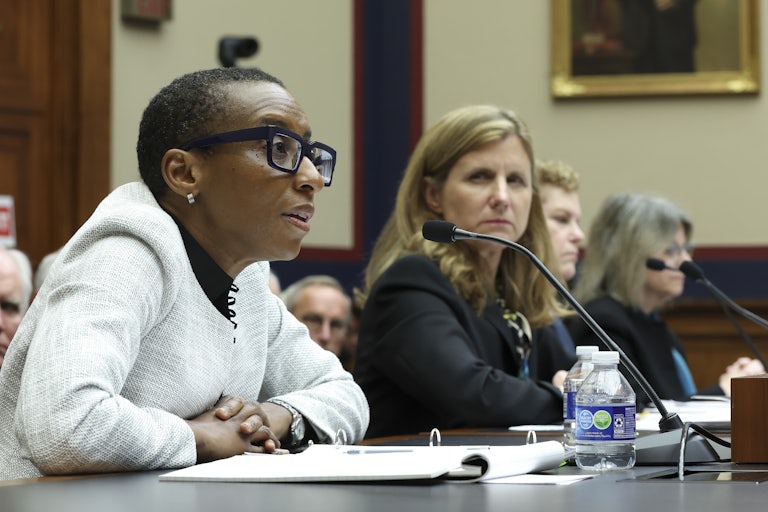
Harvard President Claudine Gay (left) and Penn President Liz Magill testified before the House Education and Workforce Committee on Tuesday.

Almost everyone has been piling on that pitiful troika of elite university presidents after their congressional testimony on Tuesday. A few other folks, people I know and respect like Michelle Goldberg of The New York Times and Jay Michaelson of The Daily Beast, have added some valuable nuance, arguing that in context, the position the presidents were defending actually had merit.

I agree with the main points both made in their columns—in effect, that Republican Representative Elise Stefanik’s disingenuous grilling of the presidents, which conflated free speech with targeted harassment, set a trap that forced them to appear to equivocate about antisemitism. But I want to make a different point, one that is sharply critical of the presidents on different grounds. I was personally offended by their gross incompetence, and it wouldn’t bother me in the least if they were all fired simply for that reason (if any of them are forced out, of course, it won’t be because of that).

Here’s what I mean. As the president of Harvard, Penn, or MIT, you are by definition one of America’s leading representatives of the liberal values of inquiry, critical thinking, science, anti-superstition, and, yes, free speech. On your home turf, you are confronted from time to time, or maybe more frequently than that, with situations in which some of these values come into conflict with each other, and you have to make a difficult decision. The national media, especially the right-wing media, is monitoring every move you make, every syllable you utter.

You exist, that is, at the center of an ideological tornado. You know this, or should. And you show up to Capitol Hill so unspeakably ill prepared that you—and your coterie of almost-certainly overpaid handlers—haven’t prepped for exactly the line of questioning that Stefanik pressed upon you? Indefensible.

A memorable moment in a 1988 presidential debate helps explain the key error the trio made. CNN anchor Bernard Shaw opened the proceedings by asking Democratic nominee Michael Dukakis about his opposition to the death penalty. “If Kitty Dukakis were raped and murdered,” Shaw asked, “would you favor an irrevocable death penalty for the killer?”

Dukakis restated his opposition to the death penalty with all the ardor of someone reading the phone book (what’s a phone book, you ask? This). The next day, some commentators criticized Shaw for being a little blunt, but mostly people laid into Dukakis for not saying something like: “First of all, Bernie, how dare you talk that way, even hypothetically, about my wife? You should be ashamed. And second of all, if I got my hands on the guy, they wouldn’t need the death penalty.”

Cheap? Theatrical? Sure. But it isn’t insane for people to want to see leaders show a little emotion about emotional things.

These presidents made the Dukakis error. They showed no emotion about one of the most emotional topics in the history of the human race, antisemitism. Harvard’s Claudine Gay said the right words, twice; she said hateful antisemitic speech was “personally abhorrent to me.” But she spoke with all the passion of someone giving a passerby directions to Widener Library.

What she and the others needed to do was show a little passion. Passion would communicate that this actually matters to them in a deep way. And they could still make the point they went on to make. It isn’t complicated. They could have said: “Congresswoman, antisemitism repulses me. When I hear someone say ‘gas the Jews,’ or when I watched those people march with those Nazi-like torches in Charlottesville in 2017, I shake with rage. I will never tolerate that on my campus. And yet, Congresswoman, universities must foster debate and allow free speech, even offensive, disgusting speech. Maybe you don’t understand this. I notice that your civil liberties and free speech vote ratings are nothing to write home about.” Boom: from defense to offense.

I know a lot of liberals will scoff at this point, but it’s quite serious. For better or worse we live in an age of theater, and right-wingers are just really good at theater. We must deal with reality as it is. Countless Americans, likely the majority, are getting their news in sound bites that elide context and nuance—on Fox News, yes, but also in 15-second videos on social media. How do we think that testimony has been playing on TikTok over the last three days?

It should go without saying, but I’ll say it all the same, that I obviously hold no brief for Stefanik. She’s a conscienceless fascist who was once a fairly reasonable conservative but took a sip from the poisoned MAGA chalice in 2016, and her career has been one long brownshirt rally ever since.

But the awfulness of her public persona just reinforces my main point. We are at war in this country. On the one side are the values embodied by Stefanik and Donald Trump and Steve Bannon and the soulless evangelical leaders who know exactly who Trump is but have elevated him to savior status because he wants to eradicate “vermin” like you and me. On the other side are the values represented, however imperfectly, by (among other institutions) our universities, great and not so great.

And if you’re on the liberal side, and you decide to waltz into the lion’s den, you had damn well better be ready. You are charged with defending a way of thinking and living that is under ceaseless attack, and you have a responsibility to represent that way of thinking and living for the rest of us who believe in it but don’t have the opportunity to appear before Congress. These presidents let half a country down, and for that, they should be ashamed.

This article first appeared in Fighting Words, a weekly TNR newsletter authored by editor Michael Tomasky. Sign up here.

Latest From Politics

Here’s How a Joe Manchin Candidacy Helps Biden

It’s not a crazy notion. Just look at the polling data.

Biden gives Senator Joe Manchin the pen he used to sign the Inflation Reduction Act
Drew Angerer/Getty Images
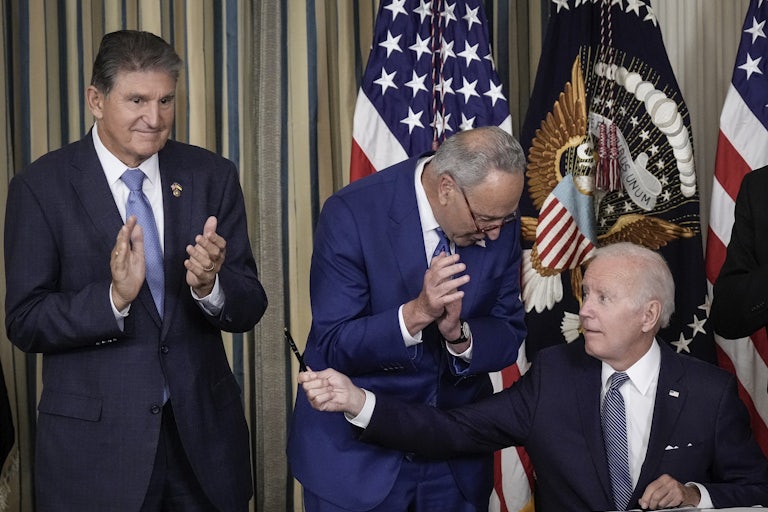
Biden gives Senator Joe Manchin the pen he used to sign the Inflation Reduction Act on August 16, 2022.

Everybody is in a tizzy about Joe Manchin’s retirement announcement. And maybe they should be. The conventional wisdom for months, or even for a couple years, has been that a presidential candidacy by the West Virginia senator under the “centrist” No Labels banner would mean the end for Joe Biden, and that’s the take in most of the insta-analyses I’ve read over the last 24 hours.

It’s also what I’ve always thought, and it stands to reason. Not because Manchin is a Democrat. But because it has been assumed that he splits the anti-Trump vote. But lately, even before this announcement, I’ve begun to wonder: What if Manchin is more likely to split the anti-Biden vote? In a moment, I’ll get to that case.

But first, let’s address the ramifications of Manchin’s announcement for control of the Senate. This, not the presidential implications, was what the media focused on first—that his decision imperils Democratic control of the Senate.

That’s a kind of base-covering or box-checking journalism that I suppose mainstream outlets feel they have a need to do, but it’s silly. Manchin had zero chance of holding his seat against GOP Governor Jim Justice. Not 10 percent. Not 5 percent. Zero. Justice has been consistently ahead by double digits in recent polls. One outlier poll—conducted, interestingly, for a GOP super PAC—had it at 6; but the most recent public polls pegged Justice’s lead at 12, 13, 22, and 14 percent.

The Democratic Party is all but dead in West Virginia. I say this with sadness, as a native of the state who remembers a day when everyone, from every member of Congress on down to the agriculture commissioner (Gus Douglass!), was a Democrat. The place was never a liberal nirvana, but there were a number of progressives in office, notably Ken Hechler, one of those longtime members of Congress, who’d been a Truman speechwriter and was the only member of the House to march with Martin Luther King Jr. from Selma to Montgomery.

Today? Three of the 34 state senators are Democrats. Three! They could hold their caucus meetings in a closet. And only 10 of the 98 state delegates are Dems (there are two vacancies). The three state senators are from the university towns of Morgantown and Huntington. Everywhere else, the party barely exists.

So that Manchin’s seat was lost was already a foregone conclusion, and anyone who argued otherwise was wasting time.

Now let’s get to a possible Manchin presidential candidacy. First of all, I don’t think it’s certain that he’ll run. I’d call it likely but not preordained. No Labels officials have said repeatedly that they don’t want to help reelect Trump. There is of course no reason to take those avowals at face value. But they can be leveraged by an effective Democratic opposition into pressure to force No Labels to stand down if polling shows consistently that it’d be doing exactly that. So I think there is still a chance that No Labels doesn’t field a candidate, or can’t get anyone of Manchin’s stature to agree to accept its nod, and ends up with a Howard Schultz–level figure.

Second, even if Manchin does run, it is no longer manifestly obvious that he hurts Biden more than he hurts Trump. Here’s the case, which rests on three points.

One: Manchin is basically against abortion rights. His ratings record from the pro-life groups is mixed, but that’s because he has a history of voting for larger Democratic bills that contain some language about abortion that those groups don’t like. And he did criticize the Supreme Court’s Dobbs decision. But on stand-alone abortion bills, he’s been consistently against choice.

The 2024 election is going to be as direct a nationwide referendum on women’s reproductive rights as we’ve ever had in this country. And as we’ve been seeing since last year and saw again Tuesday, masses of voters are heading to the polls to say they want the government to do something to preserve abortion rights. Manchin’s going to be asked about this constantly if he runs. He’ll bob and weave, but if the Democrats do a good job of letting people know about the anti-choice aspects of his record—for example, he was the only Senate Democrat to join 50 Republicans in opposing a 2022 bill that sought to codify Roe v. Wade—very few pro-choice Americans will vote for him. And that category includes not just Democrats but a majority of independents and even some Republicans.

Two: He’s just not that popular. And to the extent that he is popular, he is more popular among Republicans than Democrats.

In a recent PRRI poll, Manchin was viewed favorably by 12 percent, while 41 percent viewed him unfavorably. This man who gets so much positive Beltway press was viewed very favorably by 1 percent. This by the way was Americans, not West Virginians. And there’s a recent Morning Consult poll that ranked the popularity of every senator (these were statewide polls). It found Manchin to be one of the most unpopular senators in the country. Now that’s largely because he’s a Democrat in a Republican state. There are only seven senators who are underwater in the poll, and Manchin is one of them (the only senators deeper underwater are Susan Collins, Ron Johnson, and Mitch McConnell, who is down there in Mariana Trench territory).

But here’s the good news for Manchin, according to Morning Consult. Manchin’s 42–48 numbers are actually an improvement over the last time they polled this. And that improvement has been “driven largely by Republican voters.” That echoes the PRRI poll, which breaks down that 12 percent favorable rating by party. Manchin is lowest among Democrats (7 percent), with independents in the middle (13 percent), and Republicans viewing him most favorably (18 percent).

So a surge of disaffected Democrats is going to back this guy? I don’t buy it. In fact, if we agree that somewhere around 55 percent of Republicans are MAGA and 45 percent are not, which seems about fair based on polls, that tells me that there are, at least potentially, more—far more—disaffected Republicans who might pull for Manchin. If he runs, I suspect his polls will tell him this, and he’ll go hunting where the ducks are, as Barry Goldwater put it.

Three: his unapologetic pro–fossil fuel position. Again, it will be up to the Democrats to publicize this properly if he runs. But if they do, he will perform very poorly among voters who want the United States to move away from fossil fuels—and again, that is a category that includes independents and even some Republicans.

So it’s possible the conventional wisdom is way off here. The PRRI poll data seem to support my case. In the Biden-Trump head-to-head matchup, Biden leads 48–46. When they throw in Manchin and Cornel West, Manchin garners 10 percent and West 5, but Biden still leads Trump, 41–38. If Manchin were stealing all his votes from Biden, wouldn’t Trump have been ahead in the four-way?

Manchin is a Democrat in name. But his high-profile positions are essentially Republican ones. Or at least enough of them are that an effective Democratic spin operation can convince Democratic and a majority of independent voters that Manchin just isn’t a real option for them. It would be a delightful thing if we woke up next November 6 to see that Manchin and Robert F. Kennedy Jr. cost Trump, not Biden, the White House. It would certainly be the outcome they all deserve.

This article first appeared in Fighting Words, a weekly TNR newsletter authored by editor Michael Tomasky. Sign up here.