Behind the scenes at the Capitol—and beyond, by Grace Segers

Can Abortion Rights Voters Turn Florida Blue?

Democratic Senate candidate Debbie Mucarsel-Powell tells TNR that Sunshine State voters are “ready to come out to vote and protect reproductive freedom.”

Democratic Senate candidate Debbie Mucarsel-Powell is interviewed during a campaign event at the United Teachers of Dade headquarters in Miami, Florida.
Joe Raedle/Getty Images
Democratic Senate candidate Debbie Mucarsel-Powell is interviewed during a campaign event at the United Teachers of Dade headquarters in Miami.

This week, the Florida state Supreme Court issued two rulings with significant ramifications for abortion access in the state. In one decision, the justices overturned decades of precedent by ruling that the state constitution’s enumerated rights to privacy do not apply to abortion, which paves the way for a recently passed Florida law that bans the procedure at six weeks to go into effect beginning in May.

In their second ruling, however, the majority of justices found that a proposed constitutional amendment that would guarantee the right to an abortion up to 24 weeks of pregnancy could go on the ballot. In other words, the state legislature has had its say, now Florida voters will have the chance to provide an electoral riposte—and overnight, that pending ballot initiative becomes one of the hot tickets in an already heady election season.

But these decisions have major implications for abortion access not only in Florida, the nation’s third-largest state by population, but throughout the South as well. In 2023, more than 84,000 abortions were performed in the Sunshine State, with nearly 8,000 out-of-state residents obtaining an abortion in Florida.

Debbie Mucarsel-Powell, a former Democratic representative challenging incumbent Republican Rick Scott in the upcoming Florida Senate election, told The New Republic that she believes the two decisions by the state high court will not just be consequential for abortion access in the near future—but will have long-term political implications as well, in her state and beyond.

This interview with Mucarsel-Powell has been condensed and lightly edited.

What were your initial reactions to the state Supreme Court decisions released this week?

I had a lot of mixed feelings—because by them upholding the 15-week abortion ban, we know that in 28 days, the six-week abortion ban will go into effect. And it’s a near-ban on all abortions with hardly any exceptions for incest and rape. And I’m very concerned about the safety and the health of women in Florida and in the Southeast region. So many women from the Southeast region come [here] to receive care.

I’m really concerned to see a rise in maternal mortality rates. And it’s an issue that, as someone that came from Latin America, I have seen what happens when women don’t have access to this key critical reproductive health care. It affects, of course, Black women and Latino women disproportionately. And those are the first thoughts that came to my mind when I saw that.

And then at the same time, the good news is that Floridians are going to have the opportunity to make sure that they come out in November to protect their freedoms, their rights. This is an opportunity for us to make sure that we enshrine reproductive health care into the state constitution. But it’s not going to mean anything if Floridians come vote to make it a part of the state constitution to protect a woman’s reproductive health care and abortion care, if then Florida reelects Rick Scott [and] he goes back to the Senate and pushes the national abortion ban. And so I think that my race now is more critical than ever.

Do you think that engagement and interest regarding the ballot initiative on abortion will juice turnout in November, and perhaps get more people aware of your election and more excited about it?

I’ve been in Florida now seeing this grassroots movement and the energized groups that have been on the ground, that actually obtained over a million and a half signatures to make sure that we put this amendment on the ballot in November, and it included [around] 150,000 Republican registered voters. And I’ve been traveling across the state, and people in Florida are ready. They’re ready to come out to vote and protect reproductive freedom, and they’re ready to retire Rick Scott.

Everywhere I go, people know exactly who Rick Scott is. And they know that he’s someone that wants to push an abortion ban, that he proudly said he would have supported a six-week abortion ban if he was governor. And he also, of course, wrote that plan to sunset Social Security and Medicare. He wants to eliminate the [Affordable Care Act]. I mean, there’s so many issues in front of Floridians, and they understand, very well, the stakes. And I think that we are going to see huge turnout because of the amendment, but also because of all these issues, and because we have been present in the state in all these communities, talking to them directly about what it would mean if Rick Scott gets back into the Senate.

[Author’s note: When he was chair of the National Republican Senatorial Committee in 2022, Scott authored a proposal that would sunset all legislation after five years, including Social Security and Medicare. Under pressure from his own party, Scott later amended the plan to exclude entitlement programs.]

Florida has a significant Latino population, which has been critical in recent elections, but with whom Democrats have really struggled to engage. So how do you connect with Latino voters, but specifically on issues of abortion and reproductive care?

I’m a Latina, and I’ve been very present in my community for years before I was elected to serve in Congress, during Congress, after Congress. I have been speaking to our communities in Spanish radio, Spanish media, about issues that matter most to them. One of them is gun safety. Latinos understand what it means to live under government control, under political violence, political persecution. And I can tell you that my story is the story of so many Latinos living in South Florida, but also Floridians across the state. And so I feel very strongly that when you are present in our community, they come and vote for the person that’s going to represent them. And that’s what happened in 2018; it’s the same thing that’s going to happen now in 2024.

[Author’s note: Mucarsel-Powell was elected to the House in the “blue wave” of 2018.]

And let’s remember one thing: Argentina, Colombia, Mexico—very conservative countries in Central and South America—passed laws to protect access to abortion and reproductive rights. Because there’s a direct link to violence against women when you don’t have that care, that access to care, and also high levels of maternal mortality. And because of that, women organized in Latin America and were able to put pressure on the government to pass these laws. And so Latina women are Latinas for choice. They don’t want the government interfering in these private matters. They don’t want politicians making those decisions for them. Many of us have left that government to come to America to experience freedom and democracy. And that resonates because it resonates with me as a Latina, and it resonates with our communities in Florida.

[Author’s note: Argentina recently legalized abortion, and the procedure is decriminalized in Mexico and Colombia.]

Do you think that the National Democratic Party should be investing more in Florida and paying more attention to your race specifically?

I’m running because I want to represent all Floridians in the state. I have been called to serve. And I decided very early on that this is going to be my campaign to make sure that I have all the resources; that I have all the support inside of our state. Now I have also said that Florida is a state that’s worth fighting for and investing in. I have been saying this even before I launched my campaign to run for Senate. We are 20 million Americans living in the state of Florida under extremists that are trying to hijack the state, that have tried to paint a facade that is completely false that our state is red. The extremists up at the top—including Rick Scott, who is the poster child for extreme policies in Washington—don’t represent our values. We are a third independent voters, a third Democrats, a third Republicans. We are a bright purple state, and we are ready to vote for our rights, to protect our rights and freedoms in November. And so it would be a huge mistake for anyone to underestimate who we are in Florida.

On the ballot language on abortion: That amendment would protect abortion rights through viability, around 24 weeks. Some abortion rights advocates worry that protecting abortion through viability isn’t sufficient to ensure that everyone has abortion access. Do you believe that language, protection through viability, does enough to protect abortion rights?

I’m focusing on fighting to stop the six-week ban on abortion, and I completely support the abortion ballot measure the way that it’s written.

This article first appeared in Inside Washington, a weekly TNR newsletter authored by staff writer Grace Segers. Sign up here.


The Tragic Fallout of the World Central Kitchen Airstrikes

The IDF’s attack on food aid workers in Gaza is roiling Washington—and having a chilling effect on everyone working to stave off starvation.

One of the vehicles where employees from the World Central Kitchen were killed in an Israeli airstrike.in Deir Al-Balah, in the central Gaza Strip,  Majdi Fathi/Getty Images
Majdi Fathi/Getty Images
One of the vehicles that carried employees from the World Central Kitchen who were killed in an Israeli airstrike, in Deir Al-Balah in the central Gaza Strip

This week, after Israeli airstrikes killed seven workers from World Central Kitchen—the globe-trotting food aid organization famous for showing up wherever there are people in need (including Washington, during government shutdowns)—multiple humanitarian organizations have suspended their operations in Gaza due to concerns about the safety of their staff. These workers were killed despite traveling through a “deconflicted zone” in armored cars clearly labeled with the World Central Kitchen logo and sharing their movements with the Israeli military. World Central Kitchen, a humanitarian organization founded by celebrity chef José Andrés, is among the groups pausing their operations in Gaza, even as more than one million Palestinians are on the brink of starvation.

Andrés told Reuters in an interview that the convoy had been targeted “systematically, car by car.” “This was not just a bad luck situation where ‘oops,’ we dropped the bomb in the wrong place,” Andrés said. The strikes hit the convoy shortly after it left its warehouse in Deir Al Balah, where it unloaded over 100 tons of food aid.

Jeremy Konyndyk, the president of Refugees International and a former top official at USAID, called the strike on the World Central Kitchen convoy a “significant escalation,” notable in part because the organization had worked to coordinate their efforts with the Israeli military. But he also noted that many Palestinian aid workers have been killed since the onset of the war in October; the United Nations has reported that more than 180 humanitarian workers have died.

“Israel is trying really hard to portray this as a one-off, an accident and aberration, and it’s none of those things. The only thing that is different here is that it was international personnel,” Konyndyk said. “This one is different in degree—it is even more egregious, it is more severe, it is grotesque. But it is grotesque in a way that follows a pattern of [Israel Defense Forces] behavior.”

Anera, an organization that provides aid in the Middle East, which has partnered with World Central Kitchen and other groups, is also temporarily suspending its operations. The deaths of the humanitarian workers this week come after the killing of Anera worker Mousa Shawwa last month. As with the seven workers killed this week, Shawwa had shared his coordinates and movements with the Israeli military before his death. Sandra Rasheed, the Palestine director for Anera, said in an interview that aid workers in Gaza had been concerned about their safety after the death of Shawwa and his young son shortly thereafter.

“When April 1 happened, and the WCK convoy was deliberately and intentionally targeted and attacked, and there were seven people that were killed that day, that was a real big shocker to them. They were really worried, [and] they knew that it could have been them,” Rasheed said about the Anera workers, who coordinated closely with World Central Kitchen on the ground. Although Israeli Prime Minister Benjamin Netanyahu confirmed that strikes occurred, he called them “unintentional,” and other Israeli military leaders have characterized them as an error—but this does not reassure Anera workers, Rasheed said.

The deaths of the World Central Kitchen workers have invited international condemnation, including some of the strongest criticism from President Joe Biden. (The Biden administration has continued to approve munitions and aid for Israel, although Congress has not approved new military assistance since the Hamas attack on Israel on October 7.) In Washington, Andrés is an institution, respected across the political class; the deaths of the World Central Kitchen staff may thus resonate with American politicians more than the everyday devastation of Israeli strikes in Gaza. Rasheed theorized that the international community had become accustomed to the deaths of Palestinians, which have topped 30,000, according to health officials in Gaza.

“When the world sees images of international aid workers who are going into a crisis situation, who are going there to serve and to support the people, and then they are killed, that is a shock for them,” Rasheed said.

The pause in operations is temporary, Rasheed said, noting that Anera is still working on aid procurement. However, she said that she would like to see accountability for the Israeli military and more pressure put on the U.S. to stop supplying weapons to Israel.

“Are we being naïve that that would happen? I’m not so sure. I think that the shock of what happened and even some of the initial language of what President Biden said, shows an indication that people are starting to think that people need to be held accountable, that this needs to stop,” Rasheed said.

In a statement on Tuesday, Biden said that he was “outraged” by the incident. However, Politico reported that, while privately “angry,” Biden did not plan on changing the country’s policy toward Israel anytime soon.

“It’s very hard for me to see any real prospect of Israeli behavior changing without the U.S. government majorly upping the ante. Netanyahu has shown repeatedly that he will happily ignore the guidance that he gets,” argued Konyndyk. “As long as the approach of the U.S. government is to urge him to change, rather than deploy leverage to force him to change policy, he won’t change.”

This article first appeared in Inside Washington, a weekly TNR newsletter authored by staff writer Grace Segers. Sign up here.

The Mifepristone Case Isn’t the Endgame for Abortion Opponents

The Supreme Court was skeptical of this week’s case, but less spurious legal challenges are on the horizon.

Demonstrators outside the Supreme Court
Michael Nigro/Pacific Press/LightRocket/Getty Images
Demonstrators outside the Supreme Court on Tuesday

The Supreme Court on Tuesday appeared skeptical of arguments in favor of limiting access to mifepristone, a medication approved long ago by the Food and Drug Administration for abortions—at least on the grounds that the plaintiffs, a group of anti-abortion doctors who haven’t actually prescribed the drug, had standing to claim that its availability somehow injured them. Justice Neil Gorsuch mused that the case could be “a prime example of turning what could be a small lawsuit into a nationwide legislative assembly on an FDA rule or any other federal government action.”

This is the first major abortion-related case the Supreme Court has heard since the conservative majority overturned Roe v. Wade in 2022. The FDA approved mifepristone in 2000, but attorneys for the plaintiffs—the Alliance for Hippocratic Medicine, which set up shop shortly after Roe was overturned—asked the court to block rules the agency implemented in 2016 and 2021 that made it easier to access the drug, including by mail. (Medication abortion represented 63 percent of all U.S. abortions in 2023, according to data from the Guttmacher Institute, and it’s believed that the rise in abortions since Roe was overturned is largely due to the availability of abortion pills by mail.)

The court will release a decision by early July at the latest, but even if mifepristone survives this ruling, abortion opponents will continue to bring legal challenges against the drug. States that have implemented abortion restrictions “will file copycat lawsuits to try to restrict access to medication abortion in every state in the country,” warned Julia Kaye, a senior staff attorney with the American Civil Liberties Union Reproductive Freedom Project.

During oral arguments on Tuesday, Justices Samuel Alito and Clarence Thomas indicated another potential legal avenue for restricting mifepristone: They frequently mentioned the Comstock Act, a nineteenth-century law that bans sending obscene material and drugs for abortions through the mail. The federal government effectively stopped enforcing the law nearly a century ago, and the courts have narrowed interpretation of the law to apply only to mailing explicitly illegal material. However, as my colleague Melissa Gira Grant wrote last year, abortion opponents have sought to revive the Comstock Act to block abortion medication.

“This case is just one inflection point in an ongoing assault by anti-abortion extremists against all of our freedoms, both from the state and local level to the federal level,” said Mini Timmaraju, the president and CEO of Reproductive Freedom for All, an advocacy group that supports abortion access.

A coalition of conservative groups, led by the Heritage Foundation, has prepared a nearly 1,000-page “playbook” for a potential Republican president in 2025, including plans to restrict abortion. This would include directing the FDA to rescind its approval of mifepristone and stopping “promoting or approving mail-order abortions in violation of long-standing federal laws that prohibit the mailing and interstate carriage of abortion drugs”—a reference to the Comstock Act.

Meanwhile, former President Donald Trump, the presumptive GOP nominee, has mulled supporting either a 16-week or 15-week ban on abortion, with some exceptions. Republicans in Congress have also proposed bills to limit abortion, such as legislation that would roll back the FDA regulations allowing telemedicine prescription and mail delivery of mifepristone and even ban medication abortion altogether. Although efforts to restrict mifepristone tanked an agriculture appropriations bill last year, abortion opponents hope that a Republican in the White House and GOP majorities in both chambers of Congress could strengthen their hand.

On top of the 14 states that have banned abortion outright, 12 other states have passed at least one restriction on telehealth medication abortion. Meanwhile, blue states have begun adopting “shield laws” to protect doctors from prosecution should they prescribe abortion medication for out-of-state patients. Progressive groups have also championed state ballot initiatives to protect the right to an abortion in red states.

“We are in the states fighting around these ballot initiatives and fighting for governors, and A.G.s, and state legislatures that will uphold reproductive freedom,” said Timmaraju.

Vibe check: The scene outside of the Supreme Court

Each week, I provide an update on the vibes surrounding a particular policy or political development. This week: The scene on the ground at the Supreme Court on Tuesday.

The scene outside the Supreme Court on Tuesday morning was a familiar one, as anti-abortion and pro-Roe demonstrators held competing rallies. There were signs calling abortion a “human right” and signs declaring, “Abortion pills are murder”; anti-abortion rallygoers lying on the ground in protest and abortion supporters in Planned Parenthood pink dancing as Beyoncé’s “Cuff It” thumped from massive loudspeakers.

Shanay Watson-Whittaker, the director for Michigan campaigns at Reproductive Freedom for All, had traveled from her home state. Bedecked in the organization’s signature deep purple, Watson-Whittaker spoke of her six children in their mid-twenties. “This is about their future. It’s up to them what they want to do with their bodies, and I want to make sure that the government does not interfere with that,” she said. “I’m here to make my voice heard for them and their future.”

Inside the courthouse, most justices appeared skeptical about whether the anti-abortion doctors could prove concrete harm from mifepristone. Kaye argued that the case “should have been laughed out of court from the start,” adding, “We are certainly hoping that the justices will recognize that anti-abortion groups’ arguments in this case defied bedrock legal principles and are not based on a shred of credible evidence.”

But Kristen Day, the executive director of Democrats for Life, argued that “this is about providing medication to women without a doctor.”

“As Democrats, we support regulation. We support regulation in every avenue. And for some reason we’ve carved out abortion as, ‘Let’s give this to women without regulations and health and safety standards,’” Day said outside the court, as she waited to speak before the crowd of abortion opponents. (As the American College of Obstetricians and Gynecologists noted in an amicus brief in this case, “Serious side effects occur in less than 1% of patients, and major adverse events—significant infection, blood loss, or hospitalization—occur in less than 0.3% of patients.”)

While mifepristone can be prescribed by a doctor or obtained through a clinic, including via telehealth, a patient’s ability to access it may depend on how strictly their state has restricted abortion; the legality of using mifepristone in a state where abortion is banned is murky.

In April, the Supreme Court is expected to hear oral arguments in a case relating to a federal law allowing emergency access to abortion procedures. One thing is all but certain: When the court next convenes to consider a case relating to abortion rights, there will be protesters jostling outside, shouting to have their voices heard.

What I’m reading

Can this forgotten anti-poverty program be saved? by Grace Segers in The New Republic
Can a tribe’s religious freedom claims halt a major copper mine? by Taylar Dawn Stagner in Mother Jones
‘The whole bridge just fell down.’ The final minutes before the Key Bridge collapsed, by Lee O. Sanderlin and Adam Willis in The Baltimore Banner
In a secret game of prisoner swaps, Putin has held most of the cards, by Aruna Viswanatha, Bojan Pancevski, Drew Hinshaw, and Joe Parkinson in The Wall Street Journal
Living abroad, Jim McDermott finds his liberal utopia, by Ariel Cohen in Roll Call
Why some LGBTQ+ groups oppose the current Kids Online Safety Act, by Jasmine Mithani in The 19th
How Kate Cox became a reluctant face of the abortion rights movement, by Charlotte Alter in Time

Pet of the week

Want to have your pet included at the bottom of the next newsletter? Email me: gsegers@tnr.com.

This week’s featured pet was submitted by Tom Grafton. Hank is pictured after a long day at the dog park.

The Popular, Bipartisan Bills That Can’t Get Passed

They’re good ideas, they poll well, and they enjoy the support of Republicans and Democrats. And they haven’t got a hope in hell.

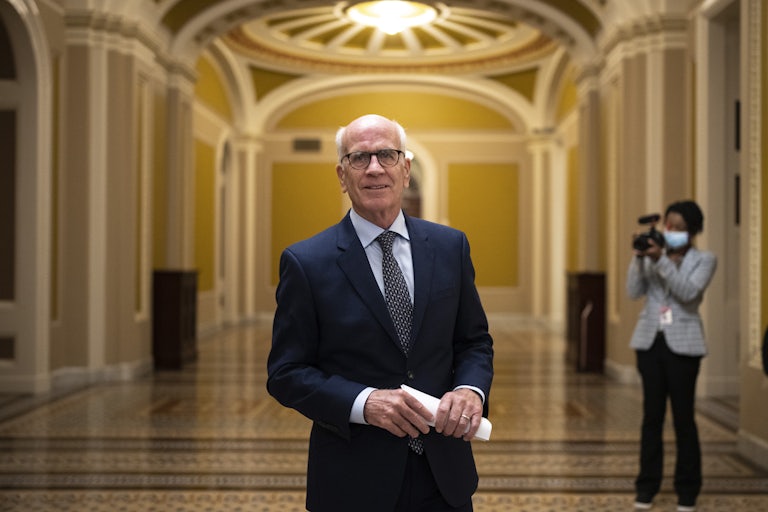
Vermont Senator Peter Welch walks through the hallways of the Senate at the U.S. Capitol.
Drew Angerer/Getty Images
Vermont Senator Peter Welch introduced the Affordable Connectivity Program Extension Act in the Senate.

Every once in a while, a bipartisan group of lawmakers comes together to support a popular policy that fulfills the interests of industry leaders and everyday Americans alike. These instances are supposed to be the slam dunks of legislating, a time for lawmakers to prove they are interested in governing to the advantage of their constituents.

It’s all easier said than done.

So it goes with the Affordable Connectivity Program Extension Act, bipartisan and bicameral legislation to fund a program that aims to provide 23 million households with affordable internet access. Unless the Affordable Connectivity Program, or ACP, receives an additional $7 billion in funding from Congress, April will be the final full month that households will receive the benefit. In early February, the program stopped accepting new enrollment.

“It’s a good thing that the program has broad bipartisan support. It’s a terrible thing that no one has been able to figure out how to turn that support into actual dollars for the program,” said Greg Guice, chief policy officer at the Vernonberg Group and spokesperson for the Affordable Broadband Campaign.

As a supplemental funding request, the ACP Extension Act was designed to be attached to a larger legislative vehicle. This week, Congress is considering the second tranche of bills to fund the government for the current fiscal year. It’s unlikely that the bill will be tacked onto this spending minibus, and it’s unclear when another opportunity to approve the additional funding for the ACP might arise. So the Federal Communications Commission, telecommunications companies, and low-income Americans alike are bracing for the end of the program.

Senator Peter Welch, the Democrat who introduced the bill in the Senate, said that while the funding bill was not the “last opportunity” to approve the ACP Extension Act, it nevertheless represented “the best opportunity” to get the measure over the goal line. “The ACP has a lot of support, but finding a vehicle to include it, on a practical level, is the challenge,” Welch told me.

The ACP provides up to $30 monthly discounts on internet bills for low-income families and up to $75 monthly discounts for eligible households on tribal lands. It is used by low-income Americans in urban, suburban, and rural areas; it benefits families in red and blue states alike. Indeed, eight of the states that rank highest for enrollment—Louisiana, Kentucky, North Carolina, Ohio, South Carolina, Mississippi, and Oklahoma—are largely controlled by Republicans. In November, 26 governors of both parties sent a letter to congressional leaders requesting Congress work with the Biden administration to extend the program.

According to a recent national survey by the Benenson Strategy Group, 49 percent of ACP participants are military families and 19 percent are households with seniors. That same report found that 95 percent of participants said they would struggle with costs if the program is not reauthorized, 75 percent said they fear losing online health care services, 65 percent fear job loss, and 81 percent of parent participants would worry about their child falling behind in school.

Research by the Benton Institute for Broadband and Society has shown that the ACP has helped connect more Americans to the internet. In a recent ethnographic survey, the AARP further found that internet access helps older Americans maintain connections and adapt to a changing world, with participants calling the loss of the ACP “unthinkable.” Some reports also demonstrate a clear economic benefit: Recent analysis by Benton found that every dollar spent on ACP subsidies “returns nearly two dollars in impacts to those using the program.”

ACP supporters outside of Congress comprise a broad coalition, from telecommunications companies like AT&T and Verizon to advocacy groups like the NAACP, the AARP, and the American Civil Liberties Union. It’s also popular with voters: A recent poll by the Digital Progress Institute found that majorities of Republican, independent, and Democratic voters support extending the ACP.

Nevertheless, the program has its detractors. Some Republican lawmakers have questioned whether ending the ACP would truly result in millions of Americans losing their internet access, with several writing in a December letter to FCC Chairwoman Jessica Rosenworcel that “it appears the vast majority of tax dollars have gone to households that already had broadband prior to the subsidy.” Senator Ted Cruz has also argued that the ACP is redundant, given a preexisting program called Lifeline intended to lower the cost of broadband. (The discount offered by Lifeline is far lower than that of the ACP, and it also has more stringent eligibility requirements.)

However, a recent survey by the FCC found that 68 percent of ACP recipients had inconsistent or no internet service prior to enrolling in the program, with the majority of those respondents citing affordability as the biggest roadblock to obtaining service. The survey also found that 29 percent of participants would drop their internet service provider if they no longer received the $30 discount monthly. The ACP—which was established by the 2021 bipartisan infrastructure law—replaced the pandemic-era Emergency Broadband Benefit Program, which had around nine million participants. Many who received subsidies through that program then transferred to its successor.

With congressional action uncertain, the FCC is preparing for the wind-down of the ACP. Participants may receive a partial ACP benefit in May, with the amount determined by individual service providers. Qualifying ACP participants earning under a certain threshold could apply for Lifeline, although several providers that participate in ACP do not also participate in Lifeline. Some cities and states have their own internet subsidy programs, and several internet service providers have discounts for low-income and elderly users.

Even if Congress did approve legislation to extend the ACP, it would only keep the program solvent for the next year. A longer-term solution, Guice said, would be for the FCC to expand its revenue base for the universal service fund, which collects money from telecommunications companies with the goal of providing universal internet access. Unlike the ACP, the universal service fund is not subject to the congressional appropriations process.

“What we have now proven, I believe, is that if you leave it to Congress to figure out how to help low-income families get broadband, they’re clearly going to get it wrong,” said Guice. “That failure demonstrates why we cannot let low-income broadband services be provided for through the appropriations process.”

This article first appeared in Inside Washington, a weekly TNR newsletter authored by staff writer Grace Segers. Sign up here.
Vibe check: Progress on special immigrant visas for Afghans

The funding minibus that will theoretically be approved by Congress in the coming days includes a provision to add 12,000 special immigrant visas, or SIVs, for Afghans who helped the United States during its war in Afghanistan. The current cap is 38,500 SIVs, a congressionally authorized limit that was expected to be reached around the August anniversary of the withdrawal of U.S. forces from Afghanistan.

This number falls short of the 20,000 additional visas sought by the Biden administration. Still, advocates are celebrating the increase as a qualified victory—an improvement on the current situation, if still insufficient to address the overarching need.

“It’s not a silver bullet, but it is rare in this work that we’re able to celebrate our victories,” said Shawn VanDiver, the founder and president of #AfghanEvac, a coalition that helped to evacuate Afghans during the withdrawal. The authorization of additional SIVs provides “breathing room” for the program, as it grants additional time before the cap is reached and helps thousands of Afghans eligible for SIVs in the U.S. who arrived before completing their application process.

Adam Bates, the supervisory policy counsel at the International Refugee Assistance Project, or IRAP, said in a statement that the “authorization of additional visas extends a vital lifeline for Afghans who risked their lives on behalf of the U.S. mission in their country, but it’s not nearly enough to fulfill the promises the U.S. government made to Afghan allies.” IRAP has undertaken a class-action lawsuit challenging federal delays in SIV application processing.

“With an application backlog of more than 100,000 applicants, many of whom have waited for years, Congress must continue authorizing additional visas until every eligible applicant has one,” Bates said.

Representative Jason Crow, a veteran who served in Afghanistan, said that Congress would need to approve more SIVs next year. “We think [it] gives us time over the next year to process those who are in the immediate pipeline and have passed the chief admission approval or prepared for interviews, but certainly next year we’ll have to go back for more,” Crow said. The State Department has said that the agency is issuing 1,000 visas per month, meaning that the additional 12,000 will likely not last as long as some advocates would hope.

Remember the previous segment of this newsletter, when I talked about bipartisan and bicameral bills that, for whatever reason, are unable to pass? One such measure is the Afghan Adjustment Act, legislation that would expand eligibility for SIVs, streamline the SIV application and approval process, authorize additional SIVs, and provide Afghan evacuees paroled into the U.S. who are not eligible for SIVs with a pathway to permanent residency. A group of senators unsuccessfully attempted to tack on an amendment based on the Afghan Adjustment Act to a national security supplemental bill approved last month. (Another, slightly narrower bipartisan bill, the Afghan Allies Protection Act, has also been unable to garner sufficient support to be approved.)

Senator Richard Blumenthal, a co-sponsor of the Afghan Adjustment Act in the Senate, echoed the sentiment that increased SIV numbers were preferable to inaction. “Any number is better than none, but I still hope the Afghan Adjustment Act will be approved,” Blumenthal said.

Another co-sponsor of the bill, Republican Senator Jerry Moran, also praised the addition of SIVs to the minibus even as he called for the passage of the Afghan Adjustment Act. “I don’t think it diminishes the political support or the need for the Afghan Adjustment Act, but it will help many Afghans who helped the United States have a future,” Moran told me.

However, with thousands of Afghans paroled into the U.S. having already applied for asylum, VanDiver worried that passing the Afghan Adjustment Act might eventually become a moot point. “I’d like to see adjustment, but the challenge is that Congress doesn’t seem willing to do it,” said VanDiver. “We’ll have most of the asylum [claims] adjudicated for these Afghans by the time Congress passes anything.”

Helal Massomi, the Afghan policy adviser at Global Refuge, a refugee advocacy and resettlement organization, argued that passing the Afghan Adjustment Act when it was first introduced would have solved some of the issues relating to SIV availability and backlog. “If there is a problem with SIVs right now, it’s because Congress doesn’t act on time, or act at all,” said Massomi, who herself had to evacuate from Afghanistan. “If they don’t pass the Afghan Adjustment Act, we will keep facing these kinds of problems.”

Moran said that “the urgency seems to be missing” from those in Congress who do not support the bill. “Even when there’s a sense of urgency around here, things happen without a lot of urgency,” Moran noted wryly.

Massomi also noted the time crunch regarding the impending presidential election. Former President Donald Trump, the Republican nominee, issued a ban on people from Muslim-majority countries entering the U.S. as one of his first acts in office, and may be less inclined to support efforts to expand SIV access.

“It’s time for the leadership in the House, the leadership in the Senate, to do something. If the administration changes, if we have another president, it will be extremely hard for Afghans to be resettled here,” Massomi said.

What I’m reading

Irish Wish is a crypto-fascist, AI-generated harbinger of doom, by Rachel Handler in Vulture

D.C.’s crime problem is a democracy problem, by Harry Jaffe in The Atlantic

Beyoncé has a country hit. How will country radio handle that? by Emily Yahr in The Washington Post

‘It feels like a mountain you never get done climbing’: Covid isn’t over for disabled and older adults, by Sarah Luterman in The 19th

Young people don’t want to farm anymore. Can Pennsylvania change their minds? by Marcia Brown in Politico

Pet of the week


Want to have your pet included at the bottom of the next newsletter? Email me: gsegers@tnr.com.

This week’s featured pet was submitted by The New Republic’s own Alex Shephard. Harriet is nine and a half. “Last year, she barked 19 times. This year, she has barked zero times,” Alex says. “Sweet and stubborn, she is as fiercely loyal to her many friends as she is to her numerous enemies (the bus, the street sweeper, shopping carts, plastic bags blowing in the wind).”

Washington Is Leaving Haiti in Limbo

Aid to the embattled Caribbean nation is caught in a Capitol Hill logjam. But this is no ordinary partisan impasse.

A protester reacts while tires burn in the street during a demonstration following the resignation of its Prime Minister Ariel Henry, in Port-au-Prince, Haiti.
Clarens Siffroy/Getty Images
A protester reacts while tires burn in the street during a demonstration following the resignation of Prime Minister Ariel Henry, in Port-au-Prince, Haiti.

This week, embattled Haitian Prime Minister Ariel Henry agreed to resign. He had spent the last week stranded in Puerto Rico, unable to return, as armed gangs took control of the airport in Haiti’s capital, Port-au-Prince. Henry’s announcement came after negotiations involving Haitian stakeholders, Caribbean leaders, and U.S. and Canadian officials resulted in the proposed creation of a presidential transition council. Henry, who was appointed—not elected—with international backing, had served as leader of Haiti since the 2021 assassination of President Jovenel Moïse. Haiti has been wracked by violence in recent years, with gangs controlling 80 percent of Port-au-Prince.

Kenyan officials had previously vowed to lead a multinational security support mission in the form of a deployment of 1,000 police officers to help combat the gangs. On Monday, Secretary of State Antony Blinken pledged an additional $100 million to finance the deployment; this brings the total promised contribution to $300 million, along with $200 million promised by the Department of Defense.

The Biden administration has also called on congressional Republicans to release a hold on an additional $40 million in pledged funds, arguing that it is necessary for a multinational force led by Kenya to deploy.

“The security force was needed months ago, but now it’s really needed,” said Senator Tim Kaine, the chair of the Senate Foreign Relations Subcommittee that oversees Western-hemisphere policy. “It would be a disaster if they were to say, ‘Well, we can’t do it, because the U.S. isn’t meeting its commitment.’”

Lawmakers have released $10 million of the pledged funds, although a congressional Republican aide said that money had not yet been spent by the administration. On Wednesday, House Minority Leader Hakeem Jeffries said in a letter to Speaker Mike Johnson that “it is imperative that the United States ensures they have the resources to complete the mission.”

“The situation on the ground in Haiti has rapidly deteriorated while House Republicans have refused to deliver the resources necessary to carry out this mission,” Jeffries wrote. “It is not in America’s national security interests to hold up the transfer of funds that support security stabilization in Haiti, particularly given the present crisis on the ground.”

The State Department says that it has briefed Republicans in Congress on the planned deployment multiple times, but GOP lawmakers and staff say that they have not received key logistical information on how long the deployment would last and what the long-term goals are, not to mention how to transport the Kenyan force when the airport is currently closed. While the GOP congressional aide said that the White House has offered an organizational structure, this does not include specific price tags or timelines.

“We need to feel some level of confidence that this is an effective plan moving in an effective direction. And we’ve given money to support moving in that direction, but then they’ve not reciprocated with anything to kind of instill confidence,” the aide said.

Moreover, after Henry’s announcement this week, Kenyan officials said that the deployment is on hold until a new government is formed, raising further questions about how the United States can and should respond to the ongoing crisis.

“We remain confident that the mission will go forward,” a senior State Department official told reporters in a press call on Tuesday. “In all the conversations we’ve had, Kenyan officials have said that they intend to go forward and they intend to lead this mission.”

But Haiti has a complex history of international interventions, from its founding more than 200 years ago in a revolution by enslaved people overthrowing the French colonialist power. In 2010, thousands of Haitians died in a cholera outbreak that was sourced to a U.N. peacekeeping camp established after a devastating earthquake.

“You just have this cyclical pattern in Haiti of intervention, and things get worse after the intervention. And I think there is a knee-jerk reaction where people say, ‘Well, it’s entirely because of the intervention, so we shouldn’t have any interventions ever again,” said Sophie Rutenbar, a visiting fellow at the Brookings Institute who previously served as mission planning officer for the United Nations Integrated Office in Haiti.

The U.S. in particular must strike a delicate balance in offering assistance to Haiti, given how the Haitian people might interpret the superpower next door barging into their affairs.

“The role that the U.S. should play is following the people of Haiti, what they want to do, listening to them, and listening and letting CARICOM lead,” said Representative Gregory Meeks, the Democratic ranking member of the House Foreign Affairs Committee, referring to the coalition of Caribbean countries. “It should not be us imposing anything on anyone in Haiti. The voices of the Haitian people need to be heard.”

Representative Ayanna Pressley, a co-chair of the House Haiti Caucus who has a large Haitian population in her Massachusetts district, also highlighted her support for a transitional government. “The United States and international community must help restore security to Haiti and work toward a just and stable future that the Haitian people deserve,” Pressley said in a statement. “With Prime Minister Henry rightfully stepping down, that means facilitating the establishment of a representative transitional government led by Haitian civil society, disrupting arms trafficking to the island, and providing urgent humanitarian relief.”

Of course, some in Haiti have opposed the presidential transition council proposed by CARICOM, with gang leaders in particular arguing that they should have a seat at the table. “We Haitians have to decide who is going to be the head of the country and what model of government we want,” Jimmy Chérizier, a gang leader known as Barbecue, said this week. “We are also going to figure out how to get Haiti out of the misery it’s in now.”

Whether and when congressional Republicans release the hold on aid, the Kenya-led mission in Haiti will likely not be the end of American engagement in the country.

“The U.S. has a huge impact on Haiti concretely in terms of money, engagement, and aid, but it also has a big impact in terms of its symbolic [role] in the Haitian imagination,” Rutenbar said.

This article first appeared in Inside Washington, a weekly TNR newsletter authored by staff writer Grace Segers. Sign up here.

Vibe Check: Farm bill futures

And now we return to everyone’s favorite topic: the farm bill. (Well, it’s one of my favorite topics, anyway, and it’s my newsletter, so …)

Let’s cast our minds back: Congress was supposed to approve a new farm bill—the massive legislation that covers nutrition, farming, and conservation policy—in 2023, five years after the 2018 farm bill went into effect. But negotiations stretched into this year, with Congress passing a one-year extension of the 2018 measure. The House Agriculture Committee is expected to release text of its version in the coming weeks, with a committee markup and vote sometime this spring. But funding for the farm bill remains controversial, with Republicans seeking to claw back funds from one of Democrats’ signature legislative achievements.

Republicans are looking to repurpose about $15 billion in funding intended for “climate-smart” agriculture policies, as approved in the Inflation Reduction Act, the 2022 climate, health, and tax policy bill passed by Democrats. Republicans want to use those funds that have not been obligated for something other than fighting climate change. GOP lawmakers have also suggested restricting future updates to the Thrifty Food Plan, the method by which the federal government determines benefits for the Supplemental Nutrition Assistance Program, or SNAP, also known as food stamps. The Biden administration updated the Thrifty Food Plan in 2021, which resulted in increased benefit amounts for SNAP recipients; the proposed change by Republicans would not affect current benefits.

“We don’t do any harm. We can find significant pay-fors without doing harm to either conservation or nutrition or the CCC,” Agriculture Committee Chair Glenn Thompson, a Republican, told me, also referring to the Commodity Credit Corporation, a line of credit tapped by the Department of Agriculture that GOP lawmakers would like to restrict. Under the GOP proposal, the Thrifty Food Plan could still be increased based on “cost of living adjustments,” Thompson said, but the plan would also “prevent any future administration from manipulating other variables.”

“But it would also prevent any future administration from arbitrarily cutting benefits. It’s kind of a firewall,” Thompson argued. (Thompson also recently laid out these arguments in an op-ed for Agri-Pulse.)

In 2018, the House version of the farm bill passed along party lines, thanks to GOP cuts to SNAP; Thompson hopes that this year will not be so partisan. Indeed, there are expected to be $75 billion worth of bipartisan programs in this year’s bill.

“At the end of the day, when you’ve got strong bipartisan policy, that normally results in strong bipartisan support,” Thompson said.

But Democrats are deeply displeased with these proposed Republican revenue streams. Senate Agriculture Committee Chair Debbie Stabenow, a Democrat, has argued that restrictions to the Thrifty Food Plan would lower the amount the formula is increased in the future, which in turn would result in smaller increases in SNAP benefits. Democrats are also largely against any rescissions in Inflation Reduction Act funding, and Stabenow—who is retiring at the end of this year—has threatened to block passage of the farm bill over these GOP proposals.

“[Republicans] double down on the cruelty [in] every farm bill, and I don’t want to be part of any of that,” said Democratic Representative Jim McGovern, a member of the Agriculture Committee. “I’m not going to support a farm bill that increases hunger in America. I’m not going to support a farm bill that goes after conservation programs.”

While introducing a farm bill would put pressure on members who represent agricultural interests in their districts, Democrats have thus far been largely united. For Representative Nikki Budzinski, a freshman Democrat whose southern Illinois district includes rural communities, passing a bipartisan farm bill is a major priority. But she put an emphasis on the “bipartisan”—meaning, without changes to the Thrifty Food Plan or the IRA’s conservation provisions. She argued that the nutrition, conservation, and farming elements of the bill are “very cyclical and interconnected”: Farmers produce the foods used by SNAP participants and use the climate-smart techniques prescribed by the IRA.

“I can’t support a bill that hurts our family farmers,” Budzinski said.

What I’m reading

Is the Rio Grande Valley just lost now to Democrats? by Luisita Lopez Torregrosa in The New Republic

No one’s children, by Steve Inskeep in The Atlantic

Biden’s highest-ranking trans official is learning the limits of representation, by Nathan Kohrman in Mother Jones

What’s the price of a childhood turned into content? by Fortesa Latifi in Cosmopolitan

Four years on, Covid has reshaped life for many Americans, by Julie Bosman in The New York Times

Pet of the Week

Want to have your pet included at the bottom of the next newsletter? Email me: gsegers@tnr.com.

This week’s featured pet is Skippy, submitted by (Hoth Takes co-host) Haley Byrd Wilt. Skippy weighs just shy of five pounds and has only two remaining teeth, but nonetheless thinks he could fight a German shepherd and win.