Breaking News
Breaking News
from Washington and beyond

In Major Upset, Harris Wins Crucial Endorsements in Key Swing States

Local teamsters chapters have defied national leadership in support of Kamala Harris.

Kamala Harris waves while boarding Air Force Two
Jim Watson/AFP/Getty Images

The Teamsters’ International Union will not be endorsing either candidate for president this election cycle—but that doesn’t mean that the local chapters of the million-plus-member union will be taking the same stance.

On Thursday, several chapters of the Teamsters in key battleground states, including Wisconsin, Michigan, and Nevada, came out in support of Vice President Kamala Harris.

“The Harris-Walz ticket offers a comprehensive vision for America—one that not only prioritizes economic fairness but also stands steadfastly by our nation’s workers,” wrote Michigan Teamsters Joint Council 43 President Kevin Moore in a statement. “Their record and future plans are exactly what our country needs to continue growing and prospering.

“I urge all my Teamster members and fellow citizens to lend their support to this outstanding campaign,” Moore continued. “In conclusion, as a nation we must move forward to protect and grow the middle class. ‘We are not going back’!!!”

Groups in Nevada, California, Hawaii, and Guam also came out in support of Harris, representing a collective 300,000 Teamsters. In a campaign email celebrating the local endorsements, the Harris-Walz ticket acknowledged that Teamsters groups in several other states, including Florida, West Virginia, and Pennsylvania, had also backed the Democratic ticket.

Donald Trump, meanwhile, painted the national nonendorsement notice as a win for his campaign, telling reports after the fact that the nothingburger was “a great honor.”

“It’s a great honor,” Trump said during a stop in New York City, reported Fox News. “They’re not going to endorse the Democrats. That’s a big thing.”
Harris Sees Major Surge Against Trump in Key Swing State Poll

Kamala Harris has pulled even with Donald Trump in Pennsylvania.

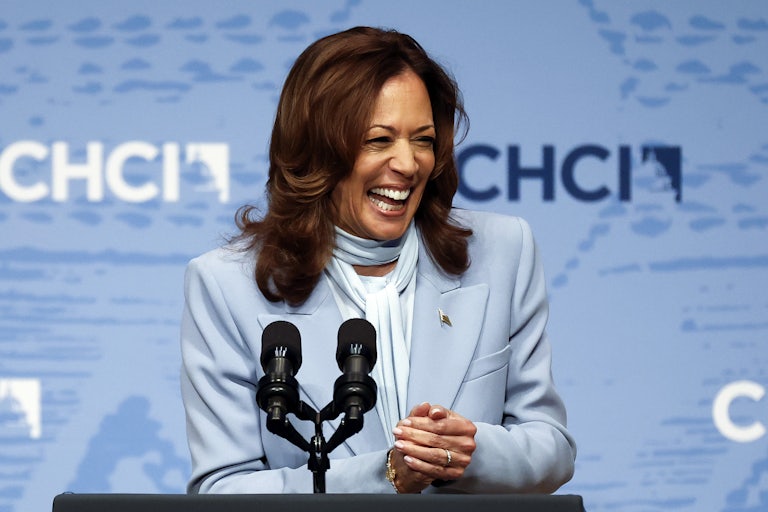
Kamala Harris smiles while standing at a podium
Kevin Dietsch/Getty Images

Kamala Harris and Donald Trump are neck and neck in Pennsylvania, an essential swing state.

A Washington Post poll published Wednesday found that Harris is favored by 48 percent of likely and registered voters, while Trump is favored by 47 percent of likely and registered voters.

When third-party candidates are removed, the race becomes even closer, with Harris and Trump in a 47 percent matchup among likely voters, and Harris at 48 percent and Trump at 47 among registered voters.

Twice as many presidential debate watchers said that Harris won the face-off between the two candidates. Fifty-seven percent said that Harris had won, while only 27 percent said Trump. Seventeen percent thought that neither won.

The slim margin between Trump and Harris shows just how competitive this race has become, in a battleground state that was narrowly won the last two cycles: once by Trump in 2016 and then by Joe Biden in 2020.

Following Harris’s strong debate performance, a few other polls placed Harris ahead of Trump in Pennsylvania. The New York Times published a poll Thursday that found her in the lead by four points, at 50 percent, with Trump at 46 percent. A Quinnipiac poll released Wednesday found Harris was leading Trump 51 percent to 45 percent. A Franklin & Marshall College poll found that Harris was in the lead with 49 percent to Trump’s 46 percent.

For Harris, Pennsylvania is key to making it to the White House. If she loses Pennsylvania, she will have to win Georgia and North Carolina if she has any hope of making it to 270 electoral votes, according to Politico.

Trump’s campaign is focusing its energy on thwarting her advances in these three states. The former president has reportedly spent the most on advertising in Pennsylvania, hoping to secure voters in the pivotal state.

In that same vein, Trump has also picked a new town to harass with racist claims that it’s been overrun by Haitian immigrants, and it’s predictably in the battleground state of Pennsylvania. It seems the former president hopes to stir up some grievance-based votes and sow a little chaos along the way.

Cognitive Decline? Trump Stutters, Stumbles During New York Rally

The former president repeatedly misspoke during a speech on Wednesday.

Donald Trump turns away from an audience at a rally while holding his arms out
Michael M. Santiago/Getty Images
Donald Trump at a rally in Uniondale, New York, on Wednesday

Speaking in Long Island on Wednesday, Donald Trump was as bombastic and boastful as ever—but also slurred his words on several occasions.

Trump stumbled over words like “migrants” and “Russia” and had trouble stringing sentences together. In another instance, Trump said he was “greater even than Elvis” because unlike the King, he doesn’t have a guitar—a riff that has increasingly featured in his speeches. 

Trump also promoted his wife Melania Trump’s new memoir—but admitted that he hadn’t read it and that he doesn’t know what she wrote about him, telling the crowd, “If she says bad things about me, I’ll call you all up and I’ll say, don’t buy it, get rid of it.” 

Trump’s erratic mental state has been on full display as his presidential campaign enters its final months before November. During last week’s debate with Kamala Harris, he went on long-winded rants unrelated to the questions asked. His speech patterns and alertness looked vastly different from 2016, as CNN demonstrated in a video comparing last week’s debate to one from eight years ago. Cognitive experts have also compared his recent speeches to ones from years ago, and see worrying signs.  

Trump even seems to have his own, false recollection of the debate, telling Fox News’s Greg Gutfeld about a nonexistent audience going “crazy” for him. Somehow, though, Trump remains neck and neck with Kamala Harris in the polls despite these stumbles. With the election less than two months away, will the Harris campaign be able to capitalize? 

Mike Johnson Roasted for Not Being Able to Control His Own Party

Even Fox News can’t believe how bad Mike Johnson is at his job.

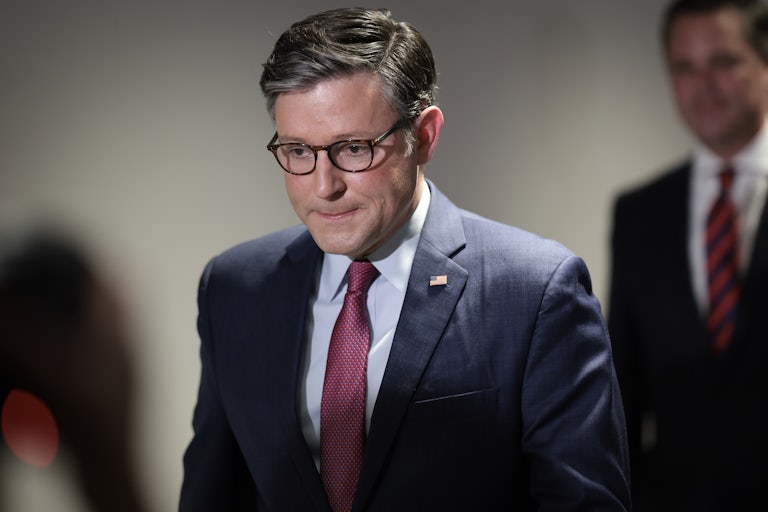
Mike Johnson looks down as he walks
Win McNamee/Getty Images

Congress has until September 30 to pass a bill that continues to fund the government, but that doesn’t mean that Republicans are all in on a solution.

Fourteen Republicans voted against an iteration of the bill on Wednesday, upending a floundering effort led by House Speaker Mike Johnson to include the Safeguard American Voter Eligibility, or SAVE, Act, a piece of legislation that would require proof of citizenship in order to vote, in the continuing resolution at the behest of Donald Trump. Five House Democrats voted for the SAVE Act in July before it was rolled into the continuing resolution, but just three remained after Wednesday.

“I’m very disappointed it didn’t pass,” Johnson told Fox News’s Sean Hannity on Wednesday. “We ran the right play, we came a little bit short of the goal line, so now we’ll go back to the playbook, we’ll draw it up. We’re already hearing good ideas from our members. And we got time to fix this, and we’ll get it done.”

But despite Johnson’s efforts, he’s still catching flack for the political theater.

“Let me ask you, you keep saying it’s the right play, and you can’t get every Republican to vote for it,” prompted Hannity. “That’s your own party. What are their objections, and how do you get them on board?”

“Well look, there’s a range of objections. Some people look for the perfect piece of legislation. Some people are philosophically opposed to continuing resolutions. Look, I’m one of those. I don’t like this,” Johnson said, before deflecting the blame of months of House chaos onto Democrats in the Senate, claiming Senate Majority Leader Chuck Schumer is the reason why Congress hasn’t passed a dozen appropriations bills that continue to fund the government the traditional way.

Johnson has cryptically alluded to a “plan B” for finding a funding solution but has refused to share the details, further frustrating members of his own party. That could include a six-month continuing resolution, which defense leaders have warned against. That measure would also be stripped of the SAVE Act, which could translate into lost votes from Trumpian loyalists and force Johnson to turn to Democrats for a funding solution.

One unidentified GOP lawmaker told Axios Wednesday that Johnson is “not where the conference is.”

Even if the stopgap bill does manage to scrape by the House, its chances of passing through the Senate are slim to none, setting the stage for an ominously familiar experience to that which preceded former House Speaker Kevin McCarthy’s exit.

“We now have only a few days left for House Republicans to come to their senses, come to the table, and come together with Democrats to craft a bipartisan agreement,” Schumer said after Wednesday’s House vote.

Read more about the government funding fight:

Trump’s New Version of the Debate Is Fully Detached From Reality

Donald Trump is making up details about his debate against Kamala Harris.

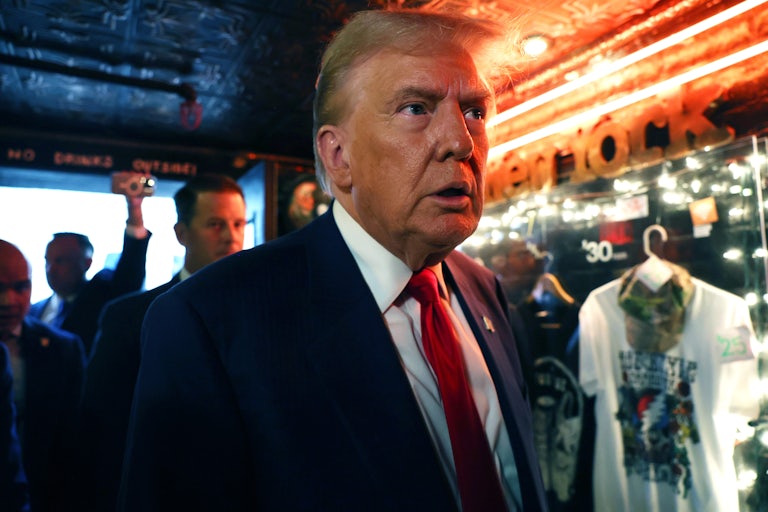
Donald Trump visits a bar
Spencer Platt/Getty Images

Does Donald Trump remember that there was no audience at the presidential debate?

During an appearance Wednesday night on Fox News’s Gutfeld! the former president took his obsession with gushing about his inflated crowd sizes a step further. He seemed to invent a crowd where there wasn’t one at all: at his presidential debate with Kamala Harris.

“And they didn’t correct her once, and they corrected me, everything I said, practically. I think nine times or 11 times,” said Trump. “And the audience was absolutely, they went crazy.”

For a moment, the Republican nominee seemed to suggest that there was an actual live audience. He then attempted to correct course.

“I walked off, I said that was a great debate, I loved it. You know you got a lot of people watching, I guess we had 75 million people watching, something like that,” Trump said.

Trump underestimates how easy it is to fact-check him. CNN’s Daniel Dale spotted at least 33 false claims Trump made during the audience-less debate.