Newsletter
Fighting Words
What got me steamed up this week

Good for Liz Cheney. Now Where Are Mitt Romney and George W. Bush?

Do we love Cheney? Of course not. But that’s hardly the point. The point is, can she move votes?

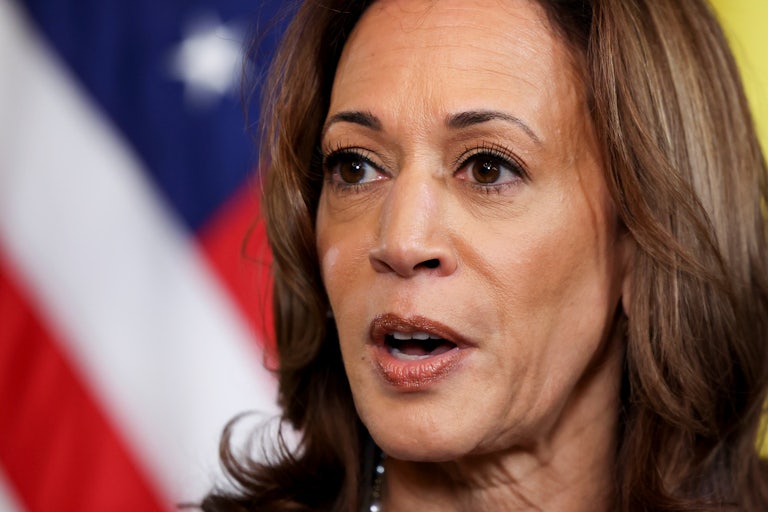
Kamala Harris with former U.S. Rep. Liz Cheney during a rally Wisconsin
Jim Vondruska/Getty Images
Kamala Harris with former U.S. Representative Liz Cheney during a rally Wisconsin in October

If you know anything about the founding and history of the Republican Party, the symbolism of Thursday’s event where Liz Cheney appeared with Kamala Harris had to get your attention. This party that has descended into antidemocratic neofascism was founded in 1854 as a progressive beacon. The Whig Party was dissolving and split into anti- and pro-slavery factions. The Free Soil Party was well intentioned but small. But when the antislavery Whigs and the Free Soilers got together, then they had some numbers and some power. Within six years, they elected not just a president but the most courageous and consequential president in American history (yes, FDR is a close second in my book).

It all started in a schoolhouse in Ripon, Wisconsin, which sits less than a mile away from where Cheney appeared with Harris. Is Cheney a “Lincoln Republican”? In one sense, she’s not even close. Lincoln was a liberal. In addition to ending slavery, he made public universities possible and created the national railroad system. He levied the country’s first income tax, to pay for the Civil War. He was way too big-government for Liz.

But in another sense, yes, she is, because at least she believes in the union, the republic, and the Constitution. By the benighted current standards of her party, that earns her a gold star.

Do liberals love Liz Cheney? Of course not. Nor should we. She’s a super-hawkish neocon. She defended torture. There’s a reason she was ascending the ladder of GOP House leadership in the 2010s. Yes, she had a pedigree, but also, she was totally fine with everything the GOP stood for.

But then Trump happened, and she stood up to say no. That did take some guts, in that authoritarian party. It unambiguously cost her her career, as she surely knew it would. And now she’s talking about the “depraved cruelty” of Donald Trump and endorsing a Democrat. And it’s not as if Harris promised her anything—that she’d bomb Iran or whatever. Cheney did this because Harris “will be a president who will defend the rule of law.”

Will it matter? I think so, and so does Ben Wikler, the chairman of the Wisconsin Democratic Party and one of the best state party chairs in the country. On MSNBC Thursday night, Wikler identified two groups of voters who might be influenced by this endorsement.

The first group is low-information uncommitted voters. He used a great analogy to describe these people. “These are people,” he told Jen Psaki, “who think about politics the way you and I think about the javelin at the Olympics, which is something that we’re vaguely aware happens every four years, but it’s not something we’re seeking out.” Yes, there are such people. For these voters, Wikler said, “just hearing that Democrats and Republicans are all agreeing that Kamala Harris is the person” might matter.

His second group was more interesting. It consists of “highly engaged” Republicans whose first loyalty is not to Trump but to “the flag and the Constitution.” Cheney’s move shows these people that “you can be yourself with your conservative commitments” and vote for a Democrat.

How many such people are there? A lot. Let’s start with the fact that Nikki Haley got nearly 4.4 million votes in the primaries. That was 20 percent of the total number of votes cast. Now let’s extrapolate that out to a November electorate. In 2020, around 155 million people voted. According to CNN exit polls, 36 percent were Republican, or around 56 million.

And 20 percent of 56 million—that is, the extrapolated Haley vote—makes for a potential pool of anti-Trump Republicans of around 11 million. Now, most of them may not bother to vote, or will write in Ronald Reagan or whomever. But surely Cheney’s backing will help convince some of them that voting for Harris is all right. And if you throw in Republican-leaning independents, that pool grows by maybe another 20 million.

If Harris can harvest votes from these people while promising nothing more than that she isn’t Donald Trump and will defend the Constitution, why shouldn’t she? I’m for as many Republican endorsements of Harris as possible. Aside from signaling a green light to Republican voters, it’ll drive Trump up a wall.

The list of Harris’s GOP endorsers is growing. Former Arizona Senator Jeff Flake joined the band earlier this week. Flake is respected by independent voters in his state. If he campaigns with Harris, he too could move votes.

Meanwhile, the big questions in this arena: What’s up with Mitt Romney and George W. Bush? There are others, like former Trump chief of staff John Kelly. But Romney and Bush are the big fish. What in the world does either man have to lose? Romney is retiring. Bush paints and golfs. Both are richer than Croesus. I assume both want desperately to save their party from Trumpism. Isn’t the obvious best way to do that by encouraging their fellow Republicans to vote for Harris so they can end the scourge of Trumpism and get back to being a normal, warmongering, poor-people-penalizing, planet-scorching party again?

But seriously. If they were to back Harris, and Harris wins semi-convincingly with something like 15 percent of the Republican vote (around half that is normal), Trump will be finished. Not Trumpism. That will take a lot longer.

People like Romney and Bush should consider their place in history. In these next few years, the Republican Party will either corrupt itself beyond repair and crumble into out-and-out fascism, becoming the vehicle that ended the human race’s longest-lasting democratic experiment, or it will finally cast that off and begin to resurrect itself. Do they want to be among those who sat by and let the former happen or those who helped the latter take place? There’s a little schoolhouse in Ripon, Wisconsin, they might visit for inspiration.
This article first appeared in Fighting Words, a weekly TNR newsletter authored by editor Michael Tomasky. Sign up here.

The Most Important Thing for Harris Isn’t the Economy. It’s This.

Yeah, the economy is important—and the border, and other things. But the most important thing doesn’t have to do with positions.

Kamala Harris
Ting Shen/Bloomberg/Getty Images

Kamala Harris’s economic vision speech (delivered in Pittsburgh on Wednesday, a mere two days after yours truly wrote that she needed to give an economic vision speech!) was … fine. Was she offering the second coming of the New Deal? No. Her rhetoric is cautious. More cautious, as American Prospect editor David Dayen interestingly pointed out this week (because Dayen is strongly of the economic populist school), than the plan itself as described in an 82-page “fact sheet” distributed by the campaign. The plan, he wrote, is more progressive than the rhetoric. But on the stump, Harris is not suddenly going to morph into Elizabeth Warren.

And today she goes to the Arizona border to try to establish more swing-voter cred. Am I loving the fact that it’s become a big Democratic applause line that she wants to sign conservative GOP Senator James Lankford’s border security bill? No, not by a long shot. On the other hand, in purely naked political terms, is it smart to go at your opponent’s strengths? Yes, it is.

It’s pretty basic politics. Trump, for all his extremism, does this frequently. Think of his twisted pitch to women this week. Campaigns that successfully neutralize the other side’s advantages tend to win (George W. Bush on John Kerry’s war record). Campaigns that let disadvantages fester tend to lose (Mitt Romney not convincingly answering Barack Obama’s Bain Capital–related attacks).

So Harris is cutting into Trump’s advantages on those two issues. That’s fine, especially with respect to the economy. But issues are the science of campaigning. There’s an art to campaigning too, and it’s on this front that the Harris campaign needs to keep pushing, because it’s here where her biggest advantage over Trump lies.

Jonathan V. Last of The Bulwark had a smart piece this week reminding us that campaigns consist of news cycles, and the point of news cycles is to win them. Remember how Harris came out of the gate like a rocket in July? That’s because she was doing everything right. She was making news and winning news cycles. The early speeches, the choice and unveiling of Tim Walz, the near-flawless convention—Harris was firing on all cylinders.

Back then, practically everything about her was new to most people. But that was bound to end. Now we’re through that discovery phase. And she’s not dominating news cycles the way she was six weeks ago.

So, Last writes, the campaign needs to find ways to drive the news. It’s especially important when running against Trump, because he drives news nearly every day. Most of it is madness. But the media machine, as we have learned and relearned, has little capacity to punish madness. It rewards performance. This is what Trump has known for 40 years.

The Harris campaign seemed to know this at first, but it has lost a little momentum in these recent weeks as she’s settled more into normalcy—and, I’d say, defense. The economic speech and the border appearance are essentially defense: They’re defending or inoculating her against possible Trump attacks. As I said, they’re justifiable as politics. But they’re not offense.

So it’s time to play offense. This is where the art of campaigning comes in, and subconsciously taking advantage of her greatest strengths over Trump:

1.     She’s not mentally unfit to be the president of the United States.
2.     She’s not pushing 80.
3.     People seem to like her. They even seem to like, or at least not dislike, her once-infamous laugh.
4.     She proved in the debate that she is smarter than he is, sharper on her feet, his mental and intellectual superior in every way.
5.     She knows how to get under his skin while keeping her cool.

What do these factors add up to? The idea that the Harris campaign should be tossing grenades at Trump that mock and expose him and that make news. Force him to respond. Make him explain. As an analogy, think of a tennis match: One player is sitting calmly at the center of the base line firing ground strokes left and right, while the other is running side to side, panting, covering 25 feet between each shot. It’s pretty obvious who’s going to win most of the points, and the match.

Here’s an example. Just yesterday, Trump spoke on Mark Robinson for the first time since the latter’s insane past comments (“I’m a Black NAZI!”) became public. He was making remarks at Trump Tower. As he finished and walked toward a bank of elevators, a reporter asked him if he was “going to pull” his Robinson endorsement. Trump, who once called Robinson “Martin Luther King on steroids,” paused and said: “Uh, I don’t know the situation.”

Obviously, he knows the situation. The Harris campaign should be out with an ad today mocking this, tying it to other similar remarks of his, like when he pretended he didn’t know who David Duke was. But more: Harris herself should talk to reporters mocking Trump’s lame denial. It needs to be Harris herself, not Walz or Doug Emhoff.

There are tons of opportunities. Trump’s liquid rhetoric is such that he constantly contradicts himself and often just makes no sense. It makes me crazy that Harris is being knocked for not having “positions.” Do those critics seriously think that what Trump is saying constitutes “positions”? Remember that answer of his a few weeks ago when the woman asked him about childcare? It was embarrassing to listen to. He does that all the time. Make sure voters know it. Attack. In a mocking way. Make news. Play offense.

People like me aren’t supposed to say things like this, but here it is: A lot of these swing voters, they’re not voting on issues. The economy, maybe. But generally, they vote on vibes. Who has the look of a winner? Who looks fresh and ready to tackle this big job, and who looks tired? Who appears to be having fun?

That was the Harris of July and August. She had some magic. It’s hardly panic time. A raft of swing state polls came out Thursday night, and she leads in every state except Georgia, where it’s tied. She’s ahead, and he’s weak and worried and knows he might lose (and then face sentencing). He’s crumbling, psychologically. Now is the time to step on the gas.

This article first appeared in Fighting Words, a weekly TNR newsletter authored by editor Michael Tomasky. Sign up here.


Donald “Blame the Jews” Trump Is Truly Losing His Sh*t Now

At an antisemitism event, Trump attacked American Jews. The man is unraveling fast, and the sanewashing must stop now.

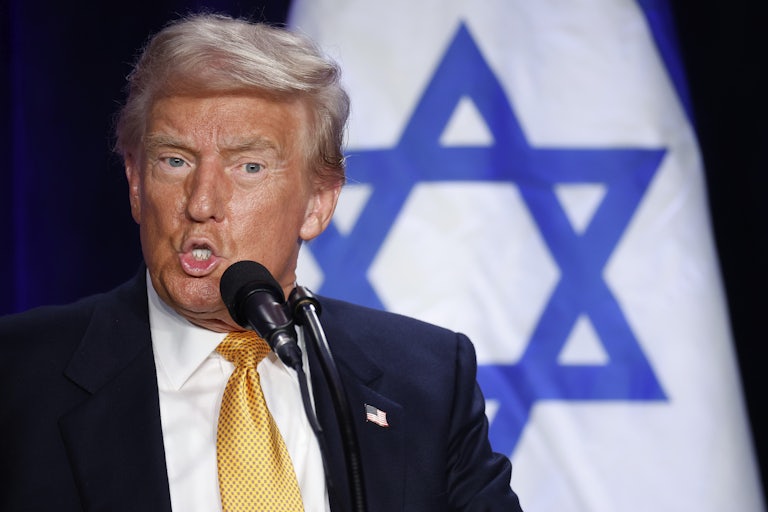
Trump spoke at an event titled "Fighting Anti-Semitism in America"
Chip Somodevilla/Getty Images
Trump spoke Thursday at an event titled "Fighting Anti-Semitism in America" in Washington, D.C.

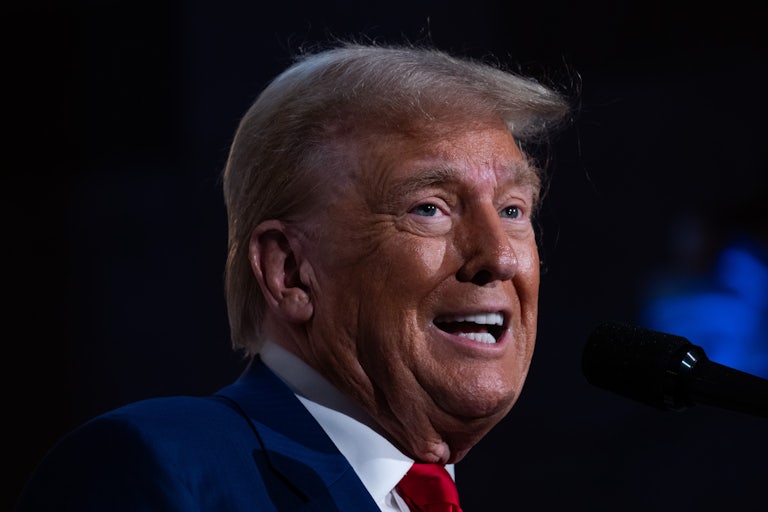
It was billed as an antisemitism event, and, well, I guess it was, ultimately, although not in the intended sense. The phrase “antisemitism event” usually refers to an event designed to draw attention to and denounce antisemitism. But in Donald Trump’s hands, it morphed into an event that featured antisemitism, in the form of the mind-blowing comments by the principal.

After opining that the Democratic Party has “a hold, or curse” on Jewish Americans, he then said: “I’m not going to call this as a prediction, but in my opinion, the Jewish people would have a lot to do with a loss if I’m at 40 percent.… If I’m at 40, think of it, that means 60 percent are voting for Kamala [Harris], who, in particular, is a bad Democrat. The Democrats are bad to Israel, very bad.”

First of all, as always, he’s lying. He’s not at 40 percent. He’s at 25 percent. But lies are par for the course. What isn’t par for the course is to show up to a constituency and serially berate them. He said again that American Jews who vote for Kamala Harris “should have their head examined.” He took it as a given that Jews have a dual loyalty to the United States and to Israel—the oldest antisemitic trope in American politics. And he whined that “I haven’t been treated right” by American Jews.

But don’t worry—it wasn’t all about attacking Jews. He attacked Muslims too! He boasted that if elected, he’ll bring back the Muslim travel ban to keep out people from “infested” countries. That is plainly fascist language.

After the debate, I wrote a column arguing that this was the beginning of Trump’s unraveling. I’ve gotten my share of predictions wrong over the years, and we still have 46 days to go, but so far, that one is looking pretty good. In the last few days, Trump:

  • has continued to spew the lies about Haitians and house pets in Springfield, Ohio (and, of course, a poll found that 52 percent of Trump supporters think the lie is “definitely” or “probably” true);
  • in a press conference in Los Angeles, rambled about that “very large faucet” in Canada that could solve all of California’s water problems. (What was he doing campaigning in California anyway? Oh, of course: He was at one of his golf courses.) This is not entirely made up—he was apparently referring to the Columbia River, but as this Canadian scientist explains, needless to say, there is no faucet and it isn’t that simple;
  • said in an interview that the audience at the debate “went crazy” for him. Uh, there was no audience;
  • in one of his more bizarre rants ever, said he was “greater even than Elvis.” Trump: “Nobody can draw crowds like me.… I’m the greatest of all time. Maybe greater even than Elvis. Elvis had a guitar, I don’t have a guitar. I don’t have the privilege of a guitar.”

First of all, asshole, a guitar isn’t a “privilege.” It’s something you earn by learning how to play it, like I have. But learning a musical instrument requires having an attention span of more than five seconds, so that’s out of the question for Trump. He couldn’t learn the kazoo.

Second, his reference point shows his age, does it not? How far removed is Trump’s invocation of someone who was at his peak of popularity nearly 70 years ago and died nearly 50 years ago from Bob Dole’s famous reference to the Brooklyn Dodgers during the 1996 campaign? I mean, that was only 40 years after the Boys of Summer fled to L.A. And third, if you know anything about Elvis’s career and what rock and roll tours were like in those primitive days, you know that he was typically playing crowds of three or four thousand, often less—fairgrounds and high-school auditoriums. Even the ’70s-Vegas Elvis played mostly the Westgate Casino Cabaret, capacity 1,700. The large-scale rock and roll tour started with The Beatles and then grew from there. But Elvis remains the lodestar of the 80-year-old Queens brain.

Oh, and by the way: Trump said this at a rally where—of course—there were lots of empty seats and where, yes, people were spotted leaving early.

So we have two issues we need to examine here. First, the astonishingly offensive remarks Trump made Thursday night about Jews. His Jewish support should start sinking like a stone. But there’s one Jew who clearly loves him, and other events this week have to make us wonder whether Bibi Netanyahu is trying to start a war with Lebanon and maybe Iran to raise gas prices and screw up the economy (right after Jerome Powell made a move to ensure that doesn’t happen) to help Trump win, but that’s another column, if I get around to it.

The second issue is one that must remain front and center in the American political media: Trump is really losing his marbles now. Was that statement about the crowd going nuts for him at the debate a normal Trump lie? Or was it a fantasy of which he has convinced himself? If we hooked him up to a polygraph and he repeated that line, would his pulse quicken? Would he change his speech patterns, avert his eyes, cover his mouth? I doubt it. He wouldn’t even think he was lying.

The mainstream media still treats comments like this with diffidence: “Oh, that’s Trump.” No. These are defining comments. They tell us about his mental fitness. They matter. They should be covered. I can’t find evidence that The New York Times or The Washington Post covered those remarks.

This sanewashing must stop. Voters need to be informed when Trump makes statements with a tenuous connection to reality at best. He’s disqualifying himself from the presidency every day that he opens his mouth, but much of the mainstream media is ignoring the words coming out.

This article first appeared in Fighting Words, a weekly TNR newsletter authored by editor Michael Tomasky. Sign up here.

Trump and Laura Loomer: Mainstream Media, He’s Just Taunting You Now

He takes a 9/11 “truther” to the 9/11 ceremony. Are we going to start talking frankly now about his mental unfitness?

Laura Loomer speaks to a crowd
David Dee Delgado/Getty Images
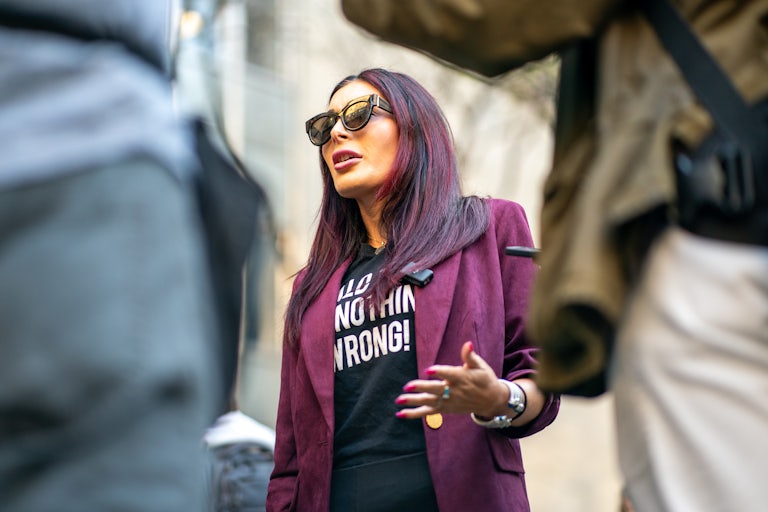
Far-right activist Laura Loomer speaks to the media prior to the beginning of former President Donald Trump’s trial in New York City, on April 15

I know some people don’t like to play the “Imagine If!” game, but at times it’s hard not to wonder, “Imagine if Joe Biden had said the crazy thing that Donald Trump uttered.” So I’m sorry to say that there is a story from this week that demands we indulge ourselves. Imagine with me that Kamala Harris had attended—oh, let’s say a Holocaust commemoration ceremony—and she brought, as a member of her entourage, someone known for saying the Holocaust was a hoax. Or that she attended a ceremony marking the anniversary of the Sandy Hook Elementary School shooting in the company of someone who’d argued, pace Alex Jones, that the shootings were faked.

That’s what Donald Trump just did by bringing Laura Loomer to Wednesday’s September 11 commemoration.

It’s just a surreal moment. I lived in New York when the attacks happened. I keenly remember how zealous Republicans and conservatives were about 9/11, how quick they were to pounce on anyone on the left side of the spectrum who said anything that even hinted at departure from the accepted narrative—and especially those who, along the way, departed from reality. And now, years down the line, the Republican Party standard-bearer comes to New York on 9/11 itself, palling around with someone who called those attacks an “inside job.”

You’ve seen that reference many times now in the last couple of days, but it’s worth unpacking the phrase in a paragraph. “Inside job,” with respect to 9/11, meant that the U.S. government had advance knowledge of the attacks and let them happen. Or even staged them. In some variants, Israel, naturally, was involved as well. I believe a lot of bad stuff about George W. Bush and Dick Cheney (still!), but I have never believed that. It’s loony tunes. But adherence to this zany theory was disturbingly widespread, at first on the far left before it spread to and was taken up by some on the far right. In polls at the time, up to a quarter of respondents, sometimes more, said they believed this silliness.

By the way, when I say that Loomer believes lunatic nonsense about the September 11 attacks, I’m not dredging up statements she made 20 years ago to criticize her today. HuffPost reported this week that just last year, Loomer “shared a video on X that said ‘9/11 was an Inside Job!’ and claimed it was somehow related to then-Secretary of Defense Donald Rumsfeld’s announcing $2.3 trillion in ‘lost’ government funds on Sept. 10, 2001.”

Loomer’s sins hardly end there, of course. She’s a racist and a xenophobe and a provocateur. She’s claimed that school shootings were staged and that the Las Vegas mass shooter was affiliated with ISIS. Remember that murder of the 6-year-old Palestinian boy outside Chicago, who was stabbed 26 times by his white landlord shortly after Hamas’s October 7 attacks? The landlord said he feared a “global day of jihad,” a lie spread by Loomer and Jack Posobiec (of Pizzagate infamy) as well as Jones’s InfoWars website, among others. There’s a lot more. She’s poison.

The fact that Trump took Loomer to the 9/11 event has gotten a lot of coverage. I woke up Friday morning ready to unload on The New York Times for not doing a story on this, but then I looked at the website, and to its credit, the Times has a good piece up today that highlights Trump bringing her to New York and traveling with her more generally. In case you missed it, she was at the debate Tuesday night in Philadelphia. She’s a frequent Mar-a-Lago presence. He wanted to give her a campaign job back in the spring, until others objected. Loomer is apparently too crazy for Marjorie Taylor Greene. I didn’t know “too crazy for Marjorie Taylor Greene” was possible.

What does all this tell us about a possible future Trump presidency? That this racist conspiracy theorist will be around the White House whispering in the president’s ear. And she won’t be alone. Trump’s “social media war room” at the debate included Loomer, Posobiec, and Chaya Raichik, who created the “Libs of TikTok” account that promotes hate speech and transphobia. Children’s hospitals across the country have received bomb threats after social media posts on Libs of TikTok—accusing the hospitals of performing gender-affirming surgeries that in some cases they didn’t even perform—went viral in the right-wing fever swamp.

Imagine the White House filled with people like this. That’s what we’re probably talking about if Trump is elected.

Call it speculative if you want. This is part of why it’s difficult for news outlets that follow traditional reporting norms to fathom these possibilities, let alone make a news story out of them. But the fact that these people are hanging around at Trump’s invitation can’t be allowed to pass without our reckoning with it. On whatever path forward Trump hopes to forge, these people will be along for the ride. And the mere possibility that the White House is going to be bursting with racists and xenophobes and transphobes and multipurpose haters and conspiracy theorists is something to which attention must be paid. There has to be a way, within the conventions of mainstream reporting, to place this alarming possibility in front of the electorate’s collective nose.

Let’s conclude by returning to the “Imagine If” game. What would the mainstream media be doing right now if, on Wednesday, Harris had indulged in one of my above scenarios? First of all, it’s absolutely impossible to imagine, because Kamala Harris is a good human being who has normal human morals. But if she had, everyone—and I do mean everyone: the right wing, of course, but the New York Times editorial page, the talking heads of MSNBC, and even yours truly—would be in a state of meltdown apoplexy until she apologized and explained herself; and even after she did so, loads of people, right and left, Republicans and Democrats, would be declaiming on her unfitness for office and demanding that she stand down as the nominee.

But in the real world? This story, like all Trump stories, is likely to fade. That would be to the detriment of all. At the very least, the mainstream media should not let this outrage die; it should continue to rub this ugliness in the faces of the hypocrites who once called liberals enemies of freedom because we opposed the stupid and tragic War in Iraq that Bush and Cheney used 9/11 as an excuse to start, and who now want this amoral nitwit to be the leader of the free world.

This article first appeared in Fighting Words, a weekly TNR newsletter authored by editor Michael Tomasky. Sign up here.

Trump Serves Up a Word Salad That The New York Times All But Ignores

The Washington Post led with his incoherent comments about childcare in a Thursday speech. In the Times’ account? Barely a word.

Trump at the Economic Club of New York
Spencer Platt/Getty Images
Trump at the Economic Club of New York on Thursday

For months, Donald Trump’s frequent lapses into incoherence—the half-sentences that suddenly veer off toward a distant galaxy, the asides that limn the virtues of Hannibal Lecter—have been mostly fodder for late-night TV hosts. Morning Joe has covered them consistently, but for the most part, the mainstream press has ignored them, either cleaning up Trump’s actual words so they made more sense on the printed or pixelated page or just not printing them at all.

This was easier to do when Trump was running against Joe Biden, who sometimes also lost the rhetorical thread, and whose age was a constant news story (not without justification). But now that Trump is running against a younger and more energetic opponent who tends to speak in full, logical sentences and who doesn’t go on rants about bacon and wind power, his mental state is rightly becoming more of a story. As my colleague Greg Sargent put it yesterday: “Trump’s mental fitness for the presidency deserves sustained journalistic scrutiny as a stand-alone topic with its own intrinsic importance and newsworthiness.”

Which brings us to Trump’s appearance Thursday before the Economic Club of New York. I watched some of it. In fairness, reading from his prepared remarks, he was coherent. He rattled off a string of statistics about the economy under his presidency, many of which were actually true, or close enough; when he got around to describing the horrors “Marxist” Kamala Harris had visited upon America, his claims were a lot less true. (He said “crime is rampant, and fleeing is the number one occupation” in California, but crime is trending down in the state this year, and the recent population declines have been turned around too—not that Harris has control over these issues one way or another.)

Then came the question-and-answer period. A woman among the handful assembled on stage asked Trump if he would commit to passing childcare legislation, and if so what his specific proposal would be. Here’s the answer in part, as put out in a tweet by the Harris campaign:

“Well, I would do that, and we’re sitting down, you know; I was, somebody, we had Senator Marco Rubio and my daughter, Ivanka, who was so impactful on that issue.… But I think when you talk about the kind of numbers that I’m talking about that because the childcare is childcare, couldn’t, you know, there’s something you have to have it, in this country you have to have it.”

Trump’s answer was longer than that, but when he got around to something resembling a response, it was that his tariffs on China are going to pay for everything, no problem. Just like deporting people is going to solve the housing crisis.

A few quick facts. In the nineteenth century, before the individual income tax became a permanent fixture of life, tariffs accounted for most of the government’s revenue (at a time when the government did very little—stood up an army, ran a postal service, etc.). But today, according to the Council of Economic Advisers, import duties bring in only around 2 percent of the federal government’s total revenues. If you want to lower taxes on corporations and the rich, as Trump does, tariffs would need to be substantially jacked up to make up for the lost revenue (although of course in the Candyland in which Republicans and their economists live, reducing tax rates does not reduce revenue, which is probably the single biggest and most insidious policy lie of the last 50 years). And of course, as the CEA and many others argue, much higher import levies are “likely to spark retaliatory tariffs that reduce U.S. exports and subsequently induce transfers of collected duties to impacted U.S. businesses.”

Now let’s get to the point here: the media. Specifically, The New York Times.

I looked Friday morning at the way the Times and The Washington Post covered the speech. The Post’s article, to my astonishment, was mostly about the childcare word salad. “Trump offers confusing plan to pay for U.S. child care with foreign tariffs,” ran the Post’s headline.

The Times’s story was by no means favorable. Under the headline “Trump Praises Tariffs, and William McKinley, to Power Brokers,” the article adopted a gently skeptical tone toward Trump’s promise that tariffs would solve everything. It even mentioned the words “child care,” once.

But the article didn’t bother to quote him on the topic. Why? It could be that the reporter didn’t think it was newsworthy (or perhaps it was an editor, since the Times’ election news blog did partially quote Trump). But this is exactly the point Sargent and others are trying to make: that Trump’s frequent incoherence is in and of itself news. It should be reported on. He should be quoted verbatim, not in a partial way that sanitizes his words and cleans them up.

Why? Because his mental fitness at age 78 to be president for the next four years is a legitimate issue. I’ve covered, and simply watched as an interested citizen, a lot of presidential candidates. Dozens, maybe hundreds, if you count Democrats and Republicans who ran in primaries. I’ve watched hours of debates and attended events like the once-famous Iowa Straw Poll in 1999, at which 11 Republican candidates spoke. I’ve never heard a candidate who talks in such a dissociative, rambling, confused way; never heard a candidate so obviously bluffing his way through certain policy questions.

The conventions of objective journalism are such that reporters tend to use “good” quotes. Reporters favor politicians’ pithiest and most succinct quotes, because reporters themselves are trying to be pithy and succinct, and ergo logorrheic and nonsensical just doesn’t fit the plan. I’ve been there, I’ve done that. Guilty.

But here’s what’s different. Until Trump, using the pithiest and most succinct quote never amounted to a quasi-conspiracy against reality. Now it does. Maybe the voters will decide that Trump’s incoherence doesn’t matter. But they at least need to be presented with the evidence to decide for themselves.

This article first appeared in Fighting Words, a weekly TNR newsletter authored by editor Michael Tomasky. Sign up here.