Newsletter
Fighting Words
What got me steamed up this week

Democrats Are Enthusiastic About Harris—but Don’t Tell the Media

Another press failure: Endless curiosity about Trump voters. About Harris voters, not so much.

Harris supporters at a rally at Temple University
Andrew Harnik/Getty Images
Harris supporters at a rally at Temple University on August 6 in Philadelphia, Pennsylvania

Polls, polls, polls. Way too many polls, way too much media coverage and obsession with polls. Right? Well … it depends on which ones. Because there is one set of polls that isn’t driving much press coverage at all, and I find it interesting and telling.

Since the day Kamala Harris got in the race, she has consistently led Donald Trump on the question of voter enthusiasm. She led by a lot when she first entered the race in late July because Democratic enthusiasm for Joe Biden was at a serious low, and because the mere fact that the Democrats made a change—and that she came out of gate with such swagger—made rank-and-file Democrats feel such a burst of relief.

That carried on through the Democratic convention. A Gallup poll from late August (right after the convention) showed Democratic enthusiasm at 79 percent—one point short of the all-time high, which was during the 2008 Barack Obama–Hillary Clinton primary—and Republican enthusiasm at just 64 percent.

Since then, Republican enthusiasm has gotten closer to Democratic levels, but in the several recent polls I looked over this week, Democratic enthusiasm was still higher. This Gallup result from October 6 was representative. When asked if they were more enthusiastic this time around than in previous elections, 80 percent of Democrats said yes, as did 75 percent of Republicans.

So Democratic voters are in fact enthusiastic about Harris—a shade more enthusiastic than Republican voters are about Trump. But ask yourself: Is that reality reflected in the media coverage you see? My own answer to that question is a thundering no.

This is admittedly unscientific, and undoubtedly, I’ve missed some stuff. But what I mostly see and hear and read is this: Trump voters love their man (and many do, of course). Black and Hispanic voters are tepid on Harris. She hasn’t “made the sale.” Black men in particular are skeptical. She’s in a danger zone.

Some of this is true and borne out by polling, and of course it’s necessary to report on it. But meanwhile, where, in the media narrative, is the Democratic enthusiasm? Where are the voters who admire and even adore Harris and can’t wait to go pull the lever for her?

They’re mostly invisible.

They’re mostly invisible because they are chiefly based in two groups, neither of whom is of the remotest interest to the press. The first is college-educated people, mostly white but of all races. These people’s votes count just like anybody else’s, but to political journalism, they don’t count because they’re not real Americans. Real Americans eat carb-heavy breakfasts in diners in Altoona and Saginaw. They don’t eat tofu scrambles in Bucks County or Buckhead. They didn’t attend private colleges, they don’t go to gyms, they don’t drive hybrids, they don’t drink lattes.

So as far as political journalism is concerned, these voters don’t exist. It’s all a bit paradoxical and frankly a little twisted, since virtually all journalists are members of the tofu-scramble class, but that only accentuates the matter, because journalists feel a collective guilt about all the above that makes them dismiss voters like them as uninteresting.

And sure, there’s a dog-bites-man element to those voters backing a candidate such as Harris. But I submit there are still stories there. Are these voters as enthusiastic as they were in 2020? Are they out there door knocking and phone banking? Are donations coming in at high levels or low from those zip codes?

The other invisible group—and this is a far worse error—is Black women. If you Google something like “Black women Harris enthusiasm,” you’ll see a bushelful of articles from late July, when she first got in the race, when the #WinWithBlackWomen network famously enlisted 400,000 Black women to join a Zoom meeting the very night that Harris became the presumptive nominee. I saw a number of stories from that period.

But since the heat of the campaign post–Labor Day? I don’t see much. In fact, the first page of search results for the search term mentioned above includes a bunch of articles from July, a couple from August—and exactly one from September. Was it in The New York Times? The Washington Post? Was it an Associated Press or Reuters piece?

No. It was in The Atlanta Voice, the Black community newspaper in Atlanta.

Black women, as usual, are invisible to the political media. Oh, Oprah’s town hall made news. But generally speaking, if you’re a Black woman in this country and you want a bunch of microphones shoved in front of your face at election time, you’ll be way ahead of the game if you’re willing to say that Kamala Harris just doesn’t speak to you for some reason and Donald Trump is a savvy businessman.

Yes, again, there’s a dog-bites-man aspect to stories about Black women backing Harris. But isn’t there also a dog-bites-man quality to white rural voters backing Trump? Of course there is. And yet, I’m still seeing those stories, still seeing those people interviewed on cable news. Why? Because the political media (reporters, but I think mostly editors at mainstream outlets) are terrified of being seen as liberal. Of missing the Trump story, of opening themselves up to accusations of out-of-touch elitism.

The right is so effective at lobbing this grenade that mainstream outlets have collectively come to sense that there is a professional price to be paid for ignoring Trump voters. But there is no professional price to be paid for ignoring Black women. They’re ignored all the time anyway.

Is Harris in real trouble among Black voters? Maybe. Maybe not. This week’s NBC poll has her beating Trump 84–8 among Black respondents in battleground states. That’s up from 82–12 a month ago (Trump lost a third of his Black support! Isn’t that a story?), and it’s on par with Biden’s 2020 national margin among Black voters over Trump of 87–12, or indeed will be better than Biden’s margin, if Trump stays in single digits.

It’s a close race. There’s a lot to worry about. I worry every day, and you should too. But you should also remember this: Democratic voter enthusiasm is high—higher than Republican enthusiasm, according to numerous polls. From the way this race is being covered, you’d never know that. Harris’s enthusiastic voters, especially Black women, aren’t “real Americans.” They’re being erased from the narrative. By the “liberal” media.
This article first appeared in Fighting Words, a weekly TNR newsletter authored by editor Michael Tomasky. Sign up here.

Trump at Madison Square Garden: Is He Kidding? Yes. And No.

The planned rally raises creepy echoes of Fritz Kuhn’s pro-Nazi rally in 1939. But there’s a lesson here for the Harris campaign.

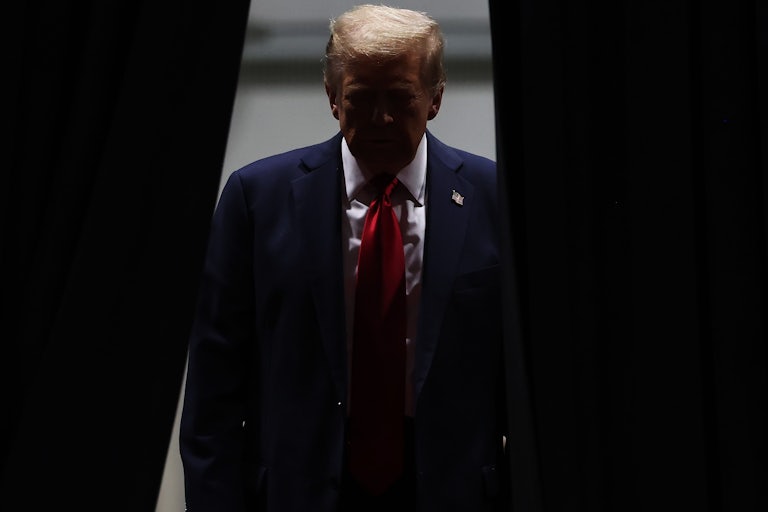
Trump in silhouette
Michael M. Santiago/Getty Images

Donald Trump announced Wednesday during a speech in Scranton, Pennsylvania, that he’ll be playing Madison Square Garden. His campaign has rented the self-proclaimed “World’s Most Famous Arena” for Sunday, October 27, and Trump said it means that “we’re going to make a play for New York.”

Trump is not going to win New York. Harris is 14 points ahead in the Empire State in the current FiveThirtyEight averages. That’s closer than the 2020 result of 23 points, but it still isn’t spitting distance. So we can say it’s a waste of his time and money, and that’s a good thing. But it’s not entirely stupid either, and there’s a lesson in this for Kamala Harris and her campaign as we wind toward the home stretch.

But before we get to that, let’s just pause to note the creepy historical echo of a neofascist rally taking place at Madison Square Garden, because there was one of those before, and it’s the first thing I (and I’m sure many other people) thought of when I heard this news. I mean the famous rally held in the Garden (then a completely different building, but still named Madison Square Garden) on February 20, 1939, by the German American Bund and its leader, Fritz Kuhn.

This was a pro-Nazi rally. The stage was adorned with a gigantic image of George Washington surrounded by stars and stripes. There were also swastikas and Hitler salutes galore among the 22,000 attendees. No, I’m not saying there will be swastikas this time around, although one can’t help but wonder if the various white supremacist groups backing Trump will send contingents. The guy plays to semi-empty houses that are half the Garden’s size, so something’s going to need to be done to paper the room. If he hews to the custom of, say, GOP conventions, he’ll invite as many Black supporters as he can up on the stage with him.

So no, he’s not going to win New York, and yes, there are disturbing historical resonances at work here. But here’s the one way in which this rally isn’t stupid or offensive.

At this point in a presidential campaign, establishing momentum becomes important—having the look of a winner. As I’ve often said, the swing voters who’ll decide the election don’t have strong political allegiances; these are people who view politics, as Wisconsin Democratic chairman Ben Wikler recently said, the way we political-junkie types view Olympic sports—we know they exist, and we pay attention for a brief period every four years, and that’s it. We choose to root for non-American Olympic athletes based on a bunch of emotional and nonrational factors—whether we have warm or cool feelings toward their country, whether we like the way they carry themselves, the way they smile—and maybe most of all, whether they have a shot at winning. In the 100-meter dash, we’re more likely to cheer for the Jamaican who has a real chance of medaling than the guy from Norway or whatever; nothing against Norway.

So campaigns need to do things in the closing weeks to communicate momentum and exude winner-ness. Having an unexpected rally at an unexpected and famous place qualifies. It shakes things up a little. It dominates, or at least figures prominently into, the cable news menu for probably four days—two before, the day of, and one day after. And if Trump can actually fill the place, or come close, that too communicates energy.

Harris came out of the blocks with a massive burst of energy, which has certainly stalled to some extent. Heading into these final three weeks, she needs to create some new buzz. Simply doing more events will help. She just hasn’t been on the trail enough. She needs to show that she can still draw the thousands she was drawing in August. A new proposal or two will help. It’s hard to say how much policy matters at this point, especially against an opponent who has contempt for policy, but it can’t hurt. Her proposal on long-term home care this week was actually pretty important—it’s a huge hole in Medicare and would make a difference in millions of people’s lives. Surely that got through to some voters.

But at this point a campaign is mostly about gestures and stagecraft. The Harris campaign could use some events that create mojo. A surprise endorsement from a prominent Republican or some other unexpected person from the corporate world or the military or some such. An event that tops Trump’s on the same day—in a stadium, maybe, if she can fill it—and totally steals his thunder. That could take the form of a concert featuring some of her celebrity supporters if they can all be pulled together on the same date—Beyoncé, Bruce, Billie Eilish, John Legend, and most of all, you know who.

And just campaign, campaign, campaign. Look hungry. Look like you want it. I remember in 2000, Al Gore campaigned nonstop for the last 48 or maybe even 72 hours. I recall it making a difference. He was generally behind in the polls, and while yes, he did end up losing that race, he lost it on First Street Northeast (i.e., the Supreme Court) on December 12. He won it on November 7.

The Harris campaign has received criticisms, many of them deserved, in these recent weeks. But the campaign has also done a lot of things right. The polls say she has become the candidate of change, which is an extraordinarily hard thing for a sitting vice president to pull off. She has narrowed or, according to some polls, eliminated Trump’s advantage on the economy. She’s catching up among working-class voters, as Timothy Noah noted this week. So some of those ideas that the press finds boring, the small-business tax credit and so on, must be getting through to somebody.

But this is the time to win news cycles and be seen as being on offense, not defense. I sure hope the campaign has a few surprises up its sleeve.

This article first appeared in Fighting Words, a weekly TNR newsletter authored by editor Michael Tomasky. Sign up here.

Latest From Politics

Good for Liz Cheney. Now Where Are Mitt Romney and George W. Bush?

Do we love Cheney? Of course not. But that’s hardly the point. The point is, can she move votes?

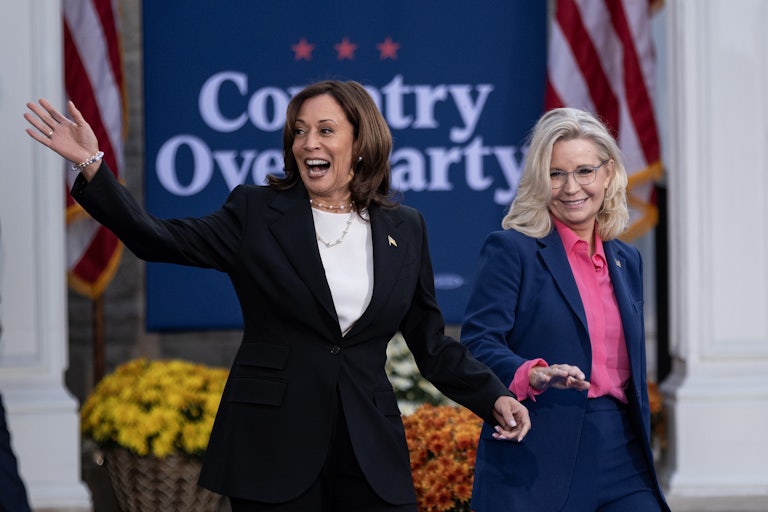
Kamala Harris with former U.S. Rep. Liz Cheney during a rally Wisconsin
Jim Vondruska/Getty Images
Kamala Harris with former U.S. Representative Liz Cheney during a rally Wisconsin in October

If you know anything about the founding and history of the Republican Party, the symbolism of Thursday’s event where Liz Cheney appeared with Kamala Harris had to get your attention. This party that has descended into antidemocratic neofascism was founded in 1854 as a progressive beacon. The Whig Party was dissolving and split into anti- and pro-slavery factions. The Free Soil Party was well intentioned but small. But when the antislavery Whigs and the Free Soilers got together, then they had some numbers and some power. Within six years, they elected not just a president but the most courageous and consequential president in American history (yes, FDR is a close second in my book).

It all started in a schoolhouse in Ripon, Wisconsin, which sits less than a mile away from where Cheney appeared with Harris. Is Cheney a “Lincoln Republican”? In one sense, she’s not even close. Lincoln was a liberal. In addition to ending slavery, he made public universities possible and created the national railroad system. He levied the country’s first income tax, to pay for the Civil War. He was way too big-government for Liz.

But in another sense, yes, she is, because at least she believes in the union, the republic, and the Constitution. By the benighted current standards of her party, that earns her a gold star.

Do liberals love Liz Cheney? Of course not. Nor should we. She’s a super-hawkish neocon. She defended torture. There’s a reason she was ascending the ladder of GOP House leadership in the 2010s. Yes, she had a pedigree, but also, she was totally fine with everything the GOP stood for.

But then Trump happened, and she stood up to say no. That did take some guts, in that authoritarian party. It unambiguously cost her her career, as she surely knew it would. And now she’s talking about the “depraved cruelty” of Donald Trump and endorsing a Democrat. And it’s not as if Harris promised her anything—that she’d bomb Iran or whatever. Cheney did this because Harris “will be a president who will defend the rule of law.”

Will it matter? I think so, and so does Ben Wikler, the chairman of the Wisconsin Democratic Party and one of the best state party chairs in the country. On MSNBC Thursday night, Wikler identified two groups of voters who might be influenced by this endorsement.

The first group is low-information uncommitted voters. He used a great analogy to describe these people. “These are people,” he told Jen Psaki, “who think about politics the way you and I think about the javelin at the Olympics, which is something that we’re vaguely aware happens every four years, but it’s not something we’re seeking out.” Yes, there are such people. For these voters, Wikler said, “just hearing that Democrats and Republicans are all agreeing that Kamala Harris is the person” might matter.

His second group was more interesting. It consists of “highly engaged” Republicans whose first loyalty is not to Trump but to “the flag and the Constitution.” Cheney’s move shows these people that “you can be yourself with your conservative commitments” and vote for a Democrat.

How many such people are there? A lot. Let’s start with the fact that Nikki Haley got nearly 4.4 million votes in the primaries. That was 20 percent of the total number of votes cast. Now let’s extrapolate that out to a November electorate. In 2020, around 155 million people voted. According to CNN exit polls, 36 percent were Republican, or around 56 million.

And 20 percent of 56 million—that is, the extrapolated Haley vote—makes for a potential pool of anti-Trump Republicans of around 11 million. Now, most of them may not bother to vote, or will write in Ronald Reagan or whomever. But surely Cheney’s backing will help convince some of them that voting for Harris is all right. And if you throw in Republican-leaning independents, that pool grows by maybe another 20 million.

If Harris can harvest votes from these people while promising nothing more than that she isn’t Donald Trump and will defend the Constitution, why shouldn’t she? I’m for as many Republican endorsements of Harris as possible. Aside from signaling a green light to Republican voters, it’ll drive Trump up a wall.

The list of Harris’s GOP endorsers is growing. Former Arizona Senator Jeff Flake joined the band earlier this week. Flake is respected by independent voters in his state. If he campaigns with Harris, he too could move votes.

Meanwhile, the big questions in this arena: What’s up with Mitt Romney and George W. Bush? There are others, like former Trump chief of staff John Kelly. But Romney and Bush are the big fish. What in the world does either man have to lose? Romney is retiring. Bush paints and golfs. Both are richer than Croesus. I assume both want desperately to save their party from Trumpism. Isn’t the obvious best way to do that by encouraging their fellow Republicans to vote for Harris so they can end the scourge of Trumpism and get back to being a normal, warmongering, poor-people-penalizing, planet-scorching party again?

But seriously. If they were to back Harris, and Harris wins semi-convincingly with something like 15 percent of the Republican vote (around half that is normal), Trump will be finished. Not Trumpism. That will take a lot longer.

People like Romney and Bush should consider their place in history. In these next few years, the Republican Party will either corrupt itself beyond repair and crumble into out-and-out fascism, becoming the vehicle that ended the human race’s longest-lasting democratic experiment, or it will finally cast that off and begin to resurrect itself. Do they want to be among those who sat by and let the former happen or those who helped the latter take place? There’s a little schoolhouse in Ripon, Wisconsin, they might visit for inspiration.

This article first appeared in Fighting Words, a weekly TNR newsletter authored by editor Michael Tomasky. Sign up here.

The Most Important Thing for Harris Isn’t the Economy. It’s This.

Yeah, the economy is important—and the border, and other things. But the most important thing doesn’t have to do with positions.

Kamala Harris
Ting Shen/Bloomberg/Getty Images

Kamala Harris’s economic vision speech (delivered in Pittsburgh on Wednesday, a mere two days after yours truly wrote that she needed to give an economic vision speech!) was … fine. Was she offering the second coming of the New Deal? No. Her rhetoric is cautious. More cautious, as American Prospect editor David Dayen interestingly pointed out this week (because Dayen is strongly of the economic populist school), than the plan itself as described in an 82-page “fact sheet” distributed by the campaign. The plan, he wrote, is more progressive than the rhetoric. But on the stump, Harris is not suddenly going to morph into Elizabeth Warren.

And today she goes to the Arizona border to try to establish more swing-voter cred. Am I loving the fact that it’s become a big Democratic applause line that she wants to sign conservative GOP Senator James Lankford’s border security bill? No, not by a long shot. On the other hand, in purely naked political terms, is it smart to go at your opponent’s strengths? Yes, it is.

It’s pretty basic politics. Trump, for all his extremism, does this frequently. Think of his twisted pitch to women this week. Campaigns that successfully neutralize the other side’s advantages tend to win (George W. Bush on John Kerry’s war record). Campaigns that let disadvantages fester tend to lose (Mitt Romney not convincingly answering Barack Obama’s Bain Capital–related attacks).

So Harris is cutting into Trump’s advantages on those two issues. That’s fine, especially with respect to the economy. But issues are the science of campaigning. There’s an art to campaigning too, and it’s on this front that the Harris campaign needs to keep pushing, because it’s here where her biggest advantage over Trump lies.

Jonathan V. Last of The Bulwark had a smart piece this week reminding us that campaigns consist of news cycles, and the point of news cycles is to win them. Remember how Harris came out of the gate like a rocket in July? That’s because she was doing everything right. She was making news and winning news cycles. The early speeches, the choice and unveiling of Tim Walz, the near-flawless convention—Harris was firing on all cylinders.

Back then, practically everything about her was new to most people. But that was bound to end. Now we’re through that discovery phase. And she’s not dominating news cycles the way she was six weeks ago.

So, Last writes, the campaign needs to find ways to drive the news. It’s especially important when running against Trump, because he drives news nearly every day. Most of it is madness. But the media machine, as we have learned and relearned, has little capacity to punish madness. It rewards performance. This is what Trump has known for 40 years.

The Harris campaign seemed to know this at first, but it has lost a little momentum in these recent weeks as she’s settled more into normalcy—and, I’d say, defense. The economic speech and the border appearance are essentially defense: They’re defending or inoculating her against possible Trump attacks. As I said, they’re justifiable as politics. But they’re not offense.

So it’s time to play offense. This is where the art of campaigning comes in, and subconsciously taking advantage of her greatest strengths over Trump:

1.     She’s not mentally unfit to be the president of the United States.
2.     She’s not pushing 80.
3.     People seem to like her. They even seem to like, or at least not dislike, her once-infamous laugh.
4.     She proved in the debate that she is smarter than he is, sharper on her feet, his mental and intellectual superior in every way.
5.     She knows how to get under his skin while keeping her cool.

What do these factors add up to? The idea that the Harris campaign should be tossing grenades at Trump that mock and expose him and that make news. Force him to respond. Make him explain. As an analogy, think of a tennis match: One player is sitting calmly at the center of the base line firing ground strokes left and right, while the other is running side to side, panting, covering 25 feet between each shot. It’s pretty obvious who’s going to win most of the points, and the match.

Here’s an example. Just yesterday, Trump spoke on Mark Robinson for the first time since the latter’s insane past comments (“I’m a Black NAZI!”) became public. He was making remarks at Trump Tower. As he finished and walked toward a bank of elevators, a reporter asked him if he was “going to pull” his Robinson endorsement. Trump, who once called Robinson “Martin Luther King on steroids,” paused and said: “Uh, I don’t know the situation.”

Obviously, he knows the situation. The Harris campaign should be out with an ad today mocking this, tying it to other similar remarks of his, like when he pretended he didn’t know who David Duke was. But more: Harris herself should talk to reporters mocking Trump’s lame denial. It needs to be Harris herself, not Walz or Doug Emhoff.

There are tons of opportunities. Trump’s liquid rhetoric is such that he constantly contradicts himself and often just makes no sense. It makes me crazy that Harris is being knocked for not having “positions.” Do those critics seriously think that what Trump is saying constitutes “positions”? Remember that answer of his a few weeks ago when the woman asked him about childcare? It was embarrassing to listen to. He does that all the time. Make sure voters know it. Attack. In a mocking way. Make news. Play offense.

People like me aren’t supposed to say things like this, but here it is: A lot of these swing voters, they’re not voting on issues. The economy, maybe. But generally, they vote on vibes. Who has the look of a winner? Who looks fresh and ready to tackle this big job, and who looks tired? Who appears to be having fun?

That was the Harris of July and August. She had some magic. It’s hardly panic time. A raft of swing state polls came out Thursday night, and she leads in every state except Georgia, where it’s tied. She’s ahead, and he’s weak and worried and knows he might lose (and then face sentencing). He’s crumbling, psychologically. Now is the time to step on the gas.

This article first appeared in Fighting Words, a weekly TNR newsletter authored by editor Michael Tomasky. Sign up here.


Donald “Blame the Jews” Trump Is Truly Losing His Sh*t Now

At an antisemitism event, Trump attacked American Jews. The man is unraveling fast, and the sanewashing must stop now.

Trump spoke at an event titled "Fighting Anti-Semitism in America"
Chip Somodevilla/Getty Images
Trump spoke Thursday at an event titled "Fighting Anti-Semitism in America" in Washington, D.C.

It was billed as an antisemitism event, and, well, I guess it was, ultimately, although not in the intended sense. The phrase “antisemitism event” usually refers to an event designed to draw attention to and denounce antisemitism. But in Donald Trump’s hands, it morphed into an event that featured antisemitism, in the form of the mind-blowing comments by the principal.

After opining that the Democratic Party has “a hold, or curse” on Jewish Americans, he then said: “I’m not going to call this as a prediction, but in my opinion, the Jewish people would have a lot to do with a loss if I’m at 40 percent.… If I’m at 40, think of it, that means 60 percent are voting for Kamala [Harris], who, in particular, is a bad Democrat. The Democrats are bad to Israel, very bad.”

First of all, as always, he’s lying. He’s not at 40 percent. He’s at 25 percent. But lies are par for the course. What isn’t par for the course is to show up to a constituency and serially berate them. He said again that American Jews who vote for Kamala Harris “should have their head examined.” He took it as a given that Jews have a dual loyalty to the United States and to Israel—the oldest antisemitic trope in American politics. And he whined that “I haven’t been treated right” by American Jews.

But don’t worry—it wasn’t all about attacking Jews. He attacked Muslims too! He boasted that if elected, he’ll bring back the Muslim travel ban to keep out people from “infested” countries. That is plainly fascist language.

After the debate, I wrote a column arguing that this was the beginning of Trump’s unraveling. I’ve gotten my share of predictions wrong over the years, and we still have 46 days to go, but so far, that one is looking pretty good. In the last few days, Trump:

  • has continued to spew the lies about Haitians and house pets in Springfield, Ohio (and, of course, a poll found that 52 percent of Trump supporters think the lie is “definitely” or “probably” true);
  • in a press conference in Los Angeles, rambled about that “very large faucet” in Canada that could solve all of California’s water problems. (What was he doing campaigning in California anyway? Oh, of course: He was at one of his golf courses.) This is not entirely made up—he was apparently referring to the Columbia River, but as this Canadian scientist explains, needless to say, there is no faucet and it isn’t that simple;
  • said in an interview that the audience at the debate “went crazy” for him. Uh, there was no audience;
  • in one of his more bizarre rants ever, said he was “greater even than Elvis.” Trump: “Nobody can draw crowds like me.… I’m the greatest of all time. Maybe greater even than Elvis. Elvis had a guitar, I don’t have a guitar. I don’t have the privilege of a guitar.”

First of all, asshole, a guitar isn’t a “privilege.” It’s something you earn by learning how to play it, like I have. But learning a musical instrument requires having an attention span of more than five seconds, so that’s out of the question for Trump. He couldn’t learn the kazoo.

Second, his reference point shows his age, does it not? How far removed is Trump’s invocation of someone who was at his peak of popularity nearly 70 years ago and died nearly 50 years ago from Bob Dole’s famous reference to the Brooklyn Dodgers during the 1996 campaign? I mean, that was only 40 years after the Boys of Summer fled to L.A. And third, if you know anything about Elvis’s career and what rock and roll tours were like in those primitive days, you know that he was typically playing crowds of three or four thousand, often less—fairgrounds and high-school auditoriums. Even the ’70s-Vegas Elvis played mostly the Westgate Casino Cabaret, capacity 1,700. The large-scale rock and roll tour started with The Beatles and then grew from there. But Elvis remains the lodestar of the 80-year-old Queens brain.

Oh, and by the way: Trump said this at a rally where—of course—there were lots of empty seats and where, yes, people were spotted leaving early.

So we have two issues we need to examine here. First, the astonishingly offensive remarks Trump made Thursday night about Jews. His Jewish support should start sinking like a stone. But there’s one Jew who clearly loves him, and other events this week have to make us wonder whether Bibi Netanyahu is trying to start a war with Lebanon and maybe Iran to raise gas prices and screw up the economy (right after Jerome Powell made a move to ensure that doesn’t happen) to help Trump win, but that’s another column, if I get around to it.

The second issue is one that must remain front and center in the American political media: Trump is really losing his marbles now. Was that statement about the crowd going nuts for him at the debate a normal Trump lie? Or was it a fantasy of which he has convinced himself? If we hooked him up to a polygraph and he repeated that line, would his pulse quicken? Would he change his speech patterns, avert his eyes, cover his mouth? I doubt it. He wouldn’t even think he was lying.

The mainstream media still treats comments like this with diffidence: “Oh, that’s Trump.” No. These are defining comments. They tell us about his mental fitness. They matter. They should be covered. I can’t find evidence that The New York Times or The Washington Post covered those remarks.

This sanewashing must stop. Voters need to be informed when Trump makes statements with a tenuous connection to reality at best. He’s disqualifying himself from the presidency every day that he opens his mouth, but much of the mainstream media is ignoring the words coming out.

This article first appeared in Fighting Words, a weekly TNR newsletter authored by editor Michael Tomasky. Sign up here.