Breaking News
Breaking News
from Washington and beyond

Dr. Oz Has Some Pretty Shady Conflicts of Interest

Trump’s pick to run Medicare and Medicaid is involved with a number of businesses that do business with both.

Dr. Oz holds a finger up to his chin and poses in a pensive manner. What is he thinking?
Mark Makela/Getty Images
Dr. Oz

Dr. Mehmet Oz, Donald Trump’s pick to run the Centers for Medicare and Medicaid Services, could face many different and serious conflicts with his business interests if he is confirmed to run the agency.

The Washington Post reports that Oz, who has a long history of promoting questionable medical cures and diet solutions, also has business ties to pharmaceutical companies such as Novo Nordisk, the manufacturer of Ozempic. If Oz is confirmed to head the Centers for Medicare and Medicaid Services, his decisions would have considerable effects on these businesses.

Oz founded Sharecare, a digital health and media company, with Oprah Winfrey and WebMD founder Jeff Arnold in 2009. Novo Nordisk was a client of Sharecare. Being in charge of Medicare and Medicaid, two taxpayer-funded health care programs, would call into question whether he’d be affected by lobbying efforts from Big Pharma, particularly over weight-loss drugs like Ozempic.

Oz has repeatedly touted the benefits of Ozempic on his TV show as well as his website. He has also promoted Wegovy, another similar drug. Both are manufactured by Novo Nordisk, and the company has been lobbying the federal government to cover the drugs through Medicare and Medicaid.

The Biden administration proposed covering the weight-loss drugs last week, which raises the question of whether the incoming Trump administration will do the same. Such a move would raise a conflict within the administration between Oz and Trump’s nominee to run the Department of Health and Human Services, Robert F. Kennedy Jr., who has attacked pharmaceutical companies for selling drugs like Ozempic.

“They’re counting on selling it to Americans because we’re so stupid and so addicted to drugs,” Kennedy told Fox News in October.

There’s also Oz’s long history of touting questionable medical cures and diet solutions, which undercuts his medical credibility and even resulted in a congressional hearing. Will Oz’s quackery, as well as his business interests, affect his confirmation? In the Trump administration, after all, conflicts of interest are routinely ignored when money is involved.
Even Team Trump Hates His Garbage FBI Pick

Donald Trump’s decision to nominate Kash Patel is not going over well.

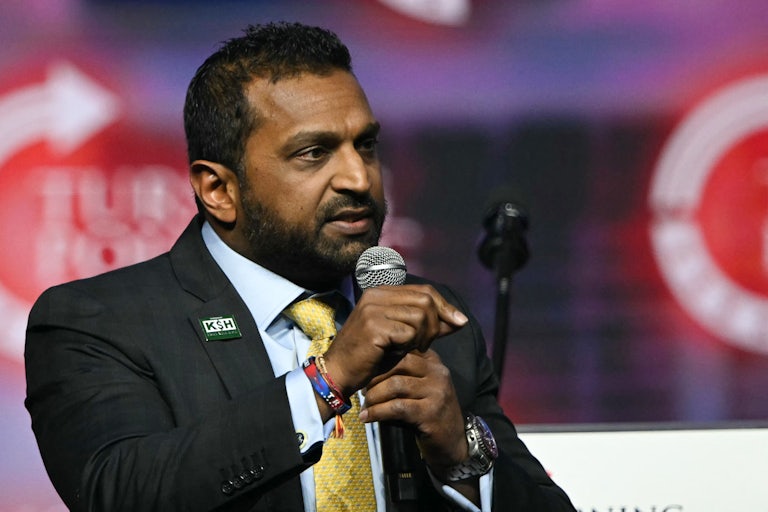
Kash Patel gestures while speaking into a microphone
Patrick T. Fallon/AFP/Getty Images

It seems that Kash Patel, Donald Trump’s pick to transform the FBI into the president’s billy club, hasn’t quite won over all of the president-elect’s allies, according to MSNBC.

Patel, who held intelligence and defense roles during Trump’s first term, is considered one of his most dangerous picks yet—and not everyone is happy about the president-elect’s choice.

MSNBC’s Joe Scarborough and Jonathan Lemire discussed reports Monday of unease in Trump’s inner circle around Patel’s nomination.

“Kash Patel is not just controversial among media outlets or Democrats, he is not just controversial among Republican senators,” Scarborough said. “He is controversial inside Trump’s own orbit.

“You go inside Trump’s own orbit and it is split down the middle with half the people thinking he is going to be a disaster for any Donald Trump administration, and they never wanted this nomination to see the light of day because—again—that divide goes straight through MAGAworld for those around Donald Trump.”

Lemire explained that Patel, with his penchant for “deep state” conspiracy theories and threatening journalists, is a pick designed to please far-right extremists.

“People I talked to say this pick was a nod to the extreme right-wing portions of Trump base, the Steve Bannon, ultra-MAGA sector here who had been disappointed by Trump’s picks like treasury secretary and secretary of state,” Lemire explained, referring to billionaire money manager Scott Bessent and Republican Senator Marco Rubio, respectively.

“This is Trump throwing them red meat because he knows he needs to keep them happy, but other people in Trumpworld are deeply worried about this pick; that Patel is not only not qualified but dangerous, that he will not think twice or hesitate in carrying out whatever Trump wants, people say, even for people breaking the law.”

It’s hard to believe Trump hasn’t already satisfied the more extreme among his base with his slate of far-right conspiracy theorists, autocrat apologists, and alleged sexual predators. At a certain point, so many “nods” to the far right aren’t really just nods anymore, as Trump’s loyalist picks for intelligence and law enforcement constitute the makings of an increasingly accelerating authoritarian takeover.

Vivek Ramaswamy Is Hopelessly Oblivious

The Trump ally, “DOGE” co-lead, and federal bureaucrat hates … federal bureaucrats.

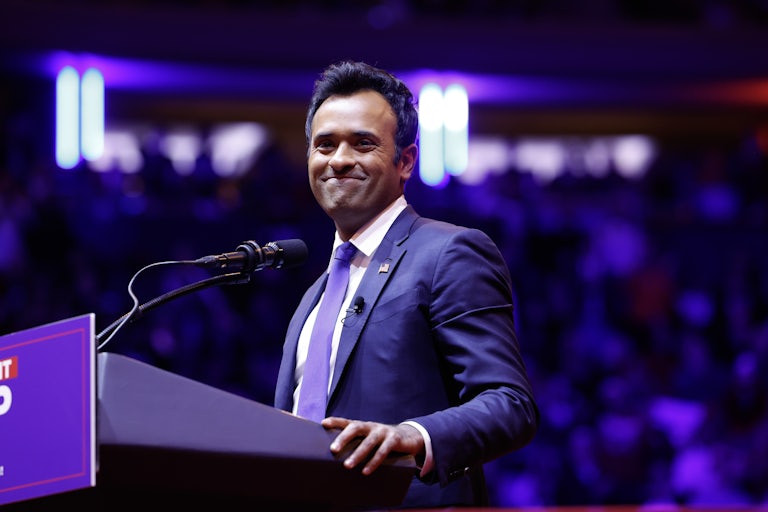
Vivek Ramaswamy smiles as he speaks behind a lectern.
Anna Moneymaker/Getty Images
Vivek Ramaswamy in October

An unelected federal bureaucrat spent his weekend complaining about how much he hates unelected federal bureaucrats.  

Former presidential candidate and Department of Government Efficiency, or DOGE, co-lead Vivek Ramaswamy offered a pretty oblivious take on X on Sunday. Chiming in on a discussion between Elon Musk and Stephen Miller about the deep state, Ramaswamy responded, “The real ‘threat to our democracy’ is the unelected federal bureaucracy.” 

This stunning lack of self-awareness—or unabashed hypocrisy—was quickly ridiculed. 

“You have already launched and are reportedly staffing a department of the United States government that has never actually been created or authorized by any statute enacted by the democratically elected Congress of the United States,” former Bernie Sanders adviser David Sirota wrote.

“Vivek is literally an unelected federal bureaucrat,” said MSNBC contributor Brian Tyler Cohen.

“That’s you, IDIOT,” said talk show host Roland Martin.

Even still, Ramaswamy and Musk are set to be equipped with power to radically change the federal government apparatus, or “deep state” as they like to call it—especially after their recent victory in the Loper Bright v. Raimondo Supreme Court case.

Puny Republican House Majority Could Threaten Trump’s Goals

House Republicans don’t have a lot of room for disagreement.

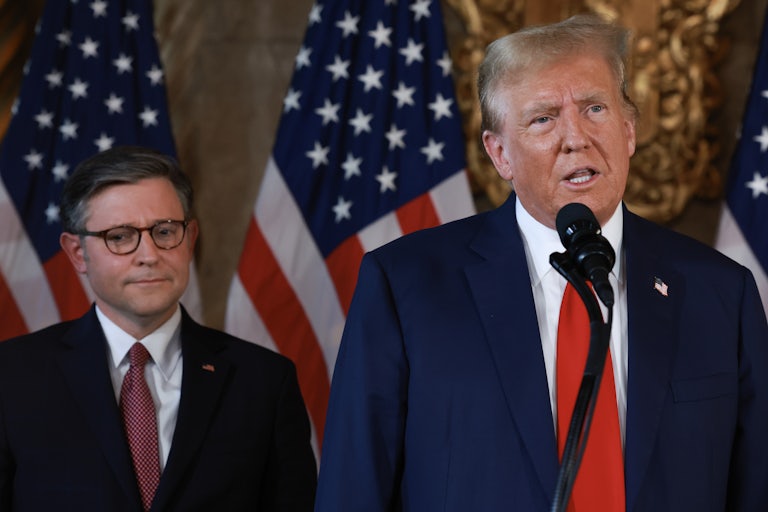
Donald Trump speaks into a microphone while Mike Johnson stands behind him and frowns
Joe Raedle/Getty Images

Donald Trump’s next term will benefit from a Republican trifecta at the upper echelons of government—but the party’s inner divisions and its tiny, two-seat majority in the House might stand in the way of some of his bigger policy goals.

With Congress winding down its 118th session, it’s clear that the divisions flaming both parties in both chambers have disrupted the legislature’s typical productivity. For scale: The branch’s last session, which also faced criticism for its lack of productivity, enacted 362 public laws. The 118th, by contrast, has passed just 136 laws, according to legislative data from LegiScan.

That’s partially thanks to rampant chaos in the House, which wasted months of the first half of its session unable to pick a leader, whether it was via Kevin McCarthy falling to the caucus’s far-right members last year or Speaker Mike Johnson, a relative unknown, almost accidentally acquiring the House’s highest position.

Meanwhile, Republicans, divided between traditional party values and Trump’s MAGA infusion, have continued to torpedo their own initiatives. Up next on the docket for the confused party is advancing Trump’s tax goals, which include extending his 2017 Tax Cuts and Jobs Act and delaying the end of $3.3 trillion in tax breaks that overwhelmingly benefit the wealthy (they’re currently set to expire in 2025).

Senior Republicans had hoped that the extension would give the president-elect the tools to expand border enforcement and begin his “mass deportations,” but even the party’s political advantages aren’t enough for a clear path forward on the issue.

“It’ll be super challenging. And the reason for that is you have razors at margins, and we’re obviously not going to get any Democrat votes. The key is going to be addressing all these coalitions that are likely going to threaten an insufficient number of votes unless they get their priorities,” Senator Thom Tillis told NBC News Sunday. “It’s infinitely more complex to get a reconciliation outcome in this cycle out of the House than the Senate.”

But the extreme nativist effort has doubly spelled out to Democrats that conservatives aren’t looking to bipartisanship to advance their policies.

“Republicans are trying to take actions that will benefit the most fortunate and grow the debt for future generations,” Representative Brad Schneider, the newly elected chair of the moderate New Democrat Coalition, told NBC. “They’ve made it very clear they’re not going to look to find any compromise. They’re going to have to work within their own caucus, this very narrow majority.”

Elon Musk and Vivek Ramaswamy Are Already Weaponizing Supreme Court

Elon Musk and Vivek Ramaswamy are taking the Supreme Court’s controversial ruling as a green light.

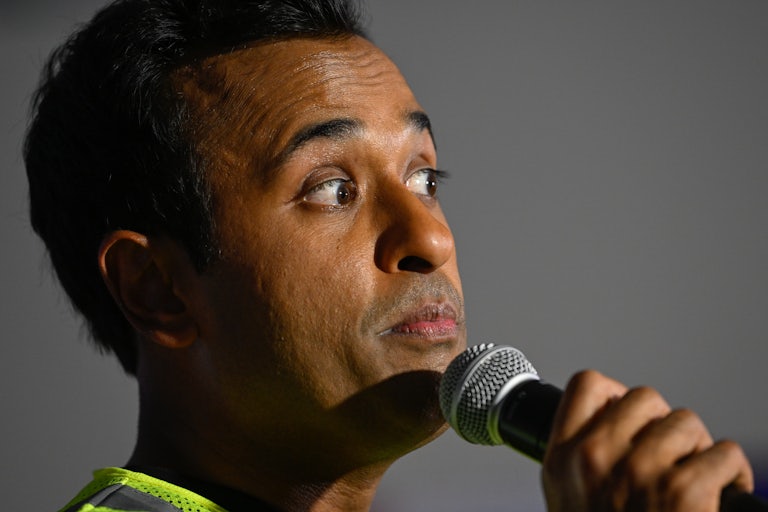
Vivek Ramaswamy raises his eyebrows and holds a microphone up to his face
Peter Zay/Anadolu/Getty Images

The nominated co-chairs of the soon-to-be Department of Government Efficiency, Vivek Ramaswamy and Elon Musk, have pinpointed a standard that will allow them to completely remake the federal government—and it’s all thanks to the Supreme Court.

Earlier this year, the nation’s highest court ruled on Loper Bright v. Raimondo, overturning a 1984 decision in Chevron v. Natural Resources Defense Council and killing a long-standing mandate that federal courts should defer to executive branch agencies’ interpretation of the laws they administered (so long as that interpretation was deemed reasonable).

In a lengthy statement Monday morning, Ramaswamy highlighted that Loper Bright will allow their department to enact the sweeping budget cuts they envision for the executive branch—which includes shrinking the federal deficit and slashing $2 trillion in spending by July 4, 2026.

“Under the old standard, federal courts deferred to agency interpretations of law when a statute was deemed ambiguous,” Ramaswamy wrote on X. “Overturning Chevron deference, combined with the Major Questions Doctrine codified in West Virginia vs EPA, paves the way for not a slight but a *drastic* reduction in the scope of the federal regulatory state. It’s coming.”

Musk quote-tweeted Ramaswamy’s lengthy post, simply replying, “Yes.”

The biotech billionaire pointed to several legal studies to back his perspective, including a 2017 study that found that Chevron had become something of a standard for determining agency interpretation, being applied to close to three-quarters of relevant cases between 2003 and 2013.

An op-ed by the duo published in The Wall Street Journal last month highlighted some specific and immediate targets for their cuts. They include slashing more than $500 million a year from the Corporation for Public Broadcasting (which funds NPR and PBS), nearly $300 million from Planned Parenthood, and “$1.5 billion for grants to international organizations.” Musk and Ramaswamy also suggested, in vague terms, that “entitlement programs” such as Medicare and Medicaid are on the line, though they refused to acknowledge how much they intend to burn from the critical health care programs.

Read more about the effects of this case: