Breaking News
Breaking News
from Washington and beyond

The Real Reason Elon Musk Forced Vivek Ramaswamy Out of DOGE

It sounds like Elon Musk didn’t enjoy sharing the spotlight.

Vivek Ramaswamy stands in the Capitol ahead of Donald Trump’s inauguration
Shawn Thew/Pool/Getty Images

Vivek Ramaswamy was pushed out of the fledgling Department of Government Efficiency because his vision didn’t align with the sieg heil-ing shadow president Elon Musk, according to an exclusive report from The Washington Post.

Ramaswamy was behind November’s Wall Street Journal op-ed that outlined a plan to slash trillions of dollars’ worth of essential government services and contract out the functions of the administrative state. He wanted DOGE to function more like a think tank, determining which government agencies could be shut down and which regulations could be repealed without congressional approval.

While Ramaswamy focused on that, Musk was meant to focus on spending and technology. But, the technocrat billionaire—glued to the president’s side—was reportedly on an entirely different page about how to best eviscerate the administrative state, according to several people who spoke with the Post. And his vision seems to have won out.

Monday’s executive order officially establishing the Department of Government Efficiency was merely a rebranding of the U.S. Digital Service, an Obama-era group created to respond to manage issues with the Affordable Care Act’s website, and that now determines best practices for the government use of technology.

While it seems like a pivot from creating a brand-new agency, this change is far more aligned with Musk’s technology-forward vision for the organization. It also lands him a White House office, and all the unfettered access that entails.

The executive order gave Musk “full and prompt access to all unclassified agency records, software systems, and IT systems,” a privilege that will likely benefit the billionaire technocrat who has already made tens of billions of dollars from government contracts.

Musk also imagined DOGE being structured as a small team within the government, not the nongovernmental body structure Ramaswamy imagined. Because it’s a White House office, Musk will also be able to sidestep federal hiring rules—and Trump’s hiring freeze.

None of the work from Ramaswamy’s team garnered mention in an executive order Monday, according to the Post.

Earlier reports said that Ramawamy exited the cost-cutting department over clashes with rank-and-file members. Someone close to Trump said that Ramaswamy had “worn out his welcome.”

And it seems that held true up the ranks. “They’ve been wanting Vivek to step aside so Elon could have more control,” one person briefed on the matter told the Post. “There was tension, and then they had an out and kind of took the out.”
Trump’s Budget Chief Pick Refuses to Answer Questions—and GOP Lets Him

Republican senators were apparently all too happy to let Russell Vought skate through.

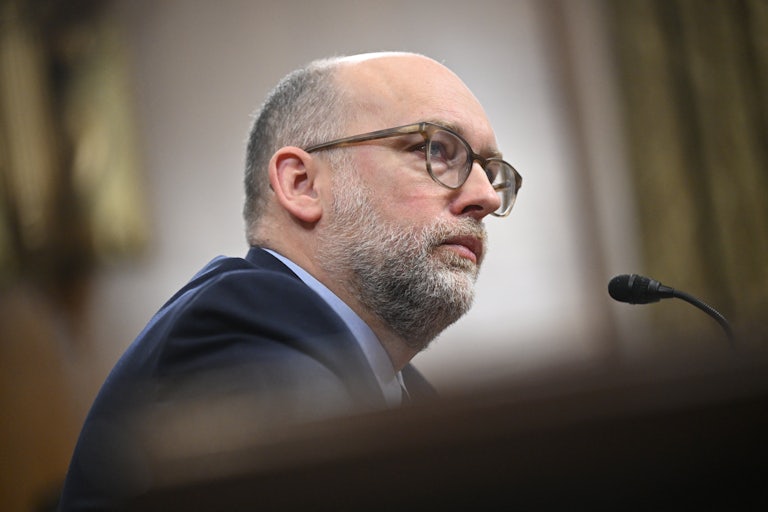
Russell Vought sits at a table during his Senate confirmation hearing
Saul Loeb/AFP/Getty Images

Donald Trump’s pick to run the Office of Management and Budget continued his Senate confirmation hearing Wednesday, but his uncanny ability to slide past tough questions—and the committee’s complicity in allowing him to do so—didn’t get past some of the Democratic lawmakers interviewing him.

Senator Sheldon Whitehouse torched Russell Vought’s evasive and bureaucratic non-answers, arguing that the nominee didn’t have any special privileges that afforded him the ability not to be completely transparent with the American public.

“Why can I not get an answer—is there some new rule in this committee?—as to where these executive orders came from?” Whitehouse pressed. “That’s perfectly, to me, legitimate congressional oversight. Over and over again this witness has told us what questions he will answer, but the oath he took was to tell the truth, the whole truth, and nothing but the truth in response to our questions.”

“So if there’s some new limitation about what question I can [have answered], I would like to understand that. And if not, I would like to have the chair tell the witness to answer my questions,” he added.

That roped Senate Budget Committee Chairman Lindsay Graham into the heated back and forth, who impressed on Vought that he did not have attorney-client privilege to evade a line of questioning as some of Trump’s other nominees did.

“I am not claiming a privilege, Senator,” Vought said.

“Generally speaking, you know, I guess the question is, did you advise on executive orders and which ones?” Graham insisted. “Can you kind of tell us that please?”

“Senator, I was not a member of the transition, I was not a member of the campaign,” Vought said, before adding that he did not have a “comprehensive knowledge of where the executive orders were drafted.”

But despite the clarification, Vought still refused to pinpoint where the sudden flurry of Day One executive orders had been drafted, despite the fact that many of them fell in line with Project 2025, a plan of Vought’s own design.

Last week, Vought similarly dipped and dodged hard inquiries by the committee, claiming that a Congressional statute used to reexamine executive branch withholdings from the budget was unconstitutional, and refusing to pledge that he wouldn’t deny grants based on the requester’s political alignment.

Vought ran Trump’s Office of Management and Budget from July 2020 to January 2021, during which time he froze military aid for Ukraine, claimed that foreign aid expenditures were “wasteful spending,” and worked to expand the number of federal employees required to work during a government shutdown.

He scooped up another supporting role in Trumpworld during the incoming executive’s presidential campaign: developing a 180-day “transition playbook” to expedite Project 2025’s implementation into the federal government. But his appointment to run the nation’s budget office could see him enter a critical role in shrinking the federal government and advancing Trump’s agenda.

Vought was also the architect of Trump’s “Schedule F” proposal, which plans to fire thousands of civil servants and replace them with as many as 54,000 pre-vetted Trump loyalists to the executive branch via executive order.

Pro-Trump Police Union Slams January 6 Pardons

The Fraternal Order of Police has finally commented on Donald Trump’s sweeping pardon of January 6 insurrectionists.

Donald Trump rests his chin on his hand as he signs executive orders in the Oval Office
Jim Lo Scalzo/EPA/Bloomberg/Getty Images

The Fraternal Order of Police has finally spoken: Trump was wrong for pardoning January 6 insurrectionists who were convicted of assaulting police officers.

The country’s most powerful police union released a statement condemning Trump’s pardons after not having a “statement about that” when the pardons initially dropped.

“The [International Association of Chiefs of Police] and FOP are deeply discouraged by the recent pardons and commutations granted by both the Biden and Trump Administrations to individuals convicted of killing or assaulting law enforcement officers,” the union said in a statement. “The IACP and FOP firmly believe that those convicted of such crimes should serve their full sentences. Crimes against law enforcement are not just attacks on individuals or public safety—they are attacks on society and undermine the rule of law. Allowing those convicted of these crimes to be released early diminishes accountability and devalues the sacrifices made by courageous law enforcement officers and their families.”

The FOP endorsed Trump for president in 2024. On Monday, he pardoned over 1,500 people in connection with the January 6 attack on the Capitol. Some, like Julian Khater, who pepper-sprayed Capitol Police Officer Brian Sicknick in the face, committed deliberate violence against police and were found guilty of doing so (Sicknick died the day after the attack). Multiple Proud Boys and Oath Keepers were also pardoned.

The FOP’s statement is actually fairly weak, as it doesn’t name a single person or pardon it has issue with and even takes time to throw stones at the prisoners Biden pardoned. The union being “discouraged” with both Trump and Biden for pardoning “individuals convicted of killing or assaulting law enforcement officers” could be referring to Biden’s commutation of the sentence of Native American activist Leonard Peltier—a man whose own prosecutor thinks he is innocent. If the FOP truly thinks that Trump pardoning violent insurrectionists is wrong, it should say that with its chest.

The Far-Right Is Celebrating One Hidden Detail in Trump’s DEI Order

The right is salivating over Donald Trump targeting universities next.

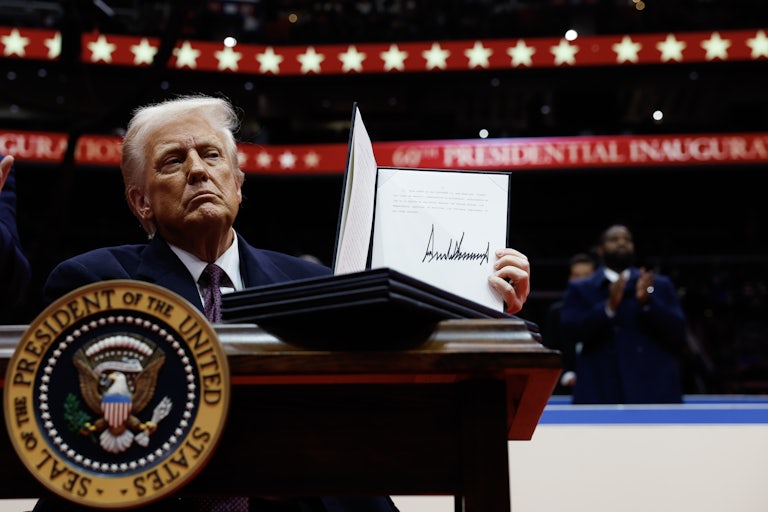
Donald Trump holds up a signed executive order during his inaugural parade
Anna Moneymaker/Getty Images

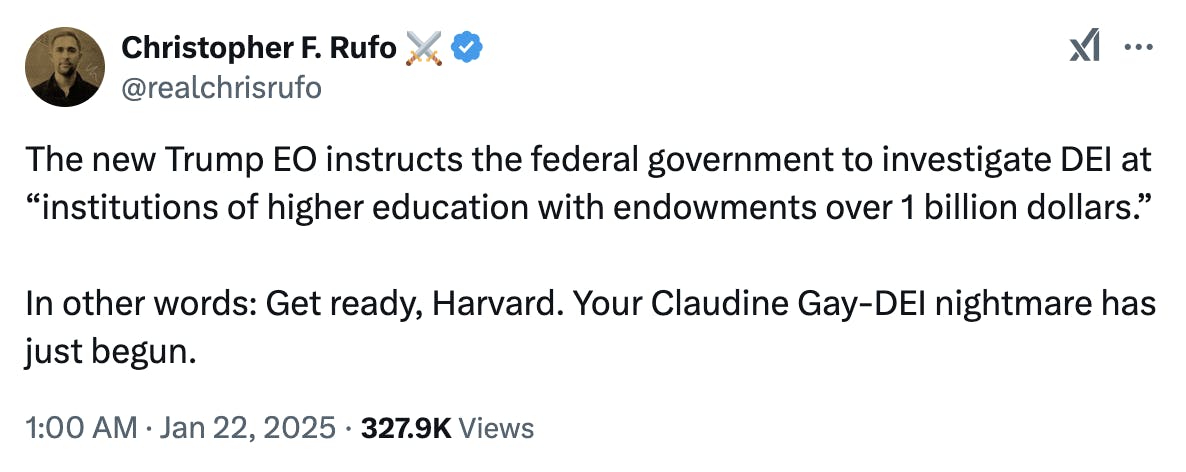
Donald Trump’s executive order on Monday against diversity, equity, and inclusion initiatives includes a provision to investigate DEI “discrimination” at “institutions of higher education with endowments over $1 billion,” and the MAGA right is celebrating.

The provision would target a large section of universities in the country, including wealthy institutions in the Ivy League, such as Harvard University. The news has right-wing personalities and pundits celebrating, including public education foe Christopher Rufo.

X screenshot Christopher F. Rufo ⚔️ @realchrisrufo: The new Trump EO instructs the federal government to investigate DEI at “institutions of higher education with endowments over 1 billion dollars.” In other words: Get ready, Harvard. Your Claudine Gay-DEI nightmare has just begun. 1:00 AM · Jan 22, 2025 · 327.9K Views

X screenshot Richard H. Ebright @R_H_Ebright: Epochal change. Earthshaking change. "[T]o deter DEI programs or principles...each agency shall identify up to 9 potential civil compliance investigations of publicly traded corporations,...non-profit corporations or associations,...and institutions of higher education"

Rufo’s X post received several approving replies from conservatives, including from Elon Musk, and demonstrates the deep hatred among the right wing for colleges and universities that seek to improve diversity.

It would appear that this executive order is the result of Rufo’s efforts. Rufo met with Trump shortly after the election in November, presenting him with a plan to withhold federal money from universities unless they end diversity measures. The conservative activist has sought to push Christian nationalism and right-wing ideology into a dominant place in American life, having given the right its talking points on “critical race theory” and tested out his anti-DEI efforts as a trustee at Florida’s New College.

Now Trump’s executive order seems to be the first step in remaking all of American society to push racial, ethnic, and LGBTQ minority groups out of public life, not just in education but also in the workforce. It’s essentially a culture-war purge that will play out in federal lawsuits.

“F**k It”: The Real Logic Behind Trump’s Sweeping January 6 Pardons

Donald Trump issued 1,500 pardons on his first day in office.

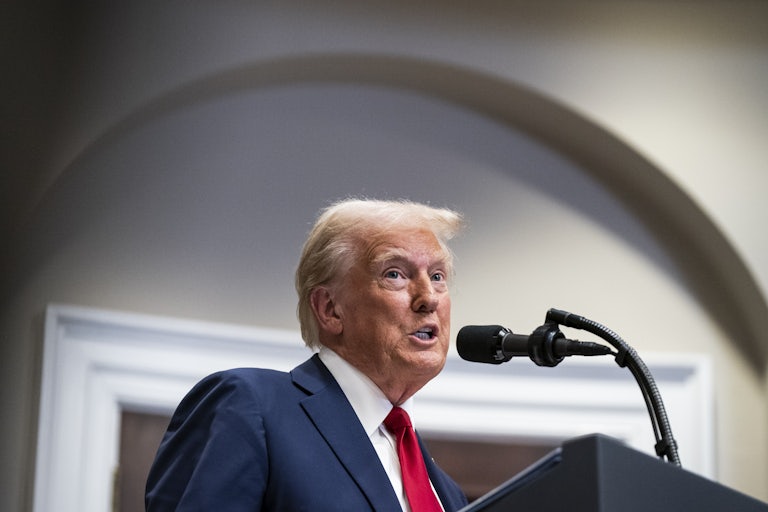
Donald Trump speaks into a microphone
Jabin Botsford/The Washington Post/Getty Images

Donald Trump’s decision to pardon some 1,500 January 6 offenders was a spontaneous move that overrode his administration’s internal debate.

“Trump just said: ‘Fuck it: Release ’em all,’” one White House adviser told Axios.

That was, apparently, completely kosher with Vice President JD Vance, who told Fox News just last week that Trump’s more violent supporters didn’t deserve pardons.

“I think it’s very simple: Look, if you protested peacefully on January 6, and you had Merrick Garland’s Department of Justice treat you like a gang member, you should be pardoned,” Vance told host Shannon Bream. “If you committed violence on that day, obviously you shouldn’t be pardoned.”

But when push came to shove—as in, when Trump was ready to make his own executive call on the long-promised pardons—Vance’s dissenting opinion suddenly caved.

“Vance was 100 percent on board,” a Trump insider told Axios. “The president didn’t change his mind. He just made up his mind, and Vance got a little over his skis on Fox, but it’s no big deal.”

“Never get ahead of the boss,” another Trump transition source told the publication, “because you just never know.”

Trump’s decision to legally and unilaterally forgive his most aggressive supporters was, actually, wildly unpopular with the American public. A November Scripps News/Ipsos survey found that few Americans—just 30 percent—actually supported a legal reprieve for the Capitol rioters, versus an overwhelming 64 percent of the country that was against it. Just 1 percent of respondents believed that the pardons should be Trump’s first priority—let alone something that he issued a sweeping executive order for on his first day in office.

Trump has claimed for years that he would free the men and women who rioted through Congress in 2021, forcing the legislature to delay the certification of the presidential election results. In an interview with NBC News’s Meet the Press in December, the MAGA leader said he would act “very quickly” to release the January 6 defendants.

“They’ve been in there for years, and they’re in a filthy, disgusting place that shouldn’t even be allowed to be open,” Trump said at the time.