Breaking News
Breaking News
from Washington and beyond

Ketanji Brown Jackson Torches Supreme Court Shadow Docket in Dissent

The justice wrote a scathing dissenting opinion in the court’s latest decision to back Donald Trump.

Supreme Court Justice Ketanji Brown Jackson gestures while seated onstage
Jacquelyn Martin/AFP/Getty Images

Supreme Court Justice Ketanji Brown Jackson slammed the “inequitable” and “inappropriate” way the court ruled to allow Donald Trump to proceed with his deportations under the Alien Enemies Act of 1798.

In a scathing dissent, Jackson voiced her disapproval of the court’s Monday decision to strike down U.S. District Court Judge James Boasberg’s injunction pausing deportations under the AEA, which was used last month to expedite the deportation of more than 100 alleged gang members to a prison in El Salvador notorious for human rights abuses.

“The President of the United States has invoked a centuries-old wartime statute to whisk people away to a notoriously brutal, foreign-run prison,” Jackson wrote. “For lovers of liberty, this should be quite concerning.”

The court’s newest justice also took issue with how her colleagues had ruled on the issue, as part of the bench’s emergency, or shadow, docket, which sees immediate action on issues ranging from scheduling proceedings to requests to halt lower court rulings—like the government’s request to halt Boasberg’s injunction.

“I lament that the Court appears to have embarked on a new era of procedural variability, and that it has done so in such a casual, inequitable, and, in my view, inappropriate manner,” she wrote.

“At least when the Court went off base in the past, it left a record so posterity could see how it went wrong,” she wrote. Jackson then cited Korematsu v. United States, in which the Supreme Court had ruled that the government was right to order the incarceration of Japanese American citizens during World War II. President Franklin Roosevelt had used the Alien Enemies Act to justify the brutality of Japanese internment.

The Supreme Court condemned its ruling in Korematsu in 2018, calling it “morally repugnant” and “gravely wrong” but at the same time rubber-stamped Trump’s travel ban targeting six Muslim-majority countries.

Jackson argued that the court hadn’t learned anything.

“With more and more of our most significant rulings taking place in the shadows of our emergency docket, today’s court leaves less and less of a trace. But make no mistake: We are just as wrong now as we have been in the past, with similarly devastating consequences. It just seems we are now less willing to face it,” she wrote.

In recent years, justices have begun to issue far more significant rulings through the shadow docket, according to the Brennan Center for Justice. Unlike the 60 or 70 merit docket cases that the justices decide each term, shadow docket cases do not receive extensive briefings or hearings, and their decisions are accompanied by scant explanations.

“Surely, the question whether such Government action is consistent with our Constitution and laws warrants considerable thought and attention from the Judiciary,” Jackson wrote.

“But this Court now sees fit to intervene,” she said, “hastily dashing off a four-paragraph per curiam opinion discarding the District Court’s order based solely on a new legal pronouncement that, one might have thought, would require significant deliberation.”
Trump Claims Nazis Treated Jewish Prisoners With “Love”

Donald Trump made the unbelievable claim during a press conference with Israeli Prime Minister Benjamin Netanyahu.

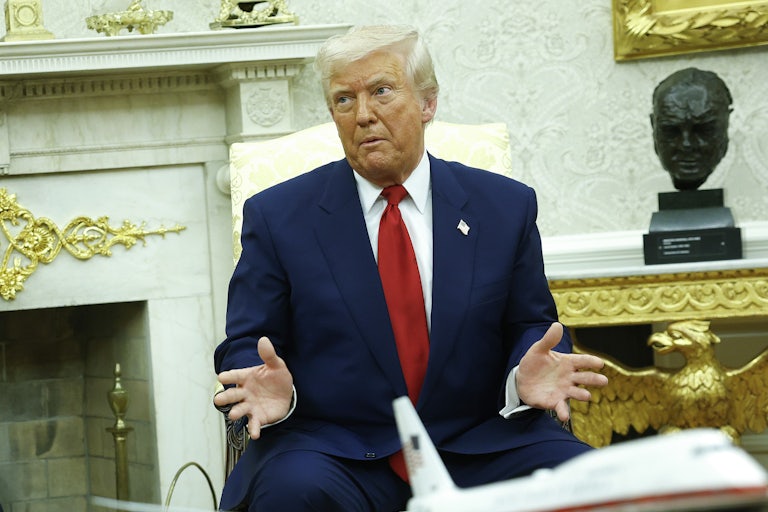
Donald Trump gestures while speaking and sitting in the Oval Office
Kevin Dietsch/Getty Images

In his latest rewrite of European history, Donald Trump made a ridiculous and sympathetic declaration about the Nazis.

Amid the tariff chaos he spurred, Trump met with Israeli Prime Minister Benjamin Netanyahu in the Oval Office Monday, where he was asked by reporters about his plan to bring about the release of the 59 Israeli hostages being held captive in Gaza by Hamas.

In typical Trump fashion, the president dodged the question and went on a bizarre rant that seemingly remembered Nazis for … their sympathy.

“I said to them, was there any sign of love?” Trump said, recounting his conversation with released hostages.

“Did the, Hamas, show any signs of like, help? Or liking you? Did they wink? Did they give you a piece of bread extra? Did they give you a meal on the side? … Like, you know, what happened in Germany?” Trump said, absurdly comparing the hostages’ situation to the Holocaust, which murdered six million Jews.

“People would try and help people that were in unbelievable distress,” the president went on, suggesting that the Nazis were known for their generosity.

“No, they didn’t do that, they’d slap us,” Trump said the hostages told him about Hamas, while sitting next to the man who is currently leading Israel’s genocide in Gaza. “Their hatred is unbelievable.”

Trump’s claim about Nazi kindness sent people reeling on social media.

“This isn’t just delusional. It’s Holocaust cosplay. He’s romanticizing genocide like it’s a fucking history podcast,” one user wrote on X.

“Equating hostages held by Hamas to victims in Nazi Germany isn’t just offensive, it’s also a grotesque distortion of history,” wrote another. “He’s always saying the first thing that pops into his head without understanding the weight of those words. And he’s sitting next to Israeli Prime Minister. Crazy stuff!”

Top Dems Launch Probe Into Elon Musk’s Lucrative Conflicts of Interest

In a letter shared exclusively with The New Republic, House Oversight Democrats urged the Commerce Department to take action against Musk.

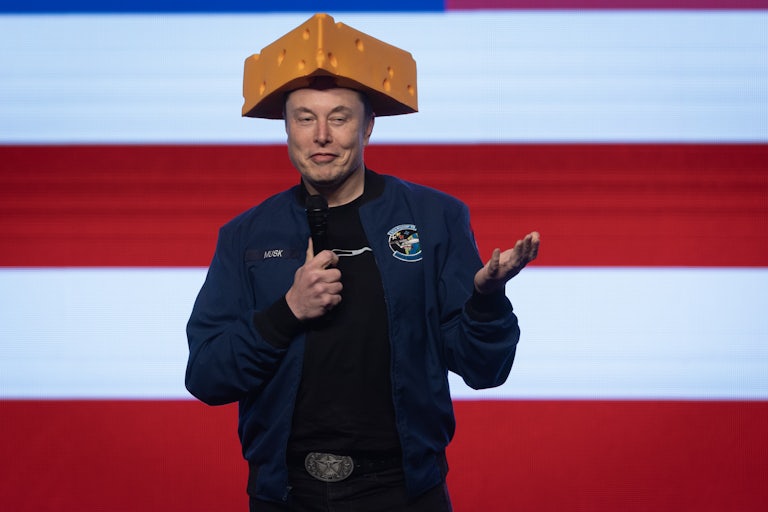
Elon Musk wears a hat that looks like a block of speech and holds a microphone and gestures while onstage at a rally in Wisconsin.
Scott Olson/Getty Images

Democrats on the House Oversight Committee sent a letter to the Department of Commerce Tuesday as part of a new investigation into Elon Musk’s glaring conflicts of interest.

In a six-page letter to acting General Counsel John K. Guenther, Ranking Member Gerry Connolly and Vice Ranking Member Jasmine Crockett requested information about how Commerce intends to prevent Musk from skirting ethics rules to use the department to enrich himself. 

The letter, shared exclusively with The New Republic, outlined several instances where Commerce’s operations had openly benefited Musk’s businesses. The representatives requested that the department provide a range of communications and documents by April 22 to demonstrate how the officials intended to prevent the billionaire bureaucrat from exploiting the government.  

“At Commerce, where Mr. Musk’s companies have received significant financial benefits and have the potential to receive vast amounts of new business, his defiance of recusal laws and control of Commerce’s operations directly benefit his businesses,” the members wrote. “The known conflicts of interest presented by this arrangement are illegal and must be addressed immediately.”

The representatives argued that Musk had been wrongly classified as a “special government employee” as part of an effort to skirt ethics requirements and that his authority to conduct sweeping cuts and recommend massive layoffs as the head of the Department of Government Efficiency was consistent with being in a high-level officer position that requires Senate confirmation. Still, ethics laws were in place to prevent special government employees from taking part in matters that could affect their personal finances. 

“The law, however, has not stopped Mr. Musk. On the contrary, Mr. Musk’s ability to enrich himself through DOGE is a textbook example of corruption at the taxpayers’ expense,” the letter stated.   

The letter cited several instances in which Donald Trump’s Department of Commerce had been poised to enrich Musk’s businesses, which have raked in a whopping total of $38 billion from government contracts over the past 20 years. 

The letter pointed to DOGE’s mass layoffs at the National Oceanic and Atmospheric Administration, launching concerns that Musk intended to use contracts for his companies SpaceX and Starlink to fill in the holes he’d created and that he could reasonably access information at NOAA that could give him an advantage over his competitors.

In March, Commerce Secretary Howard Lutnick announced that his department would begin an overhaul of the Broadband Equity, Access and Deployment Program, or BEAD. After four years, the $42.5 billion project to expand internet access across the country hadn’t yet connected a single person, and Lutnick blamed “woke mandates, favoritism towards certain technologies, and burdensome regulations.”

Lutnick’s promise of a “tech-neutral” approach, which will make way for the use of satellites in addition to fiber-optic cables, could offer a bigger piece of the pie to Musk’s Starlink. The company was originally expected to haul in around $4.1 billion under the previous rules but could rake in anywhere from $10 billion to $20 billion if Lutnick’s changes are accepted.

BEAD’s outgoing director sent a blistering email to colleagues warning that Musk was poised to profit at the expense of the very people they were trying to help. 

“Stranding all or part of rural America with worse internet so that we can make the world’s richest man even richer is yet another in a long line of betrayals by Washington,” former BEAD Director Evan Feinman wrote in mid-March.

But Starlink isn’t the only one of Musk’s businesses to benefit from the actions of Commerce. 

When Tesla’s sinking stock started tanking last month, Lutnick appeared on Fox News to urge viewers to buy shares of the billionaire bureaucrat’s electric car company. 

“I mean who wouldn’t invest in Elon Musk, you gotta be kidding me!” Lutnick raved. Notably, Cabinet members do not typically endorse products, as the Code of Federal Regulations bars public servants from “using their office’s platform to endorse companies and products.”

And Lutnick isn’t Musk’s only ally at Commerce. Michael Grimes, a finance executive who worked closely on deals for Musk’s companies, was recently made senior adviser at Commerce, where he will reportedly head a U.S. sovereign wealth fund that could potentially direct billions to his old friend. 

The letter also pointed to Trump’s dismissal of the inspector general at Commerce, who would’ve acted as a watchdog for any corruption or abuse. 

Connolly and Crockett’s letter set an April 22 deadline for Commerce to provide detailed lists of all Commerce matters involving Musk’s businesses, all steps Commerce is taking to ensure compliance with ethics laws related to Musk’s businesses, and all actions Commerce is taking to ensure that Musk was not receiving information that would give him a business advantage over his competitors. 

The letter also requested the names of any federal employees at Commerce who had been “in any way removed” from their positions by Musk or DOGE, as well as a list of all exemptions that Commerce has received from Trump’s freeze on federal funding. 

Elon Musk’s DOGE Is Now Using AI to Spy on Federal Workers

Be careful what you say if you’re a federal employee.

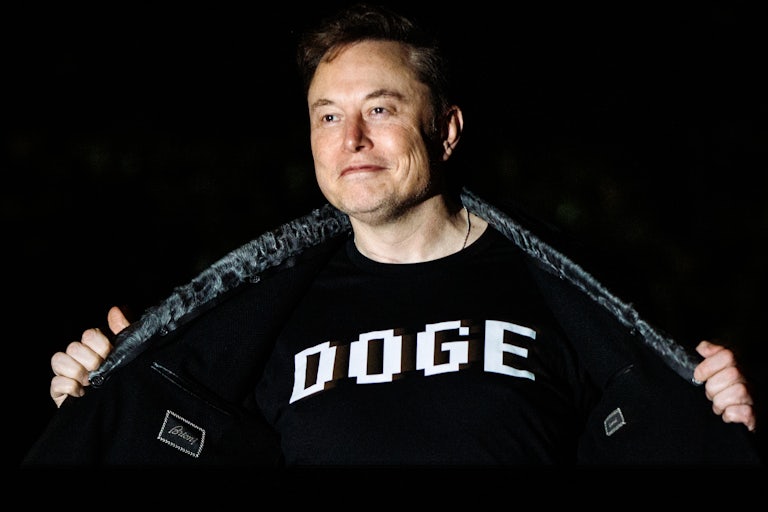
Elon Musk stands outside the White House and holds open his jacket to reveal the word "DOGE" printed on his shirt
Samuel Corum/Getty Images

Elon Musk, who wants AI to replace federal workers, is now using it to spy on them.

After speaking to 20 people close to the situation, Reuters has reported that officials within the Trump administration told federal employees that DOGE “technologists” are using AI to monitor “anti-Trump or anti-Musk language” at the Environmental Protection Agency. One person also said DOGE is using Musk’s Grok AI chatbot—an aspiring ChatGPT competitor—to make massive cuts to the government.

“Be careful what you say, what you type and what you do,” a manager allegedly told one of Reuters’s sources.

This is a grimly ironic development for Musk, who constantly claims that he and his X platform are bulwarks of free speech. The EPA has yet to comment.

“[It] sounds like an abuse of government power to suppress or deter speech that the president of the United States doesn’t like,” government ethics expert Kathleen Clark told Reuters.

DOGE employees are also using Signal—the app that landed Mike Walz in hot water for a week—to message each other. And on top of that, DOGE employees are working live on Google Docs instead of using the single copy vetting and chain of custody process that is standard operating procedure for the government.

If these allegations of spying, Signalgate II, and the use of Google Docs are true, they’re a very serious breach of security and a demonstrable lack of transparency from DOGE.

More on wtf this administration is doing:

MAGA Rages at Amy Coney Barrett After She Turns Against Trump

The right is pissed at the conservative Supreme Court justice for ruling against Trump’s recent deportations.

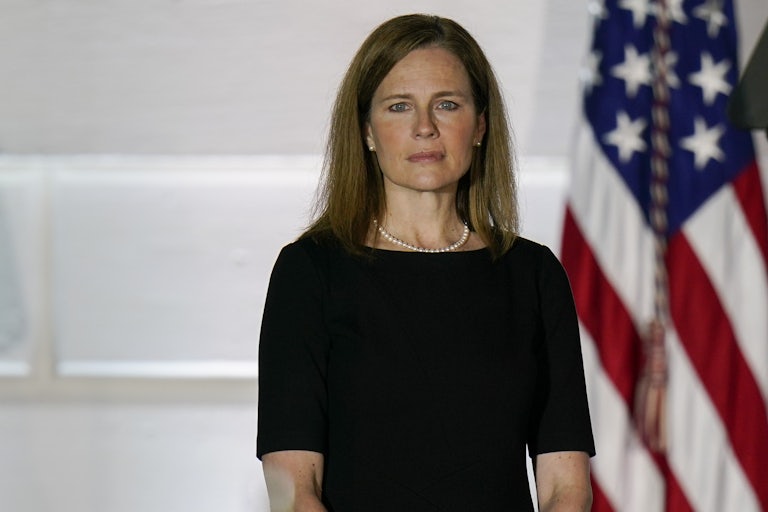
Supreme Court Justice Amy Coney Barrett
Chris Kleponis/CNP/Bloomberg/Getty Images

In any sane reality, President Trump’s deportation of immigrants based on an eighteenth-century law, with no right to due process, would be swiftly remedied by the courts. But to conservatives, such an action is tantamount to treason.

Supreme Court Justice Amy Coney Barrett sided with the high court’s liberals Monday by dissenting against Trump’s use of the “Alien Enemies Act,” drawing the ire of the MAGA faithful. While the court still ruled to uphold the president’s deportation by a 5–4 margin, Barrett, appointed by Trump in 2020, still received vitriol from the right for her decision.

Even a U.S. senator got in on the attacks, along with tech oligarch Elon Musk.

A few commentators engaged in some thinly veiled racism targeting Barrett’s adopted children.

This isn’t the first time that Barrett has broken with conservative orthodoxy in her rulings, showing that at times she thinks for herself, much to the right’s consternation. The funny part is that she is still quite conservative, voting to overturn Roe v. Wade and reliably joining her fellow right-wing justices in rulings regarding religious freedom, capital punishment, and affirmative action. While her dissent Monday wasn’t enough to tip the court’s ruling, it shows that there’s a glimmer of hope on the Supreme Court that it won’t always rubber-stamp Trump’s abuses of power.