Breaking News
Breaking News
from Washington and beyond

Supreme Court Lets Trump Move Forward on Cruel Trans Military Ban

All three liberal judges on the court tried to stop this.

People protest in front of the Supreme Court. One large sign reads "Trans Rights Are Human Rights."
Marvin Joseph/The Washington Post/Getty Images

The Supreme Court is allowing Trump to temporarily move forward with his ban on transgender people serving in the military. The court’s three liberal Justices—Sonia Sotomayor, Elena Kagan, and Ketanji Brown Jackson—all dissented, according to the brief order.

Trump’s ban “generally disqualifies from military service individuals who have gender dysphoria or have undergone medical interventions for gender dysphoria,” according to Solicitor General D. John Sauer.

Trans people are a hindrance to “military effectiveness and lethality,” Sauer wrote in a filing to the high court’s justices.

Litigation over the constitutionality of the ban is still ongoing. A Bush-appointed judge in a lower court blocked Trump’s executive order banning transgender troops in the military, which he signed on his first day in office.

Judge Benjamin Settle in Washington issued a nationwide injunction in March, ruling there’s “no claim and no evidence that [plaintiff] is now, or ever was, a detriment to her unit’s cohesion, or to the military’s lethality or readiness, or that she is mentally or physically unable to continue her service.”

Trump’s ban—and the claims that trans people are worse at operating lethal machinery simply because they are trans—is nonsensical. This is purely a culture-war item, a bone to throw at a base that’s been obsessed with transgender people for years now.

This story has been updated.
GOP Senator Tanks Controversial Trump Nominee for D.C. Prosecutor

Republican Senator Thom Tillis has just dealt a grave blow to Trump’s nominee for the top federal prosecutor in D.C.

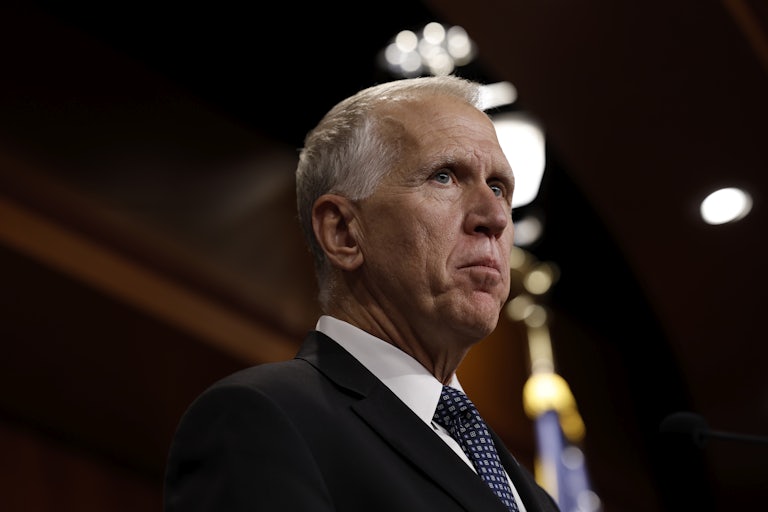
Senator Thom Tillis frowns.
Anna Moneymaker/Getty Images
Senator Thom Tillis

Senator Thom Tillis is likely just tanked Trump’s nominee for U.S. Attorney to the District of Columbia.

Tillis is opposing Trump’s pick, Ed Martin—who has been described as a “far-right election denier” and a “conspiracy theorist”—on the grounds of his legal and political support for January 6 insurrectionists.

“Mr. Martin did a good job of explaining the one area that I think he’s probably right, that there were some people that were over-prosecuted, but there were some [200 to 300 of them] that should have never gotten a pardon,” Tillis told reporters Tuesday, adding that he met Martin the night before.

“If Mr. Martin were being put forth as a U.S. attorney for any district except the district where January 6 happened, the protest happened, I’d probably support him, but not in this district.… Whether it’s 30 days or three years is debatable, but I have no tolerance for anybody who entered the building on January 6.”

Martin did his part to spread misinformation to help Trump on January 6, writing on X: “I’m at the Capitol right now. Abd [sic] I was at the POTUS speech earlier. Rowdy crowd but nothing out of hand. Ignore the #FakeNews.” Now this is coming back to bite him.

Tillis’s lone “no” vote among Republicans is likely enough to cause Martin’s nomination to die in the Senate Judiciary Committee. The U.S. attorney to D.C. serves as both the legal representative of the federal government and the local district attorney.

Why MTG’s Own Party Is Terrified of Her Next Move

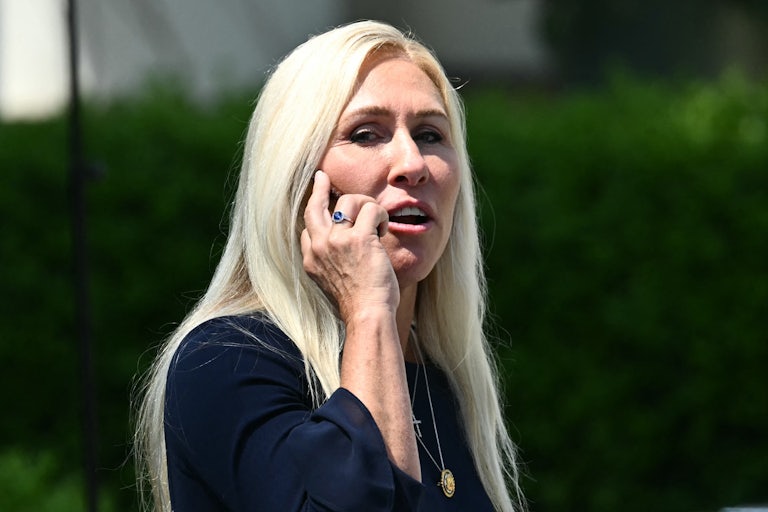
Marjorie Taylor Greene’s own party is terrified she might run for Senate.

Representative Marjorie Taylor Greene speaks on her phone
Mandel Ngan/AFP/Getty Images

At least one thing has Republicans in D.C. on edge: Representative Marjorie Taylor Greene’s quest for power.

Now that Governor Brian Kemp is officially out of the race, the fervent MAGA acolyte is rumored to be one of a dozen conservatives considering a run for a Georgia Senate seat. 

But moving Greene to the upper chamber isn’t the concern—instead, Republicans worry that her conspiratorial, shock-and-awe style isn’t enough to win over Georgia voters beyond her district, believing that a Greene run could “alienate independent voters and disillusioned Republicans,” the Atlanta Journal-Constitution reported Tuesday.

In a hypothetical matchup conducted by the paper, Senator Jon Ossoff led Greene by double digits, crushing her with a 17-point lead. That’s in large part thanks to Greene’s lack of popularity with independents in the state,  according to AJC. Just 25 percent of independents in the mock poll backed a Greene Senate bid—a significant drop from Kemp’s 46 percent favorability with the same bloc.

Conservatives had flagged Kemp as the party’s best bet to snag what is believed to be the Democrats’ most vulnerable Senate seat. Instead, his exit announcement has given Ossoff—and the Democratic Party—a remarkable lift.

“It’s possible that Greene could win a Republican primary,” Republican consultant Mark Rountree told AJC. “But it’s unlikely she could win a general election, and conservatives would once again have blown an opportunity to defeat Democrats in Georgia.”

If the Jewish space lasers conspiracy theorist does decide to run, her platform would likely be nearly identical to Donald Trump’s. On Monday, Greene lamented that conservatives in both chambers weren’t completely on board with Trump’s plan, and that party members should simply “stick with the agenda” and “ignore the people” trying to do something different.

But nothing is set in stone right now.

“The polling shows that I can win the governor’s primary or the Senate primary or continue to represent my district,” Greene said to NewsNation Monday about a prospective bid. “That’s a choice that I can make. And I’ll give it some thought.”

Trump Accidentally Admits He Hasn’t Made Any Trade Deals

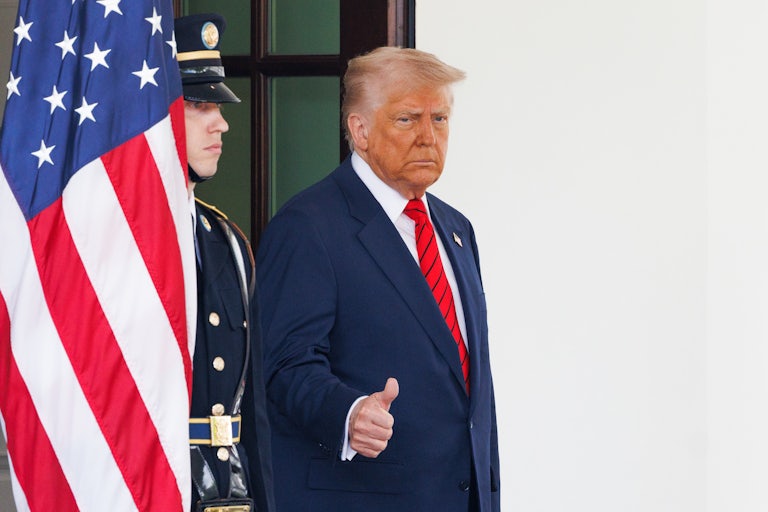
Donald Trump has continually insisted that deals over his tariffs are coming.

Donald Trump gives a thumbs up while standing outside the White House
Aaron Schwartz/Bloomberg/Getty Images

President Donald Trump claimed Tuesday that the U.S. doesn’t “have to sign” any trade deals, inadvertently admitting that his administration hasn’t made any progress during the 90-day pause on his disastrous tariffs.

During a tense meeting to discuss tariffs with Canadian Prime Minister Mark Carney, the president attempted to move the goal posts on actually completing any agreements with foreign countries.

“Everyone says, ‘When, when, when, are you going to sign deals?’ We don’t have to sign deals!” Trump said.

“We don’t have to sign deals. They have to sign deals with us. They want a piece of our market, we don’t want a piece of their market. We don’t care about their market. They want a piece of our market,” Trump rambled.

The president’s unwieldy statements downplaying the importance of the trade deals seemed to be cushioning the likelihood that negotiations would ultimately fail. Trump’s remarks also revealed that his administration has yet to complete a single trade deal.

Last month, Trump claimed to have already struck 200 trade agreements with foreign countries, a remark so outlandish it sent members of his administration scrambling to make it make sense. (There are also only 195 countries in the world.)

Instead of pledging to sign deals, Trump presented his own plan Tuesday. The president claimed that “at some point over the next two weeks,” he intended to sit down with members of his Cabinet and offer individualized deals to each country seeking tariff relief.

“We’re gonna say, ‘Here’s what this country—what we want, and congratulations we have a deal!’ And they’ll either say ‘Great,’ and they’ll start shopping, or they’ll say, ‘Not good, we’re not gonna do it,’” Trump said.

Trump claimed that the offers would include “very fair numbers,” but that they might also include other requests. He also said that his administration would be open to adjusting the deals based on how the countries responded.

“And then you people will say, ‘Oh it’s so chaotic,’ no, we’re flexible,” Trump said, referring to the press.

In any case, Trump continued to emphasize that his goal wasn’t actually to make deals, just to put out offers. “In some cases we’ll sign some deals, it’s much less important than what I’m talking about,” he said. He warned that in one day, he could present 100 offers, but “they don’t have to sign.”

Still, Trump said he wanted countries to “pay for the privilege of being able to shop in the United States of America.”

Canada PM Gives Trump Middle Finger on Wild In-Person Statehood Pitch

Donald Trump pitched statehood to the man who was just elected by campaigning on rejecting statehood.

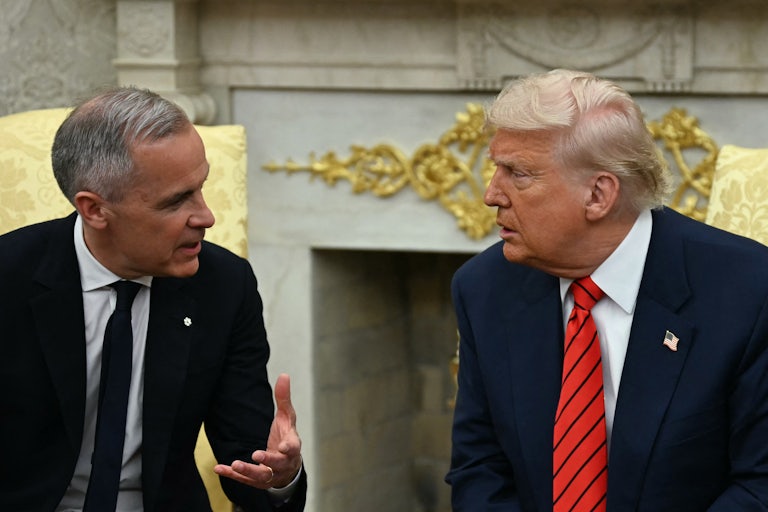
Canadian Prime Minister Mark Carney gestures while speaking to Donald Trump, as they sit next to each other in the Oval Office
Jim Watson/AFP/Getty Images

Canadian Prime Minister Mark Carney declared in the White House Tuesday that Canada would not submit to U.S. ownership. Donald Trump, however, wouldn’t back down.

“As you know from real estate, there are some places that are never for sale,” Carney said. “Having met with the owners of Canada over the course of the campaign, it’s not for sale. It won’t be for sale ever.”

“Never say never,” Trump said, telling reporters that only time would tell, while seated inches away from the Canadian leader. “I had many things that people said were not doable but ended up being doable.”

Carney won Canada’s top leadership post in April in large part due to his staunch position against Trump’s growing threats to annex the country.

In the months leading up to the election, Canada’s Liberal Party was believed to be on its deathbed. But that all changed with Trump’s tariff talk, which radically ramped up anti-American sentiment amongst Canadian voters, alongside Trump’s bizarre and public ambitions to occupy Canada.

Trump has actively aggressed U.S. relations with Canada since his first term. Recent rhetoric about annexing Canada to become America’s “fifty-first state” has not played well with the Canadian people or its leaders, causing some residents of the country to candidly dub Trump an “asshole.”

Responding to reporters Tuesday, Trump said there was nothing that Carney could say or do to lift his tariffs on Canada. “It’s just the way it is,” Trump said, when asked why he wouldn’t budge.

Carney appeared disturbed by the admission, interjecting to respond to several of Trump’s prior points.

“Respectfully, Canadians’ view on this is not going to change, on the fifty-first state,” Carney said as Trump grimaced beside him. “Secondly, we are the largest client of the United States. In the totality of all the goods, we are the largest state. We have a tremendous auto sector between the two of us.

“You know, 50 percent of the cars that come from Canada is American, that’s unlike anywhere else in the world,” the prime minister continued, gesturing to the reporter who inquired about tariffs. “This will take some time and some discussions, and that’s why we’re here, to have those discussions, and that’s represented by who’s sitting around the table.”

Trump was quick to respond. “See, the conflict this—and this is very friendly; this is not going to be like, ‘We had another little blow up with somebody else,’ that was a much different—this is a very friendly conversation,” he said. “We want to make our own cars, we don’t really want cars from Canada.

“At some point, it won’t make economic sense for Canada to make those cars,” Trump continued, claiming that the U.S. would make its own steel. “We really don’t want Canadian steel, and we don’t want Canadian aluminium and various other things because we want to be able to do it ourself.”

Trump then continued to lie about the two country’s trade situation, equating Canada’s trade deficits with the U.S. with “subsidies.” Trade deficits are indicators that America’s neighbors are purchasing more of its goods than they sell in return. In 2023, that differential—or deficit—was nearly $41 billion with Canada, according to the U.S. Census Bureau.

Shortly afterward, Trump abruptly ended the meeting, refusing to allow Carney another opportunity to respond to the American press.

This story has been updated.