Breaking News
Breaking News
from Washington and beyond

Eric Adams Sued for Running the NYPD Like a “Criminal Enterprise”

A former police commissioner says that under the New York City mayor’s watch, the police department was teeming with “systemic corruption and criminal conduct.”

New York City Mayor Eric Adams puts his hand on his tie as he walks, head facing down.
Michael M. Santiago/Getty Images

Another ex-NYPD official has filed a lawsuit accusing Mayor Eric Adams of overseeing a “coordinated criminal conspiracy” at the nation’s largest police department.

Former Police Commissioner Thomas G. Donlon, whose tenure lasted mere weeks in the fall of 2024, says the NYPD, under the watch of Adams, “functions as a racketeering enterprise in violation of Racketeer Influenced and Corrupt Organizations Act (RICO).”

Donlon went on to state that he “uncovered systemic corruption and criminal conduct being perpetrated by the NYPD’s leadership,” and that Adams “condoned the misconduct.”

The 251-page lawsuit details wire, mail, and honest services fraud, retaliation against whistleblowers, and obstruction of justice, all from the top down. Top police officials allegedly blocked disciplinary referrals for officers, and even forged Donlon’s official department stamp on important documents. These experiences have led to Donlon throwing weighty RICO allegations against his former NYPD colleagues.

“Specifically, Donlon informed Defendant ADAMS of fabricated promotions, systemic fraud, retaliatory policing, and the obstruction of internal investigations by high-ranking officials—most notably Defendant [Tarik] Sheppard, who had a documented history of unlawful violence, including the tasering and false arrest of protestors, resulting in civil rights lawsuits and monetary settlements,” the lawsuit stated. “Defendant ADAMS took no action in response. Instead, he condoned the misconduct and allowed the NYPD to function as a criminal enterprise. As a direct result of Defendant ADAMS’s failure and unwillingness to manage the NYPD, Defendant Sheppard fraudulently orchestrated his own promotion—granting himself greater authority and a higher salary.”

Donlon said he was completely frozen out by NYPD leadership after confronting Sheppard about his promotion scam, and they allegedly even carried out an unlawful arrest of Donlon’s wife as retaliation.

“[Donlon’s] professional reputation—built over decades of federal and state law enforcement and intelligence service—was deliberately destroyed. The emotional toll of the retaliation against his entire family was and is incalculable,” the lawsuit read. “These were precisely the kinds of injuries RICO was designed to remedy, and this Complaint seeks redress for Donlon, whose unwavering aspiration from the beginning was to protect and serve the NYPD’s Finest.”

The Adams administration remains indignant.

“These are baseless accusations from a disgruntled former employee who — when given the opportunity to lead the greatest police department in the world — proved himself to be ineffective,” spokeswoman Kayla Mamelak Altus said on the mayor’s behalf. “This suit is nothing more than an attempt to seek compensation at the taxpayer’s expense after Mr. Donlon was rightfully removed from the role of interim police commissioner.”

This is the fifth lawsuit filed against Adams’s NYPD in just two weeks. Four former senior NYPD officers filed separate lawsuits against Adams, also accusing him of corruption, cronyism, and whistleblower intimidation. This all comes as the mayor is preparing to run as an independent against Democratic nominee Zohran Mamdani, who has zeroed in mercilessly on the mayor’s misconduct.

Adams would very likely be under federal investigation by the Justice Department if they hadn’t (rather controversially) dismissed his federal corruption charges in exchange for loyalty and aid in Trump’s brutal immigration crackdown. Corruption has followed Adams for the entirety of his tenure. We can only wait until November to see if voters give him another.
WTF Is Going on With Trump’s Hand?

And why is no one asking him about it?

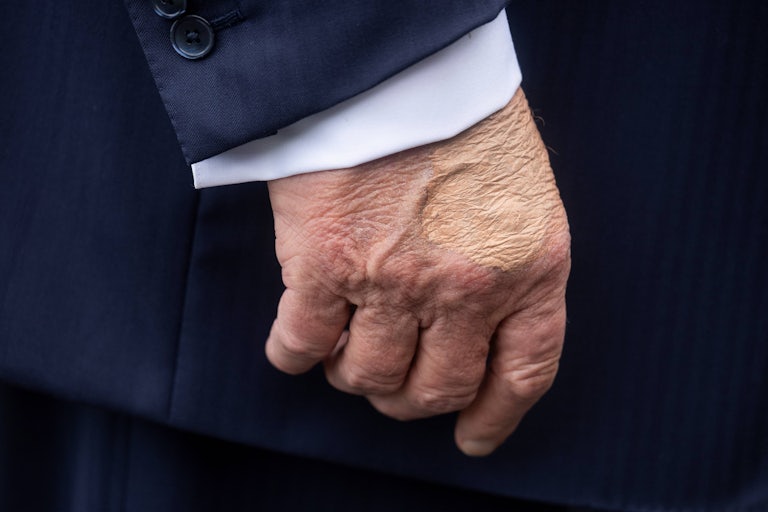
Donald Trump has makeup on his hand while walking outside the White House
Jim Watson/AFP/Getty Images

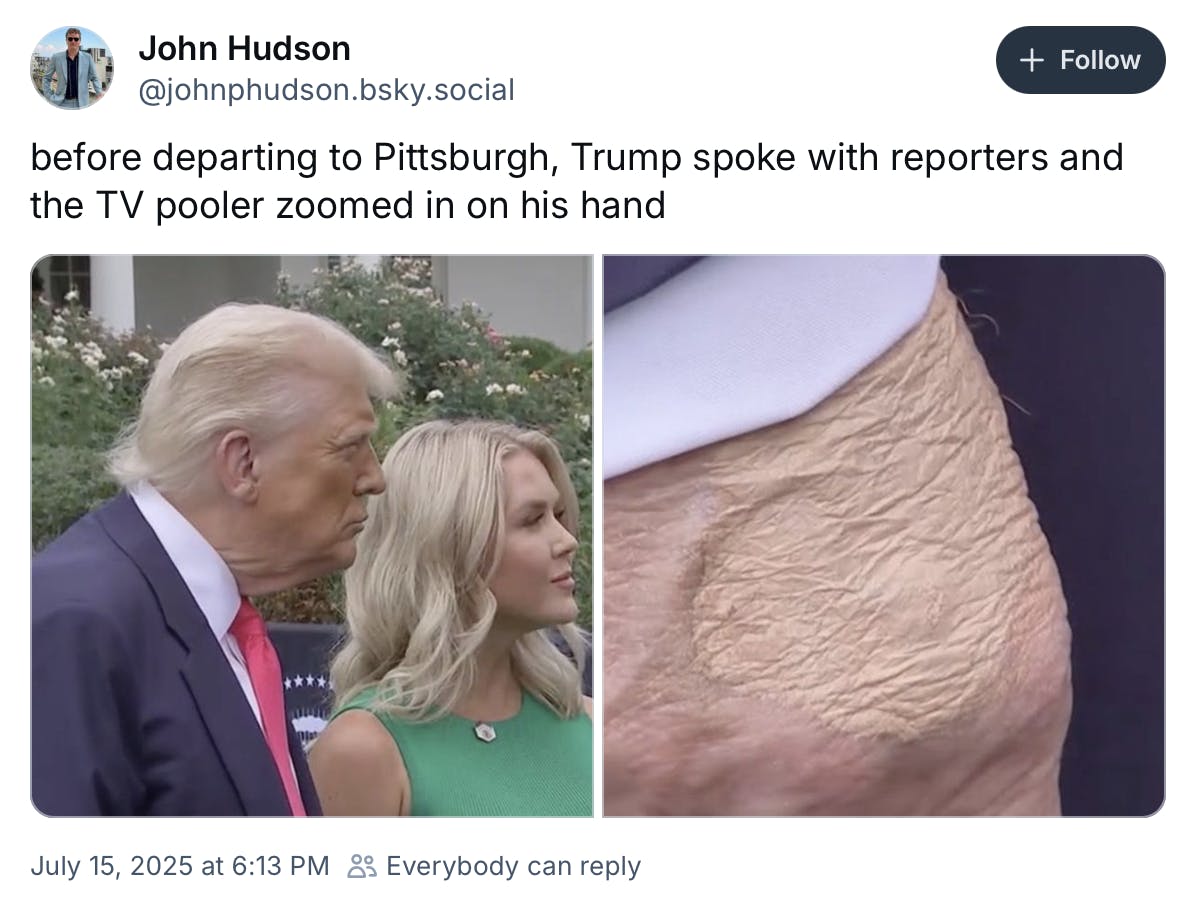
Donald Trump was spotted sporting a poorly concealed bruise on his hand, and the White House has the weirdest excuse for why that is the case.

While speaking to reporters outside the White House Tuesday evening before boarding Marine One, a cameraperson zoomed in on the president’s hand. A large patch of makeup that did not match Trump’s skin tone was clearly evident on the back of his hand.

Screenshot of a tweet
Screenshot

No one asked Trump about it in the moment, but when asked later, White House press secretary Karoline Leavitt told The Daily Beast that Trump was covering up a bruise from too much handshaking.

“President Trump is a man of the people, and he meets more Americans and shakes their hands on a daily basis than any other president in history,” Leavitt told the Beast. “His commitment is unwavering and he proves that every single day.”

This is neither the first time Trump has had a large bruise on the back of his right hand, nor the first time Leavitt has made this bizarre excuse. The bruise first appeared in spring 2024, and appears to pop back up every few months. Since taking office, Trump has been spotted with the bruise in at least February, April, and June.

Trump was also spotted with scabbed red marks on the palm and fingers of his right hand in January 2024, sparking concerns that he had syphilis.

Leavitt made her initial claim about too much gladhanding after the February bruise appearance, when Trump tried to cover the blemish with makeup approximately the color of wet brown cardboard.

Dr. Neal Patel, a primary care physician at Providence St. Joseph Hospital in California, told the Daily Mail in February that handshaking on its own was unlikely to have caused the bruising.

“I see a lot of patients who are businessmen, and I’ve never really seen them getting bruising from too much handshaking,” he said. “I guess it’s possible, but that would really not be on my list of ideas of what causes it.”

Patel and Dr. Stuart Fischer, an internal medicine physician in New York, both said that Trump’s advanced age was the likelier cause of bruising. As people age, it causes their blood vessels to become more “brittle,” Fischer explained to the Mail. That makes bruising more likely—and more intense when it does happen.

If Leavitt isn’t going to provide Trump with a decent excuse for the bruise, the least she (or literally anyone else at the White House) could do is find him some makeup that better matches his skin tone.

Sephora was hit with calls for a boycott shortly after the 2024 election when a series of social media posts alleging the makeup retail giant had donated to Trump’s campaign. Sephora has since said it “does not make corporate donations to political candidates.” Brendan Glavin, deputy research director at campaign finance watchdog group OpenSecrets, explained to CBS in November that any lump donations from “Sephora” (or any company) were likely an “aggregation of all the money that employees of the organization gave to the candidate.”

That means that there’s at least one Sephora employee who would happily color-match Trump’s skin tone. Maybe they can help him with his foundation and bronzer next.

Transportation Sec Has Staggering Excuse for Not Knowing Key Detail

Sean Duffy insisted that air traffic controllers are “in towers,” not “in the building.”

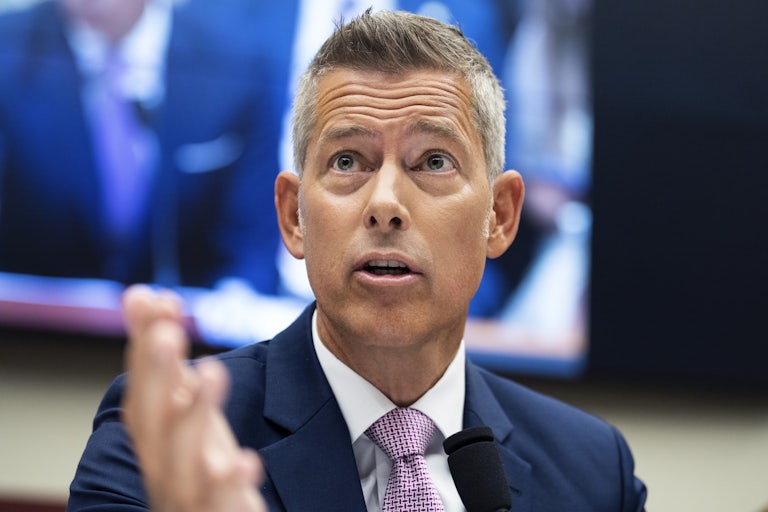
Transportation Secretary Sean Duffy gestures while testifying in a House committee hearing
Tom Williams/CQ-Roll Call, Inc/Getty Images

Donald Trump’s Cabinet officials are not keeping track of America’s air traffic controllers amid a historic shortage.

Transportation Secretary Sean Duffy was shockingly quiet when asked about the number of air traffic controllers remaining in the United States while testifying before the House Transportation and Infrastructure Committee Wednesday, refusing to provide concrete details on America’s air infrastructure.

“Can you tell this committee how many air traffic controllers have left the FAA since January 20, 2025?” asked Democratic Georgia Representative Hank Johnson Jr.

“I don’t—,” Duffy started, before Johnson interjected: “Please don’t tell me you don’t know.”

“I don’t know that,” Duffy insisted.

“This is an important job,” Johnson said. “Are you trying to tell us you don’t know how many air traffic controllers are in the building?”

“They’re not in a building, they’re in towers,” Duffy responded.

“Well I’m just speaking figuratively,” Johnson said.

Industry professionals are not so ignorant: there are currently 10,800 certified controllers working in America, according to the National Air Traffic Controllers Association. Union President Nick Daniels has said that 41 percent of those air traffic controllers are working six days a week, 10 hours a day to meet the demands required of a full staff, which is estimated to be more than 14,600 workers.

The shortage of air traffic controllers is nothing new: it’s been an unmitigated problem decades in the making. A large bulk of the country’s controllers retired over the last 10 years—a coincidence made possible due to the fact that the majority were onboarded simultaneously as replacements for the 11,350 controllers fired by President Ronald Reagan in 1982.

In 2015, the National Air Traffic Controllers Association told Congress that the situation had reached a “crisis” level and that, at the time, the Federal Aviation Administration had missed hiring targets five years in a row.

The Biden administration attempted to step up the pace of hiring in 2024, onboarding 2,000 qualified applicants. But they barely replaced the outbound workforce: 1,100 controllers left their jobs last year.

For years, the federal government has failed to properly incentivize younger generations to view the famously high-stress, high-education, and relatively antisocial job as desirable—and similar to other industries, the growing lapse between the aging workforce and the stalling youth is contributing to a brain drain which will deplete experience across the board. (To address this, Duffy also said that the FAA would change retirement limits, advising the union that air traffic controllers will be allowed to work past the age of 56.)

The massive shortage has forced controllers to do double duty, tasked (at some airports) with juggling both the flight paths of commercial airplanes and helicopters—work typically done by two separate controllers.

But the industry has faced new struggles since Trump took office. There have been critical failures at airports across the country, including a mid-air collision at Reagan National Airport in Washington that resulted in the deaths of 67 people in January, as well as rolling blackouts at Newark International Airport. These crises have sparked a new wave of retirements due to heightened stress on the already overtaxed controllers.

In February, the administration erased 400 FAA roles, including positions that supported air safety. Duffy confirmed the cuts that time, though he attempted to minimize them by highlighting the overall staffing of the agency, which Duffy claimed employs some 45,000 workers.

Duffy has promised to “supercharge” air traffic controller hiring, hoping to shave four months off the typically arduous onboarding process. But even at an expedited rate, that likely wouldn’t make a dent in America’s air traffic staff anytime soon: it currently takes about four years to become a certified air traffic controller. Instead, NATCA’s Daniels has estimated that it could take as long as nine years to reach full staffing.

Trump Admits He’s Trying to Rig the Midterm Elections

Donald Trump is eying major reform in multiple states that could hand him an even bigger House majority.

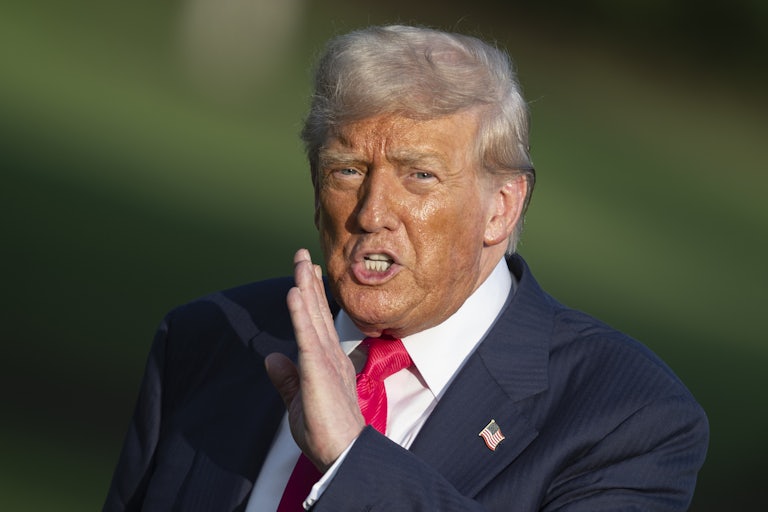
Donald Trump holds his hand next to his mouth while speaking to reporters outside the White House
Celal Gunes/Anadolu/Getty Images

The president is gung-ho about gerrymandering ahead of next year’s midterm elections.

Speaking with reporters on the tarmac of Joint Base Andrews Tuesday evening, Donald Trump said there’s “about four” states besides Texas that he would like to redraw their congressional lines.

“In three cases, it’s one. And in one case, it’s two or three. And Texas would be five,” Trump said as Commerce Secretary Howard Lutnick nodded enthusiastically beside him. Trump had previously suggested that Texas could give Republicans five more House seats by flipping a handful of blue districts in the Lone Star State next year via “a very simple redrawing.”

But suggestions that California—the largest liberal contingent in the country—could do the same did not sit well with the MAGA leader.

“Are you concerned California will turn around and do the same thing?” asked a reporter.

“Well we’ll fight them,” Trump said. “You know they’re so corrupt in California, you never know what’s going to happen. But we’ve done pretty well in the courts in California, you see. We’re batting about 1,000, ultimately.”

Trump has made a volatile enemy out of Governor Gavin Newsom. California sued the federal government last month after Trump deployed thousands of National Guard members to manhandle Los Angeles’s anti-ICE protests. An appeals court later blocked a court decision that would have handed the authority of the National Guard back to Newsom.

Now, the vengeful governor is threatening to shift the state’s redistricting policy if Texas follows Trump’s orders. In an interview with The Tennessee Holler last week, Newsom accused Republicans of “playing by a totally different set of rules,” and warned that California’s liberally dominant legislature could “gerrymander like no other state.”

“We’ve been playing fair, but I saw what he just did, and it made me question that entire program,” Newsom said.

Congressional maps are typically redrawn every 10 years, after new census data is released. But Texas’s decision to do so in the middle of the decade—at Trump’s direction—has raised alarms, with Democrats in the state labelling the effort a threat to democracy.

“The scheme of the Republicans has consistently been to make sure that they mute our voices so that they can go ahead and have an oversized say in this,” Texas Representative Jasmine Crockett said at a news conference Tuesday. “So I fully anticipate that’s exactly where they’re going with this map.”

Last year, the ideologically conservative majority on the Supreme Court made gerrymandering that much easier, ruling in Alexander v. South Carolina NAACP that alleged racial gerrymandering in South Carolina (which is theoretically still illegal) was really just partisan gerrymandering, an apparently precious part of America’s democratic system.

GOP Governor Defies Her Party and Vetoes Seven Republican Bills

New Hampshire Governor Kelly Ayotte wasn’t afraid to use her veto power when it came to the extreme bills.

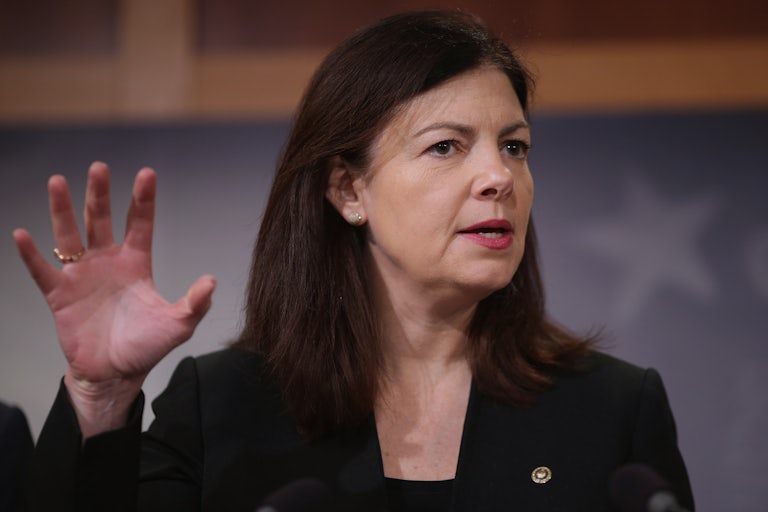
New Hampshire Governor Kelly Ayotte speaks
Chip Somodevilla/Getty Images
New Hampshire Governor Kelly Ayotte in 2016, when she served in the Senate

New Hampshire Republican Governor Kelly Ayotte on Tuesday struck down seven separate right-wing bills in an open rebuke of her party’s MAGA arm.

Ayotte vetoed House Bill 324, which gave parents greater power to remove any classroom content they felt was obscene, placing a target on LGBTQ+ literature and themes.

“Current state law appears to provide a mechanism for parents through their local school district to exercise their rights to ensure their children are not exposed to inappropriate materials,” Ayotte said. “Therefore, I do not believe the State of New Hampshire needs to, nor should it, engage in the role of addressing questions of literary value and appropriateness, particularly where the system created by House Bill 324 calls for monetary penalties based on subjective standards.”

There was also House Bill 148, which would have allowed stores, jails, and workspaces to ignore gender identity and categorize people based on their assigned gender at birth.

“I believe there are important and legitimate privacy and safety concerns raised by biological males using places such as female locker rooms and being placed in female correctional facilities,” Ayotte wrote in her veto of the bill. “At the same time, I see that House Bill 148 is overly broad and impractical to enforce, potentially creating an exclusionary environment for some of our citizens.”

She killed House Bill 358, which would have streamlined the “religious exemption” process for parents who don’t want to vaccinate their children; House Bill 446, which would have required schools to receive parental permission to conduct non-academic surveys; and House Bill 667, an anti-abortion bill that would have forced students to view “a high quality computer generated animation or ultrasound video that shows the development of the heart, brain, and other vital organs in early fetal development,” according to The New Hampshire Bulletin.

There was also House Bill 475 and House Bill 115, both budget-centered bills that Ayotte deemed unnecessary.

Ayotte’s vetoes are a rejection of her party’s attempt to assert cultural control throughout the state, and the country. Lawmakers would need a two-thirds majority in both the state House and Senate to overturn Ayotte’s vetoes, which will be a very tall task given that Republicans don’t have those numbers.