Breaking News
Breaking News
from Washington and beyond

Amazon Plans Massive Layoffs After Nine Months of President Trump

Welcome to Donald Trump’s economy.

Jeff Bezos attends Donald Trump’s inauguration, alongside his now wife Lauren Sanchez, Mark Zuckerberg, Sundar Pichai, Elon Musk, and others.
Julia Demaree Nikhinson/Getty Images
Jeff Bezos attends Donald Trump’s inauguration, alongside his now wife Lauren Sanchez, Mark Zuckerberg, Sundar Pichai, Elon Musk, and others.

Online retail giant Amazon plans to slash as many as 30,000 corporate jobs Tuesday, which would be the biggest number of layoffs at the company in three years. 

Reuters reports that the cuts would amount to 10 percent of the company’s close to 350,000 corporate employees, and would be across different departments. The last time Amazon cut this many jobs was 2022, when 27,000 were slashed late in the year. The move follows Amazon CEO Andy Jassy saying in June that AI tools would lead to job cuts. 

It’s not a good indicator for the economy under President Trump. The website Layoffs.fyi, which tracks job cuts, estimates that 98,344 technology employees have been laid off this year from 216 companies.  The site also estimates that 71,981 government employees have been laid off by Trump’s Department of Government Efficiency, out of a total of 182,528 federal employees departing from the jobs. 

The Bureau of Labor Statistics’ jobs report last month showed unemployment at a four-year high, with only 22,000 jobs added in August (compared to a forecast of 75,000). Thanks to the government shutdown, job and unemployment figures from September aren’t known, but they are likely pretty bad. ADP, which processes payrolls, reported earlier this month that the private sector lost 32,000 jobs in September. 

While the shutdown hides an official tally of how bad employment numbers are in America right now, Amazon’s impending layoffs, and estimates from other sources, indicate that the economy isn’t very strong right now—and the buck stops with the president. 
California Reveals Plan to Fight Trump’s “Election Monitors”

California isn’t taking the Justice Department’s threat lightly.

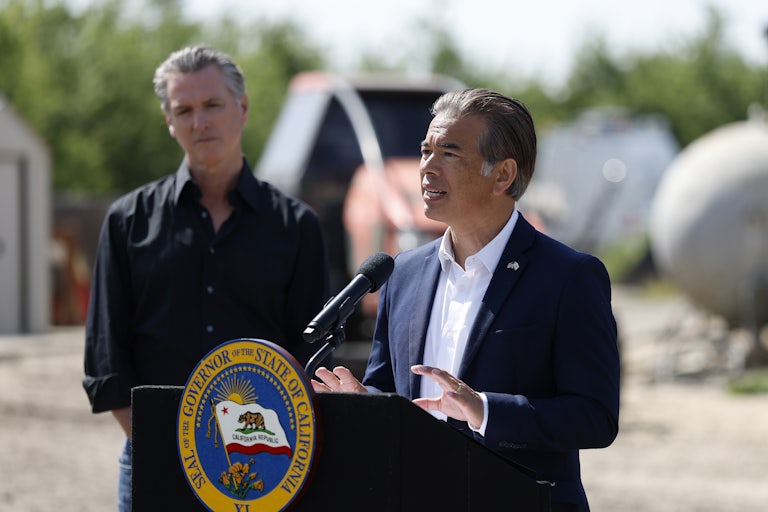
California Governor Gavin Newsom listens as state Attorney General Rob Bonta speaks at a podium with the state seal.
Justin Sullivan/Getty Images
California Governor Gavin Newsom listens as state Attorney General Rob Bonta speaks.

California will send election observers to counter the “election monitors” that Trump plans on sending to multiple deep blue districts in the state ahead of next week’s special election.

“They’re not going to be allowed to interfere in ways that the law prohibits,” California Attorney General Rob Bonta said Monday. “We cannot be naïve. The Republican Party asked for the U.S. DOJ to come in.”

“[Trump] is laying the groundwork. He is socializing an idea that is very dangerous,” Bonta added, noting that Trump still claims to have won the 2020 presidential election. “All indications, all arrows show that this is a tee up for something more dangerous in the 2026 midterms—and maybe beyond.”

Trump’s Justice Department last week announced it would send federal election monitors to several blue districts in California and New Jersey. In California, the Trump administration is likely well aware of Proposition 50, a ballot measure that would redraw the state’s congressional districts to help Democrats gain more seats in the U.S. House.

Trump’s DOJ monitoring a crucial election in California is a recipe for basic voting rights to be blatantly violated. Governor Gavin Newsom on Friday called it a “deliberate attempt to scare off voters and undermine a fair election.”

“They have no business doing that. They have no basis to do that,” he said in a video posted on X. “We have a statewide election for a statewide constitution. This is about voter intimidation, this is about voter suppression. Period, full stop.”

Business Owner Urges People to Stand Up to Trump With Wild T-Shirt

“It used to just say, ‘F*ck Nazis.’ We just clarified who the Nazis were,” says bar owner William McCormack.

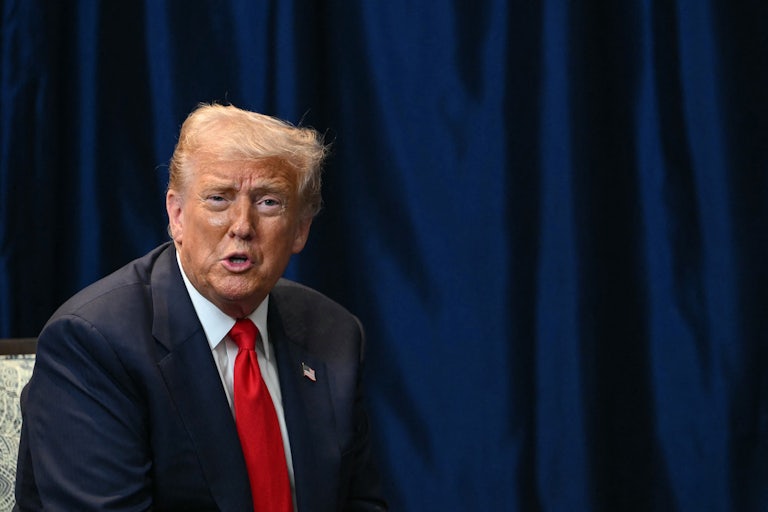
Donald Trump sits and speaks at an event
Andrew Caballero-Reynolds/AFP/Getty Images

The Irish have had enough of Donald Trump.

McCormack’s Irish Pub in Richmond, Virginia, made waves earlier this month when its owner, William “Mac” McCormack, released some hot merchandise: a load of “Fuck Trump” black T-shirts, retailing for $11 a pop.

The shirts proudly display the pub’s logo: an antifascist emblem superimposed over a shamrock. A printed phrase circles around the icon, reading: “Fuck ICE, Fuck Nazis, Fuck Trump,” according to McCormack’s Facebook.

But the top did not resonate with those on the ideological right, who consumed the comment section before spilling over to the pub’s review pages on Yelp and Google. Some commenters scorned the pub’s self-advertised ideology as “disgusting,” deriding the shirts as a stunt that would “alienate half of [McCormack’s] clientele.”

One Yelp user, who goes by Marge and lives nearly 3,000 miles away in San Francisco, wrote that the service was “terrible” and the “food is almost as bad.”

“Save your time and money. This place sucks. Not a true Irish Pub,” the account wrote, leaving a one-star review on Saturday. “Liberals who think we care where they stand politically.”

But any regular would know that the shirt—and its message—are nothing unusual for McCormack’s.

“I was just making T-shirts that align with most of my customers, with the pub’s beliefs,” McCormack told RVA Magazine.

The shirt is really nothing new. There’s always been some variation of the shirt, according to its owner. “It used to just say, ‘Fuck Nazis.’ We just clarified who the Nazis were,” McCormack said.

McCormack’s is one of Richmond’s oldest dive bars. The successful institution has since expanded into two whiskey restaurants—McCormack’s Big Whisky Grill and McCormack’s Whisky Grill—but the original establishment has been proud to be punk since the 1990s, according to RVA.

“I’ve never hidden my politics there,” McCormack told the publication. “It’s bigger than just the bar, it’s what you believe. And it’s what I believe one hundred percent.”

Despite the backlash, there’s nothing illegal about voicing dissent against the government. Protesting the government is a protected right under the First Amendment of the U.S. Constitution, as established by the Founding Fathers. Comparing MAGA politics to Nazi Germany, McCormack told RVA that small-business owners should stick by their principles. “I don’t think we should be silent,” he said.

Voicing his disdain for the current administration has actually turned out to be a positive business decision for McCormack, who told RVA that the shirts have since sold out and that “all three locations have been busier than normal.”

New customers, attracted by the firm political stance, are going out of their way to share a drink at McCormack’s. Some Facebook users said they would travel from as far as New Jersey to grab a pint at the bar if it meant supporting the cause.

McCormack’s advice to other small-business owners: “Don’t be scared to have an opinion.”

“You don’t have to do it like I did,” McCormack told RVA. “You can be more subtle, but if we don’t speak up then we’re just the same as those people in Germany who still live with three generations of regret.”

Republican Governor Tries to Force Party to Gerrymander for Trump

So far, Donald Trump’s efforts to redistrict this state have stalled.

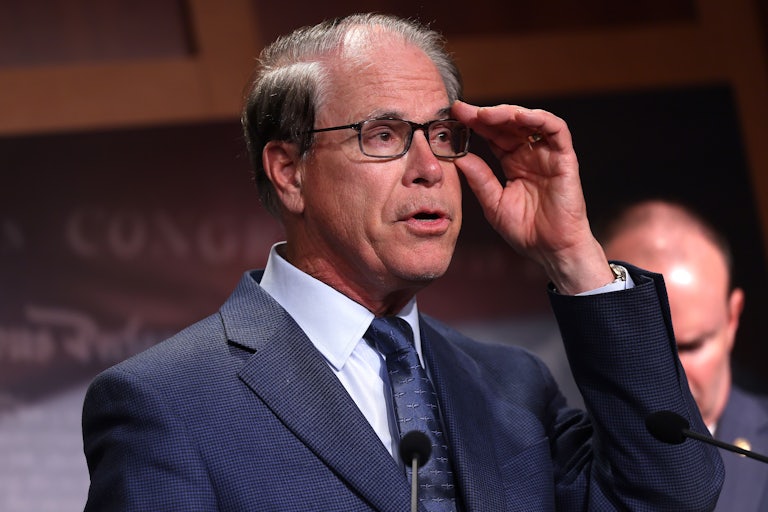
Indiana Governor Mike Braun adjusts his glasses while speaking at a podium
Kevin Dietsch/Getty Images

Indiana Governor Mike Braun is pushing President Donald Trump’s gerrymandering scheme forward in the Hoosier State—but Republicans still aren’t getting on the bandwagon.

Braun announced Monday that he was calling a special legislative session to vote on new congressional districts, ensuring Republicans maintain control of Congress in the 2026 midterm elections.

“I am calling a special legislative session to protect Hoosiers from efforts in other states that seek to diminish their voice in Washington and ensure their representation in Congress is fair,” he wrote in a statement.

But Molly Sigart, spokesperson for Rodric Bray, the Indiana Senate’s president pro tempore, told The New Republic Monday that the votes “still aren’t there for redistricting.” The 50-member Senate has only 10 Democrat members, meaning that more than a dozen of the remaining members also opposed the plan.

Last week, Bray’s office said that the Republican plan lacked the necessary support, raising red flags for Braun’s redistricting efforts. Meanwhile, Braun’s spokesperson claimed the governor was “confident” that he could secure a majority of state Senate Republicans’ support.

Braun initially floated the idea last month of calling legislators back and warned that there would be “consequences” for not keeping pace with the White House’s requests for redistricting, which have already been passed in Texas, Missouri, and most recently, North Carolina. The special session Braun called Monday, which will occur before lawmakers are set to return in January, will likely cost taxpayers a pretty penny.

In Indiana, things have gotten heated. Both Trump and Vice President JD Vance have personally connected with state Republicans about supporting a new congressional map. Last month, Indiana state Senator Jim Banks suggested that podcaster Charlie Kirk’s death was reason enough to do it. “They killed Charlie Kirk—the least that we can do is go through a legal process and redistrict Indiana into a nine to zero map,” Banks said.

Indiana state Senator Liz Brown, an assistant majority floor leader, published a statement supporting the move Monday.

“Redistricting isn’t a technical exercise. It’s power drawn on a map. And Democrats have been wielding it for decades,” wrote Brown on X. “Conservative voices have been thwarted for far too long by liberal states like Massachusetts who refuse to create competitive congressional districts.”

“Gov. Braun’s decision to call our legislature into session to address redistricting is welcome news,” she wrote.

Exxon Sues California for Violating Its Free Speech Rights

Oil companies just love to claim that they have free speech rights.

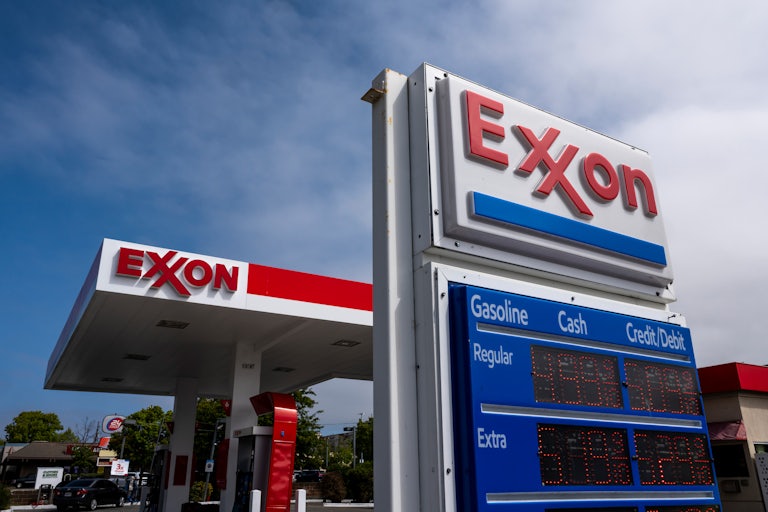
Exxon Mobil gas station
David Paul Morris/Bloomberg/Getty Images

Exxon is trying to claim that California’s climate laws infringe on its freedom of speech.

The oil company filed a lawsuit against the state Friday over two laws, passed in 2023, that require companies doing business in California to disclose carbon emissions and climate-related financial risks, with penalties if they don’t comply. Exxon claims that the laws, known as the California Climate Accountability Package, would force the company to “serve as a mouthpiece for ideas with which it disagrees.”

A spokesperson for California Governor Gavin Newsom, Tara Gallegos, told The New York Times, seemingly tongue in cheek, that it was “truly shocking that one of the biggest polluters on the planet would be opposed to transparency.”

The laws, which will be enforced beginning next year, “have already been upheld in court and we continue to have confidence in them,” Gallegos added.

Exxon said in the lawsuit that it already reports its carbon emissions and climate risks voluntarily but that the state laws would force it to change its framework to one it finds “misleading and counterproductive.”

Right now, Exxon uses a methodology to calculate its emissions developed by an oil and gas industry group, but would have to change to the Greenhouse Gas Protocol, developed by the research group World Resources Institute and business network World Business Council for Sustainable Development.

The company claims this framework would send “the counterproductive message that large companies are uniquely responsible for climate change no matter how efficiently they satisfy societal demand for energy, goods, and services.” Exxon additionally argues that the legal requirement to report its global emissions should only be focused on the company’s emissions in the state.

Exxon is also fighting against a provision in one law that requires companies to disclose how climate change threatens their business operations and what they plan to do about it. Exxon claims the law requires speculation “about unknowable future developments” and conflicts with securities laws.

There is another pending lawsuit against the laws from the U.S. Chamber of Commerce, the California Chamber of Commerce, and the American Farm Bureau Federation, with a trial expected next year.

The oil company is trying to dodge transparency about its operations, perhaps concerned about how bad these disclosures would make it look. It may also be hoping for the law to be struck down by conservative judges, or even the Supreme Court. President Trump is loudly dismissive of climate change and the threats it poses, and may take further action against California on his own.