Breaking News
Breaking News
from Washington and beyond

Trump Quietly Backtracks on Disastrous Grocery Tariffs

The president reversed course on some tariffs on items like beef—something his team promised not to do.

President Trump sits in a meeting in the Oval Office.
Andrew Harnik/Getty Images

President Donald Trump eased some of his “Liberation Day” tariffs Friday evening, all but conceding that his trade policy has increased Americans’ grocery expenses despite his administration’s claims to the contrary.

In an executive order, the president exempted certain products, including coffee, beef, and bananas, from reciprocal tariffs that he announced in April. This comes as costs for such goods—and groceries in general—have spiked under his administration, thanks in no small part to his tariffs. And the move undermines his repeated assertions that his tariffs do not hit American consumers’ wallets.

Asked about the rollback on Air Force One Friday, Trump said the reversal was meant to “bring down some of the foods” whose prices have become “a little bit high” (an understatement) because “we don’t make them in this country.”

He did not elaborate on why, in light of this predictable outcome, he had issued the tariffs in the first place.

In a fact sheet, the White House patted itself on the back—with no hint of irony—for “strengthening the economy.” On social media, prominent MAGA accounts spun Trump’s attempt to undo price increases of his own making as evidence of his commitment to affordability.

“President Trump has just signed an executive order ELIMINATING tariffs on beef, coffee, and tropical fruits,” wrote pro-Trump influencer Nick Sortor. “This is an effort to bring down food prices in America, as voters voice concerns about affordability. Keep focusing on affordability, 47.”

He omitted mentioning who had put the tariffs in place.
“Lunatic”: Trump Rants and Raves at MTG Amid Epstein Turmoil

The president has officially broken up with Marjorie Taylor Greene.

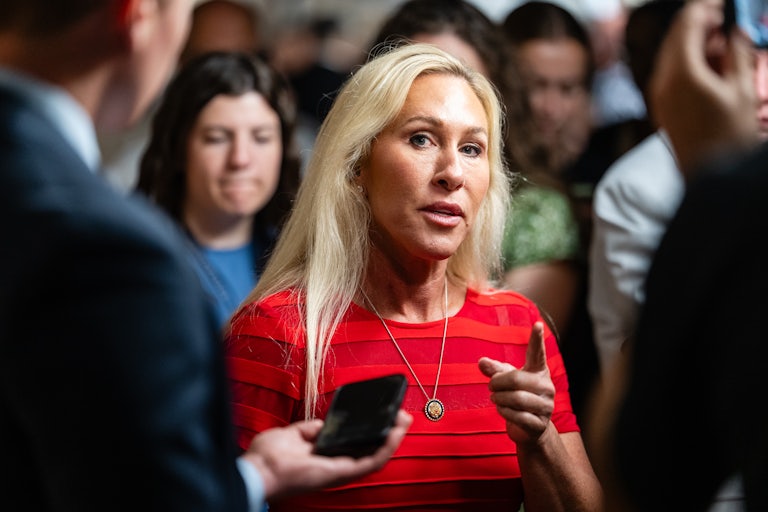
Representative Marjorie Taylor Greene points while speaking to reporters in the Capitol.
Eric Lee/Bloomberg/Getty Images

Donald Trump’s feud with Representative Marjorie Taylor Greene continued Saturday, as the president unveiled two new disparaging nicknames for the Georgia Republican.

Trump has been at loggerheads with Greene and her colleague Thomas Massie over their calls for full transparency regarding the notorious late Jeffrey Epstein. Greene and Massie were among the four members of the GOP who signed a discharge petition to force a floor vote, now expected to take place next week, on the Epstein files’ release.

The president, who maintains that l’affaire Epstein is all a Democratic “hoax,” tore into Greene on Friday evening, calling her a “ranting Lunatic” on Truth Social. Greene shot back on X, posting screenshots of text messages to Trump and a White House aide, in which she emphasized the importance of justice for Epstein’s victims: a concern that has thus far failed to move the president.

Come Saturday morning, the two were still exchanging barbs. In one Truth Social post, Trump referred to Greene as “Marjorie Taylor Brown,” as, he explained, “Green grass turns Brown when it begins to ROT!” The president dubbed Greene and Massie RINOs, or Republicans in name only.

Greene attributed Trump’s attack to her Epstein stance and her increasingly critical views of Israel, insinuating the country was putting “pressure” on the president to suppress the files.

Trump answered with more taunting, this time christening the lawmaker “Marjorie ‘Traitor’ Green,” an insult already coined by MAGA influencer Laura Loomer—to whom Trump has previously outsourced staffing decisions and now, apparently, his name-calling.

Secret DOJ Memo Claims Chemical Weapon Threat From “Drug Boats”

The Trump administration has a new justification for bombing boats in the Caribbean.

Fishermen sail on a boat in the water.
FEDERICO PARRA/AFP/Getty Images
Fishermen in a boat near Caraballeda, La Guaira State, Venezuela, on September 24. Donald Trump has bragged that his bombings have scared fishermen in the area.

Trump’s White House is naming fentanyl as a chemical weapon to justify the indiscriminate “drug boat” bombings it’s been carrying out in the Caribbean, which have killed 80 people to date.

A classified Justice Department memo reported on by The Wall Street Journal sheds light on the administration’s multiple legal arguments to justify the strikes—including that drug cartels are terrorist organizations and that their smuggling efforts are specifically meant to destabilize the U.S. and its citizens. Two people familiar with the memo shared its contents.

The brief mentions fentanyl multiple times as a justification for the strikes, even as the bulk of the drug entering the U.S. is known to come over land from Mexico. There is no evidence that Venezuela, where one of the newly classified terrorist organizations is based, is making and moving fentanyl.

“Led by Joint Task Force Southern Spear and @SOUTHCOM, this mission defends our Homeland, removes narco-terrorists from our Hemisphere, and secures our Homeland from the drugs that are killing our people,” Defense Secretary Pete Hegseth wrote on X Thursday. “The Western Hemisphere is America’s neighborhood—and we will protect it.”

Democrats and experts remain thoroughly unconvinced.

“Much of it is geared toward making a financial argument about what the drugs are providing in terms of monetary resources” to the so-called “terrorist” cartels, New Jersey Senator Andy Kim told the Journal. “But they are trying to use that now to create a lethal kinetic justification, which is not what that designation is for and has never been done before.”

“It is an incredible stretch,” said former Trump and Obama State Department legal adviser Brian Finucane.

The memo also refers to the president’s powers under Article 2 of the Constitution, which allows him to control military action for up to two months before congressional approval is necessary—something even Republicans have taken issue with.

“The president had the right to take initial actions, but should seek Congressional authorization for continued strikes,” Representative and House Armed Services Committee member Don Bacon said.

It certainly seems that the Trump administration knows it doesn’t have standing to just keep blowing up “drug boats” instead of stopping, boarding, and arresting these alleged “narco terrorists.” So instead it has to engineer claims in secret memos of chemical warfare and terrorism to avoid any congressional resistance.

Trump Plans to Use Travel Ban for Chilling New Immigration Rule

If you are from any of the countries on the travel ban, your future status could be at risk—even if you’re already in the country.

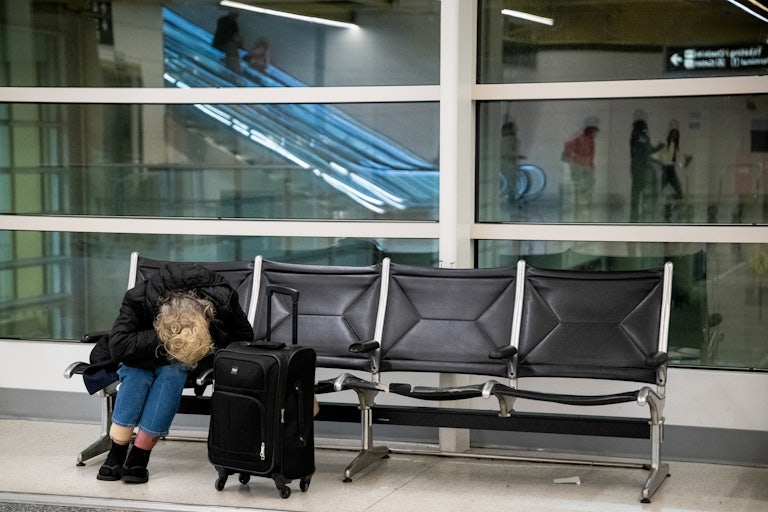
A woman seated in airport folds in on herself.
Graeme Sloan/Bloomberg/Getty Images

The Trump administration is planning to make it harder for immigrants to get green cards and other benefits if they are from any of the countries on the president’s travel ban.

The New York Times, citing documents from the Department of Homeland Security, reports that the plan is to view “country-specific factors,” referring to countries in Trump’s June travel ban, as “significant negative factors” in applications from immigrants. The policy is still being finalized, but would essentially restrict permanent resident status, and subsequent citizenship, by the basis of national origin.

The countries named in the ban were Afghanistan, Chad, the Republic of Congo, Equatorial Guinea, Eritrea, Haiti, Iran, Libya, Myanmar, Somalia, Sudan, and Yemen. Partial restrictions were placed on Burundi, Cuba, Laos, Sierra Leone, Togo, Turkmenistan, and Venezuela, with citizens of those countries barred from entering the United States permanently or receiving specific visas. The new rule would affect immigrants who came to the U.S. legally prior to Trump’s ban.

Administration officials claim that the countries on the list have poor screening and vetting practices, but critics, such as American Immigration Council senior fellow Aaron Reichlin-Melnick, say that it makes “national origin discrimination … official government policy.”

“Having something that applies to you based on your country is absurd,” Doug Rand, a senior official at Citizenship and Immigration Services during the Biden administration, told the Times. “This is a radical change.”

Last month, the administration cut the number of refugees that the U.S. accepts to a record low of 7,500 for next year, prioritizing white South Africans at the expense of people fleeing war zones and persecution. In June, it said it would screen the social media accounts of immigrant applications for anti-American activity. Now, it is trying to restrict legal immigration even further.

Yet Another Red State Kills Trump’s Redistricting Dreams

MAGA’s gerrymandering war keeps flopping in red states.

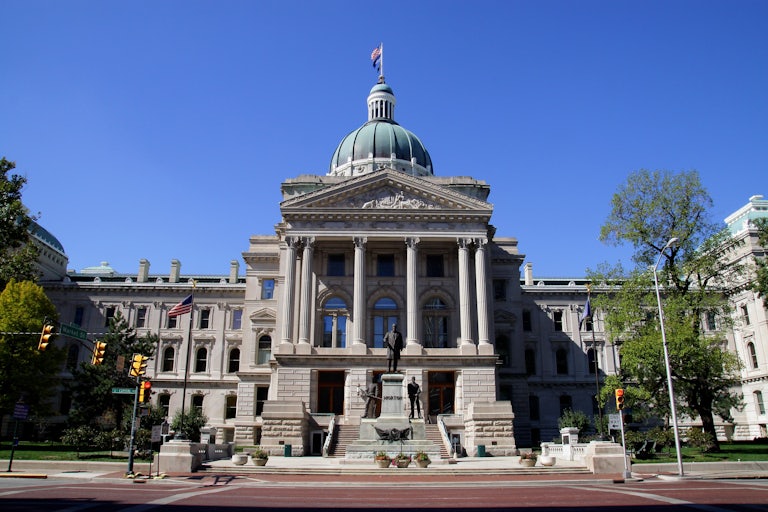
Indiana state Capitol building
Raymond Boyd/Michael Ochs Archives/Getty Images

Republicans in a red state have failed to initiate their pro-Trump gerrymandering efforts for the second time this month.

On Friday, Indiana’s state Senate Republicans announced that they failed to gather enough votes to redistrict their state in their favor ahead of the 2026 midterm elections.

“Over the last several months, Senate Republicans have given very serious and thoughtful consideration to the concept of redrawing our state’s congressional maps,” state Senator Rodric Bray said, according to the Indiana Capital Chronicle’s Niki Kelly. “Today, I’m announcing there are not enough votes to move that idea forward, and the Senate will not reconvene.”

This is a massive failure in the GOP’s plan to redraw districts in the middle of the decade to help it gain more seats in Congress. Last week, Kansas Republicans gave up on a weeks-long effort to accelerate the redrawing of their state’s congressional map. Days later, a Utah judge rejected a Republican-drawn map and instead instituted the state’s first blue-leaning one in 25 years.