Newsletter
Power Mad
A weekly review of the rogues and scoundrels of American politics

Epstein, Trump, and the Era of Elite Impunity

Democrats don’t need to pick and choose among the administration’s many sins. They all tell the same grim story.

Donald Trump talks with guests during a Halloween party at his Mar-a-Lago estate on October 31, 2025 at Palm Beach, Florida.
Samuel Corum/Getty Images
Donald Trump talks with guests during a Great Gatsby–themed Halloween party at his Mar-a-Lago estate, on October 31.

This week, we all moved a couple steps closer to finally getting a peek at what’s been the year’s biggest political MacGuffin: the Epstein files. The long-delayed swearing in of Arizona Representative Adelita Grijalva allowed the pro-disclosure caucus in the House to finally hit the magic number of “yea” votes on their discharge petition ordering their release; opposition in the House essentially collapsed after that, and the Senate used its “deem and pass” power to ratify the lower house’s decision in advance. The bill now goes to President Trump’s desk. He is expected to sign it into law and then attempt to use the contents to wage merciless war on Democrats.

All of this may come to nothing. There’s no reason to believe Trump’s Justice Department—which essentially operates as Trump’s own private legal counsel—will treat these materials with judiciousness. Frankly, you shouldn’t be surprised if they contain little in the way of smoking guns. Of Epstein’s culpability there can be no doubt; the rest is just suspicion. Conservatives have darkly warned their liberal counterparts: “Be careful what you wish for; what if this implicates a bunch of crusty old Democrats?”

To which I say, “Don’t threaten me with a good time.” As I’ve watched the Epstein story unravel across the media—through the shouting of lawmakers and the flood of tawdry emails dumped in the press—I’ve not been able to ignore how it’s all one big pile of rot at the center of polite society. My TNR colleague, Matt Ford, expressed similar sentiments in a recent piece, confessing that the truly despairing thing about the Epstein affair was that the whole idea of civic virtue seems to have been murdered, and in its place, a culture of elite impunity has risen.

For my part, I’m less worried about whether some Democratic Party luminary catches an Epstein stray and more concerned about whether Democrats bungle the opportunity to attack these corrupt arrangements and the presidential administration that has made them its North Star. This iron is, at the moment, particularly hot. A fresh Reuters/Ipsos poll released Wednesday found that Trump’s approval ratings had hit startling new lows, with respondents particularly “unhappy about his handling of the high cost of living and the investigation into the late convicted sex offender Jeffrey Epstein.”

Epstein and the economy—these are the twin albatrosses around Trump’s neck. The question, however, is whether Democrats will have the stomach and the sense to exploit both avenues to Trump’s ruin. It may not seem like a problem, but Democrats seem pathologically averse to multitasking, which explains why they’re making the salience of grocery prices their priority to the exclusion of all other matters. So monomaniacal is this approach that at various times over the past year, Democratic lawmakers have called other concerns “distractions”—up to and including Trump’s rampaging paramilitary forces.

Let’s give Democrats their due: Their affordability arguments passed electoral tests earlier this month. And the administration is spooked: Trump and his allies are attempting wan affordability arguments of their own. It’s been a while, but Democrats are suddenly calling the tune in Washington.

That the Epstein matter has wounded Trump at the same time is a fortunate coincidence for Democrats seeking a skeleton key to unlock a larger argument about the harm Trump’s done to our republic: The ICE goons on our street, Trump’s White House teardown, the high cost of living, the administration’s various decisions to hurt people during the shutdown, all the weird ghouls occupying executive branch positions that once went to qualified civil servants, and the forever stench of oligarchic swampwater suffusing public life—all of these issues roiling the lives and livelihoods of ordinary people lie at the nexus of elite impunity.

There are no distractions here, no options to weigh; this is all one single story—much like Epstein, powerful plutocratic interests have found their man in Trump, and together, they are driving the country to ruin for their own amusement and self-enrichment. Here’s how Ford captures it:

At its core, Trumpism is a permission structure for evil. It is the abolition of ethical norms and the erasure of moral authority. It defies checks and balances, rejecting the notion that power can be abused or corrupted because it justifies itself. Trumpism is not really about immigration, or inflation, or trade, or draining the swamp, or building the wall—it is ultimately about the dark thrill of abusing those whom its adherents consider to be inferiors, either directly or by proxy.

As I’ve noted before, Trumpism isn’t working, and people are growing angrier and angrier. According to the most recent NPR/PBS News Marist poll, Democrats have attained a 14-point lead over the GOP on the generic congressional ballot. The time to pummel these crooks is nigh, and they needn’t be precious about it. Think of it like this: Trumpism is the culmination of a crooked scheme that began nearly a half-century ago, in which the rich and powerful looted our wealth and tore up the civic fabric of this nation. Yes, like the Epstein affair suggests, it really is one big thieving cabal of plutocratic reprobates that has done us dirty. There is an opportunity now for Democrats with guts to crush these scumbags, and take back what they stole.

This article first appeared in Power Mad, a weekly TNR newsletter authored by deputy editor Jason Linkins. Sign up here.

There Are Two U.S. Senates—and Only One Knows How to Get What It Wants

While Republicans in the upper house advance agendas and build their base, their Democratic counterparts are mostly bystanders to their own demise.

The U.S. Capitol Building is reflected in the Capitol Reflecting Pool at sunset.
Kevin Carter/Getty Images

The United States Senate: Can’t live with it, can’t burn it down (or so my lawyers caution me). Recently, I’ve had cause to ruminate on the upper house’s continued existence and the way its workings threaten our own. And then, this week, liberals were given new reason to rue the “cooling saucer of democracy,” as the Democratic Senate Surrender Subcommittee—apparently with the assent of Chuck Schumer—threw the wettest of blankets on a historically great week for the party by caving on the government shutdown, letting a bloodied Trump up off the canvas, and giving Republicans reason to exult.

Those exultations, according to a report from Zeteo, were just as Trumpian as you could imagine, with anonymous White House officials said to be “cackling” and “gratuitously using terms such as ‘losers’ and ‘pussies’ as they reveled in the relief from a shutdown that even President Trump acknowledged was getting Republicans ‘killed’ politically.” It’s a fitting reminder that there are actually two U.S. Senates in America—one that is committed to dismantling democracy, while the other is committed to a functioning government (sometimes to a fault). It’s also worth remembering that the divergent ways that Republican and Democratic senators discharge their duties is hardly a recent development, but rather baked into the two parties’ DNA.

Recent history paints a stark contrast between how GOP senators behave and how they use the Senate to advance long-term right-wing agenda items, and how Democrats approach the same projects. On February 13, 2016, Supreme Court Justice Antonin Scalia slipped this mortal coil, and Democrats salivated at the prospect of President Barack Obama replacing him. These hopes ended up being short-lived, as the Senate was in the hands of Mitch McConnell. The Kentucky senator, who by then had mastered the art of thwarting the president’s ambitions, simply put the kibosh on advancing Obama’s pick, Merrick Garland, in a norm-breaking display of “preferring not to” that would make Bartleby the Scrivener blush.

Republican senators held the line, to the delight of their base, raising the salience of the Supreme Court vacancy in the presidential election. And once Donald Trump signaled that he was willing to simply follow the Federalist Society’s lead on judicial appointments, it became easy for many Republican elites to look past the fact that he was obviously a dumb asshole who didn’t belong anywhere near the Oval Office. Holding out in the face of public pressure helped McConnell secure lasting power for his party, a reward for keen strategic thinking.

As I was reminded this week, the key to unlocking the Democratic approach to the Senate can be found in 2006, when Connecticut voters nominated Ned Lamont to be the Democratic nominee for Senate, seemingly putting an end to incumbent Senator Joe Lieberman’s career. It didn’t go according to plan: With GOP support, Lieberman ran as an independent and won. But when Lieberman returned to the Senate, rather than knock him down a peg for his dalliances with the GOP, Democratic leaders allowed him to remain a senior member in good standing, with all the attendant chairmanships and rewards.

Lieberman repaid this generosity by repeatedly shivving his fellow Democrats—and we’re all still living with the consequences. As The New Republic’s Monica Potts recently detailed, the public option, which died at Lieberman’s hands, might have gone a long way to keeping today’s insurance premiums more affordable. (When you consider Lieberman’s weakening of Obamacare alongside his 2003 effort to create the Department of Homeland Security, there is so much current Trumpian misrule covered in his fingerprints.)

The differences between Republican and Democratic senators are largely reflective of the two parties’ approaches to politics. On the GOP side, you see an utter ruthlessness when it comes to wielding power, no fear of breaking norms or of the stern reproaches from official D.C.’s media nannies, and a complete dedication to long-term right-wing interests. The slings and arrows of denying Obama his Supreme Court nomination are easy to bear when everyone’s eyes are fully on the prize of taking over the high court for a generation.

Taken as a whole, it must be great to be a Republican voter. Their senators are advancing key ideological projects in concert with the conservative movement, pushing the envelope on what’s deemed to be polite, and training their base to expect Beltway norms to be dismantled in pursuit of their agenda. On the Democratic side, well, they’re not beating the charges that they are an insular party fully in thrall to the Iron Law of Institutions, which holds that “the people who control institutions care first and foremost about their power within the institution rather than the power of the institution itself.”

Democrats seem to treasure their tidy little debating society and its traditions and trappings far beyond any other political concern. They constantly undercut the idea that democracy is in peril by working hand in glove with the party that we are told is seeking to destroy the constitutional order. They rise in defense of the filibuster instead of their constituents and their democracy. And they piss away advantages, like a shutdown that was rattling the Trump presidency, instead of thinking strategically about the next step. (If caving was inevitable, why not force Trump to eat the pain of a ruined Thanksgiving, then step in to “save Christmas”?)

The Democratic senators’ faults shone brightly in the wake of the shutdown cave. It’s painfully obvious that the caucus maneuvered to protect its most vulnerable members from the votes to end the shutdown, instead sacrificing eight members who are not up for reelection in 2026. Schumer voted against reopening the government but is fooling nobody, multiple members are feigning anger at the result they actually sought, and no one is capable of telling the straight story of why they did what they did—probably because they are falling back on their one political idea: Let the GOP hurt people, then step in to collect the electoral winnings once the country is traumatized enough.

It’s all kabuki and prevarication, and no one is above suspicion. The Democrats opted to fund Trump’s government under unanimous consent; not one of them stepped forward to debate the merits further or use their beloved privileges to at least throw some sand in the gears. And as The American Prospect’s Whitney Curry Wimbish noted on Tuesday, it only takes one senator to put Schumer’s continued leadership up for a debate. As Daniel Schuman, executive director of the American Governance Institute, told Wimbish, “Most Senate experts would say it’s highly unlikely. But if the members are really pissed off, this is a mechanism they have.” That’s the big takeaway: While some may huff and puff for the cameras and their angry constituents, this caucus is not, in fact, pissed off enough—or at all.

Looking into the future, Republican voters are going to increasingly cherish the Senate, even as the Democratic base’s ire at the institution grows. As I’ve previously noted, the upper chamber’s malapportionment crisis—in which fewer and fewer voters are needed to construct durable Republican majorities—is only going to get worse. One study suggests that changing demographics could one day allow 30 percent of Americans to elect 70 of its senators—a cohort that will skew rural, white, and conservative.

Imagine a GOP-led Senate capable of convicting a Democratic president in an impeachment trial minutes after their being sworn in—this could be reality in some of your lifetimes. Not so much for the geriatric windbags of the Democratic caucus, but they can look into that bleak future and see a perfect arrangement: an inert superminority caucus, with cushy jobs and top-flight health care, Statler-and-Waldorfing their way into decades-long careers as stern letter writers and handwringing concern-havers. Why put up a fight when you’re getting exactly what you want?

This article first appeared in Power Mad, a weekly TNR newsletter authored by deputy editor Jason Linkins. Sign up here.
This Is the Media’s Worst Euphemism for Trump’s Tyrannical Abuses

Readers beware—and be on the lookout for the “departure.”

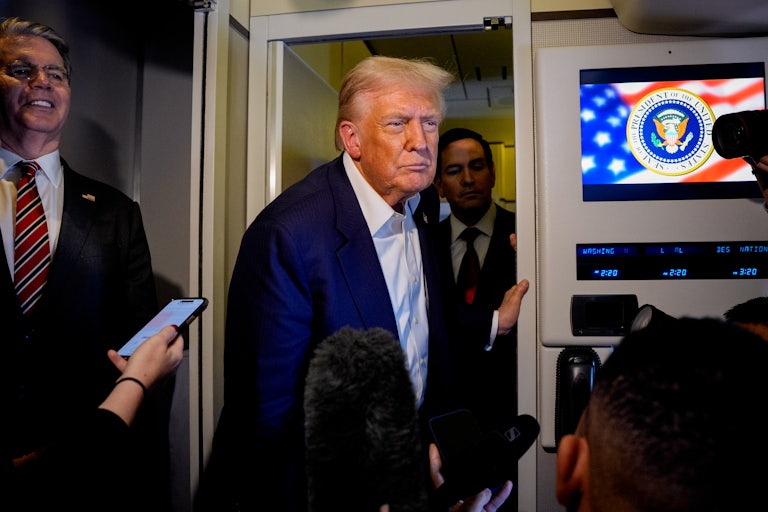
Donald Trump takes a question from a reporter aboard Air Force One.
Andrew Harnik/Getty Images
Donald Trump takes a question from a reporter aboard Air Force One.

There’s a rubric I’ve been using to maintain perspective on President Donald Trump’s second term: Imagine if the dumbest person in the world and humanity’s biggest asshole were the same person, and that guy was president. It’s a pretty simple lens through which to both view Trump’s lawless, Constitution-shredding rampage of revenge and self-enrichment while never succumbing to the idea that what’s happening to the country is somehow within bounds. It is only from this standpoint that one can write the straight story about this administration.

Meanwhile, how are the View From Nowhere folks faring these days? Somehow, in 2025, the media is still struggling with what is plainly in front of its face, demonstrating the same coherence bias that I and others had reason to complain about in the run-up to the 2024 election and its immediate aftermath.

Behold, the “departure.” Back on September 10, The New York Times used the term in their report of the Trump administration’s extrajudicial killings on the high seas. Their sources, per the report, provided “new details about a military operation that was a startling departure from using law enforcement means to interdict suspected drug boats.” More recently, a CNN report on Trump having collected a $130 million private donation to pay military service salaries—a highly impeachable offense for what is a comically paltry sum of money—explained that the move “marks a striking departure from government procedure for funding the military, which traditionally relies on public funds appropriated by Congress.”

Well, let’s give credit where due. The media is at least startled; they are struck. But these actions are not mere “departures”—a term that suggests a slight change of frame; unorthodox maneuvers that are nevertheless within the parameters of acceptable. Behind the sugarcoating are offenses that can be related in plain English, if anyone wants to take a stab at it. Here at TNR, for example, Matt Ford’s piece about how Trump’s military payroll gambit was a baldly illegal seizure of power got this headline: “Trump’s Military Payroll Gambit Is a Baldly Illegal Seizure of Power.” See, folks, it can be done.

Suffice it to say, avid readers of political news should be on their guard for other things Trump does that get labeled as “departures” or otherwise presented in a more anodyne frame. Just as TNR’s Tim Noah instructed that any time the media refers to someone as “fiery” what they really mean to say is “bugfuck nuts,” any time you see the word “departure” invoked, they are referring to a crime. And Trump’s crimes, in particular! I’m not sure you’ll see a bank robber assessed as having made “a startling departure from traditional cash withdrawals.”

It’s been something of a bleak period, watching the press make startling departures from telling the straight story about the Trump administration. TNR contributor Parker Molloy noted that, after Trump responded to the No Kings protest with an AI-generated video depicting him dumping gallons of shit on the protests from a fighter plane, the media was at great pains to sand off the edges of the story. There was a time when even the perception of this kind of antipathy toward ordinary citizens—say, when you label them as “deplorable”?—would invite the fury of the media. (Heck, there was a time when the political media launched a fatwa against Howard Dean for shouting at his own rally.) But this never became much of a scandal—though I will concede that Democrats could have done a better job pushing the issue.

And as we learned this week, pushing the issue can work wonders. Steve Bannon, as is his wont, seeded the media pasture with his announcement that there is a “plan” in place to run Trump for a third term. From there, an entire news cycle blossomed, one in which reporters peppered Trump with questions about his plan to run again, all of which he sidestepped—and so those same reporters told their readers that he is not ruling it out. Perhaps my favorite piece from this “Will Trump do a new crime?” boomlet was a Time magazine piece titled “Why Trump Keeps Talking About a Third Term” that suggested, “Whether Trump actually plans to run again for President, in defiance of the Constitution, merely bringing up the possibility so much, some observers say, may be strategic in its own right.”

The one problem with that contention is that Trump wasn’t bringing it up—a bunch of reporters were, and in so doing turned what should have been a confrontation (“Why do your allies keep saying you plan to abrogate the Constitution?”) into a jocular spitball session where they help Trump go over his options. (We are reliably informed that the president finds the maneuver where he runs as vice president “too cute.”) Trump, for once, seemed to understand what game was afoot. “Am I not ruling it out?” he responded to one inquiry, “I mean, you’ll have to tell me.” And so they did, in the pages of their publications.

If you’re wondering what is causing the media to fall down on the job in this manner, and infect coverage of a constitutional crime wave with limp euphemisms, I think it’s very much akin to the reason Democratic senators keep voting for Trump’s judicial appointments: It’s an act of desperation; a frantic need to suggest that our democratic institutions are still in proper working order and the duly elected president isn’t guiding the ship of state into tyranny. For if the members of the fourth estate were ever forced to report the truth of what’s happening, they would also have to confront how their own neglect helped pave this path. Based on the number of “startling departures” that are piling up, I reckon that day will come soon enough.

This article first appeared in Power Mad, a weekly TNR newsletter authored by deputy editor Jason Linkins. Sign up here.
Senate Democrats: Get Your Stories Straight!

The senators are sending mixed messages on Trump’s threats to democracy. Time to get it together.

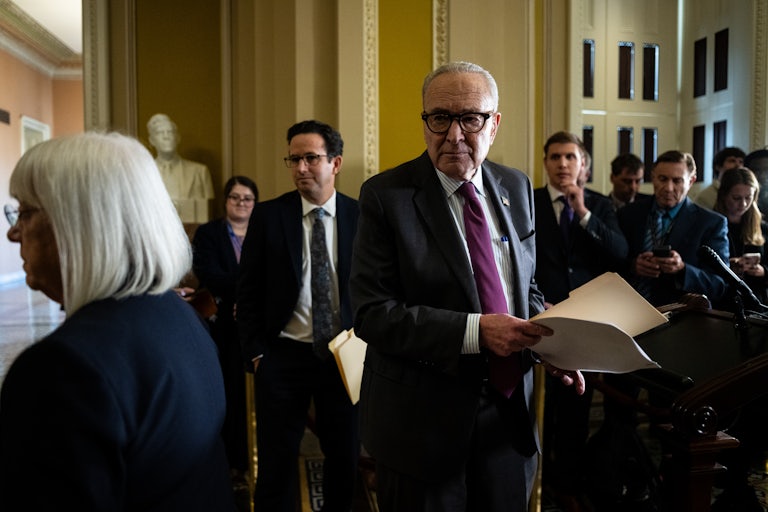
Senator Patty Murray, a Democrat from Washington, from left, Senator Brian Schatz, a Democrat from Hawaii, and Senate Minority Leader Chuck Schumer, a Democrat from New York, depart a news conference following the weekly Senate Democrat policy luncheon at the US Capitol in Washington, D.C.
Graeme Sloan/Getty Images

On Tuesday evening, Democratic Senator Jeff Merkley stepped onto the Senate floor to begin a marathon speech that extended well into Wednesday. The topic of his stemwinder was most urgent: “I’ve come to the Senate floor tonight to ring the alarm bells. We’re in the most perilous moment, the biggest threat to our republic since the Civil War. President Trump is shredding our Constitution.” For Merkley, the matter hit close to home, quite literally: “President Trump wants us to believe that Portland, Oregon, in my home state, is full of chaos and riots. Because if he can say to the American people that there are riots, he can say there’s a rebellion. And if there’s a rebellion, he can use that to strengthen his authoritarian grip on our nation.”

One shouldn’t expect the president to be moved by Merkley’s admonishments. And there are not likely to be many Senate Republicans swayed by his overtures. But there were plenty of people on hand who needed to hear what the Oregon lawmaker had to say—specifically, his Democratic Senate colleagues, who haven’t been singing from the same pro-democracy hymnal lately. Merkley’s oration arrives at a time when some spines need stiffening.

The U.S. Senate: For a long while now, it’s where Democratic Party ambitions, along with democracy itself, have hit the skids. There are structural reasons for that: Far fewer voters are represented by the GOP majority, and this malapportionment problem is exacerbated by changing demographics that could one day allow 30 percent of Americans to elect 70 of its senators. But Republicans learned long ago that their agenda—showering tax benefits on the wealthy and breaking the government—only requires 51 votes most of the time. Democratic governance—which involves building, fixing, regulating, preserving, and improving—requires 60 nearly always.

One might have expected by now that Democrats would have recognized how the Senate filibuster, which requires them to regularly conjure these supermajorities, is something of a suicide pact. Or that it’s a recent innovation that’s easily discarded. Or that it runs so counter to the Founders’ ideals that its very existence should be offensive. But not enough Democrats have made this leap. And the reason is that too many of them suffer from what The New Republic contributor Christopher Sprigman calls “Degenerative Senate Brain.”

Having observed this less than august body operate over the past few years, I think that the main problem with many of our Democratic senators is that they believe their own hype. They all think they’ve signed up for an austere debate club—the “world’s greatest deliberative body,” the “cooling saucer” of government. They don’t seem to have noticed that when it comes to deliberating, or maintaining a reputation for judiciousness and equanimity, everyone has to agree to participate in those ideals. And Trumpist Republicans do not: They’ve shut down the government. They’ve willingly ceded the power of the purse. They rarely if ever question the Mad King’s desires. Do you remember the public agonizing of Louisiana Republican Bill Cassidy over Robert F. Kennedy Jr.’s appointment to Health and Human Services? And then Cassidy ended up meekly endorsing him, to Cassidy’s lasting chagrin? That’s about as robust as GOP deliberations get.

The state of the GOP means that you can’t really have a Senate anymore. Unfortunately, the most Senate-brained Democrats still naïvely believe that they can revive this moribund body, through actions that at best send mixed messages and at worst directly undermine the work of Democrats like Jeff Merkley.

Case in point: This week, amid the government shutdown, 13 Democratic senators joined forces with all but one Republican to advance the nomination of Harold Mooty to a judgeship in the Northern District of Alabama. Some fun facts about Mooty that The New Republic’s Ellie Quinlan Houghtaling collected: He has gone to some lengths to dance questions about the January 6 riots and who was culpable; he practically invented new verb tenses to avoid saying directly that Joe Biden was the legitimately elected president.

When it comes to deal-breakers, to each their own, but I find it puzzling that these weren’t some crimson flags for Senate Democrats. But even if they weren’t, everyone should understand that the only role a Republican judicial nominee plays in American life is serving Trump as if he was their personal legal client and backstopping his savage corruption. For that reason alone, there should never be a Democratic name signed to the advancement of Trump’s judges.

Why would 13 Democrats (and Maine independent Angus King, who I find too tiresome to explain to people) do such a thing? My theory is this: In their own skewed, Senate-brained view of the world, taking these kinds of votes helps to bolster democracy. That is to say, any time there is a small window in which they can make a gesture of comity and bipartisanship, they believe the right thing to do is to take it—the better to demonstrate that the ol’ ship of state is still humming along, normal business and regular order is possible, and that we aren’t so far off from recovery. Democrats are leaving the door to deliberation open. They’re keeping that saucer on ice.

Folks, I would love to believe that a small overture might seed a future coming together of polarized parties. But if watching schoolchildren get shot to pieces several times a year isn’t going to foster that fellowship, then we’re definitely not getting there by throwing the other side a bone in the form of Harold Mooty. The government is shut down, there’s a hole in the White House, the president is ordering extrajudicial killings in Latin America as part of some run-up to a regime change war, and citizens are getting snatched off the streets by Brett Kavanaugh–inspired goons. The system so loved by the Senate-brained is currently offline! And these votes to approve the odd judicial candidate are simply small enabling acts that only help to fuel the disorder.

Is democracy in grave danger? This week, it looks like Merkley and his allies agree, and that 13 other Democrats aren’t really ready to believe him. But with midterms looming, everyone in the party has to be of one mind on the matter in order to not sow confusion among critical voters. And if they all truly agree that Trump is some unique threat, we cannot have Democrats in double digits signing their name to support his agenda—not now, not ever.

This article first appeared in Power Mad, a weekly TNR newsletter authored by deputy editor Jason Linkins. Sign up here.

The Infamy of the “Kavanaugh Stop”

The court’s majority typically doesn’t disclose their reasoning on shadow docket cases. Here’s one instance where a justice may regret speaking their mind.

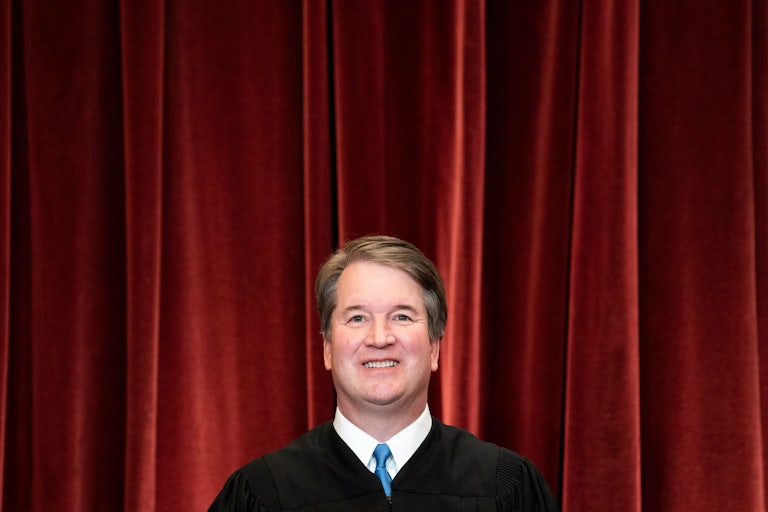
Associate Justice Brett Kavanaugh stands during a group photo of the Justices at the Supreme Court.
Erin Schaff/Getty Images
Associate Justice Brett Kavanaugh

Believe it or not, there was a time when the Supreme Court’s emergency docket rulings did not regularly garner controversy; they were simply the means by which the court could consider time-sensitive legal crises, such as motions related to capital punishment. But a key feature of the Trump era is the transformation of the emergency docket into the “shadow docket”: unsigned rulings that have had a profound effect on the country. Beyond the fact that these rulings have a “heads Trump wins, tails Democrats lose” bent, they are, as Erwin Chemerinsky notes, often proffered without much in the way of jurisprudential explanation while frequently bulldozing precedent. The justices themselves may not like the term “shadow docket,” but they seem to relish operating in the shadows all the same.

But there is one instance in which a justice did attempt to explain himself in a recent shadow docket ruling, only for that justice’s reasoning to blow up nearly immediately after its first encounter with the real world: Brett Kavanaugh’s concurring opinion in Noem v. Vasquez Perdomo, in which the Supremes stayed a lower court ruling that was specifically impeding the Department of Homeland Security from racially profiling people for immigration stops. The larger court, as is its wont, failed to offer a ruling. But Kavanaugh opted to weigh in all the same. His reward is a heaping helping of infamy in the form of a specific secret police tactic that many have taken to calling “the Kavanaugh stop.”

Here’s the essential background. As The New Republic’s Matt Ford reported after the ruling in Noem was handed down, Kavanaugh’s surprise concurrence went to some pains to “minimize the impact” of a law enforcement encounter: “Importantly, reasonable suspicion means only that immigration officers may briefly stop the individual and inquire about immigration status,” Kavanaugh wrote. “If the person is a U.S. citizen or otherwise lawfully in the United States, that individual will be free to go after the brief encounter. Only if the person is illegally in the United States may the stop lead to further immigration proceedings.”

As Ford noted, the law enforcement encounters that formed the basis of the case itself could hardly be called “brief.” One of the plaintiffs in Noem testified that his attempt to show valid proof of U.S. citizenship did not make the encounter any shorter, as the agents “refused to believe the validity of his California driver’s license.” As Justice Sonia Sotomayor recalled in her dissent, “The agent said the ID was insufficient, ‘grabbed [his] arm,’ escorted him to a vehicle, and drove him to a ‘warehouse area’ for further questioning.” None of that sounds at all like the quick interaction that Kavanaugh suggested was the theoretical norm. And in practice, the Kavanaugh stop hasn’t hewed to his imagined brief encounter, either.

The quintessential components of a Kavanaugh stop involve a person detained for immigration enforcement specifically, with race a certain or likely factor in the decision behind the stop—the Fourth Amendment’s protections from unlawful searches and seizures be damned. Sotomayor saw a grim future in the court’s decision: “We should not have to live in a country where the Government can seize anyone who looks Latino, speaks Spanish, and appears to work a low wage job.”

If the news is any guide, Sotomayor’s fears are now reality. As the Chicago Tribune recently reported, Chicago resident Rueben Antonio Cruz, a 60-year-old man originally from El Salvador, was sitting with a friend in Rogers Park when “immigration officers stopped their truck and went straight after them.” What followed was a classic Kavanaugh stop: Cruz and his friend were asked for “papers” proving their citizenship. Cruz, who was not carrying such papers on his person, was then bundled into the agents’ vehicle and interrogated. Cruz was eventually let go, but not before the agents fined him $130 for “not having his papers.” The ordeal left Cruz angry: “It’s not fair because I said, let’s go to my house and I’ll show you my papers. I’m a resident.”

The Tribune notes that while federal law requires registered foreign nationals to carry proof of registration with them at all times, “prior to a second Trump administration, it was rarely enforced.” The detention drew the criticism of the ACLU’s Ed Yohnka: “America has never been a place where people need to ‘show one’s papers.’ Ticketing a lawful permanent resident—and forcing him to appear in court and pay a fine for not carrying their papers—is unnecessary and cruel.” Unfortunately, it’s likely to become commonplace as Trump’s goons, freed from legal obligations by the Supreme Court, make the Kavanaugh stop part of their daily operations.

The possibility that Trump’s ICE agents, who have effectively been given carte blanche to abuse their authority, might simply dismiss their quarry’s valid proof of citizenship appears to have not occurred to Kavanaugh. But it has definitely occurred to the jabronis snatching up brown people in American cities. In a second Kavanaugh stop detailed by the Tribune, a 44-year-old Latina woman named Maria Greeley was out for a jog when she was jumped by federal agents who zip-tied her and detained her despite the fact that she carries her passport with her at all times to prove that she was born in the United States. According to the report, agents remarked that she didn’t “look like a Greeley,” dismissed her documentation, and accused her repeatedly of lying.

One of the most obviously impeachable things about the Supreme Court is that it’s so frequently out of touch with the real world—a perhaps inevitable condition of giving nine people special robes and lifetime job security and then stuffing them inside a sepulchral building to stew in their own partisan juices with no one to answer to. Kavanaugh’s flawed reasoning may simply be the product of profound naïveté. But since this all came about in a shadow docket case in which the Trump administration asked for emergency relief in the form of the permission to racially profile people, I think it’s hardly beyond belief to think that Kavanaugh felt compelled to try to put a good spin on a reprehensible ruling.

That Kavanaugh has to own the Kavanaugh stop is cold comfort. Who knows if it’s even possible to shame or humiliate Brett Kavanaugh anyway? It’s very possible that transforming the United States into a country more reminiscent of Nazi Germany’s “Ihre Papiere bitte” era is precisely the legacy that Kavanaugh sought for himself. We’re the ones who are stuck with the consequences.

This article first appeared in Power Mad, a weekly TNR newsletter authored by deputy editor Jason Linkins. Sign up here.