Newsletter
Power Mad
A weekly review of the rogues and scoundrels of American politics

The Media Is Responding to Trump With a Huge Face-Plant

The press’s pathological need to normalize autocratic misrule is paving the road to ruin.

Donald Trump talks to the media in the Grand Foyer during a tour at the John F. Kennedy Center for the Performing Arts.
Chip Somodevilla/Getty Images

In February of 2021, a fitness instructor named Khing Hnin Wai shot what might be history’s most viral aerobics lesson. Filming herself in front of a major thoroughfare in Myanmar’s capital city, Khing went through her paces, gyrating purposefully to some up-tempo music. The real action, however, was in the background, as a convoy of armored vehicles sped in her direction. Khing had accidentally recorded the beginnings of a military coup—and created the most lasting artifact of the overthrow of Aung San Suu Kyi’s democratically elected government.

Here in the United States this week, employees of the U.S. Institute of Peace, who rarely if ever made headlines beyond the fact that their agency is often the venue for White House Correspondents’ Dinner after-parties, were rousted from their place of work by armed authorities backing Elon Musk’s misnamed wrecking crew, the Department of Government Efficiency. Musk’s goons were apparently unmoved by the fact that USIP is not an executive branch agency and thus outside of DOGE’s alleged purview. The episode raised important questions about whether there are appreciable limits to the private property that DOGE can enter and take over. Unfortunately, much of the media stood there, dancing, as one more instance of Trumpian misrule unfolded behind them.

To write about the plain facts of the Trump administration is, admittedly, a challenge. It can be hard to write a straight news story about an unlawful administration careening through constitutional boundaries without sounding a bit hysterical. I’ve had a two-year head start on most of the political media in writing about Trump’s plan to effect a wholesale demolition of the civil service and transform it into an engine of malevolence; back when I started, I thought long and hard about whether I’d come off as overreacting. But now that we’ve reached the other side of the election, it’s become clear to me that one can almost never overreact when responding to Trump.

I wish more media professionals would realize this. Unfortunately, all around us I see more of the same exercises in sanewashing that we saw in the media’s disastrous run-up to the 2024 election. The aforementioned siege of the Institute of Peace is a perfect case in point. The New York Times characterized the matter as a “simmering dispute” between two sides that don’t have equal standing where the truth is concerned. But one is an agency that says, correctly, that it is “a congressionally chartered nonprofit that is not part of the executive branch,” and the other is a group of unaccountable thugs whose response is, “We don’t care.” Still, at least the Times made note of the fact that armed police were part of this “standoff.” One local news station left that out of their account.

But the way the media is covering the mundanity of Trump’s mob rule is just as bad as the way it sands off the edges of its most dramatic confrontations. As Tom Scocca and Joe McLeod wrote Tuesday for their newsletter, Indignity, the press is stuffed to the gills with accounts that stipulate that Trump and his associates have “fired” scads of government workers. Just this week, it was reported by a wide variety of news organizations that Trump had fired a pair of FTC commissioners. But as the authors noted, that was not, in fact, what had happened:

Donald Trump did not fire any commissioners from the [Federal Trade Commission] today. Donald Trump declared that he had fired the commissioners. That is, functionally, he announced a desire that he should have the power to fire FTC commissioners and named the commissioners that he would fire if he were to have that power—a power which he does not, within the bounds of the law and the constitution, possess.

“It is hard to fit that into a headline!” Scocca and McLeod acknowledged. “Yet it is essential for news outlets to find a way.” I wish I saw more of an effort toward that goal, and less of the brain-breaking examples of headline torture I saw in last week’s Timesaccount of Trump’s strong-arming of the GOP, titled, “Trump, With More Honey Than Vinegar, Cements an Iron Grip on Republicans.” Does that set a new standard for the mixed metaphor? Between vinegar, honey, cement, and iron, it certainly sets a mixed-media record.

Or consider a report of a more recent vintage from The Washington Post: “Trump has a plan to remake the economy. But he’s not explaining it very well.” The piece reduces the trouble the president is having on the economic front—where for the first time he’s underwater on polls—to one in which he’s left the investor class with insufficient insight into his master plan. In this telling, the president’s claims of a soon-to-arrive golden age are taken at face value. “If the administration’s plan succeeds, the $30 trillion U.S. economy would be remade,” the article claims, adding that the United States was set to become “even more self-sufficient, producing more of its energy, lumber, steel and computer chips than ever before.”

Paul Krugman greeted this article’s array of assertions and unfalsifiable claims with something more reality-based: “I don’t know about you, but I don’t think Trump’s problem is that he’s doing a poor job of explaining his plan. I think his problem is that he’s offering fake answers to fake problems, and the public—unlike, apparently, the Washington Post—isn’t buying it.” That seems right to me. Beyond that, if anyone is actually in need of an “explanation” about Trump’s economic plans, I’d say that once you understand that everything proceeds from the fact that the president is an omnidirectionally corrupt moron whose desperate need for adulation fuels his every decision, with the added problem that he has, since his first term, become more intellectually infirm, everything starts to make sense. The constant whiplashing between implementing and retracting tariffs, the constant characterization of prosperity as a bad thing, the wild-eyed talk of how economic hardship will finally set us all free—all of this stems from the simple fact that the man at the top is a deceitful asshole with a cranial cavity full of damp parsley.

Like I said, you can sound a little strange when you straight-facedly account for the plain facts of this administration. But what’s the alternative? Most of what the Trump administration does, every day, is act illegally or unconstitutionally, rampaging and pillaging the government in ways that we’d discuss in much clearer terms if it were happening in some other autocracy—like Myanmar, for example.

As Scocca and McLeod wrote, “A constitutional crisis is also a crisis of newswriting, because it is a crisis of knowing.” One of the biggest debates that seems to be raging in the media right now is whether or not we are actually allowed to tell the truth about the Trump administration—to state clearly that unconstitutional corruption is afoot in the nation’s capital with the same clarity and urgency we once used to talk about, say, a secretary of state’s private email server. Are we going to actually tell the public what is going on, or are we going to stand in front of it, dancing energetically in a fluorescent-yellow outfit?

This article first appeared in Power Mad, a weekly TNR newsletter authored by deputy editor Jason Linkins. Sign up here.

Trumpism Isn’t Working

As a checked-out president sits back and lets Elon Musk shred the civil service, the signs of economic calamity are growing—and Americans of all stripes are getting pissed off.

US President Donald Trump arrives to greet Emmanuel Macron, France's president, not pictured, outside the West Wing of the White House in Washington, DC, US, on Monday, Feb. 24,2025. Macron is aiming to secure US security guarantees for Ukraine, slow down Washington's talks with Russia, and demonstrate Europe's commitment to increase defense spending.
Bonnie Cash/Getty Images

Last November, voters elected a president who’d largely campaigned on an unrelenting hostility to trans people and a plan to let Silicon Valley oligarchs gut the civil service and turn government into a machine for the president’s self-enrichment and political revenge. Much of the political press either ignored this stuff or didn’t care enough to inform their readers—some were too busy trying to polish a mass deportation scheme into a sensible response to the housing crisis—but some of us, here at The New Republic and elsewhere, went hoarse trying to warn about the consequences.

And now here we are. While it’s early days, Trump’s second term has been going about the way you’d expect the presidency of an anti-trans, pro-oligarch, corrupt mass deporter to go: not well! Migrants are effectively being thrown into internment camps, a gang of child cybercriminals are heisting our personal data, and what’s left of the civil service is bogged down wondering whether or not they have to send busy-work emails to gang leader Elon Musk. Meanwhile, Trump has largely checked out, prompting Musk, on multiple occasions, to step in as the president’s emotional-support fascist during public appearances.

If you’re fond of certain social media memes—sowing/reaping, how it started/how it’s going, fuck around/find out—this is a real boom time. But here’s the bottom line: Trumpism isn’t working. This mostly portends pain for the country and the planet, but there’s a silver lining to be found in a president who has screwed up so royally this soon into his post-inauguration honeymoon period: His opponents have an unexpected advantage.

Right now, Trump’s biggest weakness is the very thing he believed was going to confer unprecedented strength on his return to power: his attempts to purge the federal government of its loyal workforce and replace it with subservient confederates. What Trump and his cronies misunderstand is that the civil service is essentially an extension of the people’s will. While this institution is too often castigated as a faceless bureaucracy, there’s an important material connection between those who serve the public and the public that’s being served. And when you rattle the cages in Washington, those vibrations spread outward. It’s no wonder that a recent Morning Consult poll found majorities of respondents rejecting the idea that the civil service was “too liberal,” as the Trump administration has tried to get people to believe. Nor is it surprising to find that the same set of respondents are not exactly “clamoring for DOGE cuts.” At the same time, public approval is trending against Trump’s Silicon Valley suck-ups, not to mention Trump himself, of whom half the country now disapproves.

People should be worried about the destruction that Trump is wreaking. The civil service is a collection of people doing the mostly invisible work of keeping daily life thrumming along and keeping us safe from a multitude of harms. Now, everywhere you look, Americans are getting anxious. People are suddenly less convinced that they can travel by air safely. Consumer confidence is nose-diving. The percentage of Americans who feel the economy is on the wrong track has risen 10 points in less than a month.

Reading the tea leaves, the administration is now desperately trying to finger Biden as the culprit for what could be an apocalyptic jobs report, which is pretty rich coming from the administration that’s cutting programs and putting people on the unemployment rolls. “It seems unavoidable that we are headed for a deep, deep recession,” former U.S. Labor Department economist Jesse Rothstein told The Telegraph this week. Apollo Global economist Torsten Slok said that “layoffs could approach 1 million after factoring in the likely chain reaction” that Trump’s cuts to the civil service will have; Slok went on to observe that “the US Economic Policy Uncertainty Index was now higher than at any time during the great recession.”

So it’s hardly shocking that people are already starting to react as if something has gone very wrong. Republicans are facing torrents of angry voters at their own town halls, where representatives from deep-red districts are getting earfuls of anti-Musk invective and chants of “Tax the billionaires!” Some Republicans even seem chastened enough to offer the first stirrings of anti-Trump defiance that we’ve heard from members of his own party in a while. (Naturally, it’s now being suggested that Republican members cancel their town halls entirely—a curious move for a party that claims to have a mandate to govern.)

I may not be as confident as The American Prospect’s David Dayen, who says “Trump’s cooked,” but the environment is certainly more favorable to such optimism than I imagined it would be a month ago—which makes this an apt time for Democrats to up the ante. As Senator Elizabeth Warren said during an interview on CNN this week, “Our best strategy is to make sure everybody knows exactly what the Republicans are trying to do.” That’s a plan that doesn’t require a congressional majority, just a commitment.

There really is a big opportunity here, to make some fundamental shifts in public sentiment on the value of the government that Trump is trying to burn to the ground. A 2019 study by the Niskanen Center found that Americans “mistrust services provided by the public sector, even though they increasingly rely on government programs.” The misalignment is so bad, in fact, that the public tends to “misperceive good services” rendered by the government as coming from the private sector. The biggest problem, according to the study, is that most of the good work the government does is invisible—we only notice when it’s being done poorly. Because of that, the study concludes, the public’s “views of government don’t become more positive even if they directly benefit.”

As Trump and Musk stampede through Washington, and the inevitable maladies of this destruction become more visible to the public, liberals might be staring at a historic opportunity to turn public opinion on the value of government around. And they can back up their case by showing some backbone in Washington, because the price of being associated with Trumpism is too high. This week, they passed an important test with flying colors when they voted in lockstep against the Republican budget plan, and with considerable aplomb: California Representative Kevin Mullin flew to Washington to cast his vote straight from being discharged from the hospital; his Colorado colleague Brittany Pettersen made a similar sojourn with her newborn son.

All in all, this was an instructive week of how an out-of-power party can offer a steely response to, and take advantage of, a stumbling Trump. So let the cheap clickbait merchants beat on about how Democrats would be better off rolling over and playing dead. With public sentiment riding against Trump’s designs and no end in sight to the chaos he and Musk foment, there’s never been a better time for the party that believes in government to defend that government, connecting the ruination of the civil service to the ruination that will be visited on ordinary people. Democrats might be locked out of power, but they don’t need a parliamentary majority to land damaging blows against a flailing president and party. Strike while the iron is hot.

This article first appeared in Power Mad, a weekly TNR newsletter authored by deputy editor Jason Linkins. Sign up here.
The Incredible Disappearing Republican Lawmaker

The GOP’s total withdrawal from governing is nearly complete, and they’re increasingly determined to push the entire legislative branch into functional irrelevance.

Senate Majority Leader John Thune speaks to reports at the Capitol in Washington, D.C., on January 28.
Kevin Dietsch/Getty Images
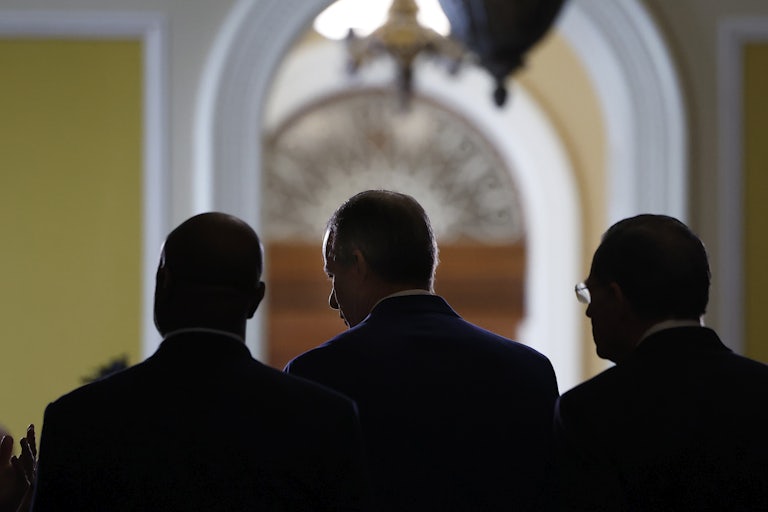
Senate Majority Leader John Thune speaks to reporters at the Capitol in Washington, D.C., on January 28.

In February of 2014, something extraordinary happened—or, at least, extraordinary in retrospect. A Republican congressman named Dave Camp, then the chairman of the House Ways and Means Committee, released a tax reform plan that … wasn’t bad! It did cut some taxes, notably in investments and carried interest—pretty much in keeping with what Republicans had been seeking to do. But it also levied new taxes on high earners and large financial institutions, a generous sop to the left.

A wide spectrum of political thinkers stepped forward to offer kudos. Liberal writers like former contributors to The New Republic Jonathan Chait and Alex Pareene both offered Camp qualified praise for producing something that at least resembled the work of an adult lawmaker. Meanwhile, in a surprising non-crank missive from The Wall Street Journal’s editorial board, Camp was hailed as one of the “smarter Republicans ... trying to reclaim the mantle of economic opportunity.”

It’s not every day that these warring camps unite, but in their notes on Camp and his tax reform proposal there was a happy sort of comity. Naturally, what happened next is that Republicans froze out Camp’s idea during the April budget-making process—a decision that Camp saw coming far enough in advance that he’d announced his intention to retire a few weeks before his tax reform plan met the knife.

I recount this history because the whole affair seemed like the first of many nervous tics heralding a larger disorder within the Republican Party, one which has indeed hit an apotheosis under the second term of Donald Trump. Congressional Republicans have rather assiduously withdrawn from their traditional duties, refashioned themselves into elected facsimiles of genuine lawmakers, and, with Trump’s return to power, completed the mission to dismantle their institutional power and weaken an entire branch of government. In many important respects, “Republican members of Congress” no longer really exist anywhere but in memory.

This is not a phenomenon that you can blame entirely on Trump, or even the Trump era. The GOP’s interest in policymaking has been eroding for some while now. In the 2012 presidential election, their nominee, Mitt Romney, was famously made to abjure the very accomplishment that catapulted him into the presidential ranks: the Massachusetts health care reform law he enacted during an era when Republicans actually worked to co-opt liberal issues and outcompete Democrats on policy. You don’t have to be too old to recall when our current secretary of state, Marco Rubio, participated in the Gang of 8 bipartisan immigration reform squad—even serving as the point man to defend the work on right-wing talk radio. He ran for president in 2016, and we all know what happened then.

Congress as a whole has been weakened by a host of malignancies in recent years. The rise of unitary executive theory during the presidency of George W. Bush paved the way for expanded executive branch powers that his successor, Barack Obama, took no real interest in unwinding. Around the same time, Congress ceded its constitutional duties by giving the executive branch blank checks in the form of Authorizations for the Use of Military Force, which allowed lawmakers to take a passive role in the ongoing “global war on terror”—crediting themselves when things were going well, while castigating the president when they weren’t. Meanwhile, the conservative legal movement was executing a decades-long plan to transform the Supreme Court into a kind of super-legislature with a line-item veto on the future, a project that came to fruition under Trump’s first term.

While Trump had a hand in shaping the GOP during his first term, the Republicans’ withdrawal from traditional governance only became more pronounced after Trump left office. As New Republic contributor Katelyn Burns noted, after 45 Republican senators declared the impeachment of Trump for January 6 to be unconstitutional, the GOP was “in full retreat from meaningful policymaking of any kind, instead charting a course away from taking on the challenges of the moment in favor of further entrenching itself in the distant patriarchal mythology of America’s past, where the only thing left for conservative lawmakers to do is to fend off the liberal cultural forces that would deny this return to a gauzy, MAGA fantasia.”

Again this took little urging from Trump, who was out of Washington beginning a long sequestration at Mar-a-Lago to lick his wounds and stash boxes of classified materials in the lavatory. The Republican Party’s journey to self-abnegation continued apace. As one adviser to Ohio Senator Rob Portman put it in an interview with the National Journal, “If you want to spend all your time going on Fox and be[ing] an asshole, there’s never been a better time to serve. But if you want to spend all your time being thoughtful and getting shit done, there’s never been a worse time to serve.”

Now that the second Trump era has kicked off, we can see that the self-diminishment of the GOP’s Washington lawmakers has hit an apex. Much of what Trump is doing is a full-frontal assault on the separation of powers: Elon Musk has been turned loose without any nod toward advice and consent; Musk in turn is attempting to shut down whole government agencies, a task that can only be legally obtained by an act of Congress.

The Republican majority are contributing to this effort mainly by allowing themselves to be trampled. And they’re refusing even to defend the paramount purposes of their own institution: As Trump and Musk have usurped the power of the purse explicitly granted to legislators by the Constitution, Republican lawmakers have stood by and let the plunder happen. Naturally, the path of true subservience to Trump never does run smooth: This week, we’ve been treated to the sorry spectacle of Republican lawmakers begging Trump to turn the money spigot back on for their constituents.

Obviously, Republicans in Congress still have some consequential duties to perform, none of which they do particularly well. The Senate confirmation process is effectively a sham; aside from some genuine deviance from Mitch McConnell, only Susan Collins seems to remember that it’s necessary to pretend to do due diligence before rubber-stamping Trump’s appointees into office. And lawmakers will still need to pass a budget and raise the debt ceiling, neither of which they seem capable of pulling off without Democratic help.

But a whole new conception of what it means to be a Republican congressperson, and what they will be expected to do, has finally taken shape. Gone are the Camps and Romneys, the diligent wonks and the rangy strategists. Here now are the little Javerts, running star-chamber investigations in newly weaponized committees, alongside an army of what are essentially internet trolls, producing content for an increasingly low-minded media economy. If you want to imagine the future, think of South Carolina Representative Nancy Mace, shrieking “Tranny! Tranny! Tranny!” on the floor of the House, while hatching newer and more confusing performance art stunts.

Democrats will, unfortunately, have to adapt to the rules of this new arena rather than pretend the old, regular order of Capitol Hill still exists. But it’s the party that’s locked out of governance that can make the case for governing if they choose to accept the challenge. That requires an aggressive, attack-minded media strategy dedicated to relentlessly hanging every malady of Trump’s second term around the necks of Republicans. It also requires getting attention—so fewer white-papers-on-websites and op-eds in the Journal, and more cheap shots and crass jokes. The GOP has essentially gone all in on a content creation war; to return to a more high-minded era, Democrats will have to win it decisively. Because while Republican lawmakers have, by their own actions, nearly disappeared—they’re not yet gone enough.

This article first appeared in Power Mad, a weekly TNR newsletter authored by deputy editor Jason Linkins. Sign up here.
The Democrats Have More Power Than They Realize. Here’s How to Use It.

They can’t just wait for Trump’s screw-ups to bring him down.

Senate Minority Leader Charles Schumer House Minority Leader Hakeem Jeffries speak at a press conference.
Kevin Dietsch/Getty Images
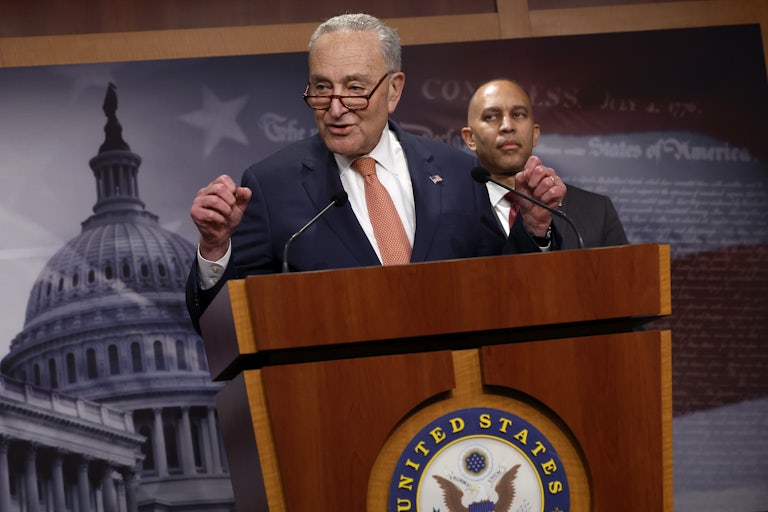
Senate Minority Leader Charles Schumer and House Minority Leader Hakeem Jeffries speak at a press conference.

To hear Senate Minority Leader Chuck Schumer tell it, despite the fact that the party just brutally lost an election and have failed to elucidate a strategy for winning back the voters they’ve recently lost to Trumpism, the Democrats actually have the Republicans right where they want them. As Semafor’s Burgess Everett recently reported, Schumer has urged everyone to just chill out and wait. “Trump will screw up,” he said, adding that Trump’s decision to release a bunch of violent insurrectionists on an unsuspecting public is actually “the best thing that’s ever happened,” which is certainly news to me. “I didn’t know he’d screw up so soon,” Schumer said, adding, “This is going to be a pattern.”

As I’ve written before, the Democrats’ enduring theory of political change is that Republicans will cock things up enough to get the public back on their side—despite the numerical paucity of bona fide, persuadable swing voters out there in the hinterlands. In the narrow sense, however, it’s probably true that backlash is the spark that will end Trumpism. But for Democrats to wait for it is political malpractice for two key reasons: First, they’re not entirely locked out of parliamentary maneuvering. More importantly, whether locked out of power or not, every elected Democrat still has constituents—citizens who depend on their elected officials for material support during these trying times. Telling these people that they’re on their own would be downright criminal.

Democrats haven’t treated their constituents decently of late. By all accounts, phones on Capitol Hill have been constantly a-jangle with calls from voters prompted by “Call your congressperson” campaigns from Democratic Party–affiliated organizations such as MoveOn and Indivisible, and tensions are mounting. This week, Axios reported that Democratic members are “pissed” at the organizations for sending so many angry callers their way, on the grounds that they are “barking up the wrong tree given their limited power as the minority party in Congress.”

But as Indivisible’s co-founder Leah Greenberg takes pains to point out, the idea that Democrats have no parliamentary levers at their disposal isn’t actually true. “Our supporters are asking Democrats to demand specific red lines are met before they offer their vote to House Republicans on the budget, when Republicans inevitably fail to pass a bill on their own,” said Greenberg, citing the fact that tight margins within the fractious GOP House caucus make it all but certain that Speaker Mike Johnson will need Democratic votes to keep things running. That means a parliamentary fight might, indeed, be in the offing.

Should Republicans fail to get must-pass budget measures enacted with their majorities, Democrats should be prepared to let Johnson know that the cost of their votes is subject to inflation. As Representative Alexandria Ocasio-Cortez told The Independent, “It is the Republican majority’s responsibility to gather the votes necessary for them to pass their agenda.” Short of that, she says, “any concession necessary for the Democratic Party to assist them ... must be incredibly substantial.”

This is all correct, and it’s going to be very disappointing if Democrats do what I expect them to do: give up their leverage to lend blank-check support to the GOP because they think that adhering to norms of comity and bipartisanship will earn them plaudits from the public and open doors to further rapprochement with the GOP. This is loser talk: The angry voters won’t be mollified, the Republican cooperation won’t come, and Democrats will lose still more political ground. It’s absurd to think that this path leads to fewer phone calls—unless, of course, the message they want to send to their base is to just give up.

But even if a surprisingly different Democratic Party shows up on that day, they need to understand that they still have constituents who need help in the meantime, and adopting a “wait for the GOP to screw up” footing is the worst possible response for this moment. Think logically: At the other end of every Trump screw-up is a hurt person. Trump’s mistakes cost people their lives and livelihoods.

Moreover, it’s important for Democrats to remember that when this Trump administration functions as intended, it will feature an administrative state bent to the task of implementing Trump’s designs for vengeance on his political enemies, and the tools now under the control of he and Elon Musk can facilitate the granular immiseration of Democratic voters. In a preview of coming attractions, New York City Comptroller Brad Lander awoke on Wednesday to discover that the Trump administration had clawed back $80 million in FEMA funding that had already cleared. This is the plan: To effectively immiserate blue states and make it as hard as possible for Democrats to govern the places where majorities want them in office.

Democrats thus cannot simply sit back and watch as the full force of Trump’s authoritarian project falls on the heads of their constituents. And while their parliamentary options are limited, they still have some resources to bring to bear on this problem. They have their own deep-pocketed donors. They have nongovernmental expertise on which they can call. They have a small universe of nonprofits and support organizations that can work on the local and community level. Democrats need to marshal and deploy this capital to help keep people informed, keep them safe, and keep them a couple steps ahead of the Trump administration’s depredations. (Which they can do, considering the GOP wrote all their plans down.)

And while I hate to beat a dead horse, I must reiterate that Democrats really need to start playing the media game according to the rules the industry has set—and which their opponents have so agreeably mastered—instead of waiting for some period of media reformation that will never occur as long as so many incompetents, deadbeats, and goons are running the show. Democrats need to be aggressively launching counter-narratives, starting conflicts, and flooding the zone with the same fervor and volume as the GOP. There should be daily, coordinated P.R. attacks on the Trump administration. (Representative Robert Garcia’s “dick pic” stunt during Wednesday’s “DOGE Committee” meeting was an example of a perfectly executed play in a media environment where crass conflict is required to gain purchase in the attention economy.)

The recent air disaster at National Airport provides an illustrative example of where Democrats might have done more. Not long after news broke of the crash, eagle-eyed social media users pulled a January 22 press release from Democratic members of the House Transportation and Infrastructure Committee criticizing Trump for his “dangerous freeze of air traffic control hiring.” What should have followed hard on the heels of the crash was a concerted effort among Democrats to brandish that prescient press release and hang it on Trump.

Now, I’d bet I know why Democrats didn’t do this: To their mind, it would have been a cynical cheap shot. So they held back, and the next day the Trump administration chalked the crash up to diversity hiring, and that’s the topic the media spent the day dishing on, to the detriment of a wider universe of people than died in the original catastrophe. Lesson learned: The first cheap shot wins, so govern yourself accordingly and take them. Stop fretting about getting scolded by the punditocracy’s various schoolmarms for being rude and uncivil! Their approval will only lose you elections. Instead, welcome their disdain.

As Josh Marshall recently wrote, “Fundamentally this is a battle of public opinion.” Democrats need to treat those constituent phone calls as the front lines of this fight. This is where you provide information about Trump’s disastrous governance, where you disseminate information about what ordinary citizens can do and who can help them do it, where you outline your playbook for fighting back (remember, Project 2025 was written and published before Republicans won anything), where you vow that you’ll never surrender the fight, and where you help a scared nation feel less alone. If you provide people with information, resources, and specific political commitments, they will organize and act—and add vital grease to the wheels of that longed-for political comeback. What lies on the other end of those phone calls isn’t a burden, it’s an opportunity. Grow up, get over yourselves, and get back in the game.

This article first appeared in Power Mad, a weekly TNR newsletter authored by deputy editor Jason Linkins. Sign up here.

Trump’s Abuse of Power Comes as No Surprise

Somehow, Democrats got badly caught out by the president doing all the things he spent the past two years saying he was going to do if reelected.

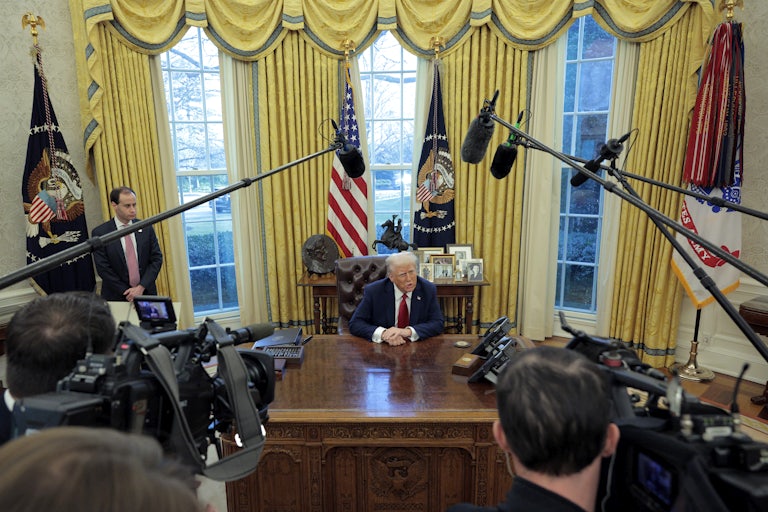
President Donald Trump talks to reporters from the Resolute Desk after signing an executive order.
Chip Somodevilla/Getty Images

The most surprising thing about Donald Trump is that there are still people here, in the year 2025, who retain the capacity to be surprised by Donald Trump. The man has no depths to plumbcontains no multitudes; to scratch his surface is to know the man entirely. We know that what he wants most in life is for the voices on his television to be praising him. We know that the biggest reason he ran for a second term is to avoid jail and that, now that he’s back, his main goal is to make off with as much money as he can. We know what kind of president he will be (bad) and how he’ll leave the country (worse). Trump is often described as a “pugilist” in the press. I’m not sure people know what that word means, because he’d be awful at pugilism. All of Trump’s punches are telegraphed.

Nevertheless, D.C. Democrats seem to be some of the last people to learn that there is nothing left to learn about Trump. Trump’s first week back seems to have caught them off guard, so much so that they’ve largely spent the last few days tiptoeing around as multiple crises unfolded. They’ve been careful, circumspect, cautious—and they’ve gotten absolutely banjaxed as a result. It wasn’t until Trump tried to turn off the entire federal government that they recovered a bit of fighting spirit, vowing to escalate the conflict with the GOP into a “street fight.”  

It’s great that they got there in the end; I look forward to this street fight, but I’ll believe it when I see it. Still, one of the Democrats’ big problems is the sheer number of times you can use the word “belatedly” to describe their reactions. It might have been better if Democrats had actually used the time between Trump getting reelected and Trump getting inaugurated to prepare to confront the things that Trump spent over a year saying he was going to do.

On Tuesday morning, The Bulwark’s Sam Stein reported on BlueSky that Democrats were planning to do a press conference on Trump’s decision to pardon the January 6ers—which occurred a full week prior—even as the effects of the Trump administration’s funding freeze were making headlines. The Democrats’ approach raises serious questions about their pathological inability to participate in the modern news cycle. Moreover, the pardoning of the January 6ers became a fait accompli the moment Trump won the election. The time to start raising a hue and cry over those pardons was thus November. 

Stein noted this lag: “Two parties running at different speeds.… Unclear if there is a presser today to go after the OMB’s power play to take over all federal grant money.” Democrats actually did manage to work the breaking news story into their brief in a rare display of nimbleness. But despite the hasty agenda change, Democrats seemed as if they’d not been following the political news for a staggeringly long amount of time. “Last night,” Chuck Schumer said of Trump’s attacks on the civil service, “President Trump plunged the country into chaos without a shred of warning.”

Trump’s actions were of course preceded by copious warnings, most notably in the form of Trump repeatedly saying that he planned to tear down the civil service and replace it with loyalists willing to use the federal government as his own instrument of plunder and revenge. In addition to these warnings, many stories generated well ahead of time elucidated Trump’s purge plans—a tightly reported piece from Jonathan Swan in Axios and two well-trafficked features from The New York Times and Vanity Fair among the biggest stories detailing Trump’s shock-and-awe schemes for the civil service. 

Readers of this very newsletter know that I wrote about Trump’s plot back in September 2022, using my patented journalism technique of listening to what Republicans say they are going to do and then writing it down and publishing it to the internet. All of these stories, based on nothing more than the public statements and documented plans of Donald Trump and his cronies, are what we in the biz would call a “warning.” 

There’s a long list of bad habits that Democrats need to break at this point, but we’ll add this to the list: Be ready to respond to the things that Republicans plan to do when they’ve given you several months of head start. If there is a takeaway for Democrats after Trump’s first 10 days in office, it’s that procrastination and lollygagging really kills. Fortunately, there’s still an easy way for them to get two steps ahead of the curve.

For instance, it’s never been a mystery that Project 2025 has essentially been the punch list for Trump’s second term—the White House is already very dutifully ticking items off. Any uncertainty about this ended this week when it was discovered that metadata in the Trump administration’s OPM memos indicated that they shared authors with the Project 2025 manifesto. Once that was publicly disclosed, the administration rather clumsily attempted to scrub that metadata from those memos. 

Based upon all of this, it seems pretty clear that this administration is just going to keep making its way through Project 2025’s pages. Democrats could probably finagle a copy of that document, given that it is publicly available, and maybe even start messaging against it.

Another thing I recommend Democrats get ahead of is the Trump administration’s plans to enact a national abortion ban. Now, I know what you’re thinking: Republicans can be pretty cagey and evasive when confronted on this matter. Here’s a fun fact: Several Republican-appointed Supreme Court justices even told Democrats during their confirmation hearing that Roe was “settled law” before they actually went and unsettled it. Chances are good, folks, that Republicans are actually doing this thing colloquially known as “lying.”

Yes, I know that Trump has repeatedly said that he would not sign a national abortion ban that comes across his desk into law. In the first place, yes, he absolutely would (see above: “lying”), but more importantly, he does not need a bill to arrive on his desk to enact a ban. As we have rather relentlessly reported here at The New Republic, Trump’s Department of Justice will enforce a law that’s already on the books known as the Comstock Act to ban abortion, something that Vice President JD Vance asked Merrick Garland’s DOJ to do when he was still an Ohio senator. 

There is no reason Democrats can’t simply count the contents of Project 2025 and a national abortion ban as done deals, things the GOP is going to roll out sooner or later, and start publicly sparring about them, along with the GOP’s other antisocial and unpopular plans. Republicans will complain, and there’s definitely a strain of pundits who will disapprove, but remember: Those people suck, and being on their bad side is evidence of good politics. Besides, with no legislative majority and thus no prospect of enacting legislation, Democrats may as well spend their time fighting the GOP, complaining about their ideas, and working the refs. 

Democrats have some reason to feel a little gun-shy about ramping up these kinds of attacks. The media, too often, reported on Trump’s denials of Project 2025 and his assertions about signing a national abortion ban way too credulously. But that’s a reason to start naming and shaming the media personages who got it so badly wrong. More to the point, Democrats need to spur, if not entirely resuscitate, a popular opposition to Trump and start planning an electoral referendum of what will be another round of failure and misrule. That begins with something that resembles energy and action, no matter how constrained you may be in parliamentary terms.

You look stupid when you’re a week late to a news story, and pathetic when saying you weren’t warned about the stuff that Trump publicly and repeatedly said he’s going to do. This administration wants to burn it all down, and measured responses won’t work as a counter; you can’t wait for your lawyers to go over the text of Trump’s executive orders and for your pollsters to focus-group the optimal response. Besides, you shouldn’t need to when you can just say, “Trump is fucking up the country and plundering the federal government.” Hopefully this week will prove to be a teachable moment heralding a quick course correction, because there’s one thing that Democrats can never say about Trump’s plans: that they weren’t told.

This article first appeared in Power Mad, a weekly TNR newsletter authored by deputy editor Jason Linkins. Sign up here.