Breaking News
Breaking News
from Washington and beyond

Vance Sent 2:30 a.m. Text as Officials Tried to Cover Up Signalgate

A new report reveals what J.D. Vance and other Trump officials were up to after their Signal messages were leaked.

JD Vance gives a thumbs up
Brett Carlsen/Getty Images

JD Vance hit up his buddies in the Signal chat used to coordinate bombing Yemen with a late-night plea for companionship—hours after the chat’s existence was revealed to the public by Atlantic editor Jeff Goldberg.

“This chat’s kind of dead,” Vance texted at 2:26 a.m. “Anything going on?”
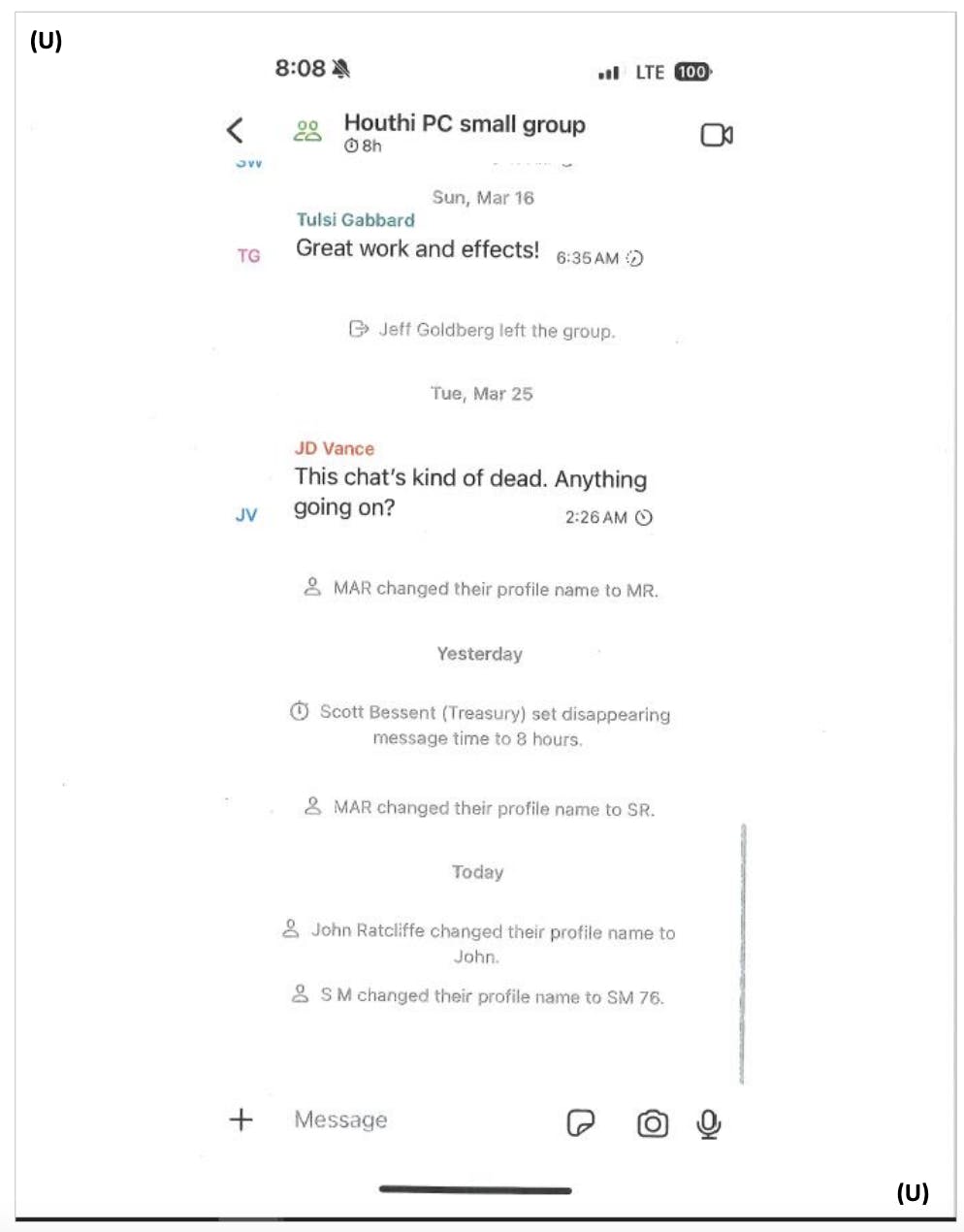
Screenshot of Signalgate messages on March 25
Department of Defense Inspector General report

A report from the Pentagon inspector general released Thursday reveals new details about what the chat’s members did in the days and hours after March 24, when Goldberg published that Defense Secretary Pete Hegseth had inadvertently texted him classified information about the Trump administration’s war plans.

The vice president’s “u up?”-style message, which we are generously reading as a joke, was sent in the wee hours of the morning of March 25.

Where Vance chose to make light of the possible treason, Treasury Secretary Scott Bessent appeared to have another aim: to cover the group’s tracks. According to the screenshot, Bessent shortened the time it would take for messages to disappear from the chat to eight hours. Goldberg reported that the messages had previously been set to disappear after either one or four weeks, already a potential violation of federal law.

Other officials changed their profile names: Secretary of State Marco Rubio changed his screen name from “MAR” to “MR,” CIA Director John Ratfcliffe shortened his name to simply “John,” and deputy chief of staff Sephen Miller, “S M,” changed his name to “SM 76.”

It’s unclear why these obviously identifiable (and already identified) officials would change their names, or attempt to make their messages disappear faster—the photo of the chat from the report was taken on March 27, leaving only a day for fast-deleting messages to be sent and then erased—but they obviously were scrambling.

Hegseth Barely Cooperated With Signalgate Probe—and Still Got Wrecked

The investigation found that Pete Hegseth’s actions endangered U.S. troops.

Defense Secretary Pete Hegseth sits during an event
HASNOOR HUSSAIN/AFP/Getty Images

The Office of the Inspector General’s Signalgate report is out, and it does not fully exonerate Defense Secretary Pete Hegseth, regardless of his supporters’ claims.

Hegseth overwhelmingly declined to cooperate with the OIG’s report on his early-term scandal, refusing to hand over the personal phone he used to make war plans over Signal and refusing to sit for an interview. Nonetheless, the report found that Hegseth not only violated the DOD’s protocol about using personal devices for sensitive information, he also endangered the lives of American troops in the process.

“We concluded that the Secretary sent sensitive, nonpublic, operational information that he determined did not require classification over the Signal chat on his personal cell phone,” the 84-page report reads.

Hegseth also sent messages on Signal detailing “the quantity and strike times of manned U.S. aircraft over hostile territory” just hours before the strike on the Houthis. “Using a personal cell phone to conduct official business and send nonpublic DoD information through Signal risks potential compromise of sensitive DoD information, which could cause harm to DoD personnel and mission objectives,” the OIG continues.

In his defense, Hegseth claimed in a written statement that his Signal messages contained “non-specific general details which I determined, in my sole discretion, were either not classified, or that I could safely declassify.” And yet one of the messages the IG obtained literally reads, “THIS IS WHEN THE FIRST BOMBS WILL DEFINITELY DROP.” Others include exact timestamps of attacks. That all sounds extremely specific.

“If this information had fallen into the hands of U.S. adversaries, Houthi forces might have been able to counter U.S. forces or reposition personnel and assets to avoid planned U.S. strikes,” the report says. “Even though these events did not ultimately occur, the Secretary’s actions created a risk to operational security that could have resulted in failed U.S. mission objectives and potential harm to U.S. pilots.”

Framing this as a “full exoneration,” of Hegseth, as Pentagon spokesman Sean Parnell did Wednesday, is laughable when the phrase “the Secretary did not comply with” followed by a specific DOD protocol is in the report at least eight different times. And yet Hegseth and the administration are acting as if he is being somehow unfairly attacked for planning a bombing over Signal as the head of the Defense Department. This, frankly, should have been an automatic firing.

Read the full report here.

Republican Senators Question Hegseth’s Future as Outrage Grows

A growing number of top Republicans are refusing to publicly support Defense Secretary Pete Hegseth after that second strike to kill survivors.

Defense Secretary Pete Hegseth speaks to troops.
Tomohiro Ohsumi/Getty Images

After 83 people have lost their lives in dubiously legal boat strikes in the Caribbean, some prominent Republican senators seem to finally be ready to part ways with Defense Secretary Pete Hegseth.

Hegseth’s Pentagon was revealed to have levied a second strike against a boat in September in order to kill two survivors of the first attack. The strike, which could be considered a war crime, may be the last straw for Hegseth.

On Thursday, Republican Senator Roger Wicker, chair of the Armed Services Committee, said he had no problem with Hegseth’s conduct regarding the Signal chat where he inadvertently shared classified information about a military operation to a reporter—but stopped short of backing Hegseth completely.

When asked by CNN reporter Manu Raju if he had concerns about Hegseth’s leadership after a watchdog’s report on Signalgate, Wicker said, “We’re continuing to get the facts, but based on this particular allegation, which is now several months old, I think the secretary is in a pretty good position on that.”

“Do you have confidence in him? Would you say that? Could you say if you do?” Raju asked, as Wicker walked away.

Wicker said nothing, and continued down the hall.

Republican Senator Mike Rounds also stopped short of backing the embattled defense secretary, saying that he needs more information to make a call. “We’ll make our decisions based on the facts of the case; we haven’t got the facts yet in front of us in a classified setting,” he told Forbes reporters on Thursday.

Leading members of the House and Senate Armed Services committees heard testimony Thursday from Hegseth’s chosen scapegoat for the second boat strike, Admiral Frank “Mitch” Bradley. At least one lawmaker left that hearing appalled.

Hegseth has claimed that he was not in the room when the double-tap strike was conducted, but that Bradley was following his orders and acted appropriately.

But Thom Tillis, a key Republican senator, told CNN’s Kaitlan Collins Wednesday that Hegseth simply claiming to be out of the room isn’t enough to exonerate him.

“I’ll take at face value right now what Secretary Hegseth said: He said he wasn’t there, he said he was busy doing other things,” Tillis said. “I would assume a part of the record was—what was the other thing that he was doing that was more important than a battle damage assessment over the first strike in the Caribbean?”

Tillis also stood by his claim that whoever was responsible for the second strike should be out of a job. “If someone knowingly launched a second missile at that boat, which led to the deaths of the other two, then they have to be held accountable and they shouldn’t be in whatever role they’re in,” he told Collins.

What We Know About the Suspect in the January 6 Pipe Bombing Case

The suspect in the 2021 pipe bombing case has been arrested and identified.

Jan. 5 pipe bombing suspect wears a gray hoodie and a face mask and walks in the streets of Washington, D.C. carrying a bag.
Screenshot of surveillance video provided by the FBI

Five years after pipe bombs were found near the Democratic National Committee and Republican National Committee headquarters, the FBI has arrested a suspect.

On Thursday morning, Virginia resident Brian Cole was taken into custody by the bureau and charged with placing the bombs on January 5, 2021, the day before Congress was to certify the 2020 presidential election. Some supporters of Donald Trump, who lost to Joe Biden, had other ideas, mounting a riot and insurrection at the Capitol building.

The bombs were placed between 7:30 and 8:30 p.m. the night before the Capitol insurrection but weren’t discovered until 15 hours later. While the bombs did not detonate, they were viable devices that could have seriously injured or killed bystanders. Multiple conspiracy theories about the bombs have proliferated online, including that they were meant to distract law enforcement from responding to the unrest at the Capitol.

Two people familiar with the arrest told MS NOW that Cole has been linked to statements supporting anarchism, but no motive has yet been determined. Solving the pipe bomb case has long been a fixation of FBI Deputy Director Dan Bongino, even before he was appointed to the bureau. As a right-wing commentator and podcaster, Bongino claimed that the FBI was covering up information about the case.

Others on the right, including current FBI Director Kash Patel, have posited that the bombs were an “inside job,” and last month, a right-wing website claimed the suspect was a Capitol Police officer. The arrest may not put those conspiracy theories to bed, as taking five years to solve a rather important case let them proliferate.

The FBI visited over 1,200 residences and businesses, conducted more than 1,000 interviews, combed through 39,000 video files, and examined over 600 tips about the pipe bombs in its long investigation. Maybe now that a suspect has been arrested, the public will have more answers about one of the darkest days in U.S. history.

Top Military Commander Showed Lawmakers Boat Strike Video—and It’s Bad

Representative Jim Himes said the video showed two survivors in “clear distress.”

Defense Secretary Pete Hegseth looks to the side while walking in the Capitol
Tom Williams/CQ-Roll Call, Inc/Getty Images

Lawmakers were shocked and appalled Thursday after they were shown video footage of the September 2 double tap that killed two survivors of an airstrike in the Caribbean.

Admiral Frank “Mitch” Bradley met behind closed doors with members of the House and Senate in an attempt to defend the Trump administration’s decision to slaughter two individuals who clung to the wreckage of their boat.

Ahead of the meeting, military attorneys claimed that there could be a legitimate explanation for the second strike if Bradley was able to prove the survivors posed a credible threat to U.S. military personnel. But the footage supposedly left no room for doubt that that was not the case.

“What I saw in that room was one of the most troubling things I’ve seen in my time in public service,” Representative Jim Himes, the top Democrat on the House Intelligence Committee, told CNN. “You have two individuals [in] clear distress, without any means of locomotion, with a destroyed vessel, [who] were killed by the United States.”

Chairman of the Joint Chiefs of Staff General Dan Caine was also in attendance at the meeting.

Since early September, the United States has destroyed at least 20 small boats traversing the Caribbean Sea that Trump administration officials have deemed—without an investigation or interdiction—were smuggling drugs. At least 83 people have been killed in the attacks.

The attacks have been condemned by U.S. lawmakers on both sides of the aisle and foreign human advocates alike, including the U.N. human rights chief, who said in October that the strikes “violate international human rights law.” The needless deaths have also pushed congressional Republicans to consider whether Defense Secretary Pete Hegseth should be stripped of his position altogether.

Donald Trump, however, is still backing Hegseth. The president has so far brushed off the widespread anger at his Defense Department pick, telling inquiring reporters Wednesday that “this is war.”

Read more about what Bradley was expected to say:

Trump Pardons Sports Executive His Own Justice Department Charged

Donald Trump’s DOJ had charged Tim Leiweke just a few months ago.

CEO Tim Leiweke speaks at a podium
Gary Miller/Getty Images

President Donald Trump has given a full and unconditional pardon to entertainment executive Tim Leiweke—whom his own Justice Department indicted on charges of “orchestrating a conspiracy to rig the bidding process for an arena at a public university” in Austin.

The pardon is dated Tuesday.

Leiweke was charged in July of this year. “As outlined in the indictment, the Defendant rigged a bidding process to benefit his own company and deprived a public university and taxpayers of the benefits of competitive bidding,” assistant Attorney General Abigail Slater said at the time. Leiweke faced a maximum of 10 years in prison and a $1 million fine. He pleaded not guilty.

In a statement following Trump’s pardon, Leiweke said, “This has been a long and difficult journey for my wife, my daughter, and me. The President has given us a new lease on life with which we will be grateful and good stewards.”

This comes alongside Trump’s pardon for Texas Democrat Henry Cuellar, whom the Biden Justice Department previously charged with allegedly accepting roughly $600,000 in bribes from an oil and gas company owned by Azerbaijan’s government and a bank headquartered in Mexico City.

Cuellar’s and Leiweke’s pardons show that Trump has no qualms about white-collar crime. He may not even see it as a legitimate crime at all. He pardoned Ross Ulbricht, the Silk Road CEO who was serving a life sentence on charges of conspiracy to distribute narcotics and money laundering. He pardoned Las Vegas city councilwoman and state lawmaker Michele Fiore, who was convicted of seven counts relating to wire fraud and using government funds for her own plastic surgery. He pardoned former Culpeper County, Virginia, Sheriff Scott Jenkins, who was convicted of taking more than $75,000 in bribes in exchange for deputy appointments.

These are just a few of the shady business folk Trump has pardoned at whim. Only time will tell just how many more of them get off scot-free before his term is up.

Trump Jr.-Backed Company Cashes In on Massive Pentagon Contract

What a coincidence!

Donald Trump Jr. speaks into a handheld mic
Paul Hennessy/SOPA Images/LightRocket/Getty Images

A start-up funded by a Donald Trump Jr.-backed venture capital firm has been awarded a $620 million contract from the Pentagon, reports the Financial Times.

Vulcan Elements, a small rare earths start-up, will receive the funds as part of a larger deal from the Defense Department. This $620 million loan is the largest made by the Pentagon’s Office of Strategic Capital.

It’s far from the first time Don Jr. has reaped the benefits of his daddy’s presidency. Vulcan is backed by the 1789 fund, where Trump Jr. sits on the board. Four of the companies in the 1789 fund’s portfolio have been awarded government contracts just this year, to the tune of more than $735 million overall, according to the FT.

According to Trump Jr., he plays a big role in where the fund spends its money: In February, he told the FT that he was “very involved in the strategic decisions regarding where to invest our resources” at 1789.

And just a few months ago, it was reported that the Pentagon awarded a contract to an obscure drone company—where Trump Jr. happened to be an adviser, with a multimillion-dollar stake, since November 2024.

This fund is just one more avenue for the Trump family to make money off the presidency. From newfound crypto billions to global real estate deals made by the Trump Organization, we are far from the days in which presidents had to relinquish their peanut farms.

Mike Johnson Proves It Doesn’t Take 50 Days to Swear In a Rep.

The House speaker has already sworn in a new Republican representative, after delaying Democratic Adelita Grijalva’s swearing-in for weeks.

House Speaker Mike Johnson with Representative Matt Van Epps in the background.
Brett Carlsen/Getty Images

House Speaker Mike Johnson swore in Matt Van Epps to Congress Thursday morning, less than two days after Van Epps won a special election for the Tennessee 7th congressional district seat.

The time it took to swear in Van Epps, a Republican, was much shorter than the seven weeks Johnson waited before swearing in Representative Adelita Grijalva, a Democrat. Grijalva won a special election to represent Arizona’s 7th congressional district on September 23 to replace her father, Representative Raúl Grijalva, who passed away in March. She was only sworn in on November 12.

Johnson initially refused to swear in the younger Grijalva for days, and once the government shut down at the beginning of October, claimed that he couldn’t do so until that impasse was resolved. The more likely reason was that Grijalva would have been (and later became) the deciding vote on a petition that would trigger a House vote on the government releasing the Jeffrey Epstein files.

Van Epps’s vote is critical for the narrow House Republican majority, and since Congress and President Trump have now approved the Epstein files, Johnson doesn’t see the need to drag his feet. Van Epps, a former commissioner of the Tennessee Department of General Services and Army helicopter pilot, was endorsed by Trump. However, he defeated his Democratic challenger Aftyn Behn by a much smaller margin of victory than expected, leading national Republicans to worry about the 2026 midterm elections.

This story has been updated.

Top Military Commander Plans Wild Defense of Second Boat Strike

Admiral Frank “Mitch” Bradley, Defense Secretary Pete Hegseth’s chosen scapegoat, will testify before the House and Senate Armed Services Committees.

Admiral Frank “Mitch” Bradley walks in the Capitol
Andrew Harnik/Getty Images
Admiral Frank “Mitch” Bradley

The two survivors who clung to the wreckage of the Pentagon’s September 2 airstrike on a boat in the Caribbean were still actively trying to advance their drug mission—at least, that’s what Admiral Frank “Mitch” Bradley is expected to tell Congress Thursday.

Bradley plans to spill how he and his advisers determined that the pair of survivors were still aboard the damaged vessel alongside packages of narcotics, supposedly making them legitimate targets for a second attack, according to defense officials that spoke with The Wall Street Journal.

Bradley is meeting lawmakers for a closed-door briefing Thursday as pressure ramps up in Washington to hold someone accountable for the merciless killing. Defense Secretary Pete Hegseth has faced enormous heat over the last week for the September double tap. But in an apparent effort to save Hegseth and his post from further scrutiny, the White House has redirected blame toward Bradley, who was in charge of the Joint Special Operations Command at the time of the attack.

Since early September, the U.S. has destroyed at least 20 small boats traversing the Caribbean that Trump administration officials deemed—without an investigation or interdiction—were smuggling drugs. At least 83 people have been killed in the attacks.

The September 2 attack was the first such attack. But it is also the only known instance in which survivors were deliberately targeted and killed.

The entire debacle could be swept under the rug if Bradley’s account is deemed accurate. Geoffrey Corn, a former military lawyer who now directs the Center for Military Law and Policy at Texas Tech, told the Journal that if the survivors were genuinely capable of threatening U.S. military personnel after the first strike, then the Defense Department would have a “legitimate explanation for the second strike.”

The attacks have been condemned by U.S. lawmakers on both sides of the aisle and foreign human advocates alike, including the U.N. human rights chief, who said in October that the strikes “violate international human rights law.” The needless deaths have also pushed congressional Republicans to consider whether Hegseth should be stripped of his position altogether.

Donald Trump, however, is still backing Hegseth. The president has so far brushed off the widespread anger at his Defense Department pick, telling inquiring reporters Wednesday that “this is war.”

Now We Know Why Top Navy Admiral Suddenly Resigned Under Hegseth

Admiral Alvin Holse didn’t resign of his own volition.

Admiral Alvin Holsey
FRANCO BRANA/AFP/Getty Images

Secretary of Defense Pete Hegseth pushed out four-star Admiral Alvin Holsey after months of conflict.

The Wall Street Journal reports that, contrary to Hegseth’s announcement in October that Holsey was retiring a year into his tenure, the defense secretary asked Holsey to resign. Tensions between the two began since Donald Trump’s inauguration in January and increased with the administration’s campaign to bomb boats in the waters near Central America, ostensibly to target boats smuggling drugs.

Holsey was concerned about the legality of the strikes, former officials told the Journal, and soon afterward, Hegseth announced the admiral’s retirement. The move to push out a highly decorated Naval officer raises questions about whether military leaders are on board with the boat bombings, and if their concerns are even being heard.

While other military leaders have been pushed out during Trump’s second term, Holsey is the only commander to be dismissed during the current military operation in Central America.

“Having [Holsey] leave at this particular moment, at the height of what the Pentagon considers to be the central action in our hemisphere, is just shocking,” Todd Robinson, who was assistant secretary for international narcotics and law enforcement affairs until January, told the Journal.

Holsey’s background lends itself to the military’s current operation. A former Navy helicopter pilot, the admiral has experience in intercepting drug shipments and had expressed interest in increasing interceptions. In his confirmation hearing in September 2024, Holsey told senators that he wanted a stronger approach to “dismantle the drug cartels.”

“My first deployment to the Southcom area of responsibility was over 33 years ago conducting counterdrug missions,” the admiral said at the time.

Hegseth and Holsey were on good terms at times during the past year, with the admiral preparing military plans after Trump said he wanted to reclaim the Panama Canal. At other times, though, Hegseth thought Holsey was a source of leaks from the DOD. But by the time the boat strikes began in September, the secretary had already lost confidence in the admiral, according to the Journal.

Holsey’s last day is December 12, and he has not spoken publicly about stepping down. But Hegseth is facing increased scrutiny over the legality of the strikes from Congress, including Republicans, and the admiral’s dismissal is going to reflect poorly on Trump and his secretary of defense.