Breaking News
Breaking News
from Washington and beyond

Trump Official Fights for His Life as Fox News Grills Him on Economy

Kevin Hassett, director of the National Economic Council, was having a tough time defending Donald Trump’s economy on Fox News.

Kevin Hassett being interviewed by someone
Al Drago/Bloomberg/Getty Images

Director of the National Economic Council Kevin Hassett is fighting for his life trying to put a positive spin on the latest economic data—and even Fox News isn’t having it.

Fox host Martha McCallum asked Hassett on Thursday about the brutal new layoff numbers from consulting firm Challenger, Gray & Christmas. “Year-to-date job cuts show an increase of 54 percent,” McCallum asked Hassett. “That seems like a troubling number. What’s your take on it?”

Hassett waffled, claiming that jobs were in flux. “Don’t forget that there’s hires and there’s fires, there’s separations and new jobs, and so net job creation for the year is very positive. But the flow of jobs in and out is a little bit higher, there’s a little bit more turnover. A lot of times that happens because people feel that they’re able to get another job if they leave this job,” Hassett said.

Hassett seems not to realize that the report does not measure the normal ebb and flow of people choosing to leave a job, but job cuts—layoffs. Layoffs this year have surpassed 1 million for the first time since Covid-19.

McCallum hit Hassett with another unpleasant truth: that despite Hassett and the Trump administration’s attempt to spin the affordability crisis, voters still know who’s to blame. Looking at a Fox News poll, McCallum noted that 76 percent of respondents see the economy as “only fair” or “poor.”

“And then, when we have ‘Who is responsible for current economic conditions, President Trump or President Biden?’ We have Trump at 62 percent.… What would you say to people who are answering the survey that way, Kevin?”

Hassett defaulted to one of the Republicans’ favorite recent scapegoats: the shutdown. “One of the things that we’ve seen, we’ve studied over the last couple of weeks, is that when there’s a government shutdown … the survey data tend[s] to really tank because everyone is in a terrible mood, because Washington can’t work and the government’s shut down, and they’re worried about how bad it’s going to be,” Hassett said.

Right. If even Fox News isn’t convinced, I’m not sure how Hassett thinks he’ll convince the American people.
France’s Macron Warned Other Leaders About Potential Trump Betrayal

European leaders don’t trust the United States when it comes to Ukraine.

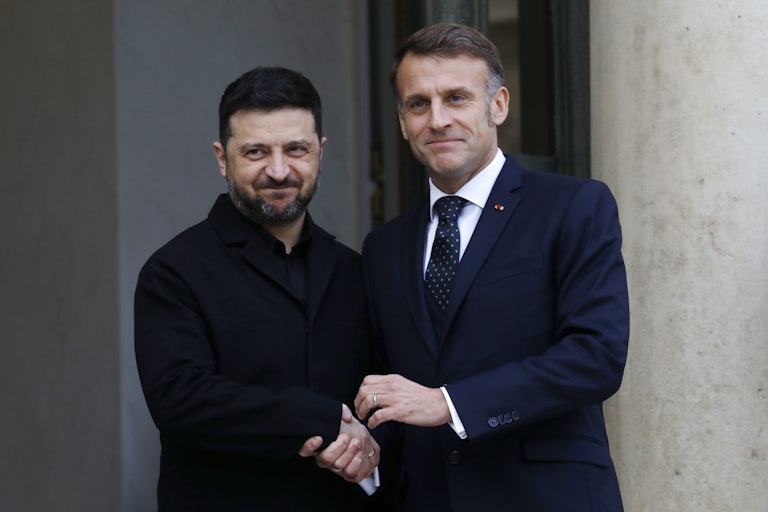
Ukranian President Zelenskiy and French President Macron shake hands.
Antoine Gyori/Corbis/Getty Images

French President Emmanuel Macron warned Ukrainian President Volodymyr Zelenskiy and other European leaders on a phone call that Donald Trump could betray Ukraine.

A transcript of the Monday call to strategize how to protect Ukraine was leaked to the German newspaper Der Spiegel and published Thursday. Macron, Zelenskiy, German Chancellor Friedrich Merz, NATO Secretary General Mark Rutte, Finnish President Alexander Stubb, and other European leaders all took part and discussed U.S. negotiation efforts to end the Russia-Ukraine war.

“There is a possibility that the U.S. will betray Ukraine on the issue of territory without clarity on security guarantees,” Macron said, noting that there was “a big danger” for Zelenskiy. German leader Merz also expressed his misgivings, telling Zelenskiy that Trump’s handpicked negotiators, Jared Kushner and Steve Witkoff, “are playing games with both you and us.”

While European leaders have expressed their concerns about America’s Ukraine policies, this transcript is the clearest indication of how they feel about the Trump administration and its efforts. The Finnish president has gotten along well with Trump in public but still said, “We must not leave Ukraine and Volodymyr alone with these guys,” referring to Witkoff and Kushner.

“I agree with Alexander that we need to protect Volodymyr,” added NATO Secretary General Rutte.

Late last month, the Trump administration presented a 28-point peace plan to resolve the conflict that was considered a Russian “wish list” and appeared to be translated from Russian. Under that plan, Ukraine would give up substantial territory, refrain from joining NATO, and limit the size of its military.

After Ukraine weighed in, a new plan was released with a shortened 19 points, to which Russia has not agreed. But it seems that Europeans are worried about Trump deferring to Russia and abandoning Ukraine, and, based on past events, who can blame them?

Trump Accidentally Lets Slip Plan to Rename Kennedy Center

Donald Trump wants to rename the Kennedy Center after himself after doing everything he could to destroy it.

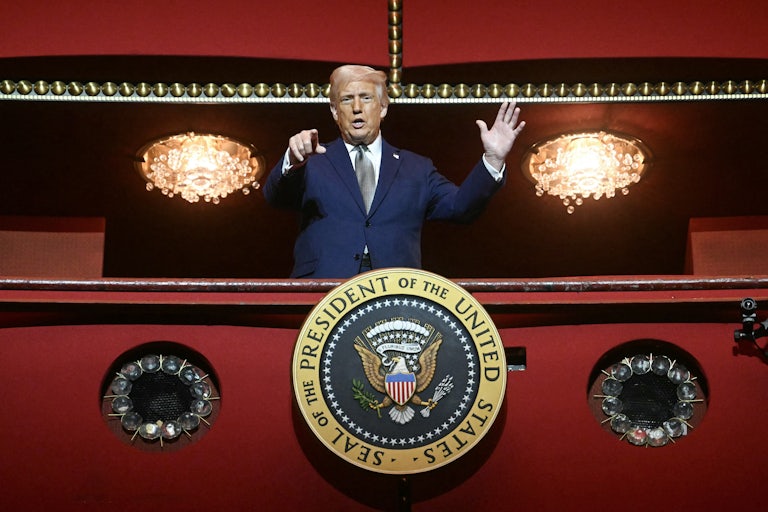
Donald Trump in a Kennedy Center balcony, speaking and pointing at the camera below. The shot makes him seem like a dictator.
JIM WATSON/AFP/Getty Images
Donald Trump at the Kennedy Center in March

President Donald Trump “accidentally” let slip on Thursday the next target for Trumpification: the Kennedy Center.

“You have a big event on Friday at the Trump-Kennedy Center—op, excuse me. The Kennedy Center,” Trump said with a laugh.

“Pardon me, such a terrible mistake,” he continued, grinning.

Trump’s “terrible mistake” came during a speech at the U.S. Institute of Peace for the signing of a peace agreement between Rwanda and the Democratic Republic of Congo. Coincidentally, the Institute of Peace is the latest building that the president has stamped his name on, even in the midst of a legal battle over who owns the building.

The president is gearing up for a big weekend, with the storied arts institution hosting the World Cup draw on Saturday and then the annual Kennedy Center Honors on Sunday. Trump may receive a special peace prize from FIFA Saturday, and is hosting Sunday’s ceremony—after personally taking over the job of selecting the Kennedy Center’s honorees, one usually done by a bipartisan council.

Trump has already brought financial ruin to the Kennedy Center, and is angling to bring aesthetic ruin as well. If he has his way, reputational ruin won’t be far behind.

Trump Is Now Denying Visas to People Who Worked in Content Moderation

If an H-1B visa applicant or one of their loved ones worked in content moderation, such as fact-checking, the State Department has said to consider the application ineligible.

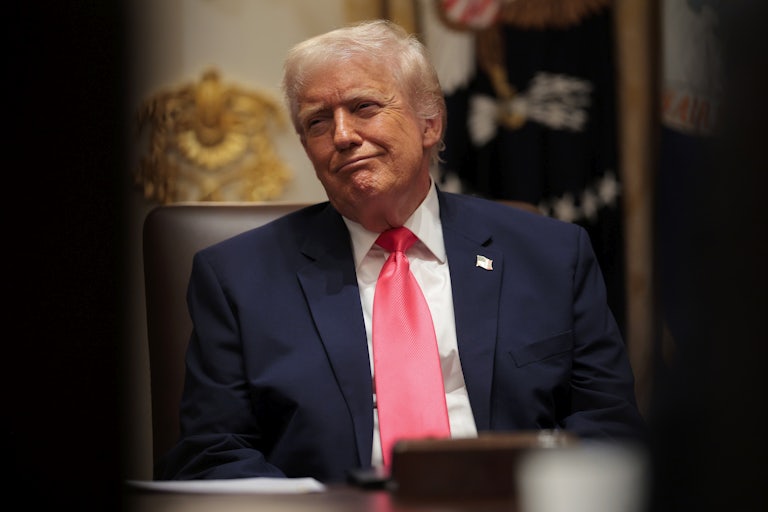
Donald Trump smiles while sitting in a Cabinet meeting
Chip Somodevilla/Getty Images

The Trump administration may revoke H-1B visa eligibility from people who worked in content moderation, fact-checking, and online safety. Their family members would lose visa status as well. 

A cable, dated Tuesday, obtained by Reuters moves U.S. consular officers to increase vetting for these individuals by looking into their résumés and LinkedIn profile pages. 

“If you uncover evidence an applicant was responsible for, or complicit in, censorship or attempted censorship of protected expression in the United States, you should pursue a finding that the applicant is ineligible,” the cable said. This includes working at “social media or financial services companies involved in the suppression of protected expression.”

“You must thoroughly explore their employment histories to ensure no participation in such activities,” the cable read.

The State Department, however, made it sound more like they were going after liberal cyberbullies more than free speech suppressors.

“We do not support aliens coming to the United States to work as censors muzzling Americans,” a spokesperson said. “In the past, the President himself was the victim of this kind of abuse when social media companies locked his accounts. He does not want other Americans to suffer this way. Allowing foreigners to lead this type of censorship would both insult and injure the American people.”  

It’s hard to believe that the State Department is saying that about Donald Trump, who is infamous for his willingness to publicly verbally abuse people online. The policy, however, is very believable, as it aligns with the larger arc of the administration’s free speech suppression efforts, from disappearing Rümeysa Öztürk for writing an op-ed to requiring universities to vet for pro-Palestinian social media posts before awarding student visas.  

Trump Nearly Has a Stroke Trying to Pronounce Names of African Leaders

Donald Trump struggled to pronounce the names of the Rwandan and Congolese presidents.

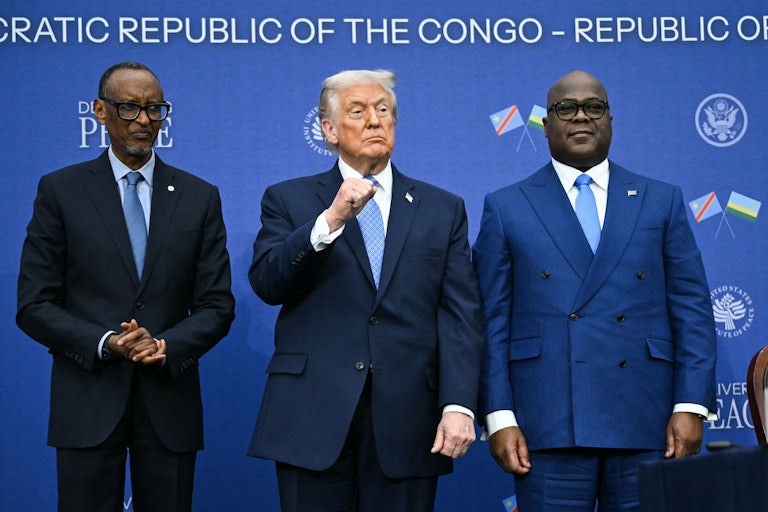
Donald Trump raises his fist while standing in between Rwandan President Paul Kagame and Democratic Republic of Congo President Felix Tshisekedi
ANDREW CABALLERO-REYNOLDS/AFP/Getty Images
Trump with (from left) Rwandan President Paul Kagame and Democratic Republic of Congo President Felix Tshisekedi

Donald Trump insulted the presidents of two countries right before signing a peace deal when he introduced the duo as “courageous leaders”—but couldn’t follow the flattery up with the correct pronunciation of their names.

The U.S. president couldn’t wrap his mouth around the name of Congolese President Felix Tshisekedi or Rwandan President Paul Kagame as the trio met in Washington Thursday to advance a peace deal that could cap 30 years of violence between the brother nations.

“I want to thank the two courageous leaders—they are courageous leaders, they really are courageous leaders, great people. President Ja-secky-theh-eh, of the Democratic Republic of the Congo,” Trump wheezed.

He then introduced Kagame, whose name he spilled out as “President Keh-goo-may.”

Tshisekedi’s name is pronounced Chi-sek-ed-dee. Kagame’s is pronounced Kah-gah-may.

Trump opted to fully skirt attempting Tshisekedi’s name when his speech required it a second time, instead referring to him as “president of DRC.”

It’s far from the first time that Trump has butchered a foreign name. Last month, he messed up the pronunciation of Kazakhstan, a decades-long U.S. ally, while seated right next to the country’s president.

During a White House dinner with Central Asian leaders, Trump claimed that “Ka-ZACK-a-stan” had joined the Abraham Accords, adding a syllable and stressing the wrong one in the country’s name while announcing supposedly new diplomatic ties between Kazakhstan (which is actually pronounced Kahz-uck-stan) and Israel.

And in 2017, Trump famously remarked on the nonexistent country of “Nambia” during a conference with African leaders.

But don’t be fooled: Trump does have a knack for language—so long as it’s the version he made up. When English proves too difficult for the president, he frequently turns to his own inventive terms, such as “bigly” (an abbreviation of big league), “ana-nomish” (an attempt to pronounce anonymous), and “covfefe,” which still no one has been able to decipher.

Trump, 79, Falls Asleep Again During Peace Agreement Signing

Donald Trump was bragging about this Rwanda-DRC peace agreement minutes before he began to doze off.

Donald Trump falls alseep
SAUL LOEB/AFP/Getty Images
Donald Trump at an Oval Office meeting in June

Days after Donald Trump fell asleep during a televised Cabinet meeting, the president on Thursday again dozed off during a ceremony to mark the signing of a peace agreement between Rwanda and the Democratic Republic of the Congo.

Trump was visibly closing his eyes as Rwandan President Paul Kagame spoke from the podium at the ceremony inside the U.S. Institute of Peace building, his hands clasped and his head drooping while he sat at a table to the left. Trump continued to doze after Kagame concluded his remarks and DRC President Félix Tshisekedi made his way to the podium, trying in vain to pay attention to each speaker.

Thankfully for the 79-year-old Trump, the two leaders spoke for less than 15 minutes, much shorter than Tuesday’s two-hour Cabinet meeting. One would think he’d be able to last longer at an event with more press, especially international outlets, at a building that he took over with questionable legality and plastered his name on.

Last week, The New York Times reported about Trump’s physical and mental decline, angering the president. But if he keeps falling asleep during public appearances, he really has nothing to argue about, especially considering the untold reasons why he needed an MRI and extra tests at his last doctor’s visit.

Vance Sent 2:30 a.m. Text as Officials Tried to Cover Up Signalgate

Vice President JD Vance texted the Signal group after all their messages about bombing Yemen were leaked.

JD Vance gives a thumbs up
Brett Carlsen/Getty Images

JD Vance hit up his buddies in the Signal chat used to coordinate bombing Yemen with a late-night plea for companionship—hours after the chat’s existence was revealed to the public by Atlantic editor Jeff Goldberg.

“This chat’s kind of dead,” Vance texted at 2:26 a.m. “Anything going on?”

Screenshot of Signalgate messages on March 25
Department of Defense Inspector General report

A report from the Pentagon inspector general released Thursday reveals new details about what the chat’s members did in the days and hours after March 24, when Goldberg published that Defense Secretary Pete Hegseth had inadvertently texted him classified information about the Trump administration’s war plans.

The vice president’s “u up?”-style message, which we are generously reading as a joke, was sent in the wee hours of the morning of March 25.

Where Vance chose to make light of the possible treason, Treasury Secretary Scott Bessent appeared to have another aim: to cover the group’s tracks. According to the screenshot, Bessent shortened the time it would take for messages to disappear from the chat to eight hours. Goldberg reported that the messages had previously been set to disappear after either one or four weeks, already a potential violation of federal law.

Other officials changed their profile names: Secretary of State Marco Rubio changed his screen name from “MAR” to “MR,” CIA Director John Ratfcliffe shortened his name to simply “John,” and deputy chief of staff Sephen Miller, “S M,” changed his name to “SM 76.”

It’s unclear why these obviously identifiable (and already identified) officials would change their names, or attempt to make their messages disappear faster—the photo of the chat from the report was taken on March 27, leaving only a day for fast-deleting messages to be sent and then erased—but they obviously were scrambling.

Hegseth Gave Signalgate Probe Little as Possible—and Still Got Wrecked

The investigation found that Pete Hegseth’s actions endangered U.S. troops.

Defense Secretary Pete Hegseth sits during an event
HASNOOR HUSSAIN/AFP/Getty Images

The Office of the Inspector General’s Signalgate report is out, and it does not fully exonerate Defense Secretary Pete Hegseth, regardless of his supporters’ claims.

Hegseth overwhelmingly declined to cooperate with the OIG’s report on his early-term scandal, refusing to hand over the personal phone he used to make war plans over Signal and refusing to sit for an interview. Nonetheless, the report found that Hegseth not only violated the DOD’s protocol about using personal devices for sensitive information, he also endangered the lives of American troops in the process.

“We concluded that the Secretary sent sensitive, nonpublic, operational information that he determined did not require classification over the Signal chat on his personal cell phone,” the 84-page report reads.

Hegseth also sent messages on Signal detailing “the quantity and strike times of manned U.S. aircraft over hostile territory” just hours before the strike on the Houthis. “Using a personal cell phone to conduct official business and send nonpublic DoD information through Signal risks potential compromise of sensitive DoD information, which could cause harm to DoD personnel and mission objectives,” the OIG continues.

In his defense, Hegseth claimed in a written statement that his Signal messages contained “non-specific general details which I determined, in my sole discretion, were either not classified, or that I could safely declassify.” And yet one of the messages the IG obtained literally reads, “THIS IS WHEN THE FIRST BOMBS WILL DEFINITELY DROP.” Others include exact timestamps of attacks. That all sounds extremely specific.

“If this information had fallen into the hands of U.S. adversaries, Houthi forces might have been able to counter U.S. forces or reposition personnel and assets to avoid planned U.S. strikes,” the report says. “Even though these events did not ultimately occur, the Secretary’s actions created a risk to operational security that could have resulted in failed U.S. mission objectives and potential harm to U.S. pilots.”

Framing this as a “full exoneration,” of Hegseth, as Pentagon spokesman Sean Parnell did Wednesday, is laughable when the phrase “the Secretary did not comply with” followed by a specific DOD protocol is in the report at least eight different times. And yet Hegseth and the administration are acting as if he is being somehow unfairly attacked for planning a bombing over Signal as the head of the Defense Department. This, frankly, should have been an automatic firing.

Read the full report here.

Republican Senators Question Hegseth’s Future as Outrage Grows

A growing number of top Republicans are refusing to publicly support Defense Secretary Pete Hegseth after that second strike to kill survivors.

Defense Secretary Pete Hegseth speaks to troops.
Tomohiro Ohsumi/Getty Images

After 83 people have lost their lives in dubiously legal boat strikes in the Caribbean, some prominent Republican senators seem to finally be ready to part ways with Defense Secretary Pete Hegseth.

Hegseth’s Pentagon was revealed to have levied a second strike against a boat in September in order to kill two survivors of the first attack. The strike, which could be considered a war crime, may be the last straw for Hegseth.

On Thursday, Republican Senator Roger Wicker, chair of the Armed Services Committee, said he had no problem with Hegseth’s conduct regarding the Signal chat where he inadvertently shared classified information about a military operation to a reporter—but stopped short of backing Hegseth completely.

When asked by CNN reporter Manu Raju if he had concerns about Hegseth’s leadership after a watchdog’s report on Signalgate, Wicker said, “We’re continuing to get the facts, but based on this particular allegation, which is now several months old, I think the secretary is in a pretty good position on that.”

“Do you have confidence in him? Would you say that? Could you say if you do?” Raju asked, as Wicker walked away.

Wicker said nothing, and continued down the hall.

Republican Senator Mike Rounds also stopped short of backing the embattled defense secretary, saying that he needs more information to make a call. “We’ll make our decisions based on the facts of the case; we haven’t got the facts yet in front of us in a classified setting,” he told Forbes reporters on Thursday.

Leading members of the House and Senate Armed Services committees heard testimony Thursday from Hegseth’s chosen scapegoat for the second boat strike, Admiral Frank “Mitch” Bradley. At least one lawmaker left that hearing appalled.

Hegseth has claimed that he was not in the room when the double-tap strike was conducted, but that Bradley was following his orders and acted appropriately.

But Thom Tillis, a key Republican senator, told CNN’s Kaitlan Collins Wednesday that Hegseth simply claiming to be out of the room isn’t enough to exonerate him.

“I’ll take at face value right now what Secretary Hegseth said: He said he wasn’t there, he said he was busy doing other things,” Tillis said. “I would assume a part of the record was—what was the other thing that he was doing that was more important than a battle damage assessment over the first strike in the Caribbean?”

Tillis also stood by his claim that whoever was responsible for the second strike should be out of a job. “If someone knowingly launched a second missile at that boat, which led to the deaths of the other two, then they have to be held accountable and they shouldn’t be in whatever role they’re in,” he told Collins.

What We Know About the Suspect in the January 6 Pipe Bombing Case

The suspect in the 2021 pipe bombing case has been arrested and identified.

Jan. 5 pipe bombing suspect wears a gray hoodie and a face mask and walks in the streets of Washington, D.C. carrying a bag.
Screenshot of surveillance video provided by the FBI

Five years after pipe bombs were found near the Democratic National Committee and Republican National Committee headquarters, the FBI has arrested a suspect.

On Thursday morning, Virginia resident Brian Cole was taken into custody by the bureau and charged with placing the bombs on January 5, 2021, the day before Congress was to certify the 2020 presidential election. Some supporters of Donald Trump, who lost to Joe Biden, had other ideas, mounting a riot and insurrection at the Capitol building.

The bombs were placed between 7:30 and 8:30 p.m. the night before the Capitol insurrection but weren’t discovered until 15 hours later. While the bombs did not detonate, they were viable devices that could have seriously injured or killed bystanders. Multiple conspiracy theories about the bombs have proliferated online, including that they were meant to distract law enforcement from responding to the unrest at the Capitol.

Two people familiar with the arrest told MS NOW that Cole has been linked to statements supporting anarchism, but no motive has yet been determined. Solving the pipe bomb case has long been a fixation of FBI Deputy Director Dan Bongino, even before he was appointed to the bureau. As a right-wing commentator and podcaster, Bongino claimed that the FBI was covering up information about the case.

Others on the right, including current FBI Director Kash Patel, have posited that the bombs were an “inside job,” and last month, a right-wing website claimed the suspect was a Capitol Police officer. The arrest may not put those conspiracy theories to bed, as taking five years to solve a rather important case let them proliferate.

The FBI visited over 1,200 residences and businesses, conducted more than 1,000 interviews, combed through 39,000 video files, and examined over 600 tips about the pipe bombs in its long investigation. Maybe now that a suspect has been arrested, the public will have more answers about one of the darkest days in U.S. history.