Fox News Finally Fact-Checks Trump’s Bizarre Claim About Drug Prices
Donald Trump’s commerce secretary spiraled trying to defend the president’s claims.

The White House has finally been called out for fabricating its pharmaceutical savings—and Commerce Secretary Howard Lutnick did not handle it well.
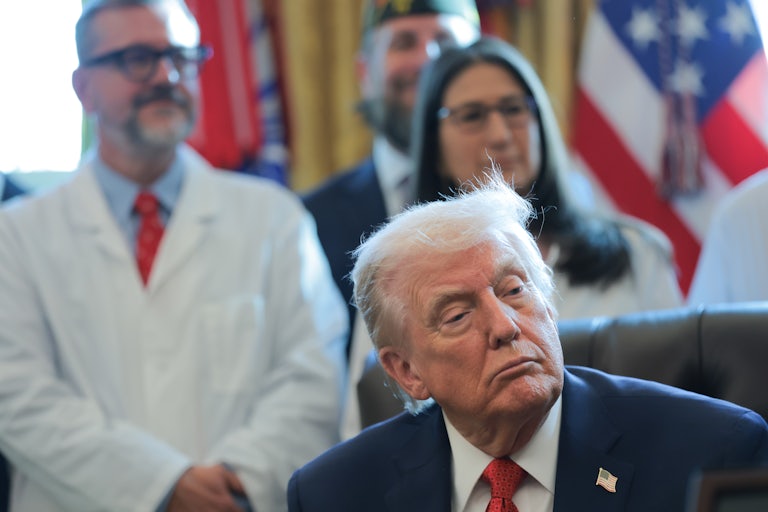
For months, Donald Trump has seemingly grabbed numbers out of thin air to impress an ignorant public—or his sycophantic followers—on his allegedly great pharmaceutical deals, boasting that he has “cut drug prices by 1200, 1300, 1400, 1500 percent.”
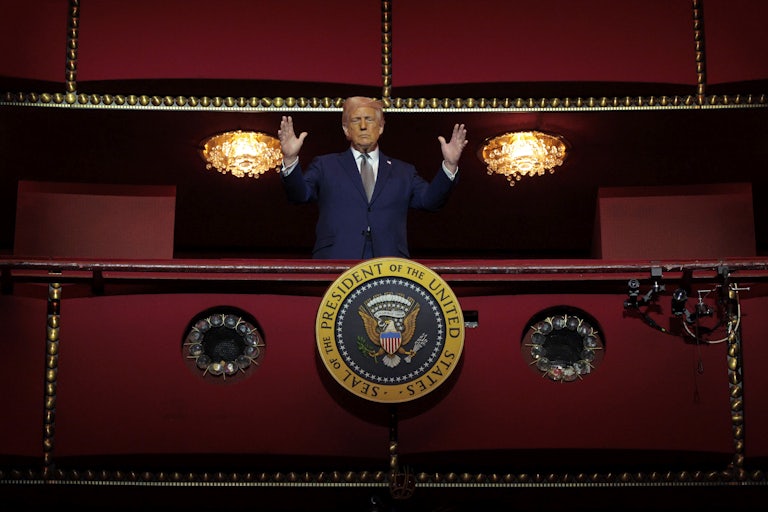
The lie continued on Wednesday night, when Trump said during his national address he had negotiated to cut drug prices by “400, 500, and even 600 percent.”
But Fox News host John Roberts saw through the numerical gibberish, excoriating Lutnick during an interview Thursday and stressing that the math was simply “not possible.”
“Well, if you cut something by 100 percent the cost goes down to zero,” Roberts said. “If you cut it by 4-, 5-, 600 percent, the drug companies are actually paying you to take their product.
“So tell me, how much of last night’s speech was hyperbole and how much was fact?” the host asked.
But Lutnick’s reply didn’t make much sense, either.
“No, what he’s saying is—bringing—if a drug was $100 and you bring the drug down to $13, right? If you’re looking at it from $13, it’s down seven times,” Lutnick said.
“No, it’s not—” Roberts interjected.
“Well, but it’s 700 percent higher price before. It’s down 700 percent now. So, $13 would have to go up 700 percent to get back to the old one. You could say, it’s down 87 percent, or you could say it would have to go up 700 percent to be the same one. So it just depends on the way you look at it,” Lutnick said, before insisting that the American public “all know what he’s saying.”
“We are hammering the price of drugs down,” Lutnick emphasized.
Fox News' host presses Howard Lutnick over Trump's claim that he is cutting pharmaceutical prices by more than 100%:
— The Bulwark (@BulwarkOnline) December 18, 2025
“If you cut something by 100%, the cost goes down to zero. If you cut it by 400% or 500%…the drug companies are actually paying you to take their products.” pic.twitter.com/xVhDwbypje
But the president has not tangibly lowered drug costs. In May, Trump penned an executive order that set a 30-day deadline for drugmakers to negotiate lower prices. If there was no deal, the U.S. would tie its drug prices to the costs set by other countries. But despite that threat, there hasn’t been any noticeable movement in either direction.
In November, the Centers for Medicare & Medicaid Services announced that it had negotiated new prices for 15 expensive drugs covered by Medicare’s prescription drug program, Part D. The negotiations were conducted in the second round of Medicare’s Drug Price Negotiation Program, which was enacted by the previous administration under the Inflation Reduction Act of 2022. Still, the cost of those drugs—which include Ozempic and Wegovy—isn’t expected to decrease until 2027.
Instead, evidence exists that drug prices have actually gone up for some 700 medications during Trump’s second term, according to a September report by the Senate Health, Education, Labor, and Pensions Committee.
Trump has previously posited that the affordable price tags on pharmaceuticals in other countries was due to American federal subsidies, which he claimed were financially offsetting their prices. But that’s not reality: The U.S. pays more for drugs because it’s an outlier among high-income, first-world countries, which predominantly support universal public health coverage.
Potential solutions that researchers argue could meaningfully address high drug prices in the U.S. include restricting pharmaceutical monopolies within the country, reworking insurance benefits to hamper out-of-pocket expenses, and recentralizing price negotiations through the leverage of a single-payer system (such as Australia, Germany, the U.K., or any number of other wealthy nations), according to a report by the Commonwealth Fund, a private American foundation focused on health care reform.