Breaking News
Breaking News
from Washington and beyond

Trump Could Bring About End of NATO With This Move, Danish PM Warns

Donald Trump’s obsession with Greenland is on track to wreck the world order.

Donald Trump speaks into a microphone
Joe Raedle/Getty Images

President Donald Trump’s imperialist warpath may be about to destroy NATO. 

Danish Prime Minister Mette Frederiksen warned Monday that Trump was on course to uproot the 77-year-old defense alliance between the United States and its allies in Europe. 

“I believe one should take the American president seriously when he says that he wants Greenland,” Frederiksen said in an interview. “But I will also make it clear that if the U.S. chooses to attack another NATO country militarily, then everything stops, including NATO and thus the security that has been established since the end of the Second World War.”

Frederiksen’s attempt to raise the stakes of a potential invasion comes as the imperialist fanatics in the Trump administration—emboldened by its large-scale military operation over the weekend to oust Venezuelan President Nicolás Maduro—have turned their attention back to Trump’s holy grail: Greenland. 

When asked by a reporter Sunday whether he had plans to take action on Greenland, Trump laughed. “We’ll worry about Greenland in two months,” he said. 

“We need Greenland from the standpoint of national security. And Denmark is not going to be able to do it, I’m telling you,” he added.  

Frederiksen released a statement that day urging the United States to “cease its threats against a historically close ally,” saying that it “makes absolutely no sense” for the U.S. to take over Greenland.

To be sure, Trump has rarely ever had anything nice to say about the member states of the North Atlantic Treaty Organization, calling them “decaying” nations led by “weak” people. Instead, Trump seems to take his security cues from the Kremlin. His latest effort to carve up the world how he sees fit only further exemplifies how little he cares about keeping U.S. allies.
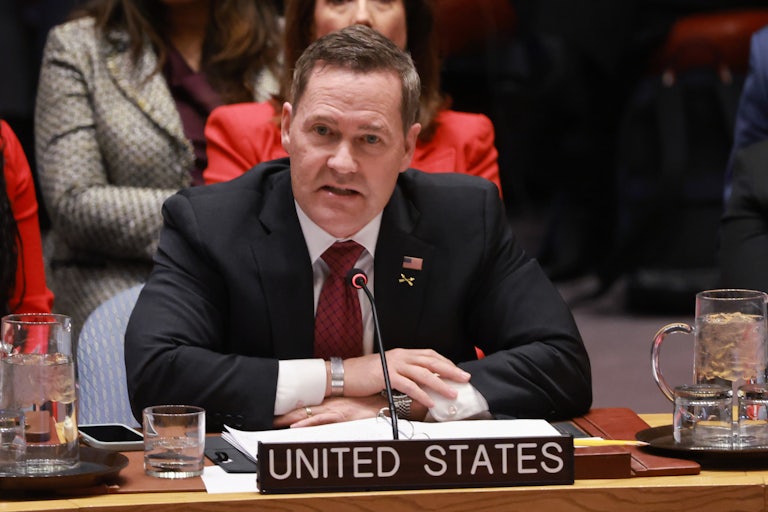
Trump’s U.N. Ambassador Gives Sick Defense of Venezuela Invasion

Mike Waltz says it was our right to invade Venezuela.

Mike Waltz speaks at the U.N. while seated behind the "United States" nameplate.
Spencer Platt/Getty Images

After the United States kidnapped their president and bombed their capital, Ambassador to the U.N. Mike Waltz swears that “there is no war in Venezuela.”

“As Secretary Rubio has said, there is no war against Venezuela or its people. We are not occupying a country. This was a law enforcement operation in furtherance of lawful indictments that have existed for decades. The United States arrested a narco-trafficker who is now going to stand trial in the United States,” Waltz said at an emergency session of the United Nations Security Council on Monday.

If this was just a simple “law enforcement operation,” then why the bombs? Why would the Trump administration consult U.S. oil companies prior to the kidnapping of Maduro? Why would Trump say outright that the U.S. will be running Venezuela?

The indictment Waltz refers to claims that Maduro allowed “cocaine-fueled corruption to flourish for his own benefit, for the benefit of members of his ruling regime, and for the benefit of his family members” and “provided Venezuelan diplomatic passports to drug traffickers and facilitated diplomatic cover for planes used by money launderers to repatriate drug proceeds from Mexico to Venezuela.” Venezuela does not play a major role in trafficking drugs to the United States—and the indictment says nothing about fentanyl, the primary cause of U.S. deaths by overdose.

In his speech, Waltz also emphasized oil, likely the real priority of the Trump administration in this escalation of aggression against Venezuela—not fighting for democracy or stopping drug trafficking.

“You cannot continue to have the largest energy reserves in the world under the control of adversaries of the United States.”

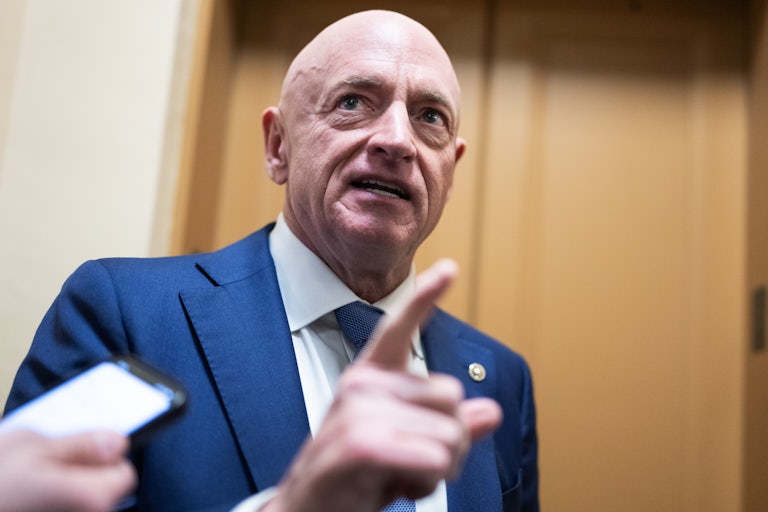
Pete Hegseth Finds New Way to Bully Mark Kelly Over Message to Troops

The defense secretary is still furious that Kelly told troops to follow the law.

Senator Mark Kelly gestures while speaking to reporters in the Capitol
Tom Williams/CQ-Roll Call, Inc/Getty Images

Pete Hegseth has finally figured out how to extract his petty payback on Senator Mark Kelly: going after his pension.

The defense secretary announced Monday that he’d initiated a Grade Determination Review following Kelly’s appearance in a video alongside fellow Democratic lawmakers to urge members of the U.S. military and intelligence community not to follow illegal orders.

Hegseth said the so-called Department of War would take “administrative action” against Kelly by reducing his military retirement grade, “resulting in a corresponding reduction in retired pay.”

Kelly slammed the Trump administration’s latest tactic to go after its critics. “Pete Hegseth wants to send the message to every single retired service member that if they say something he or Donald Trump doesn’t like, they will come after them the same way. It’s outrageous and it is wrong,” the Arizona Democrat said in a statement Monday. “There is nothing more un-American than that.”

A Grade Determination Review, or GDR, is the process by which the military assesses misconduct or poor performance to determine military retirement benefits, which are calculated based on the highest grade satisfactorily held.

A GDR typically occurs at the time of retirement and is a review of conduct during service—not after. Reviews are typically triggered by administrative disciplinary actions, poor performance evaluations, and criminal behavior or violations of the Uniform Code of Military Justice. In response to Hegseth’s previous threats to court-martial Kelly, a former astronaut and U.S. naval officer, military experts have argued that Kelly was speaking in his role as a civilian senator and had not violated any law.

Hegseth seemed to think he could get around this by issuing a formal Letter of Censure documenting Kelly’s “reckless misconduct” to be “placed in Captain Kelly’s official and permanent military personnel file.”

Hegseth said he would personally oversee the GDR, which would be completed within 45 days.

“Captain Kelly’s status as a sitting United States Senator does not exempt him from accountability, and further violations could result in further action,” Hegseth wrote, claiming yet again that the Arizona lawmaker had violated the military’s rules and committed conduct that “was seditious in nature.”

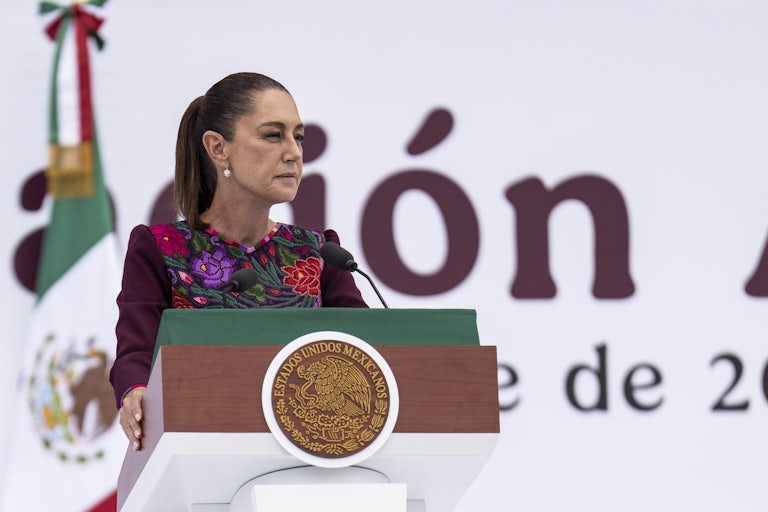
Mexican President Slams Trump After He Threatens to Invade Them Next

Claudia Sheinbaum is condemning Trump’s operation in Venezuela—and his threat to intervene in Mexico.

Mexican President Claudia Sheinbaum speaks at a podium.
Cristopher Rogel Blanquet/Getty Images

Mexican President Claudia Sheinbaum has condemned President Trump’s kidnapping of Venezuelan President Nicolás Maduro and his threat to take over her country next. 

“We categorically reject intervention in the internal matters of other countries,” Sheinbaum said at her press conference on Monday. “It is necessary to reaffirm that in Mexico the people rule, and that we are a free and sovereign country—cooperation, yes; subordination and intervention, no.” 

Trump has threatened to both bomb and/or invade Mexico multiple times in his first year back in office, and he reiterated those points this weekend.

“The cartels are running Mexico, [Sheinbaum’s] not running Mexico.…  We have to do something,” he said on Fox News. Trump also threatened the sovereignty of Greenland, Cuba, Columbia, and Iran, naming them as potential next targets in his press conference on Saturday. 

Even still, Sheinbaum seems confident that the United States will not escalate. 

“I don’t believe in an invasion; I don’t even think it’s something they’re taking very seriously,” she said. “On several occasions, he has insisted that the U.S. Army be allowed to enter Mexico. We have said no very firmly—first because we defend our sovereignty, and second because it is not necessary.”

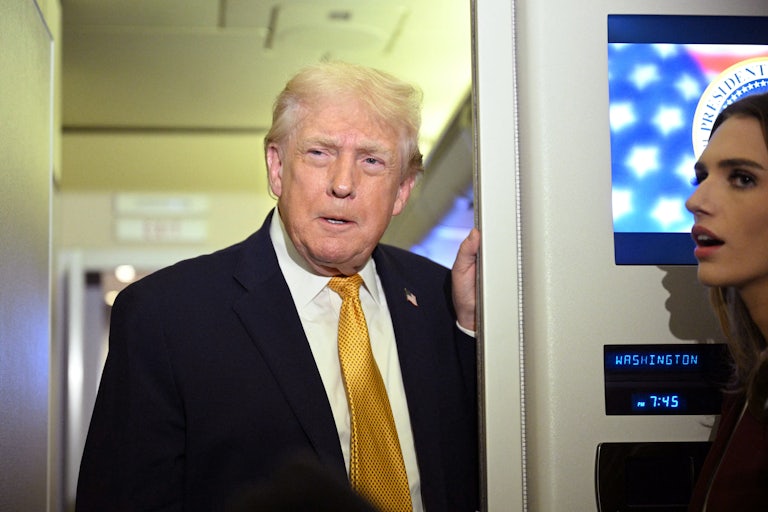
Trump Goes on Wild Spree of Threats Against Rest of the World

Donald Trump warned that Venezuela is just the start.

Donald Trump speaks to reporters on Air Force One
Jim WATSON/AFP/Getty Images

It seems that attacking Venezuela was just the beginning for President Donald Trump.

Speaking to reporters on Air Force One Sunday, Trump couldn’t stop musing about ordering more large-scale military strikes on various countries—including some U.S. allies—following America’s military operation to kidnap Venezuelan President Nicolás Maduro.

So how many countries are at risk of imminent attack from the power-mad U.S. president? At least five—but probably more. 

Trump began by turning his attention to Venezuela’s neighbor. “Colombia is very sick too. Run by a sick man, who likes making cocaine and selling it to the United States. And he’s not going to be doing it very long, let me tell you,” Trump said.

“What does that mean, ‘He’s not going to do it very long’?” one reporter asked.

“He’s not doing it very long. He has cocaine mills and cocaine factories; he’s not going to be doing it very long,” Trump replied.

“So there will be an operation by the U.S. in Colombia?” the reporter pressed.

“Sounds good to me,” the president replied. 

Trump has steadily increased tensions with Colombia, accusing President Gustavo Petro of being “an illegal drug leader,” targeting boats departing its shores, and cutting all U.S. aid to the country. Petro, for his part, has hit back, comparing Trump to Hitler.

Shortly afterward, Trump also floated a possible strike on Iran when a reporter mentioned the widespread protests there. “We’ll take a look, we’re watching it very closely. If they start killing people like they have in the past, I think they’re going to get hit very hard by the U.S.,” the president said

Trump then laughed at a reporter who asked if the president had any plans to take action on Greenland. “We’ll worry about Greenland in two months. We’ll worry about Greenland in 20 days,” he said.

Trump noted that the massive island was “covered in” Russian and Chinese ships. “We need Greenland from the standpoint of national security. And Denmark is not going to be able to do it, I’m telling you,” he said.  

Trump’s efforts to take over Venezuela have reignited right-wing fervor for the United States to claim Greenland, sparking Danish Prime Minister Mette Frederiksen to hit back once again at Trump’s repeated threats to annex the territory. 

Trump then turned his attention to his more immediate targets. “Cuba is ready to fall,” he said, claiming that the country had previously received “all of their income from Venezuela.”

“You have to do something with Mexico,” Trump continued. “Mexico has to get their act together, because they’re pouring through Mexico and we’re gonna have to do something. We’d love Mexico to do it, they’re capable of doing it, but unfortunately the cartels are very strong in Mexico.” 

But Trump wasn’t finished. He even went so far as to threaten a second strike against Venezuela “if they don’t behave,” and said that there could be U.S. troops on the ground depending on what the new administration—“if you want to call them that”—decided to do.

Trump Snubs Top Venezuelan Opposition Leader for the Pettiest Reason

Trump is leaving María Corina Machado out of the Venezuela transition plan because he still has a grudge over the Nobel Prize.

People hold up a painting of Venezuelan opposition leader Maria Corina Machado as well as a Venezuelan flag.
Cristobal Olivares/Bloomberg/Getty Images
An image of Venezuelan opposition leader María Corina Machado at a celebration in Santiago, Chile, on January 3

It seems that Venezuelan opposition leader María Corina Machado dedicated her Nobel Peace Prize to President Trump for nothing.

After Trump’s kidnapping of Venezuelan President Nicolás Maduro and his wife, many looked to Machado as the clear option to fill the vacancy, due to both her work promoting democracy in Venezuela and her close relationship with the Trump administration—most evident in her Peace Prize dedication. But over the weekend, Trump stated that the United States would “run” Venezuela and that he had not been in contact with Machado, even claiming that she didn’t have “the respect within the country” to lead.

“She’s a very nice woman, but she doesn’t have the respect,” he told reporters then.

This snubbing is reportedly a result of Machado not outright refusing the award, which Trump also wanted. Two sources close to the White House told The Washington Post that her decision to accept the Nobel Prize, even despite dedicating it to Trump, set the U.S. president off, leading to this current petty grudge.

“If she had turned it down and said, ‘I can’t accept it because it’s Donald Trump’s,’ she’d be the president of Venezuela today,” one said.

Marco Rubio Crashes and Burns Defending Trump’s Plan to Run Venezuela

What legal authority does the U.S. have to run another country?

Donald Trump gestures and speaks at a podium while Secretary of State Marco Rubio stands behind him
Nicole Combeau/Bloomberg/Getty Images

Secretary of State Marco Rubio couldn’t provide a single legal rationale for President Donald Trump’s plan to put himself in charge of Venezuela.

Rubio flailed Sunday during an appearance on ABC’s This Week, when host George Stephanopoulos asked him under what legal authority Trump intended to “run” Venezuela.

“Under—well, first of all, what’s gonna happen here is that we have a quarantine on their oil. That means their economy will not be able to move forward until the conditions that are in the national interest of the United States and the interests of Venezuelan people are met. And that’s what we intend to do,” Rubio replied.

He continued to rant that he was “hopeful” this plan would lead to “positive results,” meaning a Venezuela that was not a “narco-trafficking paradise” and had an oil industry “where the wealth goes to the people, not to a handful of corrupt individuals.”

Unfortunately for Rubio, the question hadn’t been, “What are your hopes and dreams?”

“Let me ask the question again,” Stephanopoulos pressed. “What is the legal authority for the United States to be running Venezuela?”

“Well, I explained to you what our goals are and how we’re going to use the leverage to make it happen,” Rubio said. “As far as what our legal authority is on the quarantine are very simple. We have court orders. These are sanctioned boats. And we get orders from courts to go after and seize these sanctions.”

“So, is the United States running Venezuela right now?” Stephanopoulos asked.

“What we are running is the direction that this is gonna move moving forward, and that is we have leverage,” the secretary replied.

Rubio’s mealymouthed answer seemed to suggest that the Trump administration doesn’t plan to produce any legal authority for its reign in Venezuela but instead use sanctions as soft power. However, this explanation completely ignores the fact that the Trump administration just executed a large-scale military operation—without the permission of Congress—to kidnap Nicolás Maduro and is still threatening more strikes on the country.

Shortly after the strike, Trump said he intended for the United States to manage Venezuela “until such time as we can do a safe, proper and judicious transition” of power. Speaking to reporters on Air Force One, Trump confirmed Sunday that the U.S. was currently “in charge” of the South American country.

You Won’t Believe Who Trump Told About Venezuela Attack Ahead of Time

Here’s a hint: it wasn’t Congress.

Donald Trump walks outside the White House
Aaron Schwartz/CNP/Bloomberg/Getty Images

No, President Donald Trump didn’t tell Congress before launching a large-scale operation to attack Venezuela and kidnap its president—but he did tell someone.

Speaking to the president on Air Force One Sunday, one reporter asked whether Trump had looped in U.S. oil companies to his plans to oust Nicolás Maduro by force.

“Did you speak with them before the operation took place?” the reporter asked.

“Yes,” Trump replied.

Did you maybe tip them off about what was gonna—?” the reporter continued.

“Before and after. And they want to go in, and they’re gonna do a great job for the people of Venezuela,” the president said. “And they’re gonna represent us well.”

Trump seemed to have no reservations about revealing that his government isn’t a democracy at all—it’s an oligarchy, where companies come first and his constituents don’t matter whatsoever. U.S. oil companies are already cashing in on his brazen constitutional violation.

Shortly after the military operation in Venezuela took place, Trump made clear his intention for oil companies to “go in, spend billions of dollars, fix the badly broken infrastructure, the oil infrastructure, and start making money for the country.” Trump has insisted that “the money coming out of the ground is very substantial,” but it seems that rebuilding the country’s oil industry won’t be cheap or easy.

Not only did Trump not receive authorization from Congress before launching the strike, but Democratic lawmakers now allege that Secretary of State Marco Rubio intentionally misled lawmakers about the administration’s intentions to do so.

Trump Declares U.S. Will Run Venezuela After Regime Change

U.S. oil companies will also be a big part of the transition in Venezuela, President Trump announced. Sound familiar?

Trump speaks at the presidential podium while CIA Director John Ratcliffe, Secretary of State Marco Rubio, Defense Secretary Pete Hegseth, and Chairman of the Joint Chiefs of Staff General Dan Caine stand behind him in a row.
Jim WATSON/AFP/Getty Images
President Donald Trump, alongside CIA Director John Ratcliffe, Secretary of State Marco Rubio, Defense Secretary Pete Hegseth, and General Dan Caine, chairman of the Joint Chiefs of Staff, speaks to the press following U.S. airstrikes in Venezuela, at Mar-a-Lago, on January 3.

After bombing Venezuela and kidnapping President Nicolás Maduro and his wife in the middle of the night, President Trump has declared that he will “run the country” in the meantime.

“We’re going to run the country until such time, as we can do a safe, proper, and judicious transition,” Trump said at a press conference on Saturday. “So we don’t wanna be involved with having somebody else get in, and we have the same situation that we have for the last long period of years. So we are going to run the country.”

Trump also dedicated a significant portion of the presser to discussing the future of U.S. oil companies in Venezuela, which has the largest oil reserves on the planet. “As everyone knows, the oil business in Venezuela has been a bust, a total bust, for a long time,” he said. “We’re going to have our very large United States oil companies, the biggest anywhere in the world, go in, spend billions of dollars, fix the badly broken infrastructure … and start making money.

Could you imagine if another country sent a team of special agents to kidnap President Trump and his wife Melania from the White House while they slept? And then went on air the next morning saying they’d plug and play someone else as president?

That someone else could very well be María Corina Machado, Venezuelan opposition leader and Nobel Prize winner who has already displayed her eagerness to serve Trump and the U.S. agenda. For now, Trump hasn’t yet signed off.

Was Someone Insider Trading Right Before Trump’s Attack on Venezuela?

A new account on Polymarket was very lucky with some perfectly timed Venezuela bets.

Polymarket on a smartphone
Gabby Jones/Bloomberg/Getty Images

A suspicious new user on the prediction market Polymarket just made bank on the Trump administration’s military strikes on Venezuela.

The account, which was created on December 27, has only bet on two things: the U.S. invading Venezuela, and its president, Nicolás Maduro, being forced out of leadership by January 31. The user bet $35,000 when the market estimated the probability of intervention in Venezuela at only 6 percent.

Thanks to their very lucky bets, they made over $400,000 in less than a day.

Screenshot of Polymarket account and Venezuela bets
Polymarket/Screenshot

The timing of the account’s bets—and its creation—is certainly suspicious. According to reports, U.S. military officials initially discussed bombing Venezuela on Christmas Day, but reversed course after deciding to pursue airstrikes against ISIS in Nigeria instead. In the days following Christmas, officials held off on the attacks due to the weather.

Trump announced his strikes on Venezuela, and his abduction of Maduro and his wife, early Saturday morning. While he did a good job at keeping the attack from being leaked to the media, it seems someone on his team had no problem leaking the news to Polymarket—and making themselves quite a bit richer in the process.