Breaking News
Breaking News
from Washington and beyond

Maine Governor Suspends Senate Campaign Due to Lack of Funds

Janet Mills has trailed behind Graham Platner in the polls—and apparently also in fundraising.

 stands in partial profile to the camera during a campaign event
Sofia Aldinio/Bloomberg/Getty Images
Maine Governor Janet Mills

Maine Governor Janet Mills withdrew her campaign to represent the state in the U.S. Senate on Thursday.

Mills was the establishment Democratic favorite to replace Senator Susan Collins, a Republican who has held the seat since 1997. But she severely lagged in the polls behind progressive candidate Graham Platner.

In a statement released Thursday, Mills explained that her exit from the race boiled down to basic resources, specifying that she lacked the campaign funds to continue campaigning.

“While I have the drive and passion, commitment and experience, and above all else—the fight—to continue on, I very simply do not have the one thing that political campaigns unfortunately require today: the financial resources,” Mills said. “That is why today I have made the incredibly difficult decision to suspend my campaign for the United States Senate.”

Mills’s late entrance into the race last year hampered her fundraising abilities, and raised questions about her hunger to represent Maine in Washington. Within the first three months of 2026, Mills had raised just $2.7 million, a paltry sum for an establishment favorite expected to have the party’s wealth behind her. Mills’s fundraising efforts were eclipsed by Platner’s campaign, which raised $4.6 million in the same period.

Her withdrawal is a stunning loss for the national Democratic Party, not only as a sign of her waning popularity within the state, but also for the waning popularity of the national establishment that endorsed her.

For nearly two decades, New York Senator Chuck Schumer has selected the party’s Senate candidates with little opposition. That is no longer the case. Schumer’s political apparatus also faces contention in the midwest, where his preferred Senate candidates are facing tough primary competition in Iowa, Michigan, and Minnesota.

The race to contest Maine’s Senate seat has also sparked a debate on age, challenging ideas about which generation of candidates should be representing the breadth of America. Platner, a Marine and Army veteran-turned-oyster farmer, is 41 years old. Mills, who has represented the Pine Tree State since the 1980s, is 78.

This story has been updated.

Amid All the Other Chaos, Congress Focuses on a Hasan Piker Bill

A Democrat and Republican representative have decided this is the appropriate use of taxpayer resources in this current moment.

Hasan Piker
Noushad Thekkayil/NurPhoto/Getty Images

Despite all of the other issues in the country, Congress wants to waste its time on a bill condemning Hasan Piker.

Democratic Representative Josh Gottheimer and Republican Mike Lawler on Wednesday introduced a resolution to target “the rise of antisemitic, hate-filled rhetoric disseminated by prominent online personalities, including Hasan Piker and Candace Owens, and calling on social media platforms and public leaders to take stronger action against hate.”

“Piker has openly applauded Hamas’ terrorism, downplayed the mass rape of civilians on October 7th, and dehumanized Orthodox Jews as ‘inbred,’” Lawler said in a statement, taking many of those statements out of context. “Owens has trafficked in vile conspiracy theories, promoted blood libels, and platformed Holocaust deniers. With an audience of millions, they have a responsibility to confront hatred and bigotry in every form, not to amplify it to the masses. So if they won’t call it out, I will.

“I get that speaking up is not easy,” Gottheimer said. “But our constituents didn’t elect us to always take the easy path. That’s what principled leadership is all about.”

Piker, who has built a large following as a left-wing influencer on the Twitch streaming platform, has come under fire from pro-Israel advocacy groups like AIPAC as well as centrist organizations like Third Way for alleged antisemitic rhetoric in his anti-Zionist, pro-Palestinian advocacy, despite his repeated condemnations of attacks on Judaism and the Jewish people. Owens, while criticizing Israel from the right, has engaged in openly antisemitic rhetoric, such as, “Jewish people control the media.”

Regardless, amid a war with Iran, a struggling economy, and numerous other legislative priorities in Congress, a symbolic resolution attacking two influencers can hardly be seen as a bipartisan priority for Congress. The resolution is not likely to deter any bigotry, either.

Trump Admits He’s Not Sure James Comey Was Trying to Kill Him

The confession undermines the Justice Department’s entire indictment against the former FBI director.

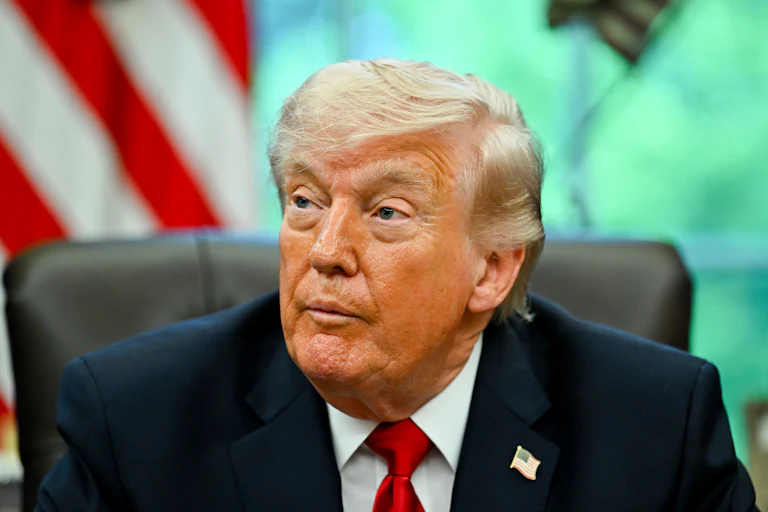
Donald Trump in the Oval Office of the White House
Graeme Sloan/Bloomberg/Getty Images

President Donald Trump’s indictments against his perceived political enemies are getting so flimsy, even he’s not sure he believes in them.

On Wednesday, CNN’s Kaitlan Collins asked Trump about the Department of Justice’s most recent target: former FBI Director James Comey, whom Trump already tried and failed to throw in jail last year. (That case was thrown out after the courts discovered Trump’s prosecutor had been illegally appointed. Brilliant move, Mr. President.)

This recent indictment is built on a photo Comey posted on Instagram last year, in which seashells on a beach were arranged to write out “86 47.” The term “86” is often used in the restaurant industry to get rid of or cancel a dish, so the DOJ is jumping to the very reasonable conclusion that this constituted a threat to Trump’s life.

Collins asked Trump whether he actually thought Comey was threatening his life with the post.

“Well if anybody knows anything about crime, they know ‘86,’” Trump said. “It’s a mob term for ‘kill ’em.’ You ever see the movies? … I think of it as a mob term. I don’t know.”

Trump then began talking about mobsters before Collins wisely cut him off: “Do you really think your life was in danger?”

“Probably, I don’t know,” Trump replied. “People like Comey have created tremendous danger, I think, for politicians and others. You know, Comey is a dirty cop. He’s a very dirty cop. He cheated on the elections.”

Entertaining as Trump’s rambling monologues are, “Probably, I don’t know,” isn’t going to hold up in court. Comey can very easily defend himself by arguing his seashell art just meant he wanted to be rid of the president.

Even some congressional Republicans have expressed reservations about the Comey indictment, as it becomes clear average Americans care little about Trump’s revenge tour. North Carolina’s Thom Tillis, who serves on the Senate Judiciary Committee, expressed skepticism that the Comey case held water.

“I’ve used ‘86’ a lot of times,” Tillis told The Washington Post. “I’ve never said it with the intent of killing somebody.”

Representative Troy Nehls called the case “a stretch,” adding, “you can indict anybody for anything.”

Hegseth’s Own Words on Illegal Military Orders Come Back to Bite Him

Pete Hegseth accused a Democratic representative of making a “partisan point.” Then she revealed whom she was quoting.

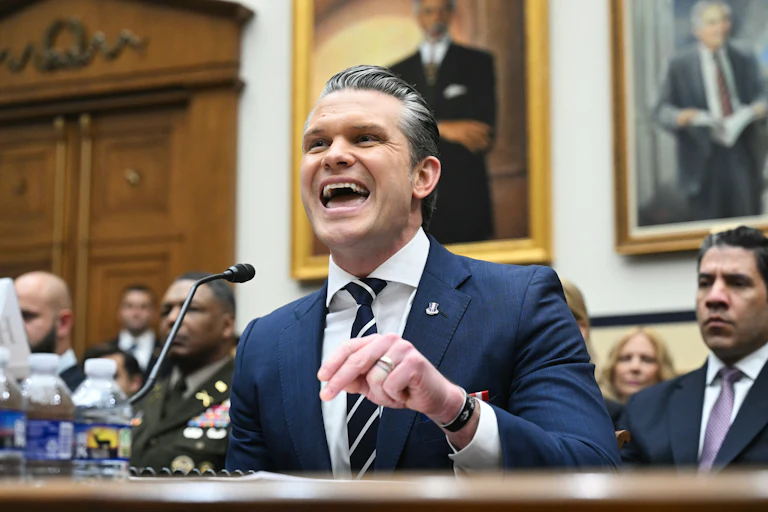
Defense Secretary Pete Hegseth gestures and speaks during a House committee hearing
Kevin Dietsch/Getty Images

Defense Secretary Pete Hegseth’s blind loyalty to the Trump administration has put him at odds with his own beliefs.

During a House Armed Services Committee hearing Wednesday, New Hampshire Representative Maggie Goodlander asked Chairman of the Joint Chiefs of Staff Gen. Dan Caine if he agreed with a statement that America’s “military won’t follow unlawful orders.” Without hesitation, Caine answered: “I do.”

Hegseth, however, was quick to pick a bone with the benign principle—an inclination that immediately morphed into a liability for the Pentagon chief as he tripped over what turned out to be a quote from his own mouth.

“Mr. Hegseth, do you agree with that statement?” asked Goodlander.

“I do, but understand what you’re insinuating is a partisan point,” said Hegseth.

“I’m not, I’m actually quoting you directly, Mr. Hegseth, from April 12, 2016, and I appreciate that on the record you’ve clarified this important principle,” Goodlander said.

At the time, Hegseth had told an audience that he believed there “had to be consequences for abject war crimes.”

“That’s why the military said it won’t follow unlawful orders from their commander-in-chief. There’s a standard, there’s an ethos. There’s a belief that we are above so many things that our enemies or others would do,” Hegseth said in footage uncovered by CNN.

But Hegseth’s belief system has obviously morphed in the decade since. Last November, six Democratic members of the House and Senate—a coalition of veterans and former national security professionals that included Goodlander and Senator Mark Kelly—urged U.S. service members not to “give up the ship.”

In a video statement posted to Facebook, the bloc repeated that America’s military and intelligence communities “can” and “must … refuse illegal orders,” echoing Hegseth’s prior remarks. They made no reference to disobeying the Trump administration directly, only reminding people to uphold the Constitution.

The White House did not take the missive in stride. Instead, Donald Trump called for the coalition’s execution, writing on Truth Social that their behavior was “punishable by DEATH!”

Hegseth then attempted to censure Kelly, claiming that the retired U.S. Navy captain should not be afforded the same First Amendment protections as the general population. A judge did not agree, and the case was tossed in February.

Hegseth Accuses Troops of Lying as He’s Faced With Facts on Iran War

Defense Secretary Pete Hegseth couldn’t explain why his version of events doesn’t line up with that of troops in the Middle East.

Defense Secretary Pete Hegseth testifies in Congress, speaking animatedly
SAUL LOEB/AFP/Getty Images
Defense Secretary Pete Hegseth testifies before the House Armed Services Committee, on April 29.

Defense Secretary Pete Hegseth is continuing to lie about an Iranian drone strike that killed six U.S. service members in early March, and now he’s lashing out at the survivors of the blast too.

After the missile struck the troop base, the defense secretary minimized the incident, calling the missile a “squirter” that “happened to hit a tactical operations center that was fortified.”

But a month later, multiple anonymous survivors of the blast talked to CBS, and claimed Hegseth was fibbing. As Representative Pat Ryan of the House Armed Services Committee put it on Wednesday:

One of our surviving soldiers told CBS “painting a picture that one squeaked through is a falsehood.” Another said the unit was “unprepared to provide any defense for itself. It was not a fortified position.” Another survivor said the building’s protection “was about as weak as one gets.” Secretary Hegseth, that is obviously a direct contradiction of what you said from the Pentagon podium the next day. Are you saying these soldiers, our soldiers, who survived this horrific attack, are lying?

Hegseth dodged the question. “Before the commencement of the conflict, we put in maximum defensive posture—”

“That’s a direct contradiction to what they said,” Ryan replied.

“Can I speak, or are you just going to monologue falsehoods all over the place?” Hegseth said.

“It’s not a falsehood.”

“We moved 7,500 troops off of the—”

“Reclaiming my time. Stop! … I’m reclaiming my time on behalf of these survivors. You just said what they said is a falsehood.”

“There’s a much larger picture at play here,” Hegseth tried to argue, speaking about the efforts of the U.S. to move troops to safety in the region. “We knew there could be a tragic moment where one could get through. Of course, that’s the consequence of conflict.”

Ryan pointed out he still hadn’t answered the question.

“Don’t play games with raising your voice and pointing your finger,” Hegseth said.

“I’m not playing games,” Ryan replied. “I want to finish with one more quote from a survivor.… ‘Telling the truth is important. And we’re not going to learn from these mistakes if we pretend these mistakes didn’t happen. Secretary Hegseth, those soldiers hold the truth. Those soldiers are braver than you are. They are asking for accountability, and they deserve accountability. I’m asking for the same.”

Hegseth’s lies about attacks on U.S. troops should be a massive story, similar to how the Pentagon is reportedly covering up recent casualties in the Middle East. But with all the madness in the world right now, it’s easy to get distracted by whatever scandal pops up next. Kudos to Ryan—a veteran himself—for bringing the incident back to light.

Trump Tries to Goad Artemis II Astronauts Into Bashing NATO With Him

The astronauts appeared stunned as Donald Trump complained about NATO.

Donald Trump speaks while sitting at his desk in the Oval Office. He is flanked by the astronauts from the Artemis II mission.
Andrew Harnik/Getty Images

The crew of NASA’s Artemis II visited the White House Wednesday to celebrate their successful mission around the moon, but they ended up roped into one of the president’s diatribes against NATO.

The astronauts were visibly uncomfortable flanking Donald Trump behind the Resolute Desk as he tossed questions their way regarding the country’s participation in the strategic alliance.

“What do you think of that, Jared? Sending help after we win the war?” Trump said, turning to address NASA administrator Jared Isaacman (Isaacman is the third administrator of the agency since January 2025).

Trump then looked behind him, waving his open hand at the astronauts.

“I don’t want to get you guys involved, but I can imagine what you’re thinking,” Trump chortled.

But no one at the desk was laughing with him. Instead, the astronauts looked pained:  grimacing, pursing their lips, and turning away from the president as he continued to take questions from reporters.

Trump has long criticized America’s membership in the international military alliance. He regularly baselessly insists that other members have failed to pay their dues and argues that the U.S. has been shortchanged by other NATO countries, even though that’s not how the alliance operates.

The Cold War–era organization has “no ledger that maintains accounts of what countries pay and owe,” according to former Obama staffer Aaron O’Connell, who explained to NPR in 2018 that “NATO is not like a club with annual membership fees.”

Nonetheless, Trump has continued to verbally attack America’s closest allies, accusing NATO members of being “cowards” and “terrible” for refusing to assist in his blockade of Iran’s Strait of Hormuz. 

On Tuesday, King Charles of Britain spoke before a joint session of the U.S. Congress, compelling the American people—and their representatives—to support the NATO alliance. In doing so, the king reminded the country that there has only ever been one time in history when NATO’s Article 5 has been invoked: the global mobilization to support America in its military offensive against Afghanistan after 9/11.

Despite the king’s heavy messaging, Trump told reporters Wednesday that he “loved the speech,” though he specified that his opinion on NATO—and America’s potential withdrawal—was unchanged by the royal’s remarks.

It is unclear who in the Western world benefits from the dissolution of NATO. John Bolton, Trump’s first-term national security adviser and a policy hawk who also served under Ronald Reagan’s administration, has said that the consequences of exiting the alliance could be dire. America’s withdrawal from the pact could effectively be the death of NATO, leaving behind a fractured and significantly weakened European alliance, while devastating America’s international credibility as an ally.

Ted Cruz Slams Trump’s FCC for Operating as “Speech Police”

Even Ted Cruz thinks Trump’s FCC is crossing the line following that Jimmy Kimmel joke.

Senator Ted Cruz
Tom Williams/CQ-Roll Call, Inc/Getty Images

Senator Ted Cruz is defending late-night talk show host Jimmy Kimmel and his employer, Disney, from the Federal Communications Commission.

The Texas Republican blasted the agency’s decision to demand an early review of Disney’s broadcast licenses following a joke Kimmel told on TV about first lady Melania Trump last week where he said she would “glow like an expectant widow” at the White House Correspondents’ Dinner. Days later, a gunman tried to attack the event but was apprehended by the Secret Service.

“It is not government’s job to censor speech, and I do not believe the FCC should operate as the speech police,” Cruz said to Punchbowl News Tuesday.

Earlier that day, the FCC directed Disney’s eight ABC TV stations to file for early renewal for their broadcast licenses, to determine whether it potentially violated the agency’s “prohibition on unlawful discrimination.”

Weeks ago, FCC Commissioner Brendan Carr said that Disney’s licenses could be in jeopardy over the company’s alleged efforts on diversity, equity, and inclusion. But the timing of the commission’s latest demand is suspect, considering that President Trump, Melania Trump, and other administration officials all attacked Kimmel in the lead-up to the request.

Cruz also came to Kimmel and ABC’s defense last September after the FCC attempted to punish networks that carried Kimmel’s show over jokes he made about the Trump administration. At the time, Cruz said on his podcast that “I hate what Jimmy Kimmel said, I am thrilled that he was fired. But let me tell you: If the government gets in the business of saying, ‘We don’t like what you, the media, have said; we’re going to ban you from the airwaves if you don’t say what we like’—that will end up bad for conservatives.”

Last year, Kimmel was suspended for a week before returning to his show. This time, will he and Disney weather this new attempt at censorship? If not, another late-night talk show could bite the dust thanks to pressure from the Trump administration.

Trump Has a Plan to Force Iran to Make a Deal—and It’s a Bombshell

Apparently Donald Trump is tired of the negotiations dragging on.

Donald Trump
Nathan Howard/Getty Images

President Donald Trump has rejected Iran’s proposal to open the Strait of Hormuz, as the U.S. military prepares to launch another wave of attacks.

Trump told Axios Wednesday that he would reject Iran’s proposal to allow trade through the Strait of Hormuz, in return for the U.S. lifting its blockade on Iranian ports and postponing nuclear talks.

“The blockade is somewhat more effective than the bombing. They are choking like a stuffed pig. And it is going to be worse for them. They can’t have a nuclear weapon,” Trump told Axios, adding: “They want to settle. They don’t want me to keep the blockade. I don’t want to [lift the blockade], because I don’t want them to have a nuclear weapon.”

It’s worth noting that experts say that Iran was nowhere near acquiring nuclear weapons when the U.S. first began its joint attacks with Israel. Even Defense Secretary Pete Hegseth struggled to explain how Iran posed any imminent nuclear threat at a congressional hearing Wednesday.

Alongside Trump rejecting a deal, U.S. Central Command has prepared a plan for a “short and powerful” wave of strikes against Iran, likely including infrastructure targets, three sources told Axios.

Their hope is to entreat Iran to come back to the table ready to acquiesce to U.S. demands, despite the U.S. president’s ready admission that bombing is less effective than the blockade. Not to mention how expensive the blockade is—the Pentagon revealed Wednesday that the estimated price tag for Operation Epic Fury was $25 billion.

A senior Iranian official warned Wednesday that the U.S. blockade would “soon be met with practical and unprecedented action.”

Pete Hegseth Flails Trying to Explain How U.S. Is Winning in Iran

Pete Hegseth struggled in the face of Iran’s evidently strong position.

Defense Secretary Pete Hegseth gestures and speaks during a House committee hearing
Win McNamee/Getty Images

The Trump administration is failing to explain how the U.S. is coming out on top in the Iran war.

Defense Secretary Pete Hegseth appeared before the House Armed Services Committee on Wednesday to defend the DOD’s latest budget requests, but he came up incredibly short in providing examples showcasing America’s accomplishments in the current Middle East conflict.

“How much has Iran profited from your administration lifting the sanctions on Iran when you started this war?” asked Massachusetts Representative Seth Moulton.

“I can tell you that Iran is financially devastated,” said Hegseth.

That’s partially true. The war has forced more than a million Iranians out of work, devastated the country’s infrastructure, and tanked the value of Iran’s currency. In response, the authoritarian regime running Tehran has raised wages, subsidized basic goods, and provided cash supplements to the poor, leveraging the government’s relative wealth to resist Washington’s pressure campaign.

But weeks into the war, Donald Trump opted to temporarily lift sanctions on 140 million barrels of Iranian oil that were sitting at sea. In doing so, he gave the country a $14 billion windfall that has since bolstered the regime.

“They’ve earned about $14 billion,” Moulton said, citing the figure, though he was cut off by Hegseth.

“They’re at a point where, between the blockade and what we’ve done to them militarily, remember they don’t have a Navy so they can’t contest the blockade,” Hegseth said, adding that Tehran has “very few options.”

“OK,” Moulton continued. “How many Chinese missiles can they buy with $14 billion? Does that sound like winning?”

“Um, they’re not—we’re ensuring that they’re not buying Chinese missiles,” Hegseth said, lowering his voice.

Hegseth tripped over his words in another exchange with Ranking Member Adam Smith, flubbing the Trump administration’s narrative by suggesting that U.S. officials had lied to the public last year when they claimed Iran’s nuclear facilities were completely destroyed during Operation Midnight Hammer.

“Their nuclear facilities have been obliterated, underground—” Hegseth started.

“Woah, woah, woah, woah,” said Smith. “You just said we had to start this war, you just said, 60 days ago because the nuclear weapon was an imminent threat. Now you’re saying that it was completely obliterated?”

“They had not given up their nuclear ambitions,” responded Hegseth.

“So Operation Midnight Hammer accomplished nothing of substance and left us at exactly the same place that we were before,” interpreted Smith. “So much so that we had to start a war.”

Florida Passes New Map to Give Republicans Four More House Seats

The Florida legislature approved the map just hours after the Supreme Court destroyed the Voting Rights Act.

Florida Governor Ron DeSantis smiles
Marie Uzcategui/Bloomberg/Getty Images
Florida Governor Ron DeSantis

Florida’s legislature on Wednesday approved a new congressional map written by Governor Ron DeSantis’s office that aims to give Republicans four more House seats.

The proposal passed 21-17 in the state Senate and 83-28 in the state House of Representatives—the same day that the Supreme Court decided to gut the Voting Rights Act. DeSantis is expected to sign the legislation into law.

The Democrats most at risk under the new map are Representatives Kathy Castor, Jared Moskowitz, Darren Soto, and Debbie Wasserman Schultz.

While the House session debating the map took less than 90 minutes, Democratic state Representative and U.S. Senate candidate Angie Nixon tried to disrupt the vote by shouting that the new map “was out of order,” and fellow Democrats tried to argue that the move would violate the state’s Constitution, which bans drawing districts with “the intent to favor or disfavor a political party or an incumbent.”

Florida House Democratic Leader Fentrice Driskell pointed out that the DeSantis staffer who drew the map, Jason Poreda, admitted to using partisan data.

“The man who drew this map testified under oath that he used partisan data to draw up every single district,” Driskell said. “Every single one. And when the governor’s attorney was asked whether Democratic voters were being underrepresented in our congressional delegation, his answer was that ‘this is a normative question.’”

“Members, if we vote yes on this bill, it’s not just that we’re being misled, we are blessing this mess. The timing tells the rest. The governor announces his intention to redistrict, shortly after the president of the United States asked Republican-led states to do exactly that. There is no neutral explanation for that sequence of events,” Driskell added.

The House vote came just an hour after the U.S. Supreme Court destroyed the Voting Rights Act by eliminating a majority-black district in Louisiana. The Florida House voted down a Democratic proposal to delay the vote by two hours to study the Supreme Court decision’s implications. On Wednesday morning, DeSantis posted on X that the high court’s ruling vindicated his move to redraw the state’s map.

“Called this one months ago,” DeSantis said. “The decision implicates a district in FL — the legal infirmities of which have been corrected in the newly-drawn (and soon to be enacted) map.”

With Republicans polling terribly thanks to President Trump, the new map could still backfire, as the new districts are not entirely safe GOP seats. Democratic-run states like California and Virginia are also seeking to redraw their congressional districts, leaving the outcome of November’s midterm elections wide open.

This story has been updated.