Breaking News
Breaking News
from Washington and beyond

The Right’s Desperate Attempt to Blame the Silicon Valley Bank Collapse on Diversity

A note to Fox News, The Wall Street Journal, and others: Find a new scapegoat.

Silicon Valley Bank name on a screen, with a red arrow plummeting downwards
Nikolas Kokovlis/NurPhoto/Getty Images

As the U.S. government swooped in to not bail out Silicon Valley Bank, many on the right suspected they had found the culprit behind the bank’s collapse: diversity.

California regulators took over SVB, a major tech start-up lender, on Friday after customers began withdrawing their money from the bank en masse. Just two days earlier, as funds dwindled due to high interest rates and low investments, SVB had sold securities at a nearly $2 billion loss and then failed to recoup its losses.

The reasons for the bank’s collapse are well known and widely acknowledged, but that hasn’t stopped right-wingers from pointing their fingers at another specter.

In its proxy statement, SVB notes that besides 91% of their board being independent and 45% women, they also have ‘1 Black,’ ‘1 LGBTQ+’ and ‘2 Veterans.’ I’m not saying 12 white men would have avoided this mess, but the company may have been distracted by diversity demands,” Wall Street Journal opinion writer Andy Kessler mused Sunday.

Multiple Fox News hosts blamed the collapse on women and LGBTQ people. Tucker Carlson said SVB focused too much on “pioneering glass-ceiling-shattering women,” while Pete Hegseth said the senior vice president of risk management was too “heavily focused” on LGBTQ inclusion programs.

Florida Governor Ron DeSantis, who has said he intends to dismantle diversity, equity, and inclusion, or DEI, programs on state college campuses, charged SVB was “so concerned with DEI and politics” that it “diverted them from focusing on their core mission.”

Far-right commentator Charlie Kirk and Republican presidential candidate Vivek Ramaswamy both said DEI initiatives were behind the bank’s collapse. Ramaswamy also blamed environmental, social, and governance factors.

Former Trump administration members Donald Trump Jr. and Stephen Miller accused SVB of being too “woke.”

SVB’s collapse is the latest instance of diversity being used as an irrational scapegoat. Having a more diverse board of directors is obviously not to blame. If anything, the blame falls on the state and federal regulators who failed to see what was going wrong and step in earlier, Karen Petrou, a managing partner at the consulting firm Federal Financial Analytics, told NPR’s Marketplace.

But Republicans have lately been blaming all crises on diversity as a way to try and argue against DEI initiatives. Just last week, Georgia Representative Mike Collins insisted that focusing too much on DEI is what led to the Norfolk Southern train derailment in Ohio.
Environmental, Native Groups Slam Biden’s “Immoral” Approval of Willow Oil Drilling Project in Alaska

“Biden approved Willow knowing full well that it’ll cause massive and irreversible destruction, which is appalling.”

Celal Gunes/Anadolu Agency/Getty Images
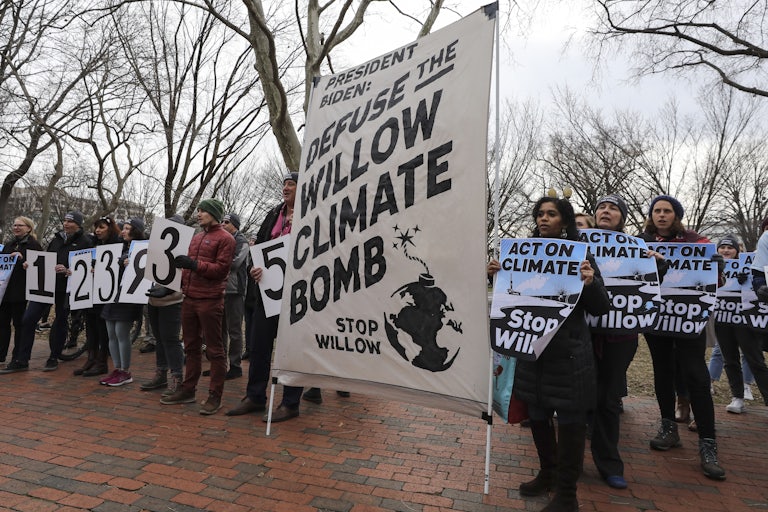
Climate activists gather to demand President Biden stop the Willow Project, at Lafayette Square in front of the White House on January 10, in Washington D.C.

“No more drilling on federal lands. No more drilling, including offshore. No ability for the oil industry to continue to drill. Period. Ends.”

That was Joe Biden’s promise in 2020. He again repeated the promise two days before the 2022 midterms.

And now, on Monday, Biden’s administration formally approved Willow, a massive oil drilling project in Alaska. The $8 billion project spearheaded by corporate giant ConocoPhillips is slated to produce over 600 million barrels of crude oil over 30 years, which will produce the equivalent of roughly two million cars’ worth of carbon pollution every year.

The project is set to infiltrate one of the country’s largest expanses of public land.

Last week, former Vice President Al Gore said it would be “recklessly irresponsible” for Biden to sign off on the project. “The pollution it would generate will not only put Alaska native and other local communities at risk, it is incompatible with the ambition we need to achieve a net-zero future.”

And Gore, who warned in his An Inconvenient Truth about how the climate crisis necessitates us “having to change the way we live our lives,” is certainly not alone.

“Instead of sticking to his own goals and listening to the millions of young people who carried the party for the last three cycles, President Biden is letting the fossil fuel industry have their way,” said Sunrise Movement executive director Varshini Prakash, who noted that Willow will emit more pollution annually than 99.7 percent of all single-point sources in the country.

Other environmental activists had similar words of condemnation for the project, which is expected to be challenged in court.

“Biden approved Willow knowing full well that it’ll cause massive and irreversible destruction, which is appalling,” said Kristen Monsell, a senior attorney at the Center for Biological Diversity. “People and wildlife will suffer, and extracting and burning more fossil fuel will warm the climate even faster. Biden has no excuse for letting this project go forward in any form. New Arctic drilling makes no sense, and we’ll fight hard to keep ConocoPhillips from breaking ground.”

“Today’s decision completely contradicts not only the administration’s climate goals but also its commitment to consider Traditional Ecological Knowledge in federal policymaking,” said Jade Begay, director of policy and advocacy at Indigenous advocacy organization NDN Collective. “The Native Village of Nuiqsut has repeatedly voiced their concerns around how the project will impact local ecosystems—including caribou, which they rely on for subsistence. This immoral decision will have devastating impacts on the livelihood of the people of Nuiqsut and beyond.”

Just last year, a monthlong natural gas leak from Conoco’s oil drilling near Nuiqsut, Alaska, prompted hundreds of people to evacuate. Now the company is marching back into the area for an enormously wider mission.

Meanwhile, the Biden administration announced Sunday it would ban drilling or (mostly) limit drilling in other parts of Alaska and the Arctic, ostensibly as an attempt to soften the blow of completely flipping on Biden’s pledge not to allow further drilling into our earth.

“It’s insulting that Biden thinks this will change our minds about the Willow project,” said Monsell. “Protecting one area of the Arctic so you can destroy another doesn’t make sense, and it won’t help the people and wildlife who will be upended by the Willow project. We need to protect the entire Arctic and stop building massive oil and gas developments that will contribute to greenhouse gas emissions for years to come.”

The Power of Ke Huy Quan’s Oscar Win for Everything, Everywhere in a World of Growing Asylum Bans

The actor spent a year in a refugee camp before arriving in the United States. But today it’s getting harder for people to claim asylum here.

Myung J. Chun/Los Angeles Times/Getty Images

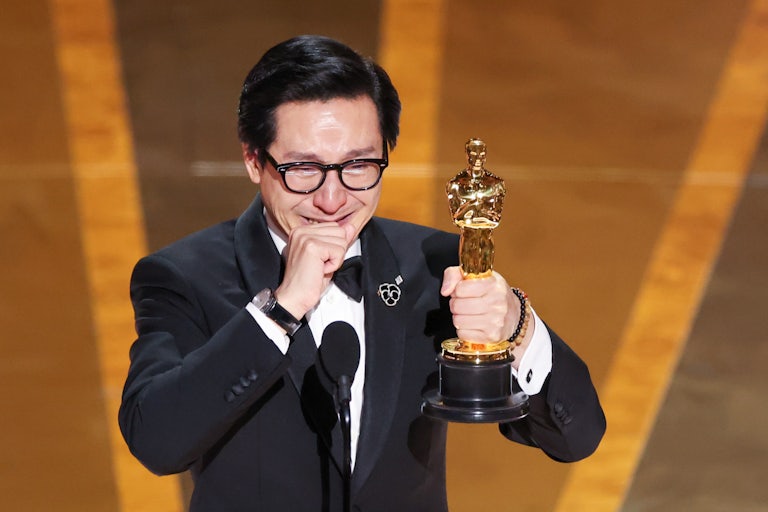
Actor Ke Huy Quan highlighted his background as a refugee while accepting an Oscar for Everything Everywhere All at Once, even as the U.S. government moves to block people with similar backgrounds from entering the country.

Quan won best supporting actor Sunday night for his role in the indie breakout film as Waymond, the patriarch of a Chinese American family trying to keep it together when they are transported on an adventure across universes. He acknowledged his own immigration story in his acceptance speech.

“My journey started on a boat. I spent a year in a refugee camp, and somehow, I ended up here,” Quan said tearfully. “They say stories like this only happen in the movies. I cannot believe it’s happening to me. This, this is the American dream!”

Quan was born in Vietnam in 1971. Seven years later, his family fled the country, and he, his father, and some of his siblings stayed in a makeshift refugee camp in Hong Kong for a year. Quan’s entire family was able to reunite in 1979 when they moved to Los Angeles under the Vietnamese refugee resettlement program.

His historic turn as the second Asian person* to win the best supporting actor Oscar comes just a month after the Biden administration unveiled a sweeping and strident new immigration policy that could prevent other stories like Quan’s from happening.

Joe Biden unveiled the new rules in February. The convoluted policy prevents adults or families from receiving asylum in the U.S. if they traveled through another country en route and did not apply for (or were denied) asylum there. The new process to apply for asylum requires multiple steps that are neither obvious nor simple, as well as the use of a phone app that is poorly designed and glitchy.

Democrats slammed Biden and the policy, with many branding it no better than the measures seen under Donald Trump. Since the new rules were announced, the Biden administration has also been reportedly considering other draconian immigration measures, including reviving the Trump-era family detention policy.

Biden’s asylum policy is not an exact comparison to Quan’s situation, but it will still cut off people who are fleeing dangerous situations from reaching a stable environment. The policy also addresses the immediate concerns of current high immigration levels, instead of trying to address the broader issues creating the need to seek asylum in the first place.

It’s worth noting that in Quan’s case, the instability in Vietnam was because of the Vietnam War, which dragged on as long as it did partly because of U.S. involvement.

It’s also worth noting that Quan’s win has been touted as an underdog victory and a movie-worthy comeback—that came as a result of Hollywood shutting him out. After achieving success as a child actor, Quan couldn’t get a single mainstream Hollywood role. He left the U.S. entertainment industry for almost three decades before getting cast in Everything Everywhere All at Once.

And then, after filming wrapped but before the movie came out, Quan wasn’t cast in anything else. All of the much-deserved praise and new roles he is getting now came after Everything Everywhere was released.

In this way, Quan’s comeback story and Biden’s immigration policy perfectly demonstrate how good the U.S. can be at shutting out immigrants until they are deemed worthy.

* This article originally misstated the historical significance of Quan’s Oscar win.

Trump’s Rollback of Dodd-Frank Regulations Directly Led to the Silicon Valley Bank Failure

This is what happens when you deregulate checks on financial institutions.

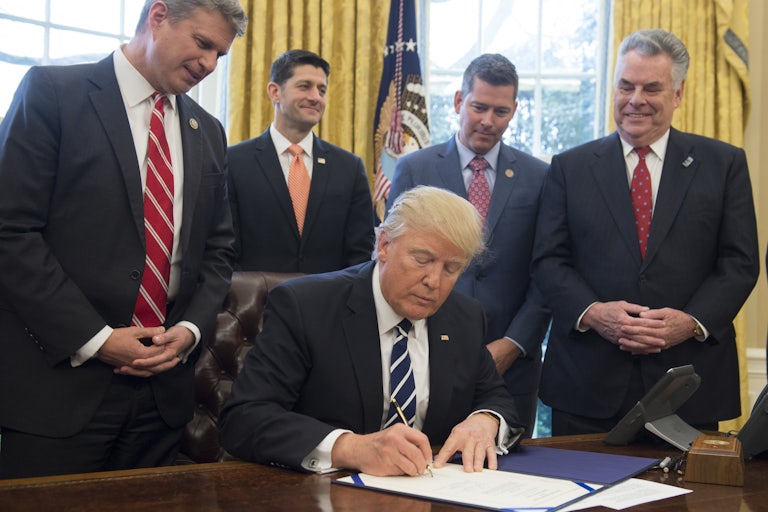
Donald Trump signs a piece of paper at his desk in the Oval Office
SAUL LOEB/AFP/Getty Images

Make no mistake: Just like train derailments, climate disaster, and most crises in society, barefaced deregulation was the antecedent to the collapse of Silicon Valley Bank.

On Friday, the major lender for tech startups was shut down by regulators. The commercial bank, among the 20 largest in the country, was caught in a free-fall bank run. Some of it seemed set off after a letter from SVB’s CEO Greg Becker, describing to shareholders a $1.8 billion loss on the sale of U.S. treasuries and mortgage-backed securities; high interest rates backgrounded the letter. Peter Thiel, a massive backer of the likes of J.D. Vance and Blake Masters, had his venture capital firms direct all their portfolio companies to withdraw their funds from the bank.

And then the floodgates burst open.

When all was said and done, $42 billion was withdrawn from SVB on Thursday. California’s Department of Financial Protection and Innovation seized the bank the following day, finding it insolvent and “incapable of paying its obligations as they come due.”

While Biden now attempts to relieve strain on depositors, while not placing burden on the rest of the public (i.e., not gratuitously bailing out the rich at the expense of everyone else), it’s important to understand how we got to this crisis in the first place.

In May 2018, Donald Trump signed into law a bill rolling back Obama-era Dodd-Frank regulations enacted to take on “too big to fail” financial institutions in the aftermath of the Great Recession. The bill was pushed through the Republican-controlled Congress—with the help of 17 Democrats in the Senate and 33 Democrats in the House.

The rollback raised the asset threshold for banks subject to enhanced scrutiny, like stronger regulations and stress tests, from $50 billion to $250 billion. As The Lever reported, SVB CEO Greg Becker had been lobbying for this change for years. SVB had just passed $50 billion in assets at the time Trump changed the regulations.

By December 2022, SVB had $209 billion in assets—below the $250 threshold but evidently enough to have certainly necessitated some form of oversight and testing to see if it could survive the type of run that just occurred.

What’s telling is how weak the conservative response has been. Venture capitalist libertarian tycoons clumsily beg for bailout funds despite their supposed disdain for government expenditure. Ron DeSantis, who voted to roll back Dodd-Frank in 2018, is now among the Republican chorus blaming the bank collapse on diversity and wokeness. In each increasingly frequent social crisis, the culprit is almost always deregulatory conservatism; not only are more and more people coming to understand Republican politics as socially untenable—it is being revealed as practically unjustifiable too.

“Everything Everywhere All at Once” Director Slams Anti-Drag Bills in Oscars Speech

Daniel Scheinert used his emotional Oscars acceptance speech to defend drag.

Kevin Winter/Getty Images
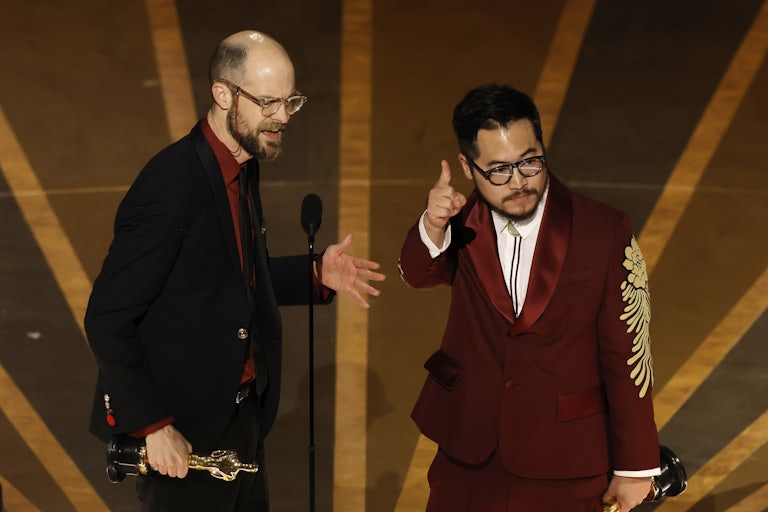
Daniel Scheinert and Daniel Kwan accept the best director award for “Everything Everywhere All at Once” onstage during the ninety-fifth annual Academy Awards on March 12.

One of the directors of indie breakout film Everything Everywhere All at Once slammed growing Republican attempts to ban drag performances during one of their many acceptance speeches at the Oscars ceremony.

The multiverse-spanning film about martial arts, mental health, and family ties swept the Oscars Sunday night, racking up seven wins that included some historic victories in the best actress and best supporting actor categories.

When accepting the award for best directing, Everything Everywhere All At Once directors Daniel Kwan and Daniel Scheinert (referred to as “the Daniels”) called out the importance of community for creativity.

“We want to dedicate this to the mommies, all the mommies in the world,” Scheinert said. “To our moms, specifically my mom and dad, Ken and Becky. Thank you for not squashing my creativity when I was making really disturbing horror films, or really perverted comedy films, or dressing in drag as a kid, which is a threat to nobody.”

Scheinert’s comment was met with cheers throughout the audience. He was referring to the more than 20 bills attacking public drag performances being considered in state legislatures throughout the United States. Tennessee recently became the first state to pass one of these bills into law.

On a larger scale, Republican-led states are cracking down on LGBTQ rights, from the drag bans to prohibiting gender-affirming care for minors and removing books featuring LGBTQ characters from school libraries.

One of the storylines in Everything Everywhere All at Once is about matriarch Evelyn, played by Michelle Yeoh, coming to terms with her daughter Joy’s (Stephanie Hsu) sexuality.

Kwan also highlighted how important a community is to creating art. “The world is opening up to the fact that genius does not stem from individuals … but rather, genius emerges from the collective,” he said.

“We are all products of our context. We are all descendants of something and someone.”