Newsletter
Power Mad
A weekly review of the rogues and scoundrels of American politics

How Badly Will the Media Botch the Trump Trials?

There’s a good chance the political press will create a circus out of the former president’s legal entanglements and then blame the people trying to hold him accountable.

Steven Hirsch/Getty Images

Donald Trump may have spent the past year creaming his wan Republican competition in the polls, but the news has not been all wine and roses for the former president—at least not in America’s legal venues. He has collected a scavenger hunt’s worth of indictments and faces a formidable calendar of dates as a professional defendant. What Trump is about to endure has few historical precedents—limp comparisons to Eugene V. Debs notwithstanding. This is shaping up to be a strange campaign, fought on large patches of undiscovered country.

But even as we fantasize about the consequences catching up with Trump, it must be said that once again he has us right where he wants us: at the center of a newshole that he is dominating. The Man Who Ate the Discourse is back, devouring whole news cycles, his attendant Gorpmans and Bleemers hopping in and out of the headlines. And with the news that the Georgia trial will be televised—for months on end—the potential for a feeding frenzy seems likely. But should this become a demented spectacle, remember: It’s not the fault of those who are seeking to hold the former president to account.

It’s not out of the realm of possibility that the media will either catastrophize the effort to hold Trump accountable or turn the justice-seekers into the villains of the story. The campaign trail is long and dull, and this time out it will wind through numerous courtrooms, in which Trump will be arrayed against a constantly shifting cast of “opponents.” Ever on the hunt for the mythical “balance” that they believe defines pure, mountain-grown political coverage, the press may well endeavor to cover these trials neutrally, as opposed to fairly—that is to say, to locate some imaginary middle ground between a criminal and his victims to defend, instead of considering the substance of the matter.

In a recent piece for The Wall Street Journal, Peter Funt convincingly argues that the transparency gained from televising the trials offsets whatever media circus is created. But along the way, he identifies a litany of concerns that we might soon hear spilling out of the hyped-up mouths of the hand-wringers on your local cable news panel—that the substance of the cases against Trump will be lost amid the grandstanding, cheapening the whole affair and thus contributing to an overall erosion of faith in the judiciary.

As Funt reminds, some fairly dubious theories about Trump have already been marshaled to argue that this moveable media feast will prove disastrous, such as the belief that the former president is some kind of inimitable maestro of the televisual arts and the idea that all of these indictments are a secret boon to his campaign. I am sorry to use this particularly overused term, but these notions are all just vibes. None of it is tethered to a quantifiable reality. It is clearly preferable to not get indicted, four times over, if you want to run for president. And Trump’s reputation for being some kind of teevee trickster all stems from the fact that he has benefited immensely from promiscuous cable news coverage.

Trump’s also already benefiting from some early carping about the media circus that’s lying over the horizon. Last week, New York Times columnist Ross Douthat complained about the logistics of Trump’s federal trial—the one in which he’ll face charges for conspiring to overturn the 2016 election. At issue was Judge Tanya S. Chutkan’s decision to begin proceedings on March 6 of next year, the day before Super Tuesday. This, to Douthat’s mind, was an “extremely suboptimal convergence.”

“If you take the judicial process seriously,” he wrote, “then clearly under ideal circumstances the trial of a major presidential contender would be completed before voters begin passing judgments of their own.” Well, sure? But what is Judge Chutkan supposed to do about this? As writer Tom Scocca pointed out in his newsletter, Chutkan had to fit her obligations into a calendar already crowded with Trump trials: “The only way to keep one or another of Trump’s trials from happening during a sensitive part of the primary season is by pushing things back into a sensitive part of the general election season.”

Yes, it’s true, these are suboptimal choices, all the way down. Court dates are mashing up against court dates, which in turn are abutting important dates on the primary calendar. I think one thing that maybe every party involved in these matters can agree on is that none of this is ideal. But who, then, should fill the blank space that Scocca locates in Douthat’s argument, the person to whom the “blame, formless and insinuating,” should attach?

Here’s a thought: Maybe it’s Trump’s fault! Trump’s allies keep darkly muttering, “If they can do this to Trump, they can do it to you too.” And my response is: “Well yes, that’s the whole point!” My one neat trick for avoiding indictments charging me with trying to overturn an election is to not try to overturn an election. And in the parallel universe where Trump had offered a dignified concession, no one’s worried about whether his federal trial is too close to Super Tuesday. It was a failure of accountability that gave rise to the media circus that’s coming down the pike. Maybe a strong dose of it will actually end this spectacle once and for all.

This article first appeared in Power Mad, a weekly TNR newsletter authored by deputy editor Jason Linkins. Sign up here.
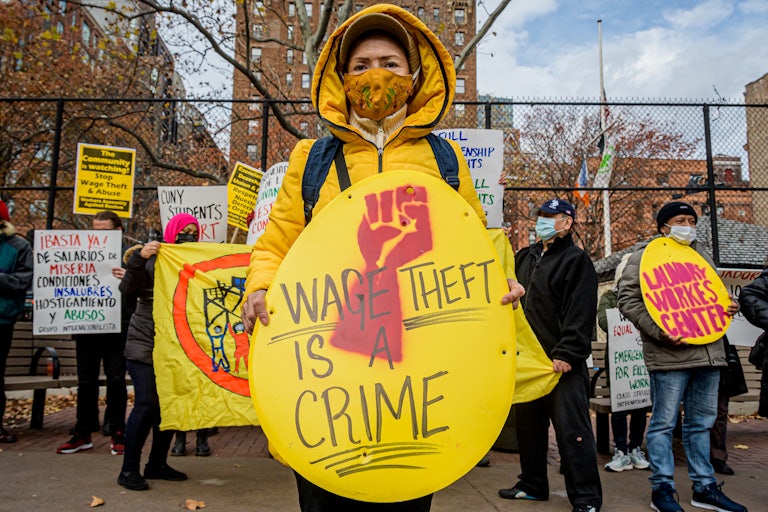
The Real Crime Isn’t Shoplifting—It’s Wage Theft

Why has the media gone all in on small time scofflaws when organized financial crime is robbing people straight from their paychecks?

Erik McGregor/Getty Images

Last weekend, I stumbled across a viral tweet thread that provided a rather thorough debunking of one of my big bugbears: the insipid shoplifting panic that’s been coursing through the media the past two years. Over several posts, WBAI radio host Rafael Shimunov punctures what’s become a classic “too good to check” story and discovered that many of the foundational ideas behind what’s been sold as a bona fide crisis were falsehoods—and not particularly well-constructed ones at that.

Once the evidence was sorted and the numbers run, Shimunov estimated that the total cost of our shoplifting horror show amounted to “seven cents per 100 dollars in losses.” The real “shoplifting crisis,” in fact, may be simply the way this nonstory has become so indelibly imprinted in the zeitgeist: Shimunov, after all, was pulling his evidence largely from a Los Angeles Times article from 2021, one of many pieces that explored these claims and found a hoax at the center instead. What will it take, then, to dislodge this falsehood from the public consciousness? Perhaps what we need here is a better enemy—and if the public wants a pound of flesh from a gang of conniving thieves, I’ve got one: corporate America’s runaway wage theft.

Unlike shoplifting, this is not a penny-ante crime, and it’s carried out every day with the ruthless efficiency of the boardroom. An L.A. Times column of a more recent vintage, courtesy of Michael Hiltzik, tells a fuller story. He enumerates many ways in which employers pull their own coordinated smash-and-grab jobs on their employees’ paychecks: “They may pay workers less than the legal minimum wage, fail to pay overtime, deny workers legal meal breaks or rest periods, divert workers’ tips, or require them to work off-the-clock to prepare for their shifts or to perform duties after their shifts have ended.”

And those are some decidedly old-school techniques. The “one neat trick” to screwing workers in today’s gig economy is simply to misclassify them as independent contractors, “thus sticking the workers with expenses that would be covered for employees.” All in all, the true cost of wage theft amounts to something substantially north of chump change: A 2014 study from the Economic Policy Institute “a nationwide epidemic that costs American workers as much as $50 billion a year.”*

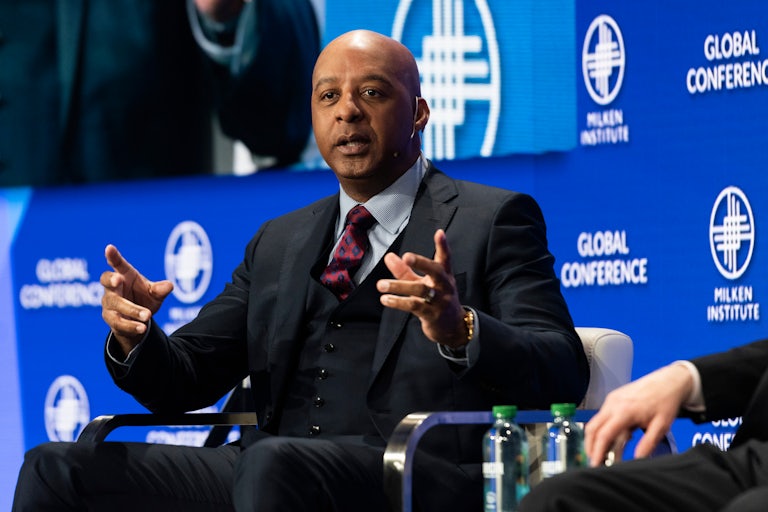
Moreover, a 2021 study from the Center for Public Integrity found that while firms that “hire child care workers, gas station clerks, restaurant servers and security guards are among the businesses most likely to get caught cheating their employees,” wage theft is a way of life at “many major U.S. corporations.” One such scofflaw that gets top billing in Hiltzik’s column is Home Depot, which in June settled a class-action lawsuit over wage theft to the tune of $72.5 million. That the firm’s former CEO Bob Nardelli was recently on Fox Business hyping up the threat of shoplifting is enough to make a cynic wonder: Is he fomenting public fear over an urban legend to distract from the real thieving?

Fortunately, in some quarters, wage theft is being treated with the seriousness it deserves. Just this week, ProPublica produced a blockbuster report on wage theft in New York City, finding that from 2017 to 2021, “more than $203 million in wages had been stolen from about 127,000 workers in New York.” And Documented, which partnered with ProPublica to produce the piece, this week launched its Wage Theft Monitor, which allows anyone to dig down into the data of who got ripped off and who did the stealing.

Under Biden, the Labor Department—whose acting secretary, Julie Su, made her name helping workers keep their hard-earned money from being pilfered by their bosses—has been frisky in the fight against wage theft. Last October, the agency reversed a Trump-era rule that permitted gig-economy employers to misclassify their workforce. A month later, an agency investigation led to Krispy Kreme paying $1.2 million in damages and back wages to more than 500 workers who’d been denied overtime. And this week, the department extended overtime protections to 3.6 million workers, the estimated equivalent of an additional “$1.2 billion in employees’ pockets, both in the form of more overtime pay and also salary increases by employers to ensure their white-collar workers will be exempt from the new rules,” according to the L.A. Times.

Naturally, we’ve a ways to go before all of the money that corporations have absconded with is back with whom it belongs. Perhaps the biggest policy change we could make in support of that effort, as TNR contributing editor Osita Nwanevu has written in the past, is to pave the way for worker ownership of firms. In the meantime, however, whenever you hear about a shoplifting crisis, remember that the actual theft isn’t occurring in the aisles of your nearby chain stores; it’s occurring in their boardrooms.

* This article originally linked to the wrong EPI study.

This article first appeared in Power Mad, a weekly TNR newsletter authored by deputy editor Jason Linkins. Sign up here.
The CEOs Who Are Robbing You Blind

Corporate executives are using taxpayer dollars and the proceeds of worker labor to keep the pay gap grotesquely wide.

Lauren Justice/Getty Images
Lowe’s CEO Marvin Ellison was 2022’s undisputed king of stock buybacks.

One of the big ironies in watching Elon Musk run his business empire in the fashion of The Twilight Zone’s Anthony Fremont is while it’s a demonstrable tragedy seeing the rapid demise of a firm like Twitter, it is also a highly entertaining spectacle. This is, after all, a strange era in which a weird array of business leaders has become world-famous for being bad at business. Elizabeth Holmes may have been sent to jail for the rampant fraud she committed while running the fake blood extraction machine firm Theranos, but she is also, somehow, a multiplatform entertainment industry unto herself. 

And let’s face it: One day, she’s going to be handed another massive pile of money to do with what she pleases. This is the way things work when you become famous for being rich: Just this week it was reported that Billy McFarland is planning to do another Fyre Festival—and while I am gobsmacked at the idea that people will give this man money, I can’t wait to watch the documentaries.  

But one of the deleterious effects of all the attention that the stars in the celebrity firmament of corporate cons and big-money malfeasance receive is it takes our eye off the ball. Beneath this straight-to-streaming-series layer of camera-ready scammers, there is a more substantial plunder going on in executive suites all across the country. Fortunately, we have the Institute for Policy Studies keeping watch over executive excess. And their 2023 report on what they term the Low-Wage 100—the 100 firms listed on the S&P 500 Index that had the lowest median worker pay levels in 2022—casts a riveting light on some real highway robbery. 

Among the companies in the Low-Wage 100, the gap between average workers and the executives who govern their lives continues to be grotesquely wide. When one of the few good things you can say about the CEO-worker pay gap at these firms is that it dropped from a staggering 670-to-1 to a slightly less stratospheric 603-to-1, you are still facing a thoroughly baked-in state of affairs.

This time last year, we talked about how stock buybacks—which the Harvard Business Review assailed as an exemplar of “bad management” because the practice neither creates capital for reinvestment nor rewards a workforce for its hard work—had become the “one neat trick” by which the executives at these firms feathered their own nests while leaving their workers wanting. As the IPS reports, 90 of the Low-Wage 100 reported “combined stock buyback expenditures of $341.2 billion” between January 1, 2020, and May 31, 2023. 

Lowe’s, which has become something of a bête noire on the IPS’s annual report, topped all-comers with respect to stock buybacks. According to the IPS, in 2022, the company spent “more than $14.1 billion on buybacks—enough to give every one of its 301,000 U.S. employees a $46,923 bonus.” Collectively, stock buybacks have allowed the CEOs of the Low-Wage 100 to cart off quite a pile of boodle—the IPS estimated that these executives’ “personal stock holdings increased more than three times as fast as their firms’ median worker pay.” 

But perhaps one of the most galling things about these corporations is how many of them are using our taxpayer dollars to add to these CEOs’ kitties. According to the IPS, 51 of the Low-Wage 100 “received federal contracts worth a combined $24.1 billion during fiscal years 2020–2023.” Additionally, “The average CEO pay in this low-wage contractor group stood at $12.7 million, 56 times as much as the salary of a Biden administration cabinet secretary” and “438 times their $34,550 median worker pay.” The firm that stands out among those fattening themselves off the taxpayer teat is Amazon, which has taken in nearly $10.4 billion in federal contracts, according to the IPS. As The New Republic contributor Sandeep Vaheesan recently reported, Amazon’s broad universe of contract work is one factor that makes it hard for antitrust regulators to bring the firm to heel.

The recently passed Inflation Reduction Act included measures to contend with the escalating problem of corporate malfeasance, most notably through a long-overdue 1 percent excise tax on stock buybacks. But according to The Wall Street Journal, “Executives largely shrugged off” the IRA’s impositions “as the cost of doing business.” It’s probably no surprise, then, that President Joe Biden wants to take a bigger bite: He’s proposed raising that excise tax to 4 percent—the better to goose “long-term investments by companies instead of rewarding shareholders and executives.”

Sarah Anderson, the director of the IPS Global Economy Project and author of this year’s report, encouraged lawmakers to keep pushing the envelope to narrow these gaping corporate inequalities. That includes executive action. “President Biden should wield the power of the public purse to push all corporate recipients of taxpayer money to narrow their pay gaps, stop wasting money on buybacks, and respect worker rights,” says Anderson.

There’s a line from Michael Mann’s movie Thief that feels apt: “I can see my money is still in your pocket, which is from the yield of my labor.” It’s worth remembering that CEOs across multiple industries have been raking it in even as they have seeded the business-friendly press with phantasmal recession fears and mass layoffs have become the norm. The New Republic contributor Boen Wang, who’s watched enthusiastic coverage of a podcasting boom even as massive job losses hit that industry, is keen to observe that the proceeds of that boom have to go somewhere—most likely, to corporate executives who haven’t earned it. Perhaps, as Wang suggests, it’s time for CEOs to return the money in their pockets to people to whom it truly belongs.

This article first appeared in Power Mad, a weekly TNR newsletter authored by deputy editor Jason Linkins. Sign up here.

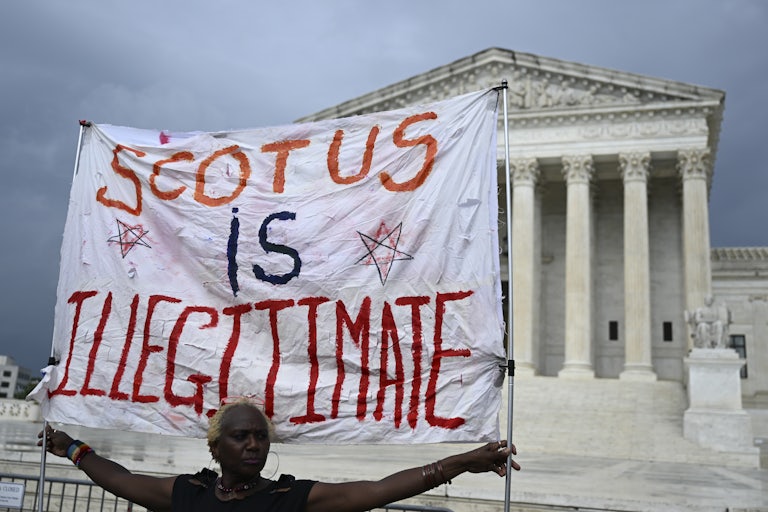
Look Who’s Defying the Supreme Court Now

Republicans haven’t lost too often at the high court of late—but when they do, they’re sore losers indeed.

Celal Gunes/Getty Images

It goes without saying that Democrats don’t believe they’ve fared particularly well at the Supreme Court in recent years. This past term was no different, as the high court’s conservative majority ruled against affirmative action in higher education, sandbagged the Environmental Protection Agency, and struck down President Joe Biden’s plan to alleviate the burden of student loans. What’s interesting about these and other radical acts of the Roberts Court, though, is that Democrats have watched the political fallout redound to their benefit. That probably explains why liberals lately have been content to wage war with the court using political rhetoric or strategic policy work-arounds, allowing the public’s increasingly low esteem for the Supreme Court speak for itself.

But Roberts and his crew haven’t actually given Republicans everything they’ve wanted—or at least not everything to which they’ve felt entitled after spending so much money and effort to purchase the Supreme Court of their dreams. And the party that’s been getting the most cake from their comrades on the bench have proven, on those rare occasions where they’ve not prevailed, to be pretty sore losers. Now, as Garrett Epps at The Washington Monthly reports, they seem poised to do something radical about it.

At issue is Allen v. Milligan, a case which Matt Ford recently enthused as a rare instance in which the Roberts Court actually did something good on voting rights: a 5–4 ruling that the state of Alabama had to draw a second majority-Black congressional district. John Roberts and Brett Kavanaugh joined the liberal justices in declaring that Alabama had violated Section 2 of the Voting Rights Act of 1965. But the plaintiffs on the losing end of this case apparently plan to do something altogether different than the Democrats typically have on those numerous occasions when they’ve been hard done by the Supreme Court: They’re contemplating simply defying it.

This would be a very Alabama thing to do. As Epps recalls, former Governor George Wallace became the poster boy for defying the federal courts in 1963 when he “stood in the door of the University of Alabama six months later to block a federal court order that the university admit two Black students.” This is an interesting fact about the Supreme Court: They don’t actually have cops on hand who can go around ensuring compliance with their orders. Those familiar with the history of the high court might remember President Andrew Jackson’s semi-apocryphal response to the court’s decision in Worcester v. Georgia, one of the foundational rulings enforcing tribal sovereignty in the United States: “John Marshall has made his decision, now let him enforce it.”

This kind of open defiance of the court may not end up being necessary in the Alabama dispute, as Kavanaugh indicated that he’d be open to resolving the matter in a different way. But Epps notes that Republicans seem unusually keyed up to go to war with a Supreme Court that mostly just delivers everything they want, gift wrapped:

Let’s begin with the states; they are raring to go. Texas, for example, seems to regard Supreme Court decisions as mild suggestions. In 2021, its SB 8 abortion bill didn’t merely test the boundaries of Roe v. Wade but successfully negated it, even though the landmark 1973 ruling was affirmed by the Court as recently as 2016. The Court meekly allowed that bill to take effect. Months later, after the Court’s majority issued its opinion in Dobbs v. Jackson Women’s Health Organization and scrapped Roe, Texas Attorney General Ken Paxton invited state officials to begin prosecuting LGBTQ persons for “sodomy” and refusing same-sex marriage licenses (both forbidden by the Court). I am surely not the only one wondering what will happen if a federal court orders Governor Greg Abbott to remove the deadly pontoons he uses to block the Rio Grande.

I wonder how the political media will respond if Republicans revive the George Wallace/Andrew Jackson style of court opposition. Back in May, I observed that the rancid coverage of the debt ceiling crisis was emblematic of the asymmetrical way the media treats the two parties, where Republicans are “allowed to exert maximal power” to get what they want while Democrats are “forced into the role of helpmate, permitted to step up occasionally to buffer the GOP’s excesses but not to exert maximal power themselves.” It’s a fairly consistent pattern that puts Democrats in a bind while granting the GOP broad permission to test the limits of our norms and institutions.

So it’s not a great sign that The New York Times covered these goings on in Alabama with a piece headlined, “Alabama Lawmakers Decline to Create New Majority-Black Congressional District”—as if the court had merely offered a suggestion that could be opted out of instead of issuing a ruling. It is hard to believe that the same paper would have treated Biden as mildly if he had, say, refused to comply with the Supreme Court’s decision to scuttle his student loan relief plan. The political press seems overly vigilant about what Democrats might do in response to a wayward Supreme Court. (Even Epps is hard-pressed to deliver the examples of court defiance on the left that his piece promises.) During the last presidential campaign, they treated the mere notion that Biden might countenance court-packing as radical beyond words—this after largely treating the GOP’s refusal to grant Merrick Garland a hearing as the normal stuff of politics.

In any event, Democrats aren’t in any rush to impose those kinds of radical reforms on SCOTUS, and as TNR contributor Simon Lazarus explains, they have good reason: For the time being, the rhetorical and political campaigns they’ve waged against an unpopular court, coupled with some creative policy responses, have proven to be sufficient to mitigate some of the damage done. What’s more, liberals seem to be having an influence on the justices themselves: In Allen v. Milligan, Roberts was able to temper his previously well-documented hostility to the Voting Rights Act, which Lazarus chalks up to the fact that liberals have been highly effective politically of late, even as they’ve faced adversity from the court. Still, if that adversity ever gets to be too much, it will be worth remembering that the GOP has made it fair game to openly defy the court’s rulings.

This article first appeared in Power Mad, a weekly TNR newsletter authored by deputy editor Jason Linkins. Sign up here.

This Week’s Republican Faceplant Has a 2024 Lesson for Democrats

The failure of Ohio’s Issue One shows that abortion—and democracy—are still potent issues for voters.

Anna Rose Layden/Getty Images

Did Ohio Republicans actually think their plan was going to work? The idea was, at least, somewhat simple to understand: To head off the possibility that a majority of Ohioans might approve a referendum to enshrine abortion rights in the state constitution this November, Buckeye State conservatives decided to rig the rules of the game with a referendum of their own. Issue 1, as it came to be known, would change the ballot initiative rules so that a 60 percent supermajority would be required to carry the day instead of the simple majority Ohioans had hitherto enjoyed. Then they scheduled the Issue 1 vote for August—the silliest of seasons—believing that doing so would lead to low turnout.

These well-laid plans went spectacularly awry this week as voters rejected the call to restrict their own voting rights. Turnout was massive, and Ohio Republicans got mauled.

It sure seems as if the Supreme Court’s decision in Dobbs has created the ultimate “be careful what you wish for” situation for conservatives, who’ve watched as voters all across the country beat back plans to further restrict abortion rights at the ballot box. Whenever they’ve been given a chance to do so, voters have rejected the call to limit reproductive freedoms—including in ruby-red redoubts such as Kentucky and Kansas. The Ohio result was a “five-alarm fire for the pro-life movement” for anti-abortion activist Patrick Brown, who tweeted, “The cause of life has to adapt, even if that means unwelcome compromise for the time being. We’ll keep getting run into the ground if we don’t.”

Whether or not that’s true is still up for debate in some quarters. The New York Times’ David Leonhardt noted on Wednesday that Democrats failed “to defeat Republicans by emphasizing their hostility to abortion” in statewide races held in Florida, Ohio, and Texas, calling it “an important caveat” to the issue’s “political potency.” But The Washington Post’s Greg Sargent was not convinced by Leonhardt’s argument, noting that there were numerous electoral successes on the other side of the ledger that were in whole or in part driven by backlash to the Supreme Court’s Dobbs decision, including several 2022 gubernatorial races (Arizona, Pennsylvania, Wisconsin, and Michigan); Senate races in Arizona and Georgia; and a crucial Wisconsin state Supreme Court election earlier this year.

There are no silver bullets in politics, but to paraphrase Dave Wasserman, I’ve seen enough to contend that the instability of the post-Dobbs world has become a motivating force for voters and a critical piece of electoral ammunition for Democrats. But Ohio Republicans may have unwittingly thrown a healthy dose of accelerant on an already burning fire by launching a broadside against democracy on top of their attack on abortion rights, as The Guardian’s Moira Donegan wrote this week:

And so the fight over abortion rights and Issue 1 in Ohio has become a proxy for the broader fight many Republicans are waging across the states: when voters don’t like the party’s proposed policies—and overwhelmingly, voters do not like abortion bans—then instead of changing their platforms or setting out to persuade the electorate to change their minds, Republicans simply change the rules, so that the voters’ wishes don’t get in the way of their preferred policy outcomes. Don’t want to vote for the Republican party line? Then state Republicans will make sure that your vote doesn’t matter.

In 2022, the Democrats’ decision to put democracy on the ballot and wage a campaign against the illiberal aims of the Republican Party was greeted with puzzlement by many pundits. But as Axios subsequently reported, the exit polls proved that Democrats had gotten it right: “National polling showed abortion and democracy turned out to be big issues with voters. Coverage in the run-up to midterms had focused heavily on pocketbook issues.” That Ohio Republicans, with this knowledge in hand, decided to court backlash in these potent areas with this ballot initiative fight makes me wonder if they ever really thought that they were going to pull off this plot against their own voters.

But it’s not like the GOP have given themselves much of a choice. Having abandoned the work of policymaking in favor of an increasingly weird and rapidly expanding universe of culture-war obsessions, Republicans don’t have all that many political moves at their disposal. The fact that voters are torpedoing the GOP agenda at the ballot box, TNR contributor Alex Thomas reported this week, means that Republicans will try even harder to demolish these avenues of direct democracy.

Democrats have lately endeavored to highlight the success of Bidenomics; there’s no doubt that pocketbook issues will be a critical component of the 2024 campaign. But there’s still a considerable amount of voltage flowing through the third rails of last year’s midterms. As TNR contributor Laleh Ispahani argued this week, Democrats should stay invested in Dobbs and democracy, especially as Republicans continue to wage war on voting rights—and dream of a national abortion ban.

This article was adapted from one that first appeared in Power Mad, a weekly TNR newsletter authored by deputy editor Jason Linkins. Sign up here.