Breaking News
Breaking News
from Washington and beyond

Bob Menendez Indicted for Taking Bribes From Yet Another Country

The Democratic senator is ringing in the new year with a new superseding indictment.

Win McNamee/Getty Images

New Jersey Senator Bob Menendez is on the hook again—this time for taking bribes from Qatar.

A superseding indictment, filed in a New York district court on Tuesday, accuses Menendez of waxing poetic about Qatar in an attempt to help a New Jersey real estate tycoon, Fred Daibes, secure a multimillion-dollar investment from an investment company tied to the Middle Eastern country, collecting lavish gifts in exchange for his handiwork. The charging documents include screenshots of messages between Menendez and Daibes, sending links to watches valued between $9,990 and $23,990 to the New Jersey politician along with the message, “How about one of these?”

After the politician returned from one of his trips to Qatar, Menendez googled, “How much is one kilo of gold worth,” according to the indictment.

It’s the third time the Senate Foreign Relations Committee member has been charged with corruption in the last decade.

Menendez was previously indicted in September on corruption-related offenses, in which he was accused of taking $480,000 in cash, numerous gold bars, and “luxury vehicles” from Egyptian officials in exchange for favors that included sending aid to the Egyptian military and pressuring the Department of Agriculture to protect a business monopoly in the country.

“Over $480,000 in cash—much of it stuffed into envelopes and hidden in clothing, closets and a safe—was discovered in the home,” according to the September indictment.

In 2017, Menendez was investigated after he was accused of taking campaign donations and lavish trips from a south Florida ophthalmologist. That case ultimately ended in a mistrial after the jury voted 10-2 to acquit the New Jersey congressman.
How Many More? Yet Another Trump Adviser Indicted for Being Foreign Agent

A former Trump adviser has been charged for violating the Foreign Agents Registration Act.

Donald Trump
Scott Olson/Getty Images

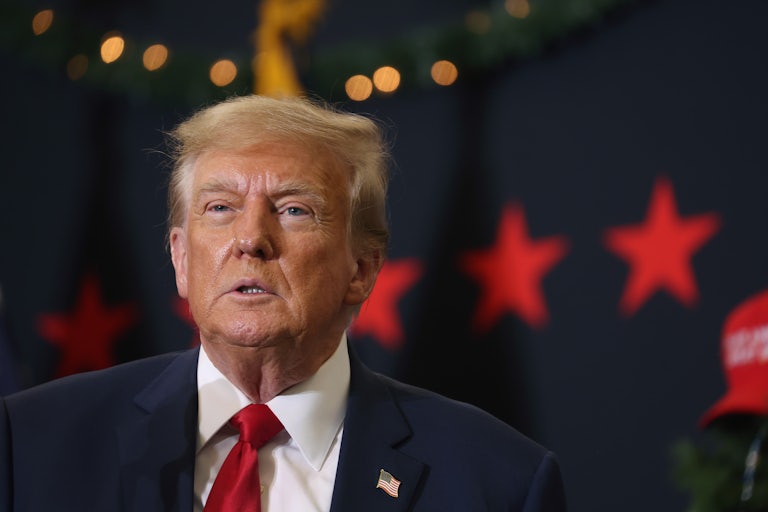
A former adviser to Donald Trump’s 2016 presidential campaign was indicted Tuesday for failing to register as a foreign agent.

Barry Bennett, who worked as an unpaid adviser to the Trump 2016 campaign, and his associate Douglas Watts were charged with violating the Foreign Agents Registration Act, or FARA. FARA requires people or entities working on behalf of a foreign government to register with the Department of Justice and report their relationships, activities, and financial compensation.

Federal prosecutors began investigating Bennett in 2021. They alleged Tuesday in court documents that Bennett “did knowingly and willfully falsify, conceal, and cover up” information in order to block the FARA investigators’ probe into his business. He and Watts are both accused of lying to investigators.

Prosecutors also accuse Bennett’s lobbying firm Avenue Strategies of submitting false information to the investigators.

Bennett founded Avenue Strategies shortly after Trump was elected. The court documents do not say what country he was working for, but Avenue’s federal lobbying disclosure records show he agreed to represent Qatar a few months after starting his firm.

The Wall Street Journal first reported in 2021 that the Embassy of Qatar paid Avenue about $3 million between July 2017 and July 2018 for work, including developing a “long-term plan to create closer ties between the United states and the State of Qatar.”

Bennett also started a group called Yemen Crisis Watch, according to the Journal. The group’s main goal was to publish ads and editorials criticizing or embarrassing Qatar’s rivals Saudi Arabia and the United Arab Emirates. At the time of payment, Saudi Arabia and the UAE were launching air strikes and providing military support to the government of Yemen, which was engaged in a civil war against the Qatari-backed Houthis.

In October 2017, Qatar gave Avenue Strategies $250,000 specifically for “use in supporting the relief of humanitarian suffering in Yemen.” Bennett did not register Yemen Crisis Watch with the Justice Department.

This is not the first time a former Trump ally has come under scrutiny for shady ties to a foreign government. Former Trump fundraiser Tom Barrack was accused of acting on behalf of the Emirati government and then obstructing justice and making false statements to FBI investigators looking into his relationship with Emirati officials. Barrack was acquitted in November 2022.

Harvard President Resigns Thanks to Far-Right Attacks Elevated by Media

Harvard University President Claudine Gay has resigned, thanks to a controversy manufactured by the right and elevated by the media.

Kevin Dietsch/Getty Images

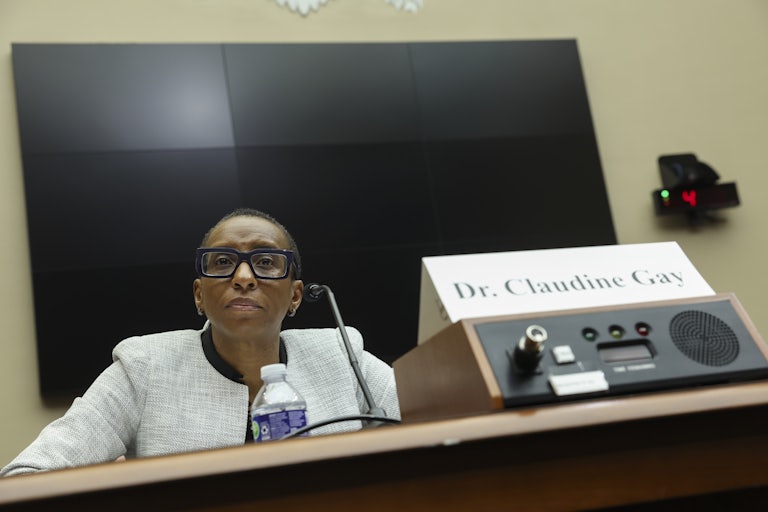
Harvard University President Claudine Gay resigned Tuesday amid a conservative-stoked firestorm over her response to questions about antisemitism on campus and allegations of plagiarism.

Gay served a total of just six months as university president, the shortest tenure in the school’s nearly four-century-long history. She was the first Black person and just the second woman to lead Harvard.

“It is with a heavy heart but a deep love for Harvard that I write to share that I will be stepping down as president. This is not a decision I came to easily,” Gay said in a letter to the school. “But, after consultation with members of the Corporation, it has become clear that it is in the best interests of Harvard for me to resign so that our community can navigate this moment of extraordinary challenge with a focus on the institution rather than any individual.”

Gay received national scrutiny in December when she, MIT president Sally Kornbluth, and University of Pennsylvania president Elizabeth Magill testified before the House Education and Workforce Committee about their responses to incidents of antisemitism on their campuses.

Committee Chair Elise Stefanik asked the university presidents whether students chanting “intifada” violated the schools’ codes of conduct. Each president said it would depend on the context, with Gay pointing out that chants she finds “personally abhorrent” could still be protected under freedom of speech.

But the video clip that went viral—thanks to the right—showed the university presidents stumbling after Stefanik asked whether calls for genocide against the Jewish people should be forbidden, leaving out the longer disingenuous line of questioning.

The university presidents tried to explain their stances after the congressional hearing. In a video the following day, Magill clarified that “speech alone is not punishable,” but calls for genocide would be “harassment or intimidation.” Magill ultimately resigned in mid-December, prompting Stefanik to triumphantly tweet, “One down. Two to go.”

In the weeks following the hearing, far-right activists began to accuse Gay of plagiarism. The charges were led by Christopher Rufo, a prominent Ron DeSantis ally, anti-woke warrior, and liar about having a Harvard degree.

Media coverage of Gay’s alleged plagiarism reached a height not typically seen for academia. As Paul Waldman wrote for The New Republic in December, “There’s no question that the accusations against Gay are being offered in utter bad faith, and the charges are inseparable from the political context in which they’re being made.”

He argued that the examples of Gay’s supposed plagiarism “amount to academic misdemeanors—real, but evidence of occasional sloppiness rather than malicious theft.”

“But you can’t separate this controversy from its context, which is that nobody proclaiming their outrage actually cares about the proper application of academic citation protocols any more than your average Republican members of Congress sincerely worry about antisemitism as something other than a bludgeon they can use against those they perceive as their enemies,” Waldman wrote.

Stefanik celebrated Gay’s resignation, bragging that she “will always deliver results” and branding the outgoing academic head as “morally bankrupt.” Her committee has also launched an investigation into antisemitism on the Harvard, MIT, and UPenn campuses.

Representative Jerry Nadler, the most senior Jewish member of Congress, excoriated his Republican colleagues in December for moves like that investigation, which “weaponize Jewish lives for political gains” while in reality doing nothing to “genuinely counter” antisemitism.

It does not seem to have occurred to Stefanik or Republicans in general, who regularly pride themselves on being the protectors of free speech, that they have essentially taken a cudgel to free speech on college campuses. Gay is the latest casualty in GOP attempts to essentially police free speech—and she won’t be the last.

Here Are the Members of Congress Who Made the Most in Stock Trading in 2023

Congratulations to this bipartisan group for making a record profit in stock trading last year.

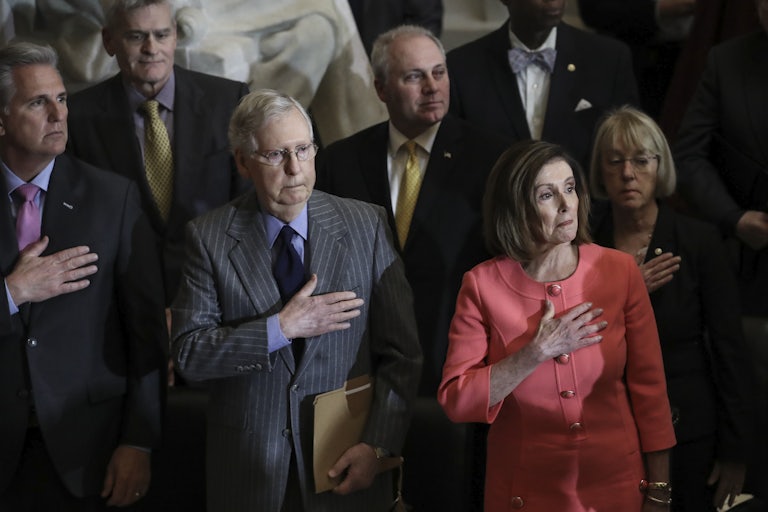
Nancy Pelosi and Mitch McConnell put their hands on their hearts, as other members of Congress do the same around them
Drew Angerer/Getty Images

Congress killed it in the stock market once again, with Democrats outdoing their Republican colleagues by far, despite conflicts in some of their committee appointments, according to a new report by Unusual Whales, a market analysis group.

Some of those high-flying lawmakers included Democratic Representatives Nancy Pelosi and Brian Higgins and Republican Representatives Mark Green and Garret Graves. Senate Minority Leader Mitch McConell, Senator Tommy Tuberville, and Representative Marjorie Taylor Greene also make an appearance in the list of top officials who made bank in the stock market last year.

The Unusual Whales analysis is based on financial disclosures made by members of Congress every time they or their families make a trade. Higgins’s gains far outpaced the others’, with 238.9 percent returns over 2023, nearly 10 times the S&P 500 index, which rose 24.8 percent by the end of the year. The data also found Democratic members of Congress secured a 31 percent gain in returns, far outpacing Republicans’ 18 percent gain.

Some of those boons were thanks to unusually timed trades, according to the popular watchdog account, begging the question: How are our politicians making such informed choices?

Technically, it’s illegal for lawmakers to buy and sell stock based on non-public information. In 2012, President Barack Obama signed the STOCK Act, preventing members of Congress from trading based on details obtained through their work, like committee work or entertaining lobbyists.

But as long as a trade is reported in 45 days, U.S. legislators are free to trade however they want, even if the bills they pass or reject could influence a company’s performance and help them line their own pockets.

For example, several lawmakers sitting on the House and Senate committees that regulate the financial industry sold Silicon Valley Bank stock before it crashed.

“One thing people always say is that members are very good at picking stocks, that’s often assumed … but to be quite frank, members were also quite good at avoiding losses,” the founder of Unusual Whales told ABC News in an anonymous interview last year.

Some of the biggest purchases included members on the House Oversight and Accountability Committee scooping up health care stocks in 435 separate transactions, buying financial services stocks in 328 separate transactions, and technology stocks in 272 separate transactions. The House Armed Services Committee saw similar conflicts, with members scooping up health care stocks in 392 separate transactions and financial services stocks in 277 separate transactions, according to data from Unusual Whales.

Representatives Ro Khanna, a California Democrat, and Michael McCaul, a Texas Republican, had the most eyebrow-raising activity. Khanna, who sits on the House Armed Services and House Oversight and Accountability committees, had 1,589 separate purchases in health care, financial services, technology, consumer cyclical, industrials, consumer defensive and real estate in his portfolio, while selling nearly $26 million worth of other stocks. McCaul, meanwhile, purchased tech stocks in 142 separate transactions while sitting on the House Foreign Affairs and House Homeland Security committees. He also sold $10.4 million in technology stocks, $9.5 million in communication services, $9.2 million in financial services, $6.6 million in consumer cyclical, and $6.4 million in health care stocks.

This article has been updated.

You’ll Never Guess Who Bibi Wants at Hague Genocide Hearing. Actually, You Will.

Benjamin Netanyahu seems to have landed on a representative for Israel at the Gaza genocide hearing.

Alan Dershowitz
Sarah Silbiger/Getty Images

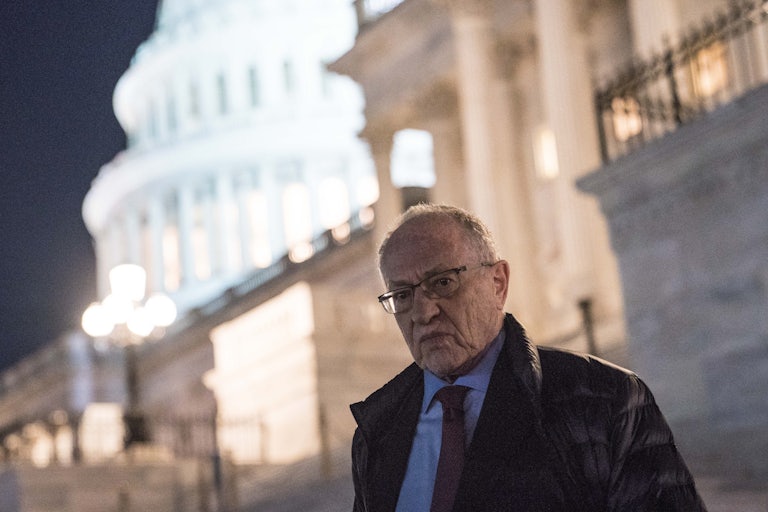
Prime Minister Benjamin Netanyahu reportedly wants former Donald Trump lawyer Alan Dershowitz to represent Israel at the upcoming hearing at the Hague about the war in Gaza.

South Africa asked the International Court of Justice on December 29 for an urgent order declaring Israel is committing genocide against Palestinians in its unrelenting bombardment of the Gaza Strip. The ICJ will hear the case, which Israel has denounced as “baseless,” next week.

As a defendant, Israel is entitled to pick one judge to the 15-member court—and Netanyahu wants that person to be Dershowitz, Axios journalist Barak Ravid reported Tuesday. When Ravid contacted Dershowitz for confirmation, the former Trump attorney said he “can’t comment about it at this time.”

Dershowitz would be a highly fitting representative, though. A longtime friend and advisor of Netanyahu, Dershowitz has defended Israeli settlements, downplayed the horrors of civilian casualties, and attacked liberal Jewish groups.

He has also helped defend Jeffrey Epstein, Harvey Weinstein, and Donald Trump.

Dershowitz repeatedly defended Trump during the former president’s time in office. Dershowitz backed Trump’s controversial ban on travelers from predominantly Muslim countries. Dershowitz argued that the ban was actually constitutional and didn’t really target Muslims, even though then–Trump lawyer Rudy Giuliani admitted the order came about after Trump asked him how to do a Muslim ban “legally.”

Dershowitz also literally defended Trump, acting as his lawyer during the former president’s first impeachment trial, over charges that he tried to use Ukrainian assistance to help him get reelected. During the trial, Dershowitz argued that in using foreign policy to pursue his personal interests, Trump was actually upholding national interests. This monarchic approach to governing is likely appealing to Netanyahu, who has sought to increase his power in Israel’s government.

Dershowitz has also claimed that Islamophobia does not exist on college campuses. In the wake of rising Islamophobia and antisemitism, the result of the Israel-Gaza conflict, Dershowitz said in November, “Oh, we have to fight antisemitism and Islamophobia.”

“Let me tell you who the antisemites are,” he then continued. “They are largely, not completely, the radical Muslims who claim to be victims of Islamophobia. This is a one-sided issue.”

“There is no Islamophobia at any university in the United States. It’s a fake. It’s virtue parading.”

More than 22,000 Palestinians have been killed in Israel’s nearly three-month-long assault on the Gaza Strip. The majority of the victims are women and children. Some organizations, such as the nonprofit Euro-Med Human Rights Monitor, put the death toll at nearly 30,000.