Breaking News
Breaking News
from Washington and beyond

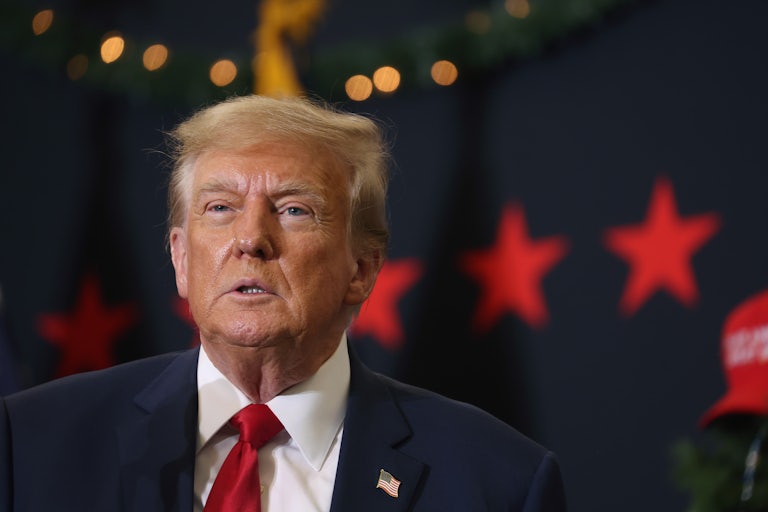
Donald Trump’s Galactically Unhinged Christmas Wishes

The commander-in-chaos is back with Yuletide rants about his many grievances and enemies.

Saul Loeb/Getty Images

He’s making a list. He’s checking it twice. He’s posting it on Truth Social. No, not Santa Claus. Donald Trump gave us an angry, multiday rant about all his perceived enemies and slights on social media for Christmas.

Trump’s screed, which spanned Christmas Eve and Christmas Day, highlighted the former president’s growing anger over the ways he feels he has been wronged—as well as how dangerous a second Trump presidency would be. He took aim at President Joe Biden and special counsel Jack Smith and spewed multiple falsehoods about the 2020 election for good measure.

“2024 WILL GO DOWN AS THE YEAR OF GREAT AND FULLY COORDINATED ILLEGAL ELECTION INTERFERENCE BY CROOKED JOE BIDEN, THE WORST AND MOST CORRUPT PRESIDENT IN THE HISTORY OF THE UNITED STATES, THE DOJ, FBI, A.G.’s, & D.A.’s THROUGHOUT THE COUNTRY,” Trump wrote on Monday morning. “BUT DESPITE IT ALL, IN THE END, THERE WILL BE A BIG AND GLORIOUS VICTORY FOR THOSE BRAVE AND VALIANT PATRIOTS WHO WANT TO MAKE AMERICA GREAT AGAIN. MERRY CHRISTMAS TO ALL!!!”

A few hours later, he branded Biden, Smith, and the Democratic Party in general as “thugs” who are “looking to destroy our once great USA.”

“MAY THEY ROT IN HELL. AGAIN, MERRY CHRISTMAS!” Trump wrote.

Some of Trump’s other posts accused the House January 6 investigative committee of unethical practices. He also accused Biden of weaponizing the Department of Justice (a favorite Republican talking point, rich with irony given the GOP’s plans to reengineer the federal workforce as an engine of retribution against their political opponents), of spying on Trump’s 2020 presidential campaign, and of rigging the 2020 presidential election. No evidence has been found to support any of these claims.

Trump’s unfiltered social media spew is emblematic of his current presidential campaign, which is less about policy proposals or a vision of the future and more focused on his plans to get revenge on those who he feels have wronged him. Trump has already explicitly stated that his 2024 campaign is about “retribution.”

As The New Republic has reported recently, the other worrying feature of Trump’s holiday season rhetoric has been his newfound love of paraphrasing Adolf Hitler. Trump has lately seemed determined to make parallels to the world’s best-known avatar of monomaniacally retributive politics a central part of his campaign persona.
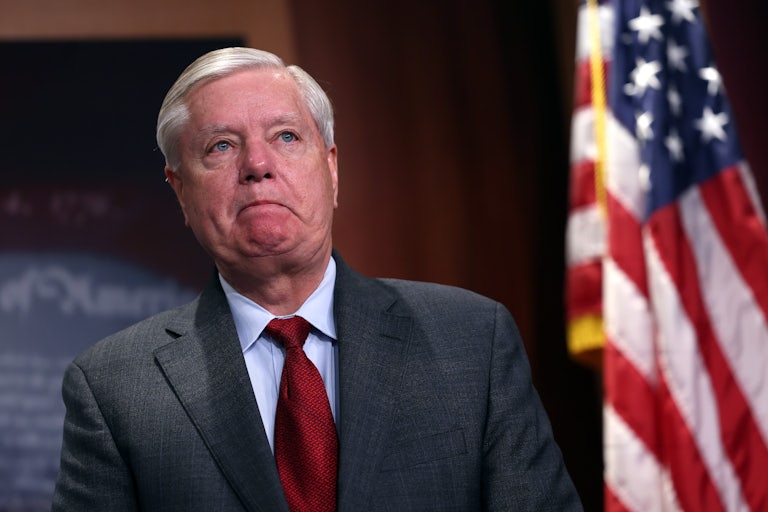

The Stupid Reason Lindsey Graham Is Worried About Trump’s Colorado Disqualification

The South Carolina senator frets that Colorado Supreme Court’s ruling may have a “chilling” effect on future despots.

Kevin Dietsch/Getty Images

South Carolina Senator Lindsay Graham has taken a dim view of a recent ruling by the Colorado Supreme Court, which determined former President Donald Trump was ineligible to run on that state’s presidential ballot based on a straightforward reading of Section 3 of the Fourteenth Amendment to the U.S. Constitution, which precludes anyone who violated their constitutional oaths to hold future office. The court deemed that this applied to Trump based on the role he played on fomenting the January 6 attack on the Capitol. It will be up to the U.S. Supreme Court to either overturn this decision or let it stand.  

In its unsigned decision, the court stated, “We are mindful of the magnitude and weight of the questions now before us. We are likewise mindful of our solemn duty to apply the law, without fear or favor, and without being swayed by public reaction to the decisions that the law mandates we reach.” Graham’s contribution to that public reaction is to assail the Colorado court decision for creating a “chilling” effect—presumably on future would-be despots since it’s not clear who, outside of those determined to have gravely violated the public trust, would be bound by the precedent set by the Colorado decision.

The senator offered his legal opinion on a recent edition of ABC’s This Week. Donald Trump will eventually be on the ballot in Colorado,” Graham said. “I think he will win the primary, he’s got a lot of good choices in the Republican Party, but this ruling in Colorado is chilling to me and it would set up a politicization of the presidential races. It would be bad for the country.” 

As The New Republic’s Matt Ford wrote last week, most of the critics of the ruling have “skipped past whether the decision was legally sound and went straight to whether it was a good idea politically,” offering little more than flimsy reasoning along the way. (Graham’s most interesting contribution to this body of work is to fret about “presidential races” getting “politicized.”) To Ford’s mind, a plain reading of the Constitution’s text makes it hard to dismiss the Colorado ruling as some kind of political stunt:

Though written in a bygone style of English, the meaning is fairly straightforward when you break it into its constituent parts. Generally speaking, if someone has held a federal or state office and sworn an oath to support the Constitution and then subsequently taken part in an insurrection or rebellion, they are permanently ineligible from holding future federal or state office. The only remedy is an act of Congress; lawmakers passed one in 1872 to un-disqualify ex-Confederates in an attempt at national reconciliation.

If Graham is sincerely worried about the “chilling” effect that the ruling may have on future political candidates, he should take heart. “Section 3 has only come up in a few fleeting instances since the Civil War,” writes Ford. Indeed, in the rich history of American presidents and presidential candidates, only one figure—Donald Trump—seems to have run afoul of the Constitution in this manner. Moreover, the Republican Party seems to have several people running for president right this very minute who qualify for Colorado’s ballot and who needn’t worry about this court ruling. It would seem, in a final analysis, that the “one neat trick” to avoid the predicament in which Donald Trump has found himself is to simply not foment an insurrection.

Someone Called the Cops to a Massachusetts School … Over a Book

Police received a complaint over the book, so an officer went to hunt it down.

A child stands in front of a bookcase in the library
Paul Chinn/The San Francisco Chronicle/Getty Images

Free speech advocates are slamming a police officer going to a Massachusetts middle school to search for a single book.

On December 8, an anonymous caller contacted the police department in Great Barrington, Massachusetts, to complain that an obscene book was available to eighth grade students at the W.E.B. Du Bois Regional Middle School. An officer was sent to investigate.

The book in question is Gender Queer by Maia Kobabe. The memoir does contain sexually explicit illustrations and language, but more importantly, it discusses the writer’s confusion about and understanding of gender.

The police alerted the school district superintendent and the Du Bois principal, but no one told the teacher accused of having the book. The principal escorted the police officer to the English teacher’s classroom after school let out, catching the teacher by surprise. The book was nowhere to be found.

The American Civil Liberties Union condemned the fact that a police officer was sent to look for a book. The organization said it could not remember this happening before.

“That’s partly what is so concerning,” Ruth A. Bourquin, the senior and managing attorney for the ACLU of Massachusetts, told The Berkshire Eagle. “Police going into schools and searching for books is the sort of thing you hear about in communist China and Russia. What are we doing?”

Justin Silverman, the executive director of the New England First Amendment Coalition, was worried that this won’t be the last time the police are asked to get involved in school literature. “While it might be rare now, it doesn’t mean that it will be rare in the future,” he said.

More than 100 students and teachers in the state organized a walkout last Friday to protest the police involvement in the incident. Some students said they suspected the larger issue was the LGBTQ themes in the book, not the sexual images.

Gender Queer is generally recommended for ages 14 and up, but it really depends on the maturity level of each individual reader. The teacher who had it in her classroom has remained anonymous, but she did initially write about the investigation on social media.

She noted that she has many years of experience as an English teacher. “How on earth is a cop more qualified to decide what books are OK to be in an educational setting for teens?” she wrote.

The Du Bois school librarian, Jennifer Guerin, pointed out that the point of having such a book around is “not about forcing a book into students’ hands” but making sure that such a resource is accessible.

“It’s about the freedom to read,” she said. “It’s about providing voluntary access to a well-written, highly acclaimed resource in a safe place for a teenager who might want or need it.”

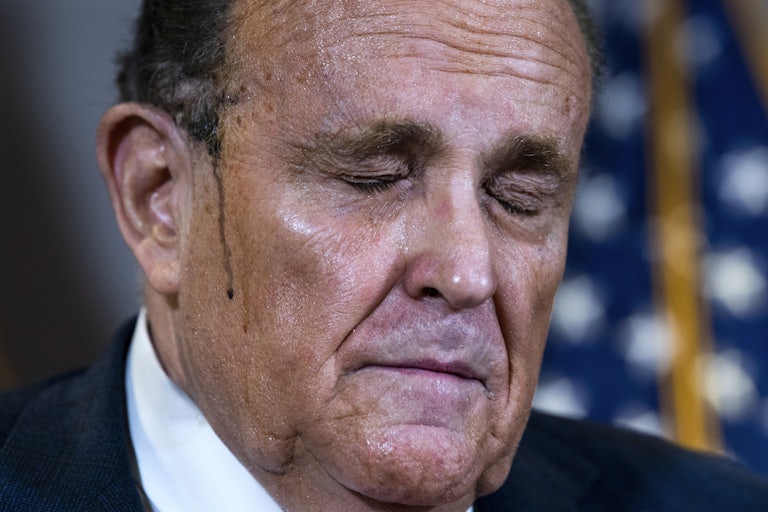
Broke Giuliani Files for Bankruptcy, Lists Every Person He Owes Money To

Rudy Giuliani has filed for Chapter 11 bankruptcy, days after being hit with a $148 million judgment in a defamation lawsuit.

Tom Williams/CQ-Roll Call, Inc/Getty Images

Rudy Giuliani filed for bankruptcy on Thursday, faced with insurmountable debt after he was found liable for defaming two Georgia state election workers.

The bankruptcy filing shows that Giuliani owes as much as $500 million in debt but has only up to $10 million in assets. The documents also include a list of people that Giuliani owes money.

The man once affectionately known as “America’s mayor” owes money to multiple law firms for unpaid legal fees. Several of Giuliani’s former lawyers, including his longtime attorney Robert Costello, have sued Giuliani for failing to pay their legal fees.

Giuliani also owes money to an accounting firm after he failed to pay them for helping in his most recent divorce. Giuliani’s ex-wife says he owes her more than $260,000 for her country club memberships, condominium fees, and health care as part of their divorce settlement, but she is not mentioned in the bankruptcy filing.

Electronic voting machine companies Smartmatic and Dominion are listed, though. Giuliani helped spread lies in the wake of the 2020 elections that the companies’ voting machines were used to rig the election results.

What’s more, Giuliani owes money to Dominion employee Eric Coomer. A right-wing conspiracy claims that Coomer participated in an “antifa conference call” ahead of the 2020 election, during which he said he “made f-----g sure” that Donald Trump wouldn’t win.

Giuliani owes money to Daniel Gill, a man who was charged with assault after he approached Giuliani last year in a Staten Island grocery store, slapped him on the back, and said, “What’s up scumbag?” The charges against Gill were ultimately dropped, and he then sued Giuliani for pressing baseless charges against him.

Another of Giuliani’s listed creditors is Noelle Dunphy, one of his former associates. Dunphy sued Giuliani in May, accusing him of promising to pay her a $1 million annual salary but instead sexually harassing and abusing her over two years.

Giuliani owes money to Hunter Biden, too. Although the filing only says it is for a “lawsuit” and does not provide further details, Biden sued Giuliani in September for allegedly trying to hack his laptop.

And of course, Giuliani owes money to Ruby Freeman and Shaye Moss, the two election workers. Giuliani was found liable in August for defaming the women, after he accused the pair of manipulating ballots in Georgia during the 2020 election. The women have been subjected to months of harassment and death threats.

A judge ordered Giuliani on Friday to pay Freeman and Moss $148 million in damages. This was the straw that broke the camel’s back and prompted Giuliani to file for bankruptcy. But he has been struggling for cash for a while now.

Giuliani listed his Manhattan apartment for sale in July and began representing himself in court to save on legal fees. In August, after he was indicted in Georgia, Giuliani asked his social media followers to donate to his defense fund.

He also flew to Mar-a-Lago to beg Trump to pay him for working as Trump’s personal attorney. That didn’t work, but Trump did agree to host a fundraiser dinner for Giuliani. Entry cost $100,000 a plate.

California Lieutenant Governor Calls for Trump to Be Kicked Off Ballot

A top official in California is calling for Donald Trump’s removal from the ballot, citing the Colorado Supreme Court’s recent decision.

Donald Trump
Scott Olson/Getty Images

A Colorado court’s decision to remove Donald Trump from the 2024 Republican primary ballot may have unfurling implications across the nation.

On Thursday, California’s Lieutenant Governor Eleni Kounalakis called on the secretary of state to “explore every legal option to remove former President Donald Trump from California’s 2024 presidential primary ballot,” leveraging the Colorado Supreme Court’s decision as a precedent.

“This decision is about honoring the rule of law in our country and protecting the fundamental pillars of our democracy,” Kounalakis wrote in the letter. “California must stand on the right side of history. California is obligated to determine if Trump is ineligible for the California ballot.”

“There will be the inevitable political punditry about a decision to remove Trump from the ballot, but it is not a matter of political gamesmanship. This is a dire matter that puts at stake the sanctity of our constitution and our democracy,” she concluded.

Kounalakis’s call will likely incense some of the state’s voters, more than 34 percent of whom supported Trump in the last presidential election. Still, California could soon become a part of a growing movement of states that have formally tried to kick Trump’s name out of their voting booths, including Arizona, Rhode Island, Michigan, Maine, and Minnesota. The GOP front-runner’s hold at the top of the primary ballot is also facing legal challenges in more than a dozen states, including Alaska, Nevada, New Jersey, New Mexico, New York, Oregon, South Carolina, Texas, West Virginia, Wisconsin, Wyoming, Vermont, and Virginia.

The Colorado court’s 3–4 ruling dually determined that Trump participated in insurrection on January 6, 2021, and that his bid for the Oval Office violates the U.S. Constitution’s Fourteenth Amendment, which bans insurrectionists from holding public office.

And while Colorado’s decision is the first of its kind, its challenge is also likely to be appealed up to the overwhelmingly conservative U.S. Supreme Court, stacked with three Trump-appointed judges. That will pin the nation’s highest court as an even more integral component of the 2024 presidential election than it had already primed itself for following the decision to hear several high-profile reproductive rights cases.

Republicans, meanwhile, have balked at the nation’s turn on their favorite, ironically slamming state’s decisions to decide for themselves what they consider to be constitutional despite their traditional, states-rights party philosophy.

More on Colorado’s decision: