Newsletter
Fighting Words
What got me steamed up this week

The Right-Wing Media Takeover Is Destroying America

The purchase of The Baltimore Sun is further proof that conservative billionaires understand the power of media control. Why don’t their liberal counterparts get it?

JIM WATSON/AFP/Getty Images

You have no doubt seen the incredibly depressing news about the incredibly depressing purchase of The Baltimore Sun by the incredibly depressing David Smith, chairman of Sinclair Broadcast Group, the right-wing media empire best known for gobbling up local television news operations and forcing local anchors to spout toxic Big Brother gibberish like this.

The Sun was once a great newspaper. I remember reading, once upon a time, that it had sprung more foreign correspondents into action across the planet than any American newspaper save The New York Times and The Washington Post. It had eight foreign bureaus at one point, all of which were shuttered by the Tribune Company by 2006. But the Sun’s real triumphs came in covering its gritty, organic city. And even well after its glory days, it still won Pulitzers—as recently as 2020, for taking down corrupt Mayor Catherine Pugh, who served a stretch in prison thanks to the paper.

Smith wasted no time in showing his cards during his first meeting with the staff Wednesday. He was asked about a comment he made to New York magazine back in 2018, when he said, “Print media is so left wing as to be meaningless dribble.” (“Dribble”? Let’s hope he won’t be on the copy desk.) Did he feel that way about the Sun specifically? “In many ways, yes,” Smith said, adding that he wants the paper to emulate the local Fox affiliate, which is owned … by Sinclair.

But this column isn’t about the Sun and Smith. In fact, I applaud Smith and Sinclair in one, and only one, respect. They get it. They understand how important media ownership is. They are hardly alone among right-wing megawealthy types. Of course there’s Rupert Murdoch, but there are more. There’s the late Reverend Sun Myung Moon, who, after he got rich from his Unification Church, sprouted media properties, most notably The Washington Times, still owned by the church’s News World Communications (once upon a quaint old time, it was shocking that the conservative newspaper in the nation’s capital was started by a cult). And Philip Anschutz, whose Clarity Media Group started the tabloid newspaper The Washington Examiner in 2005. These days, the list includes Elon Musk with X/Twitter, Peter Thiel and Senator J.D. Vance with Rumble (a right-wing YouTube alternative), Ye with his attempted purchase of the now-defunct Parler, and, of course, Donald Trump, with Truth Social. They all understand what Viktor Orbán told the Conservative Political Action Conference in 2022: “Have your own media.” Shows like Tucker Carlson’s old Fox show, the Hungarian strongman said, “should be broadcast day and night.”

I’ve been watching this develop for decades. The right-wing media was a thing long ago, but it was still easily drowned out by the mainstream media. If the mainstream media was a beach ball, the right-wing media was a table tennis ball.

Today? The mainstream media, with cuts like those endured by the Sun, is maybe a volleyball, and the right-wing media is a basketball—a little bigger. And it’s on its way to beach-ball-hood. The right-wing media is now the agenda-setting media in this country, and it’s only getting bigger and more influential every year.

And how have the country’s politically engaged liberal billionaires responded to this? By doing roughly nothing.

I’ve been in the trenches of this fight for many years. Back in the George W. Bush era, the late Rob Stein, a Democratic insider and good friend of mine, mapped for the first time the conservative infrastructure in a PowerPoint presentation that became such a hot ticket in Washington liberal circles that The New York Times Magazine did a story about it. He showed, from looking over conservative groups’ 990s (because they were mostly all nonprofits), how much was spent on policy development, how much on field operations, how much on youth training, and how much on media. I don’t remember the numbers, but the media figure was high.

Much of this spending was coordinated. Murdoch’s empire didn’t count, because his properties were for-profit, as was The Washington Times. But a lot of the nonprofit spending was directed by a handful of anointed movement leaders, and they made certain that a big chunk of money was spent on media.

I used to try to argue, whenever I was lucky enough to get the ear of one of our side’s rich people for five minutes, that we needed to build an avowedly liberal media infrastructure. I was told that they just weren’t that interested. They had other priorities. They were concerned with the issues. They weren’t prepared to lose all that money, and for what?

For what? Ask Viktor Orbán. He knows. Ask Rupert. Why has he held onto the New York Post? News Corp., the parent company, makes a profit. But the Post loses kajillions. Nobody knows how much, but here’s an estimate from 12 years ago that put the paper’s losses at $60 to $120 million a year.

So why does he keep it? Because it’s worth every penny. It gives him power. The Post’s editors know how to use its front page and its news pages to shape discourse. Where did last fall’s New York crime scare come from, the one that had Westchesterites convinced they dare not set foot in the city, and which elected all those Republican members of Congress? From the Post, that’s where.

I used to be told sometimes, “Yes, but we have The New York Times, The Washington Post …” Really? No, not really. Sure, they endorse Democrats mostly. And sure, much of their social and cultural coverage proceeds from liberal assumptions. They, and almost all of the mainstream media, will not write a story today suggesting, for example, that undocumented immigrants across America should be rounded up en masse and deported. This has been a hard-won reality forged by many activists and intellectuals over many years, and it is a good thing.

But it isn’t capital-P Politics. On capital-P Politics, The New York Times and The Washington Post often let liberals down. I was having these arguments, as I said, back when Dubya was president, and he and his vassals were ginning up their phony case for invading Iraq. Which newspaper published the infamous “aluminum tubes” story charging that Saddam Hussein was seeking material that could only be used in nuclear centrifuges? The Times, on its front page on a crucial Sunday in the fall of 2002, as Bush officials spent the day fanning out onto the political chat shows touting the article.

It was false. Eventually, the Times itself debunked the story—but in 2004, well after the war had started. And as for the Post, that liberal paper’s editorial page was one of the most important promoters of the Iraq invasion in all of American media. (Speaking of the unreliability of liberal media outlets at that time, it would be evasive of me not to mention The New Republic’s own fervent support of the war, but that wasn’t me; I was helming The American Prospect at the time, and we opposed it.)

I used to say to people: What we need is a full-throated liberal tabloid in Washington—a Washington version of the New York Post that would use its front pages and its news columns to promote embarrassing stories and scandals about Bush administration officials, evangelical grifters, and other prominent right-wingers. It would be agenda-setting. It would have some juicy gossip columns and a great sports section because a tabloid newspaper has to. And most of all, it would have done the vital work of connecting liberal values to a proletarian tabloid sensibility.

Everyone I mentioned this to laughed in my face, and maybe you are too. But Phil Anschutz didn’t laugh. He started a conservative tabloid right around the same time I was saying our side should start a liberal one. And what’s happened? I suppose he’s lost money, although I don’t really know. But The Washington Examiner is a respected property (it gave up on print in 2013, but that was fine; by then it was an established presence). I see its people on cable news, and it has produced some legit stars like Tim Alberta. It has influence, I assume its reporters have Hill press credentials, and I don’t see anybody laughing at it.

How different would today’s discourse be if someone had funded such a paper? I don’t want to overstate things, but it would be different, no question. Four years of tabloid “woods” (covers) smartly and riotously mocking Trump while he was president would absolutely have changed the way he was perceived and described by the rest of the media.

And now let’s return our thoughts to Sinclair. How different would things be out there in America if, 15 or 20 years ago, some rich liberal or consortium of liberals had had the wisdom to make a massive investment in local news? There were efforts along these lines, and sometimes they came to something. But they were small. What if, instead of right-wing Sinclair, some liberal company backed by a group of billionaires had bought up local TV stations or radio stations or newspapers all across the country?

Again, we can’t know, but we know this much: Support for Democrats has shriveled in rural America to near nonexistence, such that it is now next to impossible to imagine Democrats being elected to public office at nearly any level in about two-thirds of the country. It’s a tragedy. And it happened for one main reason: Right-wing media took over in these places and convinced people who live in them that liberals are all God-hating superwoke snowflakes who are nevertheless also capable of destroying civilization, and our side didn’t fight it. At all. If someone had formed a liberal Sinclair 20 years ago to gain reach into rural and small-town America, that story would be very different today.

There has in recent years been an impressive growth of nonprofit media outlets, led nationally by ProPublica and laying down roots everywhere, from the aforementioned Baltimore, where the Baltimore Banner has sometimes been scooping the Sun, to my home state of West Virginia, where Pulitzer Prize–winner Ken Ward’s Mountain State Spotlight is doing terrific reporting. These outlets are welcome indeed. They do sharp and necessary reporting. But they’re nonprofits, which, under IRS rules, cannot be partisan. They have to be apolitical.

What we used to call “the progressive infrastructure” has grown in the two decades since Stein was showing his PowerPoint around town. Donors got together at Stein’s behest to create the Democracy Alliance. It helped seed the Center for American Progress, designed as liberalism’s answer to the Heritage Foundation. It helped grow groups like the Center on Budget and Policy Priorities. On the media front, it funded Media Matters for America, the broad left’s leading media watchdog outfit.

But there is one job liberal benefactors have refused to take on (with a few exceptions, starting with the owner of this very magazine). The cost has been enormous. And by the way—this story isn’t over. By a long shot. I’m certain David Smith wants to buy more struggling newspapers and turn them into MAGA sheets. And there are surely mini-Sinclairs in formation. Prager University’s right-wing misinformation videos are gaining a foothold in some public schools. Right-wing outlets have zero interest in sharing the “media space” with the mainstream media. They want to crush it.

And I fear that they probably will. There’s a story in the Times today about three moguls who bought prominent media properties, most notably Bezos with the Post, and the many millions they are losing. That’s sad. But what did they expect? You don’t buy a newspaper expecting to make money. You buy a newspaper because you want influence. You are passionate, as Murdoch is, about pushing the country in a certain direction. You either learn to live with the losses or you find a way to cover them. To those who say it’s impossible, I point out that somehow, the rich men of the right have figured this out. And so Bezos, who has no discernible public passion, will probably tire of it all and sell someday—and maybe to David Smith, whose public passion is very discernible indeed. If you can’t imagine the Post as a right-wing rag, you’d better start smelling the coffee that’s been brewing for 20 years.

What will the result be 20 years from now? Will we be raising a generation of children in two-thirds of the country who believe that fossil fuels are great and trees cause pollution, that slavery wasn’t the cause of the Civil War, that tax cuts always raise revenue, and that the “Democrat” Party stole the 2020 election? Yes, we will. And it will happen because too many people on the liberal side refused to grasp what Murdoch, Anschutz, Smith, and Viktor Orbán see so clearly. Have your own media.
This article first appeared in Fighting Words, a weekly TNR newsletter authored by editor Michael Tomasky. Sign up here.

Why the Media Narrative on Donald Trump’s Legal Woes Is Wrong

Political pundits are ignoring the poll numbers on independent voters.

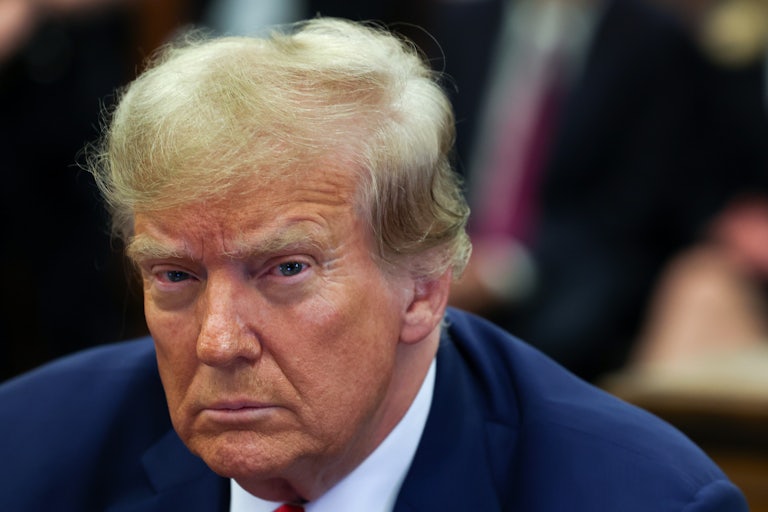
Trump at the closing arguments
Shannon Stapleton/Pool/Getty Images
Trump at the closing arguments in the Trump Organization civil fraud trial in New York City on Thursday

Sometime this month, New York Supreme Court Justice Arthur Engoron will decide how much Donald Trump should pay in penalties in the fraud case brought by New York State Attorney General Letitia James. Engoron has already ruled that Trump did commit fraud, so now it’s just a matter of the money. Engoron has been decidedly unimpressed by Trump’s lawyers’ arguments throughout the proceeding, so it seems reasonable to think Engoron will come close to, match, or maybe even exceed James’s request of $370 million.

According to Lisa Rubin of MSNBC, speaking on Morning Joe Friday morning, the very theatricality of Trump and his attorneys’ denials can be a factor in the judge’s determination—that is, if Engoron determines that Trump and his lawyers’ lies are egregiously flamboyant and obvious, that can help dictate the penalty amount. Rubin predicted that the amount would be “in the hundreds of millions” of dollars and that perhaps Engoron would drop the nuclear penalty on Trump and his family—barring them from doing business in New York again.

Meanwhile, as Engoron is deliberating, another trial is about to begin. The E. Jean Carroll defamation trial will open next Tuesday, the day after the Iowa caucuses. Last year, a jury found that Trump had lied about not sexually abusing Carroll years ago, and awarded her $5 million. Trump appealed. Last summer, the judge in the case clarified, amid intense media debate and speculation, that Trump did in fact “rape” Carroll.

Meanwhile, on the political front, Trump will win Monday’s Iowa caucuses. The following Tuesday, January 23, New Hampshirites will go to the polls. One poll that got a ton of attention showed Nikki Haley within seven points of Trump. She has some momentum, but in the polling averages, Trump still has a double-digit lead. And he’ll be coming off a massive win in Iowa. So let’s say for the moment that Trump wins New Hampshire handily too.

The media narrative with respect to the Trump lawsuits will be what it has been, except on steroids: Trump’s legal woes only help him. That’s true with respect to Republican voters. But there are a lot of reasons to think that that piece of conventional wisdom will be dead wrong when it comes to other voters.

First of all, New Hampshire may well prove this point. Independents can vote in New Hampshire primaries and have a history of being cranky and unpredictable. Now let’s assume that Trump doesn’t win the Granite State handily—he wins it narrowly or maybe even loses. If that happens, Haley will be succeeding on the strength of those independent voters. And that will constitute a big and important switch that’s worth paying attention to.

In 2016, independents made up 42 percent of the electorate in the state’s GOP primary, and Trump cleaned up among them: He got 36 percent of the independent vote, while his closest competitor, John Kasich, got 18 percent.

If Trump loses independents in New Hampshire to Haley—even if he still wins overall—that will be a big sign that the Trump show isn’t playing well beyond the MAGA base. We’d have to wait until the results to see what these voters say about why they didn’t vote for Trump. But it’s hardly a stretch to think that Trump’s legal problems have to be part of the story.

The media aren’t paying attention to this at all. Case in point: Last week, there was a Washington Post/University of Maryland poll that got a lot of attention. In its write-up, the Post highlighted the fact that three years after January 6, Republicans were if anything more loyal to Trump, not less. The rest of the media largely followed that lead, so the story of that poll became yet another “Trump can get away with anything” story.

But other results from the poll that got a lot less attention told a different story. The survey asked people if the Justice Department, in charging Trump for insurrection, was holding him accountable as it would anyone else or was targeting him unfairly. A comfortable majority, 57 percent, said he was being treated fairly. That’s the exact percentage of independents who said the same, compared to 90 percent of Democrats and 20 percent of Republicans.

In other words: The Republican base, as is so often the case in these kinds of polls, is a total outlier that distorts the overall results. What does this tell us? I think it’s clear. As the primary “drama” winds down, and as the courtroom drama heats up—and both of these are likely to happen in early March—we’ll see the trials start to take more of a toll on Trump. If the Jack Smith insurrection trial proceeds as originally planned on March 4 (that’s now in abeyance pending resolution of a Trump appeal), Trump’s remaining and mathematically meaningless primary wins are going to get a lot less attention than what’s going on in that Washington courtroom.

Don’t buy the narrative that none of this hurts Trump. It will. He’s not being persecuted. He’s a scumbag who did lie about his property values, who did rape Carroll, who did lead an insurrection, who did take classified documents (he doesn’t dispute this—he just says he was allowed to do anything he pleased), and God knows what else. Republicans may not care. But I think real Americans do.

This article first appeared in Fighting Words, a weekly TNR newsletter authored by editor Michael Tomasky. Sign up here.

Americans Don’t Care About Democracy? Well, Democrats—Make Them Care

What Biden needs to tell American voters today—and every day until the election

Rebecca Noble/Getty Images
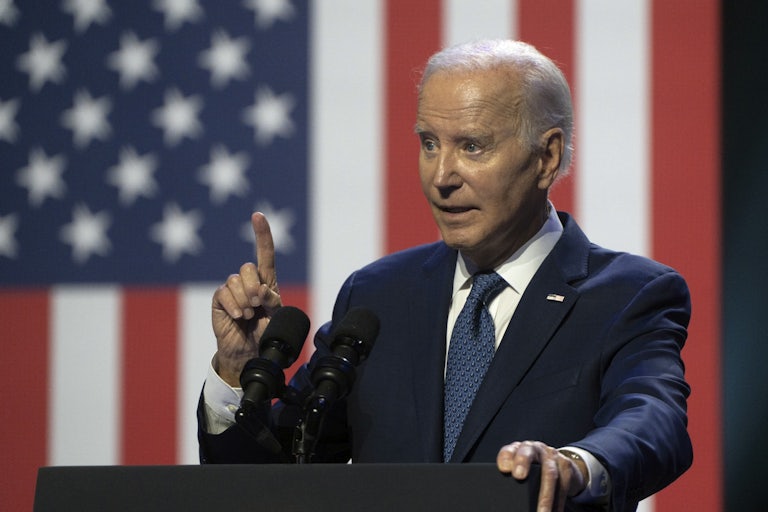
Biden speaking at the Tempe Center for the Arts in Arizona on September 28

President Biden will give what they’re billing as the first speech of his reelection campaign today, and in it, he will attack Donald Trump by name as a historic threat to democracy. An aide told The Washington Post that Biden “is going to be very straightforward on what happened, the truth of what happened, and the role that Trump played in that.”

The speech will arrive, as we approach the third anniversary of the insurrection, in about as bleak a context as we could imagine. Trump leads Biden in most head-to-head polls, albeit just by a point or two. And Republicans are apparently rallying to Trump. A Post poll released earlier this week had some gob-smacking findings showing that Republicans are far less concerned about January 6 than they were right after it happened, and they weren’t very bothered then.

We’re in a surreal hall of mirrors. Trump keeps suffering legal defeat after legal defeat. He’s being tossed off state ballots. His lawyer all but admits he led an insurrection. A new House report details nearly $8 million he made from foreign governments while serving as president. And for now, none of it matters.

This campaign will be about a lot of things, as all campaigns are. But the main question will come down to this and this alone: Will a majority or plurality of Americans use their vote—that is, employ the peaceful means of democracy’s most essential right—to put a violent fascist back in charge of this country?

That the answer isn’t a clear “no” is terrifying. But here’s the thing. Some would argue that the fact that the answer isn’t a clear “no” means that Biden and Democrats shouldn’t emphasize the issue because it’s not a clear winner. I say the opposite is the case. Emphasize the issue and make it a winner. If polls today show that not enough people care about democracy, don’t just follow the polls. Change the polls. Make them care.

Republicans understand this dynamic and have for years. The classic recent example is the Iraq War. After the 9/11 attacks, no one outside a handful of neoconservatives thought they justified waging war on Iraq. But over the course of 2002, the Bush White House changed public opinion. They did it largely through lies, but they did it. By the time the United States invaded Iraq, majorities supported it.

Trump has changed polls too. Pre-Trump Republicans believed a lot of bad things, and I’m certainly not sugar-coating that GOP—which, after all, laid down and gave itself over to Trump. But they did still believe in the general integrity of the American electoral system. No one was urging Mitt Romney to dispute the 2012 election results. Romney conceded on election night (or very early Wednesday morning, technically), and everyone moved on. But by 2016, Trump was saying that he would respect the results “if I win.” And that was all it took. The polls, at least among Republicans, changed and changed dramatically.

Democrats historically don’t do this. When the polls are on their side—as when, for example, George W. Bush tried to privatize Social Security in 2005—they’re as swashbuckling as Blackbeard. (That was one case where the GOP/right-wing media onslaught failed conspicuously to change the polls.) But when the polls aren’t on their side, they’re about as swashbuckling as Caspar Milquetoast.

If they want to make this democracy argument—and I think they’re right to do so—and if they want to win it—and they must—this habit has to change. They need to be mapping out a plan now that stage by stage will lay out an argument to voters (swing voters especially) that by Election Day will have them terrified at the prospect of Trump getting back into the White House. This can, and must, start with January 6. But then, by late spring say, and especially by the fall, the argument should be almost entirely about the future. Attack ad after attack ad simply need to take Trump’s own words, and the words of his people in leaks to media outlets, about how they’re going to impose authoritarianism in his second term. I would anticipate too that, by the fall, Trump will have said as much many times on the hustings, handing the Democrats fresh and irrefutable fodder.

Obviously there are other things the Democrats need to do. They are positioned to win millions of votes on the question of abortion rights. They have to press an economic argument the best they can, and as I wrote Monday, if some economic predictions are right, that could be less of a challenge than it seems like it will be today.

But there is a deep moral and ethical question at the center of this election unlike any other of my lifetime. Will Americans use the tools of democracy to hand their country to a democracy destroyer? They won’t if Democrats refuse to accept the “people don’t care about democracy” argument and make them care.

“Just Like the Ones I Used to Know...”

A Fighting Words quiz on several centuries’ worth of Christmas music.

GraphicaArtis/Getty Images

1. According to Billboard, this is the oldest English-language Christmas carol, dating back to the 1650s:

A. “Silent Night”

B. “Lo, How a Rose E’er Blooming”

C. “God Rest Ye Merry, Gentlemen”

D. “The Holly and the Ivy”

Answer: C, “God Rest Ye Merry.” Read this article. I really like that song. And notice that no, it’s not “God Rest Ye, Merry Gentlemen.” One of the most important commas in all of commadom.

2. There is a theory these days holding that “O Come, All Ye Faithful” was written with secret political intent, as a rallying crying for what cause?

A. The Stuart Restoration of 1660

B. The attempted Stuart retaking of the throne in 1745 under “Bonnie Prince Charlie”

C. The consolidation of the Austrian Empire in 1804

D. Napoleon’s return from exile in Elba in 1815

Answer: B, the Bonnie Prince Charlie episode. So says Bennett Zon, the head of the Music Department at Durham University. What, you know better?

3. According to a 2015 tally by FiveThirtyEight, what is the most covered Christmas song of all time?

A. “Silent Night”

B. “White Christmas”

C. “Jingle Bells”

D. “Have Yourself a Merry Little Christmas”

Answer: A, “Silent Night.” Followed by “White Christmas,” second, and “Jingle Bells,” third. “Have Yourself” was seventh.

4. According to a 2021 YouGov poll, what do Americans think is the worst Christmas song of all time?

A. “Baby, It’s Cold Outside”

B. “Grandma Got Run Over by a Reindeer”

C. “All I Want for Christmas Is My Two Front Teeth”

D. “Santa Baby”

Answer: D, “Santa Baby.” It nosed out “Grandma” by one percentage point, so, within the margin of error. Still, it was liked overall by 68 percent–32 percent. Great trivia here: It was co-written by Phil Springer, who, first of all, is still alive (!) and second of all went on to write songs with Utah GOP Senator Orrin Hatch, who was something of a tunesmith. And there’s more politics to this: The co-composer was Joan Javits, the niece (I think) of longtime liberal Republican New York Senator Jacob Javits. And I don’t see what’s so bad about it. It’s a fine song.

5. And according to a 2021 ranking by SmoothRadio.com, what is the best country Christmas song of all time?

A. “Jingle Bell Rock,” by Bobby Helms

B. “Blue Christmas,” by Elvis Presley

C. “Rockin’ Around the Christmas Tree,” by Brenda Lee

D. “Christmases When You Were Mine,” by Taylor Swift

Answer: C, “Rockin’ Around.” Great song, great guitar, pretty cool sax solo. Brenda Lee was 13 when she record this!

6. Which of these artists has never recorded a Christmas song?

A. Snoop Dogg

B. They Might Be Giants

C. Bee Gees

D. Foo Fighters

Answer: Surprisingly, C, Bee Gees. Look it up! Snoop appears to have done a number of holiday tunes. They Might Be Giants made a Christmas E.P. with five songs, and Foo Fighters recorded Chuck Berry’s classic “Run Rudolph Run,” also covered by Keith Richards and Dave Edmunds.

The Real Problem With Those College Presidents? Gross Incompetence.

Yes, Elise Stefanik set a trap. But the presidents of Harvard, Penn, and MIT didn’t have to walk right into it.

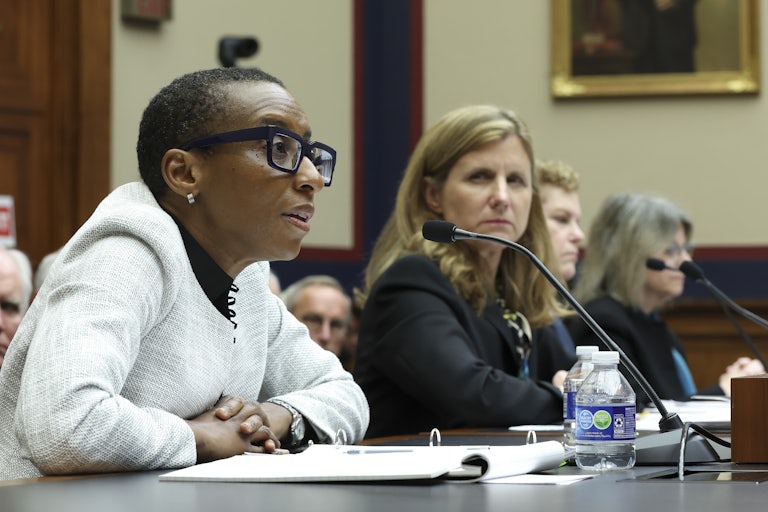
Harvard President Claudine Gay (L) and Penn President Liz Magill
Kevin Dietsch/Getty Images
Harvard President Claudine Gay (left) and Penn President Liz Magill testified before the House Education and Workforce Committee on Tuesday.

Almost everyone has been piling on that pitiful troika of elite university presidents after their congressional testimony on Tuesday. A few other folks, people I know and respect like Michelle Goldberg of The New York Times and Jay Michaelson of The Daily Beast, have added some valuable nuance, arguing that in context, the position the presidents were defending actually had merit.

I agree with the main points both made in their columns—in effect, that Republican Representative Elise Stefanik’s disingenuous grilling of the presidents, which conflated free speech with targeted harassment, set a trap that forced them to appear to equivocate about antisemitism. But I want to make a different point, one that is sharply critical of the presidents on different grounds. I was personally offended by their gross incompetence, and it wouldn’t bother me in the least if they were all fired simply for that reason (if any of them are forced out, of course, it won’t be because of that).

Here’s what I mean. As the president of Harvard, Penn, or MIT, you are by definition one of America’s leading representatives of the liberal values of inquiry, critical thinking, science, anti-superstition, and, yes, free speech. On your home turf, you are confronted from time to time, or maybe more frequently than that, with situations in which some of these values come into conflict with each other, and you have to make a difficult decision. The national media, especially the right-wing media, is monitoring every move you make, every syllable you utter.

You exist, that is, at the center of an ideological tornado. You know this, or should. And you show up to Capitol Hill so unspeakably ill prepared that you—and your coterie of almost-certainly overpaid handlers—haven’t prepped for exactly the line of questioning that Stefanik pressed upon you? Indefensible.

A memorable moment in a 1988 presidential debate helps explain the key error the trio made. CNN anchor Bernard Shaw opened the proceedings by asking Democratic nominee Michael Dukakis about his opposition to the death penalty. “If Kitty Dukakis were raped and murdered,” Shaw asked, “would you favor an irrevocable death penalty for the killer?”

Dukakis restated his opposition to the death penalty with all the ardor of someone reading the phone book (what’s a phone book, you ask? This). The next day, some commentators criticized Shaw for being a little blunt, but mostly people laid into Dukakis for not saying something like: “First of all, Bernie, how dare you talk that way, even hypothetically, about my wife? You should be ashamed. And second of all, if I got my hands on the guy, they wouldn’t need the death penalty.”

Cheap? Theatrical? Sure. But it isn’t insane for people to want to see leaders show a little emotion about emotional things.

These presidents made the Dukakis error. They showed no emotion about one of the most emotional topics in the history of the human race, antisemitism. Harvard’s Claudine Gay said the right words, twice; she said hateful antisemitic speech was “personally abhorrent to me.” But she spoke with all the passion of someone giving a passerby directions to Widener Library.

What she and the others needed to do was show a little passion. Passion would communicate that this actually matters to them in a deep way. And they could still make the point they went on to make. It isn’t complicated. They could have said: “Congresswoman, antisemitism repulses me. When I hear someone say ‘gas the Jews,’ or when I watched those people march with those Nazi-like torches in Charlottesville in 2017, I shake with rage. I will never tolerate that on my campus. And yet, Congresswoman, universities must foster debate and allow free speech, even offensive, disgusting speech. Maybe you don’t understand this. I notice that your civil liberties and free speech vote ratings are nothing to write home about.” Boom: from defense to offense.

I know a lot of liberals will scoff at this point, but it’s quite serious. For better or worse we live in an age of theater, and right-wingers are just really good at theater. We must deal with reality as it is. Countless Americans, likely the majority, are getting their news in sound bites that elide context and nuance—on Fox News, yes, but also in 15-second videos on social media. How do we think that testimony has been playing on TikTok over the last three days?

It should go without saying, but I’ll say it all the same, that I obviously hold no brief for Stefanik. She’s a conscienceless fascist who was once a fairly reasonable conservative but took a sip from the poisoned MAGA chalice in 2016, and her career has been one long brownshirt rally ever since.

But the awfulness of her public persona just reinforces my main point. We are at war in this country. On the one side are the values embodied by Stefanik and Donald Trump and Steve Bannon and the soulless evangelical leaders who know exactly who Trump is but have elevated him to savior status because he wants to eradicate “vermin” like you and me. On the other side are the values represented, however imperfectly, by (among other institutions) our universities, great and not so great.

And if you’re on the liberal side, and you decide to waltz into the lion’s den, you had damn well better be ready. You are charged with defending a way of thinking and living that is under ceaseless attack, and you have a responsibility to represent that way of thinking and living for the rest of us who believe in it but don’t have the opportunity to appear before Congress. These presidents let half a country down, and for that, they should be ashamed.

This article first appeared in Fighting Words, a weekly TNR newsletter authored by editor Michael Tomasky. Sign up here.