Behind the scenes at the Capitol—and beyond, by Grace Segers

When a Failed Pregnancy Becomes a Crime

The Alabama IVF ruling has stoked fears that patients and their health care providers might soon be subject to criminal prosecution in cases where a hoped-for birth goes wrong.

Protestors participate in a 2019 rally against bans on abortions in Montgomery, Alabama.
Julie Bennett/Getty Images
Protestors participate in a 2019 rally against bans on abortions in Montgomery, Alabama.

Last week, the Alabama Supreme Court handed down a ruling that could have devastating repercussions for families hoping to obtain in vitro fertilization treatment, or IVF. The court ruled that frozen embryos outside of the womb are “children,” in accordance with state law allowing civil litigation for the wrongful deaths of children and a 2018 constitutional amendment to protect the rights of “the unborn child.”

This 8–1 ruling protecting the rights of “extrauterine children” thus leaves clinics vulnerable to lawsuits. The lone dissenter, Justice Greg Cook, wrote in his opinion that “the main opinion’s holding will mean that the creation of frozen embryos will end in Alabama.”

The decision in Alabama raises concerns about the “criminalization of pregnancy outcomes,” said Kimya Forouzan, principal policy associate for state issues at the Guttmacher Institute, a research organization that supports abortion access. An outcome as common as a miscarriage could be viewed with suspicion; if an IVF treatment fails to take, that could not only be considered a physical failure of the mother but potentially a criminal one as well. Or, for the clinics that would provide IVF treatments, a power outage caused by a storm could be cause for liability.

The Alabama ruling was the latest salvo in a longtime campaign by abortion opponents to “establish personhood,” that is, to enshrine into law that life begins at conception. That battle has been ongoing in Alabama, where the 2018 constitutional amendment, ratified by voters, requires courts to “recognize and support the sanctity of unborn life and the rights of unborn children, including the right to life.” Last year, the Alabama attorney general said that women who use abortion medication could be prosecuted for violating a law written to protect children from meth-lab fumes.

“In the state of Alabama, for more than a decade, there have been efforts to stretch state laws and amend state laws to apply to fetuses and embryos, and to criminally punish pregnant women,” said Michele Goodwin, a professor at Georgetown Law and expert on abortion law. When the Supreme Court overturned Roe v. Wade in 2022, Goodwin continued, it emboldened state legislatures and courts “to either enact sweeping laws, or to bend precedent, to bend state constitutions, to bend legislation to suit what would be pro-natalist aims and anti-abortion aims.”

Restrictions to abortion access have particularly affected lower-income Americans, many of whom cannot afford to travel to another state to obtain the procedure. With the Alabama decision, a new subset of people—middle- to high-income families struggling with fertility issues—could face the consequences of limited reproductive care for the first time. (This week, the University of Alabama at Birmingham temporarily paused IVF procedures.)

“While there has been a targeting of poor people and their reproductive futures—women of color, certainly, and their reproductive futures—there are categories of Americans that have been able to experience parenthood because in significant ways they could afford to use these technologies,” said Goodwin. “Now what we see is the coming for these technologies, and those communities of people, who will now find themselves vulnerable.”

Meanwhile, days before the Alabama decision was handed down, and a few hundred miles away, a state House committee in Oklahoma approved a bill that would create a database within the Oklahoma State Department of Health to track women who have had abortions, as well as how many they have had, and require physicians to justify why they performed an abortion under oath. It would also prevent Oklahomans from obtaining some over-the-counter emergency contraceptive prescriptions without a physician’s approval, and would place new restrictions on intrauterine devices, or IUDs, a popular form of birth control.

The Oklahoma bill is emblematic of the larger movement across several states. “We have seen throughout the states an effort to ban or limit access to contraception generally,” said Forouzan, pointing to legislation in several states to limit young people’s ability to obtain contraception. This legislation could provide another blueprint for states seeking to restrict access to certain contraception.

“As we monitor the state legislative sessions, as they progress, we see different types of bills start to trend, in a sense. So they’ll have success being implemented in one state, and then in the next session, we’ll see a few states that have introduced them,” Forouzan said. “Often, that can serve to normalize something that we hadn’t really seen before, especially when it comes to abortion restrictions.”

The same goes for litigation: The Alabama decision has already inspired a religious organization to challenge a proposed ballot initiative in Florida to protect abortion rights. “Every human life begins as an embryo, and now the Alabama Supreme Court has upheld the decision of its citizenry that every unborn life should be protected, no matter their stage or location,” said Mat Staver, the chair and founder of Liberty Counsel, which is bringing forward the challenge in Florida.

This development is only to be expected. “What one sees in the wake of the kind of pro-natalism that’s taken hold in the United States is that when one state sneezes, the rest catch a cold,” said Goodwin.

This article first appeared in Inside Washington, a weekly TNR newsletter authored by staff writer Grace Segers. Sign up here.

Vibe Check: A government funding jump scare


Each week, I provide an update on the vibes surrounding a particular policy or political development. This week: Congress is a horror movie, and the need to fund the government is the monster lurking behind the door.

This Monday, we celebrated Presidents’ Day, so named because it happens to fall roughly around the birthdays of noted Aquarians George Washington and Abraham Lincoln. (February 19 actually was Washington’s birthday, which means we get an extra point for accuracy, I guess.)

Congress, as it is wont to do, opted to extend the three-day weekend into a full week away from Washington. (Yes, comms directors, I know lawmakers do work in their districts/states, simmer down.) Which means that when they return, on the evening of February 28, they will have three legislative days to partake in what’s become one of their more regular pastimes: preventing a partial government shutdown. Long ago, in mid-January, Congress approved a “laddered” continuing resolution, extending funding for five federal agencies through March 1, and then for the remaining nine through March 8. This itself was an extension of a previous continuing resolution, but here’s the best part: Unless Congress can pass all 12 appropriations bills in a few days, there will likely be yet another short-term continuing resolution to avert a shutdown.

Representative Mike Quigley, the Democratic ranking member of the Appropriations subcommittee pertaining to transportation and housing, said that he did not believe Congress could approve appropriations bills before the early March deadlines. “You’re never losing money betting against Congress,” Quigley said. When asked if Congress would need to pass another continuing resolution, Quigley replied: “That’s always a safe bet.”

Appropriations Committee staff will still be working to finalize legislation while lawmakers are away from Washington, said Representative Rosa DeLauro, the ranking member of the Appropriations Committee. But some sticking points remain, she added, such as the possible inclusion of so-called “policy riders” that would provide wins for conservative lawmakers otherwise upset by the amount of spending. “Riders are unacceptable,” DeLauro said. “If they decide they’re going to create chaos again around the riders, then the process becomes unglued.”

Continuing resolutions are exceedingly unpopular with many Republicans in the rank and file, so Speaker Mike Johnson has had to lean on the Democratic minority to help push the stopgap measures over the finish line. He will likely have to do so again, using a procedural maneuver that allows legislation to pass with support from two-thirds of the House. Given the narrow three-seat Republican majority, conservative members could otherwise throw hurdles in front of any spending legislation.

If another such short-term resolution is needed, it will likely enrage far-right Republicans even more, potentially threatening Johnson’s speakership. Lest we forget—and truly, how could you?—Speaker Kevin McCarthy was ousted in part because of his compromise to keep the government open last fall. If the government funding bills do pass in “minibus” or “omnibus” form, in which several measures are roped together for one vote, many hard-right members would see that as a further betrayal.

Then there’s the threat of not actually being able to pass any appropriations bill, and instead needing to approve a full-year continuing resolution—an idea opposed by Democrats and Republican hawks, as it would functionally amount to across-the-board spending cuts (including for defense programs). Axios reported this week that given these disagreements, many House Republicans are expecting a government shutdown, even if it only lasts a few days.

Despite the time crunch, some lawmakers remain optimistic. “A lot of these bills are pretty close to done now,” said Representative Tom Cole, the chair of the Transportation and Housing Subcommittee in the Appropriations Committee. However, he acknowledged there were “some disagreements we knew we would kick upstairs” for committee leadership to consider—i.e., the aforementioned policy riders—and he said that some agency funding bills were still being hammered out. At a recent Republican leadership retreat in Miami, Punchbowl News reported, Cole said that he expected congressional leaders to back the spending bills, rather than relying solely on appropriators to push them across the finish line.

Moreover, despite not having passed government funding for fiscal year 2024, congressional appropriations committees will soon begin working on fiscal year 2025. President Joe Biden will also be releasing his proposed budget (*cough* policy wish list) soon.

“This shows you how messed up we are,” said Quigley about the potential overlap in budgets. “This is no way to run a railroad.”

What I’m reading

Control of the House could come down to this New York Republican, by Grace Segers in Politico. (No, I don’t have a doppelgänger who is also a political reporter—I wrote this piece for Politico’s magazine, and you should check it out!)

Everyone knows Sutton Foster can sing. Now we know she can juggle, by Michael Paulson in The New York Times

Matt Gaetz’s chaos agenda, by Dexter Filkins in The New Yorker

Naps, jokes and younger advisers: How octogenarians think Biden can win, by Meryl Kornfield in The Washington Post

Private equity has its eyes on the child-care industry, by Adam Harris in The Atlantic

The hot new luxury good for the rich: air, by Shayla Love in The New Republic

Pet of the Week

Want to have your pet included at the bottom of the next newsletter? Email me: gsegers@tnr.com.

This week’s featured pet was submitted by The New Republic’s own Daniel Pritchett. Norma Jean—not named after Marilyn Monroe—was rescued from ASPCA seven years ago, chosen because she was super shy and sitting alone in a corner of a box. She’s since come out of her shell and is very friendly, playful, and vocal. The only toys she plays with are pom-pom balls, which Daniel describes as “endearing and strange.”

How Tom Suozzi’s Big Win Upended Washington’s Border Wars

His special election victory has Democrats drunk on Long Island iced tea—and hopeful that a winning message just fell in their laps.

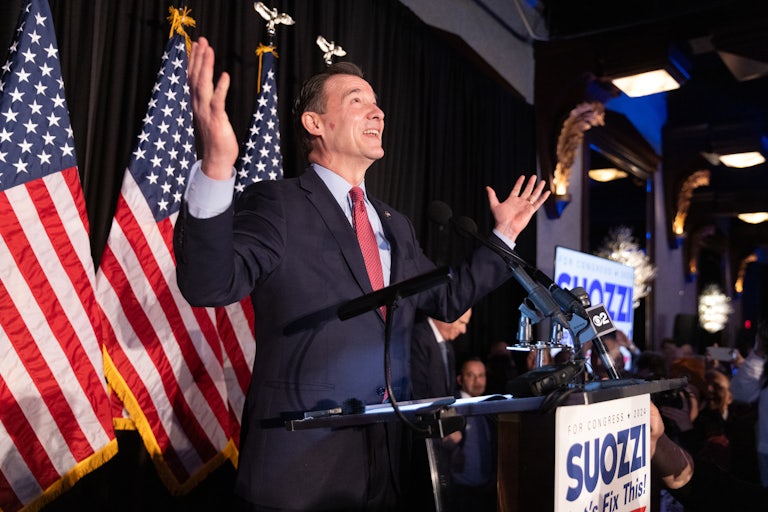
Tom Suozzi celebrates during an election night watch party.
Jeenah Moon/Getty Images
Tom Suozzi celebrates during an election night watch party. Suozzi won the race to succeed ousted New York Representative George Santos.

I know it’s tough, but let’s not read too much into this. Yes, Democrat Tom Suozzi won the special House election vacated after the ouster of George Santos, flipping the Long Island and Queens–based district. But while his defeat of Republican Mazi Pilip can inform how we think about the 2024 elections in the suburbs, there’s a substantial risk of overinterpretation.

First, you better know this district: New York’s 3rd congressional district is one of the wealthiest in the country, with a median salary of nearly $130,000. It is also relatively diverse across racial, ethnic, and religious lines, with significant Asian, Hispanic, Jewish, and Muslim populations. And then there is the “act of God” factor that came into play on Tuesday: Voter turnout was likely disrupted by a massive snowstorm, which resulted in school closures. Democrats had the early voting advantage, while Republicans who were more likely to turn out on Election Day had more trouble traveling to the polls.

There’s also the idiosyncrasies of the candidates to consider: Pilip was a relative nobody with limited political experience, bolstered by the well-oiled machine of the Nassau Republican Party. Suozzi is a former county executive and representative who held the district for six years before unsuccessfully running for governor in 2022, allowing the Biden +8 district to be snatched up by Santos.

Still, it’s instructive to consider the outcome of the election, if not as a true crystal ball then at least as tea leaves. The race was defined by what Lawrence Levy, the associate vice president and executive dean of the National Center for Suburban Studies at Hofstra University, called the “three I’s and one A”: immigration, Israel, inflation, and abortion. Suozzi’s win “shows that a moderate candidate who has ties to the community—and not just to some ideological sliver of it at one extreme or the other—has a real good chance to buck some pretty powerful political trends.”

The topics of immigration and Israel became increasingly salient toward the end of the race. The district has a large Jewish population, including a significant bloc of Orthodox Jews, who tend to be more conservative. (The Ethiopian-born Pilip is, herself, an Orthodox Jew, and served in the Israel Defense Forces.) But immigration was even more critical to the election.

“The issue of the border and migration had a particular salience on Long Island, fed by a daily drumbeat of headlines about migrants arriving by the busload in New York City,” said former Representative Steve Israel, a Democrat who represented the district until 2017. “Immigration and border safety is unquestionably an issue on the minds of voters across the country, but it had special significance for New York voters because of the daily news headlines.”

Republican attacks on Democrats regarding immigration policy were particularly successful on Long Island in 2022; Suozzi used hard-line language on the issue in the waning days of the campaign to counter them. He slammed Pilip for her opposition to the bipartisan border deal that was negotiated in the Senate—and then blocked by the GOP. Suozzi tied Pilip to the transgressions of her would-be Washington colleagues, arguing that she was uninterested in real solutions to addressing the “migrant crisis.”

In a postelection memo, the super PAC affiliated with House Democratic leadership argued that Suozzi offered a blueprint for future Democratic campaigns, saying that “it is imperative for Democrats to take the fight to Republicans and hammer them on their failure to support the Senate’s bipartisan border security bill.” (Or, as Speaker Mike Johnson put it, Suozzi “sounded like a Republican talking about the border.”)

“On contentious issues like the border and immigration, Tom Suozzi taught Democrats that they don’t have to shy away from those issues, but can lean into them,” said Israel. “Essentially, he met voters where they are, and that’s a vital lesson.”

Indeed, according to CNN reporter David Wright, immigration was the top issue by ad spending, with $12.4 million spent on advertisements related to the topic through Sunday. A Pilip-aligned super PAC spent $1.35 million on a 30-second ad that aired during the Super Bowl, bashing Suozzi as “soft on illegal immigration and tough on taxpayers.”

Truly, a frankly bonkers amount of money was spent on a roughly two-month campaign. In the period between October and the end of January, Suozzi raised roughly $4.5 million, compared to $1.3 million raised by Pilip. The race also attracted significant outside spending. The Congressional Leadership Fund, the political action committee associated with House Republican leadership, spent nearly $5 million against Suozzi, according to OpenSecrets. Meanwhile, the House Majority PAC, which is associated with House Democrats, spent nearly $6 million against Pilip.

Suozzi may also have benefited from engaging certain segments of the district, such as the Asian American community. Representative Grace Meng, who represents the neighboring district and lent some of her campaign staff to Suozzi, praised his engagement with the Asian population, particularly in Queens—participating in community meet and greets, hiring staff who spoke multiple Asian languages, and spending money on advertisements in Asian media.

“This is one reason why I wanted Tom to win, was because I want to be able to say to almost every candidate that, ‘hey, when you engage in our community, their voices are being heard,’” said Meng, adding that she hoped this race provided a “blueprint” for future Democratic candidates to reach out to Asian communities.

As someone who spent the majority of her childhood on Long Island, I can confirm: It is an odd political petri dish of suburban mentality, New York bluster, and provincial loyalty. Although Suozzi’s district had begun to pivot to the right in 2021 and 2022—triggered in large part by considerations around crime and immigration—in the special election, it returned to its more natural state of moderate Democratic tendencies.

“In 2024, it reverted to its natural center and centrism,” Israel said.

This article first appeared in Inside Washington, a weekly TNR newsletter authored by staff writer Grace Segers. Sign up here.

Vibe check: Salty about SALT

Each week, I provide an update on the vibes surrounding a particular policy or political development. This week: failure to launch a rule to lift the cap on the state and local tax deduction.

In keeping with the theme of the week, we’ll turn now to a major policy issue for Long Island politicians in particular: the state and local tax deduction, colloquially known as SALT. (It’s also generally a major priority for Republicans in high-tax, typically blue states, but I’m sticking to a motif here.)

In 2017, Republicans in Congress approved massive tax cut legislation. As one of the revenue streams for the nearly $2 billion measure, the law capped the SALT deduction at $10,000 per household. Prior to this law, taxpayers could deduct state and local income, property, and sales taxes with no limit. Although the SALT deduction primarily benefits the wealthy nationwide, lifting the deduction cap has become a major priority for lawmakers representing districts with high state and local taxes in states such as New York, New Jersey, and California.

“Everybody has a perspective.” said Representative Marc Molinaro, a Republican representing an exurban swing district in upstate New York. “Ours is, by no fault of their own, New York taxpayers are overtaxed, and they deserve the same middle-class tax relief as every other American. And our goal is simply to garner what support we can.”

Fast-forward to two weeks ago: Several of these SALT-focused House Republicans were frustrated by the exclusion of a SALT-related provision in a bipartisan tax deal. Four New York Republicans—including three Long Islanders—initially blocked a procedural vote in protest, before allowing the measure to pass with the promise that they would get a vote on a measure to end the so-called “marriage penalty” in the SALT deduction cap. Their legislation, which would double the cap to $20,000 for married couples for the 2023 tax year, was narrowly approved by the House Rules Committee at the beginning of February and faced a procedural vote on the House floor this week. The bill would only apply to couples earning up to $500,000 annually.

Unfortunately for the SALT-y members of Congress, Republicans and Democrats alike, raising the cap is (a) expensive and (b) unpopular with pretty much everyone who doesn’t represent a wealthy, high-tax district. The Penn Wharton Budget Model at the University of Pennsylvania found that the bill to lift the cap would cost roughly $12 billion in lost revenue. The measure would also benefit the wealthy more than the middle class: An analysis by the Tax Foundation found that the proposal would primarily benefit filers earning more than $200,000, while the Tax Policy Center calculated that only one in 1,000 households earning less than $100,000 annually would qualify for a tax cut.

The rule vote for the SALT measure was brought to the House floor on Wednesday evening. It failed, due to opposition from Republicans and Democrats alike. (Lest you think this is only a problem for Republicans, there are SALT-focused Democrats who were disappointed by the lack of movement on the issue when their party controlled the House as well.)

All of the above raises the question: Why prioritize lifting the SALT deduction if it is doomed to fail, sad-trombone style? Perhaps not coincidentally, several of the New York Republicans interested in lifting the marriage cap also represent swing districts and are locked in tough reelection races in 2024. What better way to show that you fought for your constituents’ priorities than pressing for the passage of a bill to ease their tax burden?

Well, a better way would be to actually see it approved. But barring that, a failed rule vote will do the trick.

What I’m reading

The raw talent in Usher’s halftime show, by Hannah Giorgis in The Atlantic

The once and future Democratic Party, by Rebecca Traister in New York

A prescription for housing? by Rachel M. Cohen in Vox

Kristen Stewart uncensored: ‘I want to do the gayest thing you’ve ever seen in your life’, by Alex Morris in Rolling Stone

This year, love and death go hand in hand on Valentine’s Day, by Ruth Graham in The New York Times

Pet of the week


Want to have your pet included at the bottom of the next newsletter? Email me: gsegers@tnr.com.

This week’s featured pets are Darrow (bottom) and Eugene (top), submitted by Brendan Pedersen. Darrow, who is 3 years old, is “physically and emotionally soft,” according to Brendan. He likes to wander around at night and sing the song of his people, and is obsessed with the whooshing sound the Hulu app makes when you open it on a Roku TV. Eugene, who just turned 1, is a recent amputee due to a birth defect in his front left arm. He likes to scream in excitement when he has something he shouldn’t, “i.e., wrapper fished out of the trash.” The defining characteristic of both boys: They love their brother.

The Most Cynical Week in Washington

Behind all the political theater over the now-dead border bill, there is still a humanitarian crisis that’s been left to fester.

Senator James Lankford at the U.S. Capitol on February 7
Chip Somodevilla/Getty Images
Senator James Lankford at the U.S. Capitol on February 7

The national security supplemental legislation that included a controversial bill on border and asylum policy—which failed to even scrounge up 60 votes in the Senate on Wednesday—was the result of months of negotiations, yet ended in foreseeable defeat. So foreseeable, in fact, that Senate Majority Leader Chuck Schumer immediately replaced it on the floor with a bill that included aid to Ukraine, Israel, and the Indo-Pacific region—without any border provisions. The second supplemental advanced on Thursday afternoon, with more votes expected over the weekend.

Nonetheless, the first national security supplemental proposed this week, and the bipartisan border bill contained within, was significant for two reasons: its politics and its policy. Less than 24 hours after its release, Senate Republicans immediately torpedoed the prospects of the bill negotiated in part by one of their own—GOP Senator James Lankford—because they found it insufficiently stringent.

Even though the border legislation will not become law, it’s worth considering its substance: It could provide a framework for future legislation or—perhaps more likely—yet another cautionary tale as to why substantive immigration-related measures are doomed to fail in the modern political era.

Substantively, the initial supplemental contained controversial elements regarding asylum, immigration, and border policy, which left many humanitarian and immigrant rights groups concerned. Not only was this legislation insufficient to solve any of the problems the bill purported to solve, these organizations say, but serious unaddressed issues will remain long after the media stops gawking at this week’s legislative wreckage.

“It doesn’t do anything to solve the root of the problem, which is that our immigration system hasn’t been overhauled since 1986,” said Mark Hetfield, the president and CEO of HIAS, a refugee resettlement organization. “The entire asylum system is bearing the burden that we haven’t updated our immigration laws to make sure they meet the labor needs of the country.”

The border legislation would have made significant changes to the backlogged asylum system. It would have made it more difficult for migrants to claim asylum, requiring them to show greater proof that they have a “credible fear” of facing persecution upon returning to their home countries. It would attempt to streamline the appeals process by functionally excising immigration courts, granting those decisions to internal review boards. It would include around $3 billion for Immigration and Customs Enforcement to expand detention capacity.

The measure would also require the Department of Homeland Security to shut down the border if illegal crossings exceed 5,000 migrants over a week, or 8,500 in one day; the administration would also be able to shut down the border if crossings exceed 4,000 daily for a week. The border would only reopen if crossings dropped to 75 percent of that number over the course of a week. (This was a provision that many Republicans found to be unsatisfactory, contending that it allowed for too many crossings.)

Krish O’Mara Vignarajah, the director of the refugee resettlement organization Global Refuge, called that provision “deeply unsettling” because it would require the expulsion of migrants seeking asylum without recourse, and thus perhaps even a violation of international agreements like the Refugee Convention.

“I think at the end of the day, we all understand that bipartisanship requires compromise. But lawmakers have to ask themselves, does it require us to compromise our nation’s core values?” O’Mara Vignarajah said. “We’re trying to support the effort to fix the system but also ensure that it doesn’t preclude people in the most desperate of circumstances from exercising a legal right.”

There are elements of the legislation that humanitarian organizations would support, including offering 250,000 new visas for migrants who wish to work in the United States or join family members, making asylum-seekers eligible for work permits as they wait, and providing a pathway to citizenship for children of immigrants who came to the U.S. on certain work permits. However, as Hetfield put it, “the good stuff doesn’t compensate for all the bad stuff.”

Hetfield argued that economic circumstances “demand” immigration reform to help address the labor shortage. Many migrants are using the asylum system to get into the U.S. for work, he continued, even though that process is not designed for such a purpose. “What really drives me crazy is this line that Republicans have been giving for years, which is that ‘first we have to fix the border,’” Hetfield said. “It is one ecosystem.”

This article first appeared in Inside Washington, a weekly TNR newsletter authored by staff writer Grace Segers. Sign up here.

Vibe check: Update on the Afghan Adjustment Act

Each week, I provide an update on the vibes surrounding a particular policy or political development. This week: the future of a key bill to aid Afghan allies.

There were other elements of the initial legislation that did not make it into the second supplemental proposal, including a version of the Afghan Adjustment Act: a bill that would grant Afghan evacuees paroled into the U.S. after the withdrawal from Afghanistan a way to obtain permanent residency, and that would expand and streamline the Special Immigrant Visa process for allies still trapped in Afghanistan. Veterans groups and humanitarian organizations have been lobbying to pass the bill for years.

“We’re very unhappy about it not being in the bill right now,” said Senator Richard Blumenthal, one of the co-sponsors of the Afghan Adjustment Act.

The initial exclusion of the Afghan Adjustment Act was a major blow to the tens of thousands of Afghans paroled into the U.S., the allies still in Afghanistan, and their advocates stateside. However, there was a fervent behind-the-scenes effort by the bill’s supporters in the Senate to ensure it would receive a vote as an amendment—assuming, of course, that the underlying second supplemental could advance.

“We are trying to get a vote on that amendment,” Senator Chris Coons, one of the bill’s co-sponsors, told me on Wednesday afternoon. “There’s a strong bipartisan group that would support it.”

Although it was unclear whether there would be votes on amendments at the time of publication, the Afghan Adjustment Act might be a relatively popular addition.

“If it gets offered as an amendment, I’ll be voting for it,” said Senator Thom Tillis, a Republican co-sponsor of the Afghan Adjustment Act. “I’ve got to imagine that there are several members that would want to offer that up as one of the amendments.” Such an amendment might be brought by Senator Amy Klobuchar, who introduced the legislation in the Senate and has helped drive the behind-the-scenes effort to attach it to the supplemental.

Representative Earl Blumenauer, who introduced the bill in the House, said on Wednesday that the Afghan Adjustment Act is “noncontroversial” and has bipartisan support. (The bill is not entirely “noncontroversial”—GOP Senator Chuck Grassley previously blocked it due to concerns over vetting of parolees, even though the legislation would include an additional vetting process.)

But Blumenauer also highlighted the chaos that has consumed Congress, indicating that across-the-aisle endorsements may not be enough to get this portion over the finish line. “It’s a crazy time. I mean, who knows?” Blumenauer said.

For refugee advocates, the inclusion of the Afghan Adjustment Act in the initial supplemental legislation was a positive step forward—even if it didn’t make up for the provisions they did not like. “When you work in the immigration space, you’ve got to have hope,” said O’Mara Vignarajah. “But it still feels like an uphill battle.”

What I’m reading

Billy Joel said he’d retired from pop. Here’s what brought him back, by Caryn Ganz in The New York Times

It was a pleasure just to watch Carl Weathers move, by Matt Zoller Seitz in Vulture

We all know we should save the whales. What about the sardines? by Russell Jacobs in Slate

Team Cow or Team Soy: The milk wars roiling America, by Kristina Peterson in The Wall Street Journal

TikTok is full of tryhard slang, by Rebecca Jennings in Vox

Pet of the week

Want to have your pet included at the bottom of the next newsletter? Email me: gsegers@tnr.com.

This week’s featured pets are Bandit (left) and Cleo, submitted by Tal Kopan. The two are 7-year-old littermates; their favorite things include cuddles, scratchies, loudly hunting their toys in the middle of the night, and sharing Goldfish crackers for snack with their human sister.

Is Washington Writing the Script for the Next Forever War?

The Biden administration's open-ended escalations in the Middle East are starting to feel like the sequel to a bad movie.

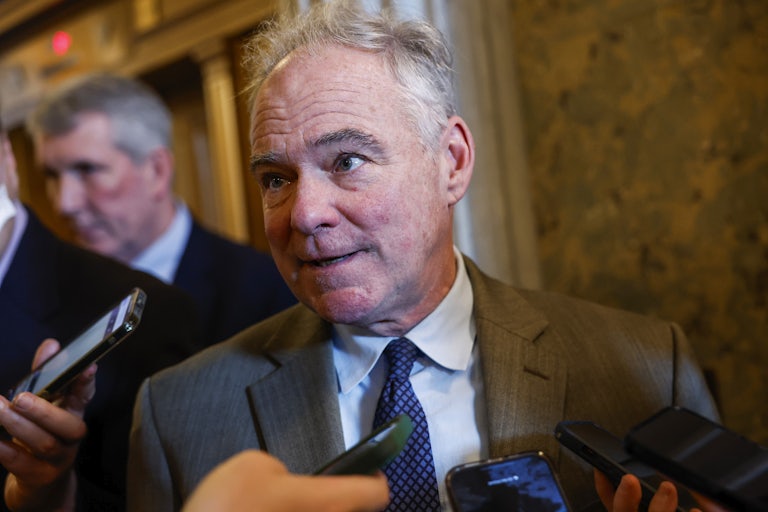
Sen. Tim Kaine speaks to reporters during a vote in the Senate Chambers of the U.S. Capitol Building on January 25, 2024 in Washington, DC.
Anna Moneymaker/Getty Images
Sen. Tim Kaine speaks to reporters during a vote in the Senate Chambers of the U.S. Capitol Building on January 25, 2024 in Washington, DC.

INT. U.S. CAPITOL—OUTSIDE THE SENATE CHAMBER ON JANUARY 30, 2024

It’s been a few days since three U.S. service members were killed in a drone strike by an Iran-backed militia in Jordan. President JOE BIDEN has said that the U.S. “shall respond” but has not given details about what that response will be. Given the various ongoing conflicts in the Middle East—including Israel’s war against Hamas in Gaza, and recent U.S. airstrikes against Houthis in response to their disrupting traffic in the Red Sea—reporter GRACE SEGERS wonders whether lawmakers are concerned that the U.S. might become embroiled in yet another “forever war” in the Middle East. She questions senators across the ideological spectrum about this possibility.

Enter Senator TIM KAINE, a Democrat from Virginia who has co-sponsored legislation to repeal the 1991 and 2002 Authorizations for the Use of Military Force in Iraq.

KAINE:  We shouldn’t be in another war in the Middle East, but particularly without a congressional debate and vote. So self-defense is one thing, but escalating regional conflict with the U.S. involved and our troops at risk is something that should not happen without a congressional debate and vote.

Camera pans to the Senate basement. Grace asks Senator MIKE ROUNDS, a Republican from South Dakota, if he’s worried about the U.S. getting entangled in a larger conflict in the United States.

ROUNDS:  Sure, everybody should be. If we continue down this policy of not dealing with the problem children in the Middle East, yes. It started with a very, very poor policy with regard to Afghanistan, and now it’s continued on … where if you don’t deal with these individuals that are causing the problem up front, then they just continue to test the waters.

GRACE:  Isn’t there the threat that if you go down that route of responding, that then it could end up in a tit-for-tat?

ROUNDS:  We know what happens when you’re in a tit-for-tat, which is what we’re in right now. Where all we do is, just kind of push them a little bit, and then they go, “Oh, that wasn’t so bad.” So then they push back, and now they’re killing Americans. Bottom line is, they have to fear us, and they have to respect our military.

Back outside of the Senate chamber, we turn to Senator JOSH HAWLEY, a Republican from Missouri who has been skeptical of U.S. involvement in foreign conflicts.

HAWLEY:  We’ve got to find a way to isolate Iran, to cut off any kind of support from the international community, to return to something like we had in the previous administration, where they really were truly isolated. Their revenues were way down. I mean, that’s got to be our goal while we continue our pivot toward the Pacific, where our biggest enemy is in China, where our biggest national security threats are.

GRACE:  I think everyone wants to avoid another type of “forever war,” but do you feel as if there are steps that could be taken where the U.S. could go in that direction again?

HAWLEY:  I’m leery of anything that would get us more involved in the Mideast in terms of central command—the central command area of authority—in terms of more manpower, more hardware. We have finite resources, and we have threats all over the world, but we have to prioritize.… Do I want to do nothing with Iran? No, I think we need to retaliate. We certainly need to isolate them. But I think we want to be careful that we don’t find ourselves embroiled, we don’t take actions that can embroil us in a major military conflict.

INT. U.S. CAPITOL—IN THE SENATE BASEMENT ON JANUARY 31, 2024 Enter Senator CHRIS COONS, Democrat from Delaware, a close ally of Biden.

GRACE:  I’m wondering if you’re concerned at all—

COONS:  “Wondering if you’re concerned.” Oh, my. That’s quite a way to frame it.

GRACE:  Sure.

COONS:  Let’s try again.

GRACE:  How do you feel about the possibility that what’s happening in the Middle East could escalate into another type of “Forever War” that the U.S. could be embroiled in?

COONS:  (Laughs, shakes head) Well, that’s about as negative a way as you could possibly characterize it. “Are you concerned about another Forever War?” I mean the answer to any formulation like that is going to be, “Of course I’m concerned.” Let’s put it differently: How confident am I that President Biden is clear eyed about the risks in the Middle East and is taking measured, responsible steps to both deter aggression and defend our troops and yet avoid a regional conflagration? Highly confident.

One of the great things about having a president with 50 years of experience in foreign policy is, he’s very, very aware of the difficulties, the tension, the competition in the region; the differences between the Houthis, Hezbollah, Hamas; the different militias in Syria and Iraq; and the overarching role that Iran is playing. But I’m confident that he is carefully balancing how to deter Iran, how to strike back in a way that shows a firmness and determination to protect American troops, with an eye towards avoiding broadening the conflict.

Camera pans to GRACE, who looks directly into the lens as she offers the following analysis.

GRACE:  It’s still unclear to what extent the U.S. will become further engaged in conflicts in the Middle East in the coming weeks. While senators agree that Iranian-backed aggression should not go unheeded, the correct path for de-escalation is uncertain. While the prospects of another “forever war”—à la Afghanistan or Vietnam—are unappealing, time will tell whether the current conflict will evolve into a full-blown sequel.

Vibe check: Senate Republicans iffy on Mayorkas impeachment

Each week, I provide an update on the vibes surrounding a particular policy or political development. This week: how Senate Republicans are reacting to the impending impeachment of Homeland Security Secretary Alejandro Mayorkas.

The House Homeland Security Committee advanced articles of impeachment against Mayorkas early on Wednesday morning, after a brutally long and contentious hearing. (Readers will be unsurprised to learn that the articles, which have been decried by Democrats as a “political sham,” passed along party lines.)

With the full House expected to vote on the articles imminently, the Senate may soon undertake its third impeachment trial in five years—albeit the first trial for a Cabinet official in a century and a half. The outcome is a foregone conclusion: Sixty-seven senators would need to convict Mayorkas for him to be removed, which would never happen in the Democratic-controlled Senate. The impeachment discussion also comes as bipartisan negotiators toil over a legislative deal on border security, although it is one that House Republicans—spurred by former President Donald Trump—have insisted will be DOA in the lower chamber.

For their part, Senate Republicans are feeling mixed about the House sending articles of impeachment for Mayorkas their way. When I asked Senator Mitt Romney whether he believed an impeachment trial was the best use of the Senate’s time, he bluntly replied: “No.”

Senator Todd Young, who previously expressed frustration with the speedy timelines of the two Trump impeachment proceedings, highlighted “the importance of some measure of due process and building a very strong factual foundation before you impeach.”

“Otherwise you end up … with snap impeachments. I predicted this was what would happen. It is happening,” Young said. “There was a rush to impeach. There’s a rush to dispense with our consideration of the impeachment.”

Indeed, it’s possible that the Democratic-controlled Senate may try to avoid the issue altogether by moving to table the articles. “It’s going to be up to Senator Schumer how to proceed over here, I suspect,” predicted Senator John Cornyn, who is “all for” the House’s impeachment effort. “I suspect [Democrats] might try to table impeachment, which will take 51 votes, because they probably don’t want additional attention to their failures.”

Schumer, the Democratic majority leader, did not commit to a decision on holding a trial, saying the Senate will “see what the House does first.”

Even those who approve of the House’s actions could be noncommittal about the prospects of a trial. Senator Tommy Tuberville appeared broadly supportive of the effort, saying he was glad the House is “doing their work.” However, when asked about whether a trial would be a valuable use of time, Tuberville said, “Well, not our time, but their time.”

What I’m reading

The band that’s been charting America’s burnout for decades, by Spencer Kornhaber in The Atlantic

Are we sliding toward McCarthyism? by Emily Tamkin in The New Republic

​​Prisoners in the US are part of a hidden workforce linked to hundreds of popular food brands, by Robin McDowell and Margie Mason in the Associated Press

Tammy Murphy and the nepo state, by Simon van Zuylen-Wood in New York

Chita Rivera, electrifying star of Broadway and beyond, is dead at 91, by Robert D. McFadden in The New York Times

Pet of the week

Want to have your pet included at the bottom of the next newsletter? Email me: gsegers@tnr.com.

This week’s featured pet is Babs, submitted by Eleanor Mueller. The 6-year-old Babs acts exactly like a dog, according to Eleanor, even coming running when you walk in the door and climbing on top of you any time she can.

Lawmakers Want Biden to Ask Permission Before Bombing Yemen Indiscriminately

The administration's escalation of an open-ended conflict with the Houthis has reawakened the long-running debate over who has the power to go to war.

Tom Williams/Getty Images
Senators Tim Kaine (left) and Todd Young

As tensions in the Middle East escalate, some lawmakers are questioning whether the Biden administration can authorize attacks against the Houthi militants in Yemen without the express consent of Congress.

“We just need to get clarity about their perception about their legal authorities and the implications of those understandings moving forward. The American people want us to duly deliberate before committing to some sort of sustained action against the Houthis or others,” said Senator Todd Young, a Republican member of the Foreign Relations Committee who has helped lead efforts in the Senate to overturn the 2002 Authorization for Use of Military Force, or AUMF, that justified American action in Iraq. 

This month, the Biden administration authorized multiple strikes against the Houthis, an Iranian-backed organization based in Yemen that has disturbed traffic in crucial shipping lanes connecting to the Suez Canal. The Defense Department has characterized strikes against the Houthis as “defensive,” citing “imminent threat” of attack to merchant ships and U.S. Navy vessels. The Houthis began attacking commercial ships in the Red Sea in response to Israel’s military campaign in Gaza.

“I know of no definition of self-defense that includes protecting foreign flagships. It might be a really good thing to do—but what’s the legal justification for it?” Democratic Senator Tim Kaine, the other leader of efforts to overturn the 2002 AUMF in the Senate, told me on Tuesday. “There’s a ‘What’s the strategy?’ question. And since the administration said they expect more escalation, and that’s what’s happening—OK, then, well, what’s the plan to de-escalate?”

Indeed, President Joe Biden himself has acknowledged that, despite failing to dissuade the group from attacking vessels traveling through key sea lanes, the campaign against the Houthis may be open-ended: “Are they stopping the Houthis? No,” Biden said last week. “Are they going to continue? Yes.”

(Insert extremely quick primer: The Houthis control a portion of territory in Yemen, and a Saudi-backed campaign to uproot them—supported by the United States—proved to be largely ineffective; a truce was eventually implemented in 2022. That conflict displaced millions of people and further exacerbated a humanitarian crisis in the Middle East’s poorest country.)

On Tuesday, Young and Kaine were joined by Democratic Senator Chris Murphy and Republican Senator Mike Lee in sending a letter to the White House asking for more details on the administration’s strategy in responding to Houthi attacks. While the senators said they “support smart steps to defend U.S. personnel and assets” and “hold the Houthis accountable for their actions,” they “further believe Congress must carefully deliberate before authorizing offensive military action.”

“The Administration has stated that the strikes on Houthi targets to date have not and will not deter the Houthi attacks, suggesting that we are in the midst of an ongoing regional conflict that carries the risk of escalation,” the senators said, adding that there is “no current congressional authorization for offensive U.S. military action against the Houthis.” Kaine separately told me that his office has been in contact with White House staff but has not yet received a satisfying response as to the administration’s strategy against the Houthis.

Some lawmakers in the House have also raised concerns about the president’s authority to launch strikes against the Houthis. In an op-ed in The Nation last week, Democratic Representative Ro Khanna argued that Biden has “both the constitutional obligation and a political imperative” to seek authorization from Congress.

“Conducted with extensive planning and in coordination with five other countries, the multiple rounds of US airstrikes in Yemen are retaliatory strikes for deterrence, not defense,” said Khanna.

It’s not just the strikes against the Houthis that have members of Congress scratching their heads. Young and Kaine also each expressed bafflement at the Biden administration’s use of the 2002 AUMF to justify airstrikes in Iraq earlier this month. The White House said the strike was justified by Article 51 of the United Nations charter, which outlines a nation’s right to self-defense, as well as the 2001 and 2002 AUMFs.

“We could not understand, like, what was the [White House] counsel’s office thinking? And we still haven’t gotten a good answer,” said Kaine.

Young, who described himself as a “recovering attorney,” told me on Tuesday that it was a “mistake” to cite the 2002 AUMF for the Iraq strikes, calling it an “untenable position.” 

“Sometimes attorneys can get carried away. And that’s what happened in this case, which is what led the administration to a nonsensical and inconsistent position,” Young said. “The 2002 AUMF was drafted and passed for the narrow purpose of ensuring that we could go to war against Saddam Hussein’s regime. Saddam Hussein is dead, last time I checked—still dead, still very dead. And that AUMF is no longer in effect as a matter of law.”

The House voted in 2021 to repeal the 2002 AUMF. The Senate repealed the 1991 and 2002 AUMFs on a bipartisan basis last year, although that second measure has not made progress in the now Republican-controlled House. The recent strikes in Yemen—and, to a lesser extent, in Iraq—are once again raising questions about how far a president can go without congressional authority. Even in a divided and often dysfunctional Congress, some lawmakers argue that debating to authorize use of force in the legislature is a necessary next step.

“My anticipation would be that the president’s hand would be substantially strengthened if he came to Congress before committing to any longer-term action,” Young said.

This article first appeared in Inside Washington, a weekly TNR newsletter authored by staff writer Grace Segers. Sign up here.

Vibe check: The Chevron conundrum

Each week, I provide an update on the vibes surrounding a particular policy or political development. This week: how lawmakers are reacting to a Supreme Court case with far-reaching effects.

The Supreme Court appears poised to overturn a key precedent that empowers federal agencies, which would in turn raise the level of specificity required for  Congress to draft regulatory laws to a near-impossible standard of complexity.

In oral arguments last week, conservative members of the court seemed skeptical of the so-called Chevron doctrine,” a precedent that grants agencies authority to interpret congressional statutes when intent is unclear. The 1984 case that established the Chevron doctrine is one of the most cited cases in recent legal history; if overturned, it would transfer authority from executive agencies to the courts to determine legislative intent.

Although the Chevron doctrine was established during and supported by the Reagan administration, recent support for or opposition to it has largely fallen along party lines, with Democrats in favor of preserving agency authority and Republicans opposed.

“The Supreme Court is considering a power grab designed to make day-to-day governance less effective and to give the courts more power in determining every detail of how government works,” said Senator Elizabeth Warren, who joined an amicus curiae brief supporting the doctrine along with other Democratic senators. “Instead of having scientists, for example, figure out the safety standards on nuclear energy, overturning the Chevron doctrine would mean courts could make that decision.”

But Republicans argue that Congress should be more specific in outlining statutes, contending that changing administrations allow agencies to interpret laws differently based on who is in office. “For too long, Congress has been content to punt decision-making to unelected bureaucrats in the executive branch,” said Senator Ted Cruz, who led several other Republican lawmakers in an amicus brief urging the court to overturn the precedent. “The growth of the administrative state has allowed politicians to avoid accountability to the people.” (However, the Supreme Court justices—who would almost definitely end up deciding what actions taken by regulatory agencies are kosher and which aren’t—are just as unelected and perhaps even less accountable to voters than executive branch bureaucrats.)

Senator Josh Hawley, another Republican opponent of the doctrine, said that “Congress has deliberately given up authority to agencies.”

“And then, you know, we whine about it all the time. ‘Oh, these agencies, they pay no attention to us.’ Well, that’s because we’ve given them wide-open discretionary authority,” Hawley told me. He echoed the common Republican belief that agencies functionally amount to a “fourth branch of government,” unaccountable to Congress or the executive (a Deep State, if you will).

Still, requiring Congress to be more specific in developing statutes would require a degree of granularity lawmakers are not used to considering. Moreover, supporters of the doctrine argue that leaving a statute up to the courts would not necessarily ensure stability in interpretation, because conservative and liberal justices may rule differently on a law: This could ultimately bring a statute before the conservative-majority Supreme Court for final decision, which has shown itself to be largely hostile to government regulation.

Democratic Senator Sheldon Whitehouse—who led the brief supporting the doctrine and has pointed out the ties between the conservative Koch network and the plaintiffs in one of the Supreme Court cases under consideration—said that agencies are already held accountable.

“Look at all the CRAs we’ve done in this building,” Whitehouse said, referring to votes to undo agency actions under the Congressional Review Act. “Look at the appropriations riders that get put on, look at all the Oversight Committee work, look at what’s happening to [Homeland Security Secretary Alejandro] Mayorkas on the House side, and tell me that Congress doesn’t oversee agencies.”

Whitehouse, who has pressed for the Supreme Court to adopt a formal ethics code, also argued that the judicial branch may not be the best venue for interpreting laws. “Even if it were true, which it isn’t, the idea you could solve an accountability problem by moving the locus of decision to an even less accountable part of government, shows how little this argument makes sense,” Whitehouse said.

What I’m reading

NJ race to replace Menendez pits insiders vs. grassroots backlash, by Jonathan Tamari in Bloomberg

She filed a complaint after being denied an abortion. The government shut her down, by Caroline Kitchener and Dan Diamond in The Washington Post

A small town struggles to survive in the heart of Mississippi’s hospital crisis, by Devna Bose in Mississippi Today

‘It’s embarrassing’: Republicans worry they have no achievements to run on in 2024, by Sahil Kapur in NBC News

The menu trends that define dining right now, by Priya Krishna, Tanya Sichynsky, and Umi Syam in The New York Times

Fetterman’s break from the left excites Republicans, by Ursula Perano in Politico

Pet of the week

Want to have your pet included at the bottom of the next newsletter? Email me: gsegers@tnr.com. 

This week’s featured pets are Ruby and Layla, submitted by Ally Boguhn. Ruby is a Boston terrier–French bulldog mix, and Layla is also a Boston terrier mix. The two pups, who are both rescues, like to hang out together in the sun. Fun fact about Layla: She can jump through hoops, a talent she enjoys sharing with guests at parties.