Breaking News
Breaking News
from Washington and beyond

The Disturbing Footnote in Supreme Court’s Trump Immunity Ruling

In a short footnote, Chief Justice John Roberts says the federal cases against Donald Trump cannot continue if he is elected.

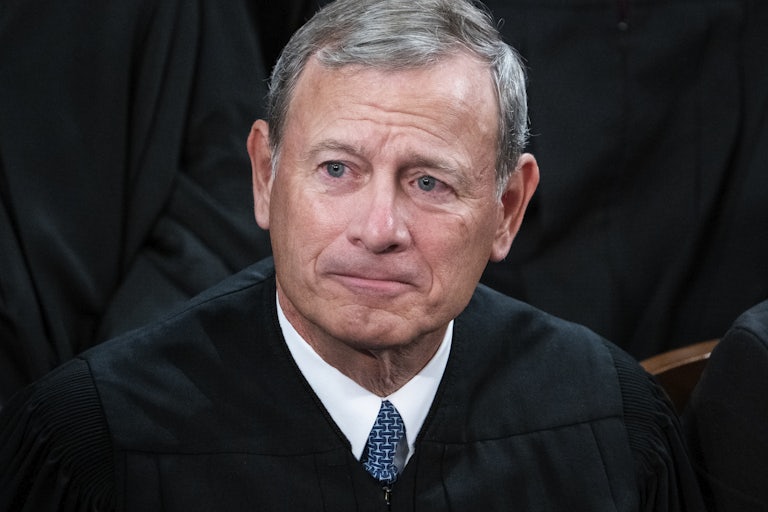
Chief Justice John Roberts looks up
Leah Millis/Pool/Getty Images)

As a part of the U.S. Supreme Court’s ruling Monday on presidential immunity, the highest court in the land officially determined that a sitting president cannot be criminally prosecuted, promising an abrupt end to some of Donald Trump’s remaining criminal trials should he be elected in November.

While the Department of Justice has long held that a sitting president cannot be criminally prosecuted, the Supreme Court has never explicitly ruled on the issue—until now. In one brief footnote of his majority opinion granting sweeping protections to the president, Chief Justice John Roberts reaffirmed the department’s rule.

“Our decision in Clinton permitted claims alleging unofficial acts to proceed against the sitting President,” he wrote, referring to Clinton v. Jones, a civil suit brought against former President Bill Clinton over conduct from before he was president. “In the criminal context, however, the Justice Department ‘has long recognized’ that ‘the separation of powers precludes the criminal prosecution of a sitting President.’”

The decision in Trump v. United States has gutted Jack Smith’s indictment alleging that the former president attempted to overturn the results of the 2020 presidential elections; it also makes clear that if Trump is elected, he won’t face justice for crimes committed out of office, either.

If he makes it back into the White House, Trump will likely never face trial over allegations that he illegally kept a trove of classified documents and obstructed their return, a trial that has faced significant delays at the hands of a Trump-appointed judge, pushing its start date to well after the election.

The Supreme Court decision further incentivizes Trump to do anything necessary to seize the presidency in November, so that he can evade prosecution for his alleged crimes. This significantly increases the vigor with which the former president will oppose the results of the democratic elections if he doesn’t come out victorious.
Steve Bannon Press Conference Outside Prison Ends in Total Disaster

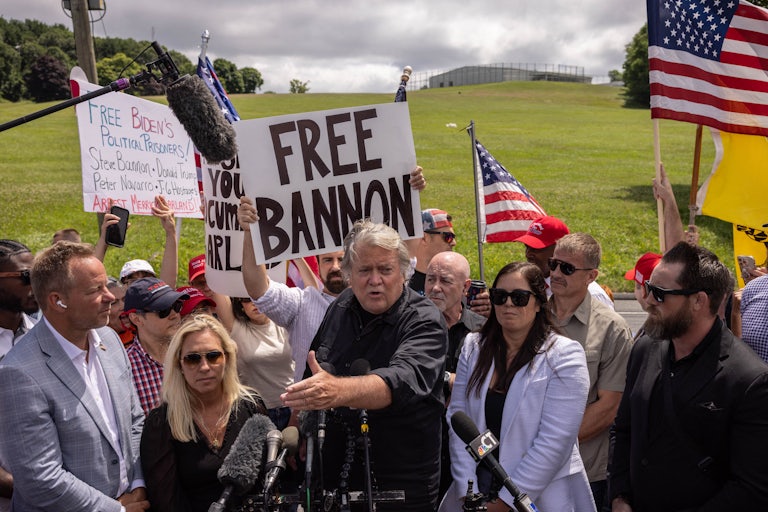
MAGA mastermind Steve Bannon tried to offer his last words before heading to prison. It did not go to plan.

Steve Bannon and Marjorie TAylor Greene hold a press conference
YUKI IWAMURA/AFP/Getty Images

As Steve Bannon turned himself in to Danbury federal prison in Connecticut on Monday to serve out a four-month stint for refusing to testify to Congress for his role in the January 6, 2021, Capitol insurrection, demonstrators led by ruckus royalty Anarchy Princess carried signs reading, “Bleach blonde bad built butch body” behind Bannon ally Marjorie Taylor Greene and smirkingly chanted, “Lock him up” against competing chants of “USA,” which inadvertently aided in the cacophony.

Demonstrators drowned out the MAGA press conference with cowbells and chants, making Bannon’s last words before heading off to the big house indecipherable.

Bannon was found guilty on two counts of contempt of Congress after refusing to comply with a congressional subpoena in 2022 and sentenced to four months in federal prison. He unsuccessfully attempted to appeal his conviction, with the Supreme Court refusing to save him just last week. Greene has fumed at Bannon’s conviction, calling it “a DISGRACE to our country, and an affront to the principles of justice it was founded upon.”

Anarchy Princess first came to prominence when she stood behind Trump ally Peter Navarro during his own press conference after he too was found guilty of contempt of Congress, in September 2023. During that presser, Anarchy Princess’s simple yet effective antics ruffled Navarro’s feathers so much he attempted to take her sign blazoned with the words “Trump lost (and you know it!),” which she deftly kept out of his reach as she reminded him, “You’re already facing charges.”

Bannon will be in prison until just before the general election, serving his time in a facility slightly less glamorous than the “Club Fed” minimum-security facility he had hoped for, due to yet another open criminal case against him in New York.* Bannon is accused of defrauding donors with empty promises to build a border wall. He pleaded not guilty to charges of money laundering, fraud, and conspiracy in September 2022 and is expected to stand trial this September in the same courthouse that convicted Trump.

* This article originally misstated when Bannon will get out of prison.

The Most Chilling Line in Supreme Court’s Trump Immunity Ruling

The court not only handed Donald Trump ultimate power, but it also gave him an extra boost to handle future trials against him.

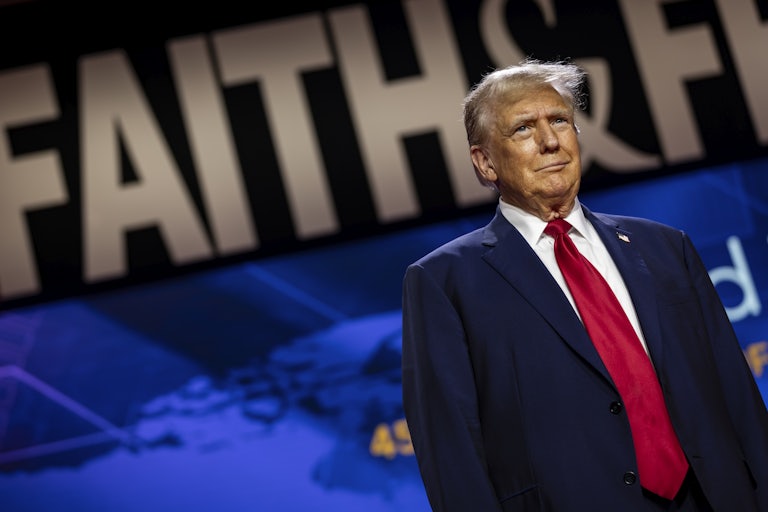
Donald Trump stands and smiles weirdly
Samuel Corum/Getty Images

With its ruling in favor of presidential immunity Monday morning, the Supreme Court has heavily undermined much of the evidence expected to be used against Donald Trump in his pending criminal trials. 

In the ruling, the court stated that “testimony or private records of the President or his advisers probing such conduct may not be admitted as evidence at trial,” referring to anything a president does as an “official” act.

Much of the evidence gathered against Trump in his January 6 trial, for example, relies on what he said to his advisers and to Vice President Mike Pence, as well as records that were kept on such discussions in the White House. It could also erase evidence of Trump speaking to lawmakers on the evening of January 6 to delay the certification of Biden’s victory. According to the Supreme Court, all such evidence is now unusable, an interpretation that, fortunately for Trump, guts that case against him. 

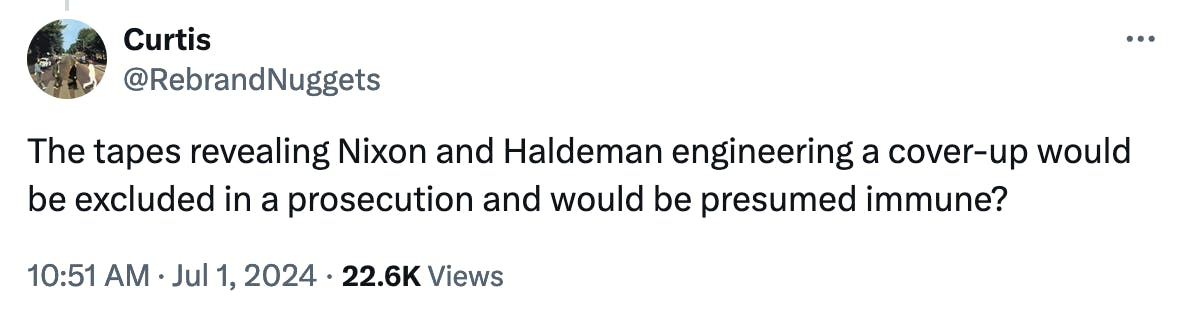
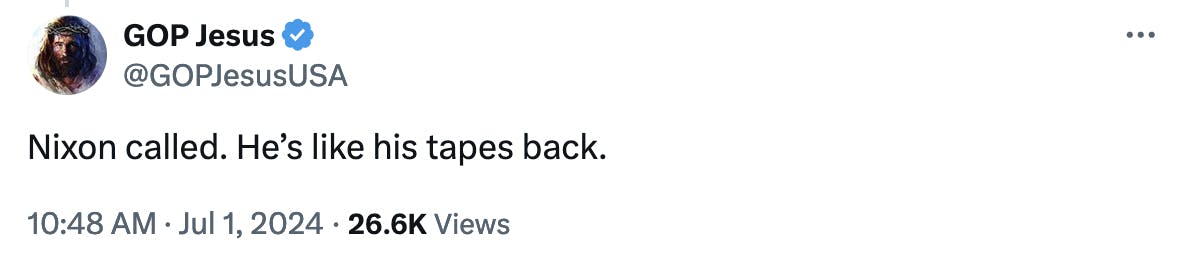
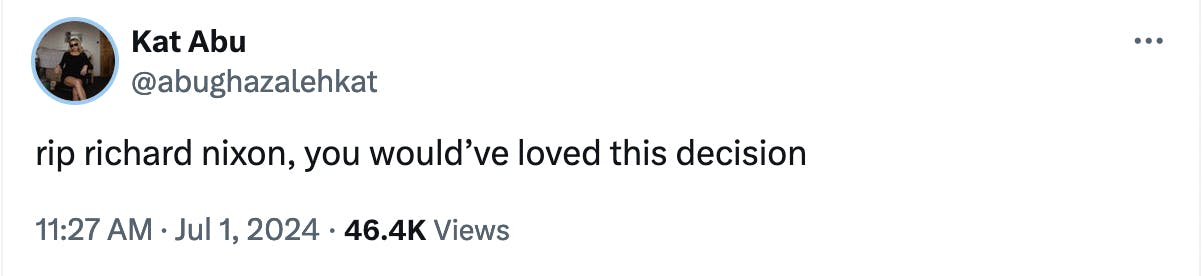
As some commentators on X (formerly Twitter) noted, even the Watergate case against former President Richard Nixon would have been heavily undermined by Monday’s ruling. In the 1974 case United States v. Nixon, Nixon was required to deliver audiotapes of his conversations in the Oval Office to a district court, which contained damning evidence against him and ultimately led to his resignation.

Twitter screenshot Curtis @RebrandNuggets:
The tapes revealing Nixon and Haldeman engineering a cover-up would be excluded in a prosecution and would be presumed immune?
Twitter screenshot GOP Jesus @GOPJesusUSA:
Nixon called. He’s like his tapes back.
Twitter screenshot Kat Abu @abughazalehkat:
rip richard nixon, you would’ve loved this decision

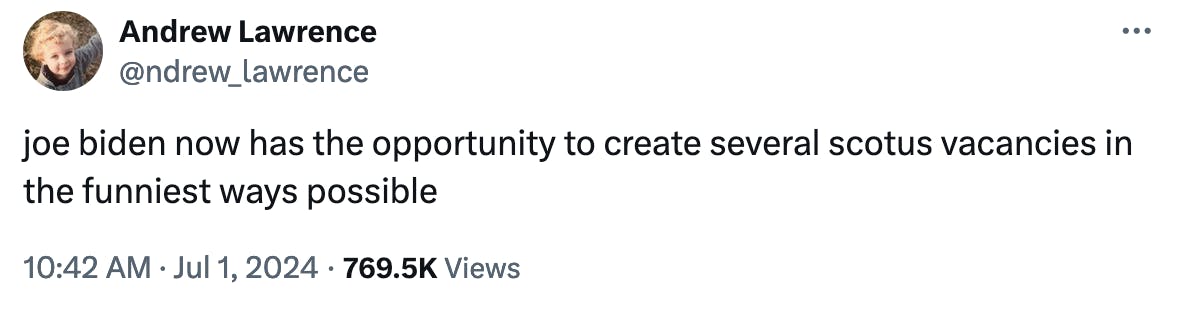
It’s little wonder that Trump immediately celebrated Monday morning’s ruling, as he very likely will escape prosecution for January 6. But, as other commentators on social media noted, the Supreme Court has very well opened the door for Joe Biden to discuss taking outrageous actions in his capacity as president, since the ability to gather evidence against him has been rendered moot.

Twitter Screenshot Andrew Lawrence @ndrew_lawrence:
joe biden now has the opportunity to create several scotus vacancies in the funniest ways possible
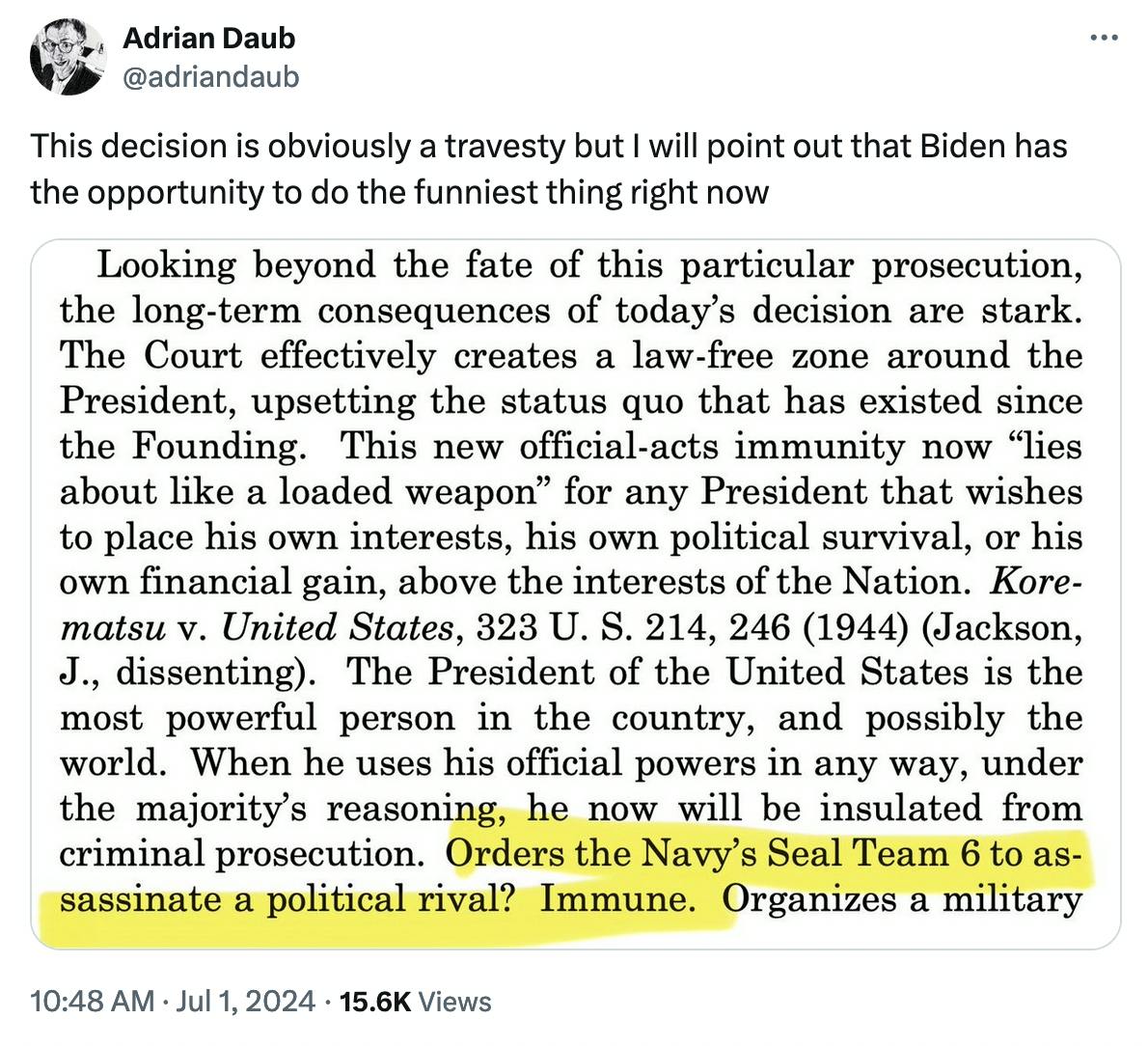
Twitter screenshot Adrian Daub @adriandaub:
This decision is obviously a travesty but I will point out that Biden has the opportunity to do the funniest thing right now
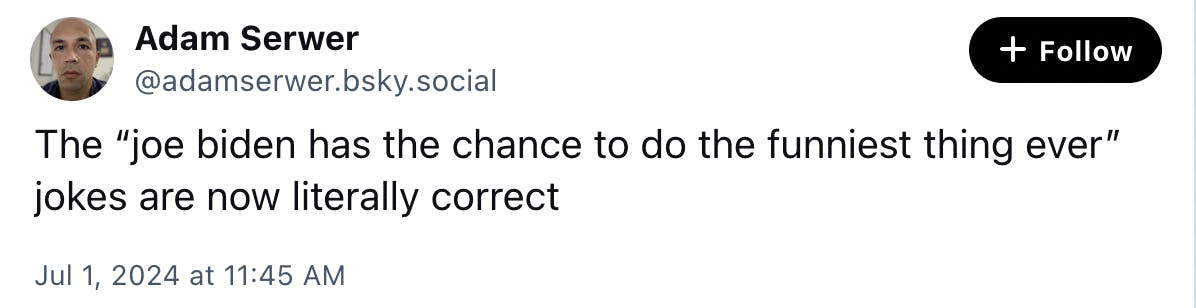
Blue Sky Screenshot Adam Serwer @adamserwer.bsky.social:
The “joe biden has the chance to do the funniest thing ever” jokes are now literally correct

Supreme Court Immunity Ruling Destroys Independent Justice Department

Chief Justice John used Donald Trump’s immunity ruling to casually wreck the concept of an independent Department of Justice.

Supreme Court Chief Justice John Roberts looks up
Tom Williams/CQ-Roll Call, Inc/Getty Images

The Justice Department will no longer be an independent authority on the law, thanks to the Supreme Court’s ruling on Donald Trump’s immunity case Monday. Instead, it will be an arm to be leveraged by the Oval Office, with open communication enabled between the federal law enforcement agency and the presidency for all future investigations.

Chief Justice John Roberts slipped the allowance into his majority opinion, as the justices ruled 6–3 in Trump’s favor along ideological lines. In a quiet sentence, Roberts argued that the fresh take on the executive branch relationship would help the president carry out his constitutional duties.

“The president may discuss potential investigations and prosecutions with his Attorney General and other Justice Department officials to carry out his constitutional duty to ‘take care that the laws be faithfully executed,’” Roberts wrote.

“And the Attorney General, as head of the Justice Department, acts as the President’s ‘chief law enforcement officer’ who ‘provides vital assistance to [him] in the performance of [his] constitutional duty to ‘preserve, protect, and defend the Constitution,’” Roberts continued, citing a precedent from an immunity case argued for Cabinet members, Mitchell v. Forsyth.

This means that if Trump returns to office, he will have free rein to wield the Justice Department as he sees fit—and he and his allies have already given plenty of indications as to what they plan to do.

The decision from the conservative majority overturned a federal appeals court ruling that had unanimously rejected all three of Trump’s presidential immunity arguments in his January 6 case, “patiently, painstakingly, and unsparingly” dismantling his arguments in an “airtight” opinion, according to George Conway, a conservative attorney and ex-husband of former Trump adviser Kellyanne Conway.

Monday’s ruling has effectively killed the January 6 trial, which would have been overseen by U.S. District Judge Tanya Chutkan.

Supreme Court’s Trump Immunity Ruling Decimates Jack Smith’s Case

The court’s decision on Donald Trump’s immunity doesn’t just delay his trial. It guts the entire case against him.

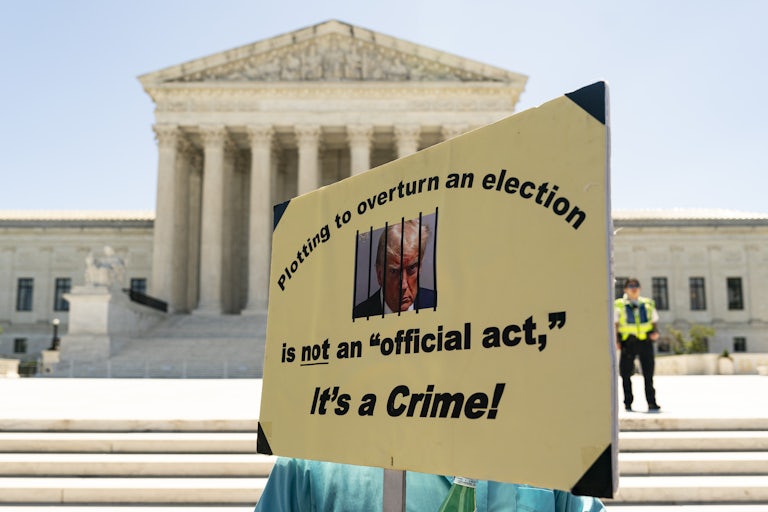
A person holds an anti-Donald Trump protest sign outside the Supreme Court
Al Drago/Bloomberg/Getty Images

The U.S. Supreme Court’s ruling Monday that the president is entitled to presumptive immunity from all official acts has severely undermined the case against Donald Trump for seeking to overturn the results of the 2020 presidential election, making it even less likely he will face justice for his actions.

In his majority opinion granting sweeping protections to the president, Chief Justice John Roberts wrote that part of the Department of Justice’s indictment against the former president “alleges that Trump and his co-conspirators ‘attempted to enlist the Vice President to use his ceremonial role at the January 6 certification proceeding to fraudulently alter the election results.’”

“In particular, the indictment alleges several conversations in which Trump pressured the Vice President to reject States’ legitimate electoral votes or send them back to state legislatures for review,” Roberts continued.

“Whenever the President and Vice President discuss their official responsibilities, they engage in official conduct,” wrote Roberts, meaning that Trump can no longer be prosecuted for outright demanding that his former Vice President Mike Pence not certify the 2020 election results.

“Presiding over the January 6 certification proceeding at which Members of Congress count the electoral votes is a constitutional and statutory duty of the Vice President,” Roberts said. “The indictment’s allegations that Trump attempted to pressure the Vice President to take particular acts in connection with his role at the certification proceeding thus involve official conduct, and Trump is at least presumptively immune from prosecution for such conduct.”

The ruling established that the president may not be indicted on conduct that is immune to prosecution, specifically including conversations between the president and his allies, nor can those acts be considered when trying to prove guilt.

“Testimony or private records of the President or his advisers probing such conduct may not be admitted as evidence at trial,” the ruling stated—a surprising new precedent in the face of 1974’s United States v. Nixon, which required then-President Richard Nixon to deliver tapes of his conversations in the Oval Office to a district court, a ruling that ultimately paved the way for his resignation.

A major part of special counsel Jack Smith’s case against Trump hinges on the allegation that Trump knew he had lost the election but continued to urge his supporters to subvert it via unlawful means. This includes demanding Pence delay certifying the nation’s votes, which Trump’s lawyer John Lauro essentially admitted in August was illegal. But now, those conversations cannot be used as evidence in the case.

Monday’s decision has effectively gutted Trump’s January 6 trial, which would have been overseen by U.S. District Judge Tanya Chutkan. Trump has already started celebrating, and it’s clear it also would’ve made Nixon pretty happy.