Newsletter
Fighting Words
What got me steamed up this week

Trump and Laura Loomer: Mainstream Media, He’s Just Taunting You Now

He takes a 9/11 “truther” to the 9/11 ceremony. Are we going to start talking frankly now about his mental unfitness?

Laura Loomer speaks to a crowd
David Dee Delgado/Getty Images
Far-right activist Laura Loomer speaks to the media prior to the beginning of former President Donald Trump’s trial in New York City, on April 15

I know some people don’t like to play the “Imagine If!” game, but at times it’s hard not to wonder, “Imagine if Joe Biden had said the crazy thing that Donald Trump uttered.” So I’m sorry to say that there is a story from this week that demands we indulge ourselves. Imagine with me that Kamala Harris had attended—oh, let’s say a Holocaust commemoration ceremony—and she brought, as a member of her entourage, someone known for saying the Holocaust was a hoax. Or that she attended a ceremony marking the anniversary of the Sandy Hook Elementary School shooting in the company of someone who’d argued, pace Alex Jones, that the shootings were faked.

That’s what Donald Trump just did by bringing Laura Loomer to Wednesday’s September 11 commemoration.

It’s just a surreal moment. I lived in New York when the attacks happened. I keenly remember how zealous Republicans and conservatives were about 9/11, how quick they were to pounce on anyone on the left side of the spectrum who said anything that even hinted at departure from the accepted narrative—and especially those who, along the way, departed from reality. And now, years down the line, the Republican Party standard-bearer comes to New York on 9/11 itself, palling around with someone who called those attacks an “inside job.”

You’ve seen that reference many times now in the last couple of days, but it’s worth unpacking the phrase in a paragraph. “Inside job,” with respect to 9/11, meant that the U.S. government had advance knowledge of the attacks and let them happen. Or even staged them. In some variants, Israel, naturally, was involved as well. I believe a lot of bad stuff about George W. Bush and Dick Cheney (still!), but I have never believed that. It’s loony tunes. But adherence to this zany theory was disturbingly widespread, at first on the far left before it spread to and was taken up by some on the far right. In polls at the time, up to a quarter of respondents, sometimes more, said they believed this silliness.

By the way, when I say that Loomer believes lunatic nonsense about the September 11 attacks, I’m not dredging up statements she made 20 years ago to criticize her today. HuffPost reported this week that just last year, Loomer “shared a video on X that said ‘9/11 was an Inside Job!’ and claimed it was somehow related to then-Secretary of Defense Donald Rumsfeld’s announcing $2.3 trillion in ‘lost’ government funds on Sept. 10, 2001.”

Loomer’s sins hardly end there, of course. She’s a racist and a xenophobe and a provocateur. She’s claimed that school shootings were staged and that the Las Vegas mass shooter was affiliated with ISIS. Remember that murder of the 6-year-old Palestinian boy outside Chicago, who was stabbed 26 times by his white landlord shortly after Hamas’s October 7 attacks? The landlord said he feared a “global day of jihad,” a lie spread by Loomer and Jack Posobiec (of Pizzagate infamy) as well as Jones’s InfoWars website, among others. There’s a lot more. She’s poison.

The fact that Trump took Loomer to the 9/11 event has gotten a lot of coverage. I woke up Friday morning ready to unload on The New York Times for not doing a story on this, but then I looked at the website, and to its credit, the Times has a good piece up today that highlights Trump bringing her to New York and traveling with her more generally. In case you missed it, she was at the debate Tuesday night in Philadelphia. She’s a frequent Mar-a-Lago presence. He wanted to give her a campaign job back in the spring, until others objected. Loomer is apparently too crazy for Marjorie Taylor Greene. I didn’t know “too crazy for Marjorie Taylor Greene” was possible.

What does all this tell us about a possible future Trump presidency? That this racist conspiracy theorist will be around the White House whispering in the president’s ear. And she won’t be alone. Trump’s “social media war room” at the debate included Loomer, Posobiec, and Chaya Raichik, who created the “Libs of TikTok” account that promotes hate speech and transphobia. Children’s hospitals across the country have received bomb threats after social media posts on Libs of TikTok—accusing the hospitals of performing gender-affirming surgeries that in some cases they didn’t even perform—went viral in the right-wing fever swamp.

Imagine the White House filled with people like this. That’s what we’re probably talking about if Trump is elected.

Call it speculative if you want. This is part of why it’s difficult for news outlets that follow traditional reporting norms to fathom these possibilities, let alone make a news story out of them. But the fact that these people are hanging around at Trump’s invitation can’t be allowed to pass without our reckoning with it. On whatever path forward Trump hopes to forge, these people will be along for the ride. And the mere possibility that the White House is going to be bursting with racists and xenophobes and transphobes and multipurpose haters and conspiracy theorists is something to which attention must be paid. There has to be a way, within the conventions of mainstream reporting, to place this alarming possibility in front of the electorate’s collective nose.

Let’s conclude by returning to the “Imagine If” game. What would the mainstream media be doing right now if, on Wednesday, Harris had indulged in one of my above scenarios? First of all, it’s absolutely impossible to imagine, because Kamala Harris is a good human being who has normal human morals. But if she had, everyone—and I do mean everyone: the right wing, of course, but the New York Times editorial page, the talking heads of MSNBC, and even yours truly—would be in a state of meltdown apoplexy until she apologized and explained herself; and even after she did so, loads of people, right and left, Republicans and Democrats, would be declaiming on her unfitness for office and demanding that she stand down as the nominee.

But in the real world? This story, like all Trump stories, is likely to fade. That would be to the detriment of all. At the very least, the mainstream media should not let this outrage die; it should continue to rub this ugliness in the faces of the hypocrites who once called liberals enemies of freedom because we opposed the stupid and tragic War in Iraq that Bush and Cheney used 9/11 as an excuse to start, and who now want this amoral nitwit to be the leader of the free world.
This article first appeared in Fighting Words, a weekly TNR newsletter authored by editor Michael Tomasky. Sign up here.

Trump Serves Up a Word Salad That The New York Times All But Ignores

The Washington Post led with his incoherent comments about childcare in a Thursday speech. In the Times’ account? Barely a word.

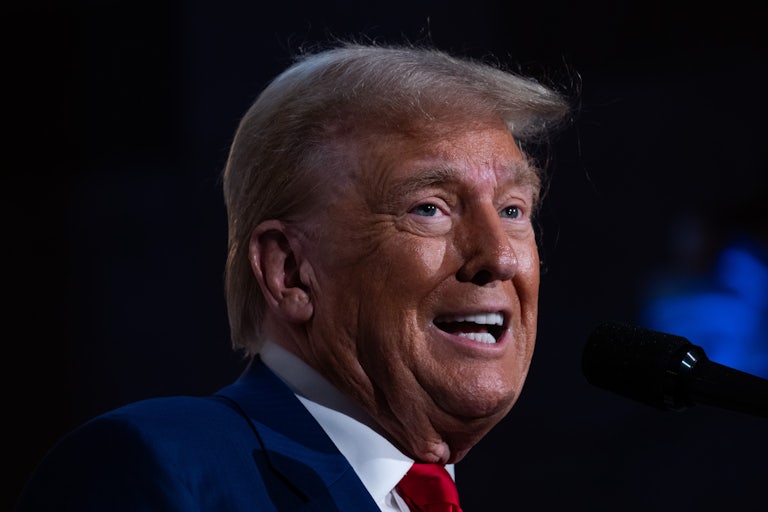
Trump at the Economic Club of New York
Spencer Platt/Getty Images
Trump at the Economic Club of New York on Thursday

For months, Donald Trump’s frequent lapses into incoherence—the half-sentences that suddenly veer off toward a distant galaxy, the asides that limn the virtues of Hannibal Lecter—have been mostly fodder for late-night TV hosts. Morning Joe has covered them consistently, but for the most part, the mainstream press has ignored them, either cleaning up Trump’s actual words so they made more sense on the printed or pixelated page or just not printing them at all.

This was easier to do when Trump was running against Joe Biden, who sometimes also lost the rhetorical thread, and whose age was a constant news story (not without justification). But now that Trump is running against a younger and more energetic opponent who tends to speak in full, logical sentences and who doesn’t go on rants about bacon and wind power, his mental state is rightly becoming more of a story. As my colleague Greg Sargent put it yesterday: “Trump’s mental fitness for the presidency deserves sustained journalistic scrutiny as a stand-alone topic with its own intrinsic importance and newsworthiness.”

Which brings us to Trump’s appearance Thursday before the Economic Club of New York. I watched some of it. In fairness, reading from his prepared remarks, he was coherent. He rattled off a string of statistics about the economy under his presidency, many of which were actually true, or close enough; when he got around to describing the horrors “Marxist” Kamala Harris had visited upon America, his claims were a lot less true. (He said “crime is rampant, and fleeing is the number one occupation” in California, but crime is trending down in the state this year, and the recent population declines have been turned around too—not that Harris has control over these issues one way or another.)

Then came the question-and-answer period. A woman among the handful assembled on stage asked Trump if he would commit to passing childcare legislation, and if so what his specific proposal would be. Here’s the answer in part, as put out in a tweet by the Harris campaign:

“Well, I would do that, and we’re sitting down, you know; I was, somebody, we had Senator Marco Rubio and my daughter, Ivanka, who was so impactful on that issue.… But I think when you talk about the kind of numbers that I’m talking about that because the childcare is childcare, couldn’t, you know, there’s something you have to have it, in this country you have to have it.”

Trump’s answer was longer than that, but when he got around to something resembling a response, it was that his tariffs on China are going to pay for everything, no problem. Just like deporting people is going to solve the housing crisis.

A few quick facts. In the nineteenth century, before the individual income tax became a permanent fixture of life, tariffs accounted for most of the government’s revenue (at a time when the government did very little—stood up an army, ran a postal service, etc.). But today, according to the Council of Economic Advisers, import duties bring in only around 2 percent of the federal government’s total revenues. If you want to lower taxes on corporations and the rich, as Trump does, tariffs would need to be substantially jacked up to make up for the lost revenue (although of course in the Candyland in which Republicans and their economists live, reducing tax rates does not reduce revenue, which is probably the single biggest and most insidious policy lie of the last 50 years). And of course, as the CEA and many others argue, much higher import levies are “likely to spark retaliatory tariffs that reduce U.S. exports and subsequently induce transfers of collected duties to impacted U.S. businesses.”

Now let’s get to the point here: the media. Specifically, The New York Times.

I looked Friday morning at the way the Times and The Washington Post covered the speech. The Post’s article, to my astonishment, was mostly about the childcare word salad. “Trump offers confusing plan to pay for U.S. child care with foreign tariffs,” ran the Post’s headline.

The Times’s story was by no means favorable. Under the headline “Trump Praises Tariffs, and William McKinley, to Power Brokers,” the article adopted a gently skeptical tone toward Trump’s promise that tariffs would solve everything. It even mentioned the words “child care,” once.

But the article didn’t bother to quote him on the topic. Why? It could be that the reporter didn’t think it was newsworthy (or perhaps it was an editor, since the Times’ election news blog did partially quote Trump). But this is exactly the point Sargent and others are trying to make: that Trump’s frequent incoherence is in and of itself news. It should be reported on. He should be quoted verbatim, not in a partial way that sanitizes his words and cleans them up.

Why? Because his mental fitness at age 78 to be president for the next four years is a legitimate issue. I’ve covered, and simply watched as an interested citizen, a lot of presidential candidates. Dozens, maybe hundreds, if you count Democrats and Republicans who ran in primaries. I’ve watched hours of debates and attended events like the once-famous Iowa Straw Poll in 1999, at which 11 Republican candidates spoke. I’ve never heard a candidate who talks in such a dissociative, rambling, confused way; never heard a candidate so obviously bluffing his way through certain policy questions.

The conventions of objective journalism are such that reporters tend to use “good” quotes. Reporters favor politicians’ pithiest and most succinct quotes, because reporters themselves are trying to be pithy and succinct, and ergo logorrheic and nonsensical just doesn’t fit the plan. I’ve been there, I’ve done that. Guilty.

But here’s what’s different. Until Trump, using the pithiest and most succinct quote never amounted to a quasi-conspiracy against reality. Now it does. Maybe the voters will decide that Trump’s incoherence doesn’t matter. But they at least need to be presented with the evidence to decide for themselves.

This article first appeared in Fighting Words, a weekly TNR newsletter authored by editor Michael Tomasky. Sign up here.

Donald Trump Has Totally Jumped the Shark

Once upon a time, he was must-see TV. Now, everyone is tuning out his boring show.

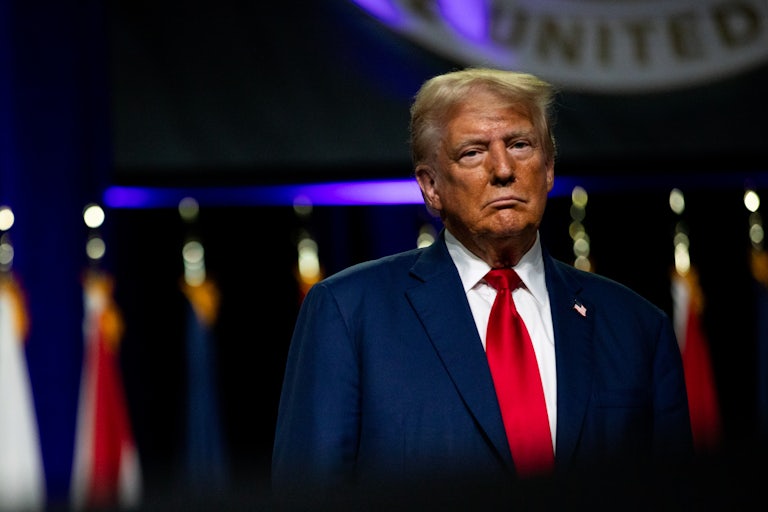
Donald Trump looking sad
Emily Elconin/Getty Images

I got an email Thursday morning from a dear old friend of mine. He lives in Virginia. He’s a Democrat who was never susceptible to Donald Trump’s alleged allures. But he did make an interesting point. Years ago, my friend wrote, he used to watch Trump and maybe give some consideration to a couple of the points he made, or at least be entertained. “I turn him off when I see him now,” my friend wrote—and he guessed millions of others did the same.

Trump is staring down the business end of a number of problems right now. There’s Project 2025, and there’s his bragging about ending Roe, and there’s the hefty ankle weight that is J.D. Vance. But for all those things and more, public lack of interest may be Trump’s biggest problem as we enter the homestretch of the presidential race next week. Since the man sees life wholly in terms of acts and star power and ratings, let’s think of him on the terms he understands. The Trump Show has entered its ninth season. That’s a long run for any TV show. Many of the most iconic shows in television history didn’t last that long.

There’s a reason for that: In TV world, longevity can be a curse. Shows lose their originality. They lose key characters. They introduce new ones who aren’t nearly as compelling. They jump the shark, in a phrase coined in 1985 by a radio personality who was discussing an iconically far-fetched 1977 episode of Happy Days when Fonzie literally jumped over a shark while on water skis.

That’s Trump today. Fonzie on water skis. All in the Family after Meathead and Gloria moved to California. Buffy by season 6 (although they still delivered a few classics in the last two seasons). The Office after Michael Scott left, which pulled off the accomplishment of making even Will Farrell unfunny. (I’m sorry I don’t have more recent reference points, but you can fill in your own.)

Trump’s ratings are down. Kamala Harris drew 28.9 million viewers for her convention speech; Trump, just 26.3. There are all those videos of loads of empty seats at his rallies, and columns of people streaming out while he’s speaking. His unfavorable rating, which ticked down a bit after the assassination attempt and the GOP convention, is ticking back up. In poll after poll after poll, both nationally and in swing states, he’s going from four- and five- and six-point leads to one-, two-, or three-point deficits. The race is still close, but the swing is unmistakable.

Trump’s act is old. Don’t get me wrong, it’s still offensive. That Arlington Cemetery stunt was gobsmacking. It’s now a three-day story, and as long as Trumpworld keeps fighting and escalating, trying to convince voters that they should distrust the not-handsomely-paid people who stand guard over ground that your average American considers to be among the most sacred in the nation, it’ll continue. Three days means it’s really getting through, becoming quasi-foundational. It’s reinforcing the view—potentially deadly to him—that he has contempt for veterans and soldiers who died serving the country.

And of course he still says and promotes all kinds of offensive and alarming things. His repost of a “joke” mentioning Harris and Hillary Clinton and blow jobs (I’ll stop there). Those photos he posted of Democrats and others (Bill Gates?) in orange jumpsuits, reinforcing earlier promises about how he’ll pursue “justice” if elected. There’s still plenty of reason to be terrified of a second Trump term, especially if you’re an undocumented immigrant or a transgender person or anyone else he considers “vermin.”

But again, for now, let’s just judge him as an act. His act is way tired. It’s now nine years of “Fake news” and “You won’t have a country anymore” and all the rest. In 2015, all those Trumpisms were stupid and disgusting; but at least they were new. I actually laughed when he described Jeb Bush as a “low-energy person.” He was! I could imagine then how, for voters who didn’t hate him, he was interesting and possibly amusing as a species that American politics rarely produces: someone who threw the script in the air and said whatever the hell popped into his mind.

That was bound to be something people wanted to watch, for a while. And it was just as bound to be something that became less compelling over time. It’s an act. And this is a key difference between politics and show business that Trump can’t see. In showbiz, and on TV, it’s all about whether the production values can sell the act. In politics, it turns out, the act needs more than slick production. It still needs to show some connection to people’s lives and concerns. Harris is better at that than Trump is. And her act is a lot fresher, too. And Walz’s act versus Vance’s? Not remotely close. Yes—Walz is so compelling, and Vance so repelling, that this is one election where the veep choices may actually make two points’ worth of difference.

None of this means Trump is finished. Happy Days lasted several seasons after it literally jumped the shark. But the ratings did start to fall soon enough. No one ever hated Fonzie, like many do Trump. But even fans of the show became a lot less invested in it. My old friend reminded me of the quote by Elie Wiesel: “The opposite of love is not hate. It’s indifference.”

This article first appeared in Fighting Words, a weekly TNR newsletter authored by editor Michael Tomasky. Sign up here.

Democrats: “He Was Better Than the Debate” Is Not Remotely Good Enough

In Trump world, they’re thinking landslide. Democrats need to act and talk Biden into stepping aside, and soon.

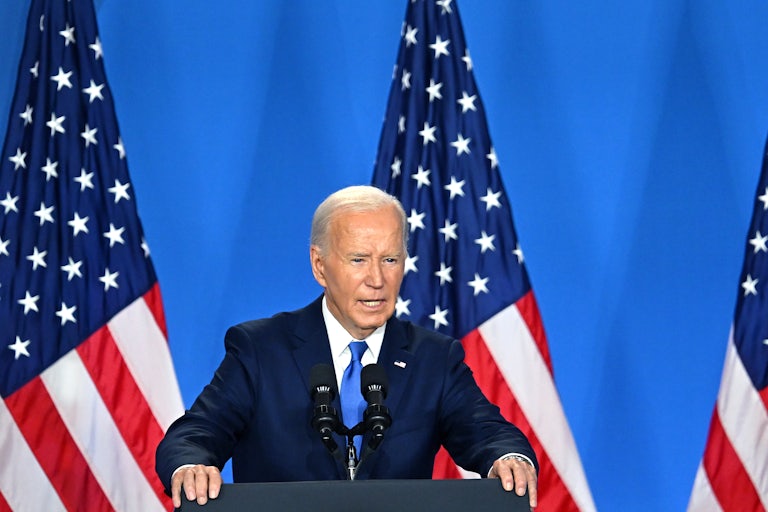
Biden at his long-anticipated on news conference
Graeme Sloan/Bloomberg/Getty Images
Biden at his long-anticipated news conference on Thursday

Joe Biden had many lucid moments at his Thursday evening press conference, but the idea that we’re going to judge Biden day by day on the latest speech or press conference is terrifying, for two reasons. First, it sets a ludicrously low bar that is bound to favor standing pat with Biden as the nominee. This is because every one of these appearances is going to be judged on whether he was better than he was at the June 27 debate, and every time, the answer to that question is almost certain to be yes, because he can hardly be worse. But is “He was better than the debate” really the right standard here?

Second, this clock is ticking. It’s five weeks until the Democratic convention, which opens Monday, August 19. That’s time enough to act. Biden did open the door just a crack Thursday night to not being the nominee, but mainly he sounded very dug in, and if that’s the case, he can run out that clock by doing just enough interviews and speeches to be able to say he didn’t go into hiding, but without genuinely exposing himself to a risky public situation. One can predict the news cycles: three days of sensing that the dam may be about to burst and the Democrats are ready to take collective action, then Biden makes an appearance, does OK but only OK, but the momentum for replacing him is killed. 

So if that’s how we’re going to spend these next five weeks, Biden will be the nominee. Is there a chance he can win? There is. Lots of Americans really don’t like Donald Trump. In 10 long weeks between the end of the convention and Election Day, maybe the Democrats can succeed in making the race about Trump, and Biden can eke out a win. A poll came out Friday morning showing Biden ahead by two points.

But the odds are growing that Biden will lead his party to a defeat that will extend to both chambers of Congress. That means that Trump, armed with the radical proposals of Project 2025, a self-declared “Secretary of Retribution” who has a list of some 350 people who may be arrested in a new Trump term, and a fresh Supreme Court ruling that makes all this presumably legal, will return to the Oval Office with Republican majorities in the Senate and House, the latter of which Democrats had been confident of recapturing before the debate but where they now fear they could lose 20 seats.

More House Democrats, and one senator, have come out this week calling on Biden to step aside. Three, led by Connecticut’s Jim Himes, made their announcements after Biden’s press conference, meaning that it did not staunch the bleeding. And we’ve all been reading and hearing this week that privately, the percentage of Hill Democrats who want to see Biden step aside is in the neighborhood of 80 percent.

In Trump world, meanwhile, they’re salivating at the thought of running against this weakened Biden and this divided Democratic Party. The Atlantic’s Tim Alberta wrote a much-discussed article this week headlined, “Trump Is Planning for a Landslide Win.” The landslide is predicated on one fact: that the opponent is Biden. Alberta: “Biden quitting the race would necessitate a dramatic reset—not just for the Democratic Party, but for Trump’s campaign. [Trump aides Susie] Wiles and [Chris] LaCivita told me that any Democratic replacement would inherit the president’s deficiencies; that whether it’s Vice President Kamala Harris or California Governor Gavin Newsom or anyone else, Trump’s blueprint for victory would remain essentially unchanged. But they know that’s not true. They know their campaign has been engineered in every way—from the voters they target to the viral memes they create—to defeat Biden. And privately, they are all but praying that he remains their opponent.”

Even assuming that there is some spin there, there is no doubt that Trump himself has spent four years thinking about running against Biden and that the Trump campaign is planning on spending millions to attack Biden on his age and capacities.

Democrats can no longer ignore this. So next week, Chuck Schumer, Hakeem Jeffries, Nancy Pelosi, and other senior Democrats who are friends of Biden’s (ex-senator Chris Dodd has been mentioned) need to go to him and have the talk with him. They need to get him to withdraw.

And, I suppose, to release his delegates to Kamala Harris. I’d rather see an open process. It would be more democratic (for the party that’s supposedly fighting to save democracy). It wouldn’t have to be chaotic. It could be galvanizing. A handful of candidates would step forward. They’d campaign for a month. They’d give convention speeches. The delegates would vote, and the party would have a candidate, who would then have 10 weeks to campaign against Trump. If most voters pay no attention until Labor Day anyway, that’s time enough. The money and logistical questions are serious, but people who really want to figure those things out can do so.

But a Harris scenario seems more likely. Fine. Just choose a scenario, and go to Biden and explain to him the stakes of his staying in the race, for him personally and for his legacy. If he bows out soon, he goes down in history as the guy who saved the country from a second Trump term, had a surprisingly successful term as president, and graciously gave up power like none other than George Washington for the sake of his party and his country.

If he resists that, he risks dragging the Democratic Party into its biggest crisis in a century. A decisive loss that many people anticipated and feared to the hated Trump, with all the authoritarian ramifications thereof, could lead the party into a period of vicious recriminations and weakness. Is that really what Biden wants? We’re about to find out.

Is There a Good Reason Not to Panic? Well, No, Not Really.

The Democrats have always had three options. Sticking with Joe Biden always seemed like the least bad option. Last night, that changed.

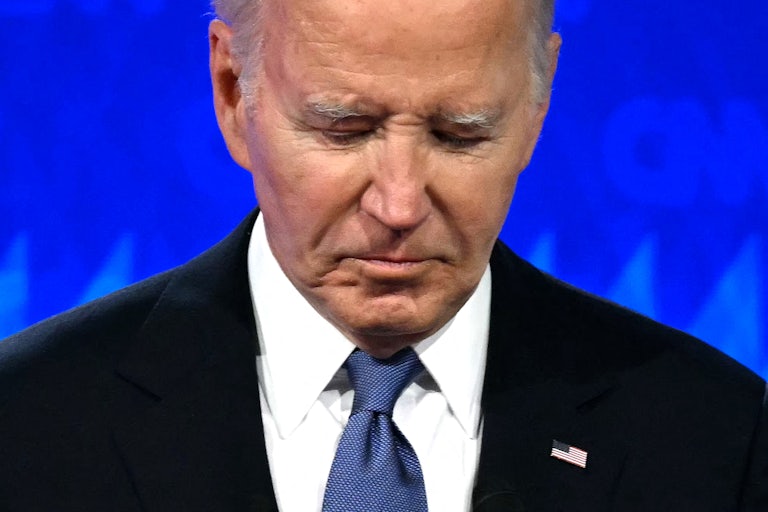
Joe Biden looks down at the debate.
ANDREW CABALLERO-REYNOLDS/AFP/Getty Images
President Joe Biden looks down as he participates in the first presidential debate of the 2024 elections with former president and Republican presidential candidate Donald Trump at CNN’s studios in Atlanta, on June 27.

Joe Biden had barely opened his mouth last night when I gasped and said to myself, “Oh God, this might be really bad.” His voice was thin and raspy and weak. His words, ostensibly about how badly Donald Trump botched the pandemic, were unfocused and constituted a huge missed opportunity. And that kept happening over and over and over again.

Trump lied like crazy, sure. Nobody’s aborting a fetus after it’s born. “Everyone” did not want Roe overturned. Millions of people from prisons or mental institutions have not crossed the border. Food prices haven’t “quadrupled.” It went on and on—CNN’s fact-checker said he counted at least 30 outright lies. Jake Tapper and Dana Bash never stepped in to fact-check Trump. All that is true. But none of that changes the overwhelming fact. Biden confirmed Democrats’ worst nightmares. “We finally beat Medicare”? Dear God.

CNN’s flash poll had respondents saying Trump won by 67 to 33 percent. Frankly, I’m not sure who those 33 were. The die-hardest of die-hard Democrats, I guess, or maybe single-issue voters who heard Biden say one thing they liked. But 33 percent means a ton of Democrats admitted that their guy lost, and the guy they really hate and rightly consider a direct threat to the country won. And probably half of that 33 were voting with their heart.

What happens now? Let’s talk about the people who have the power to go to Biden and tell him to step aside. What kinds of conversations is Barack Obama having today? Who’s Chuck Schumer talking to? Hakeem Jeffries? Nancy Pelosi? How about Bill and Hillary Clinton, and Al Gore? The big donors and bundlers? And perhaps most of all, there’s Jill and his family.

All these people have known for a long time that the Democrats had three options. The first has been sticking with Biden. People knew he was a risky proposition. But until this debate, Biden was, plausibly, the least bad option. Because the other two options are these.

Option two is that Biden steps down and hands it to Kamala Harris. She’s his vice president, and how in the world do you sidestep a sitting vice president?

That’s the most likely non-Biden option, but I know no one who’s excited about it. She’s just not a good politician. What’s the scenario where she beats Trump? Maybe she generates some higher enthusiasm among Black women, and theoretically among younger voters to some extent. Maybe she’d have more success making the race a referendum on abortion.

Harris, though, has a huge weakness. She has never really been able to make a strong economic argument. Even back when people were gushing about her in early 2019, when she announced her presidential candidacy, I noticed she had nothing to say about economic issues. And they’re kind of important in a presidential election. And then, of course, there are the racism and sexism you have to factor in here that would hurt her unfairly. My guess is that she runs three to five points worse than Biden against Trump, and that turns a margin-of-error race into a decisive loss—and one that probably affects control of the House and/or Senate.

The final option, therefore, is to throw the thing open and try to get the nomination to one of the governors, or someone else. This has always had a lot of theoretical appeal, because several of these people look like they’d be good candidates.

But the two perceived problems with this scenario are these. First, how much bad blood would start boiling within the party if Harris were pushed aside? The assumed answer has always been: a lot. If Biden were to step aside, pollsters would start asking questions about Harris, and if those polls showed that Black women will basically bolt, going around Harris could be a nonstarter.

And second, is there really any proof that Gretchen Whitmer or Gavin Newsom or Josh Shapiro or Jay Pritzker or anyone else would be a better candidate? Governors sometimes just don’t have it when it comes to running for president. Look at Ron DeSantis.

Those are real problems. But in this break-glass moment, they start to look like smaller problems than staying with Biden or just handing it to Harris.

We’ll see what the post-debate polls say. They’ll start coming out early to mid-next week. My guess is that Biden will lose four points on average, maybe five. It might be a little less. But the coverage of this fiasco over the next two days will only amplify how bad it was.

Politicians fear the unknown. They don’t want to cast votes whose political fallouts they can’t predict. They don’t want their districts redrawn. And they sure don’t want to change a presidential candidate in July.

But this is an undeniable crisis. I don’t know the convention rules. And remember—this is made even more complicated by the fact that Democrats have decided to nominate Biden via Zoom (or whatever) two weeks before the mid-August convention, because they need to have a nominee by early August for the nominee to appear on the ballot in Ohio.

So: Is an abbreviated, multicandidate campaign even possible? Here’s a scenario. Biden drops out next week, releasing the delegates he’s amassed during the primaries to do whatever. Candidates announce—Harris, the governors I named above (along with a few others, like Kentucky’s Andy Beshear), Pete Buttigieg, Cory Booker, maybe another senator or two. Throughout July, they have an intensive schedule of debates. Six or seven. Over the course of those debates, some will rise, some will fade. In early August, in time for Ohio, let the rank-and-file decide via electronic vote. Make all the contenders commit to supporting the process and standing 100 percent behind the winner.

Weirdly enough, that could actually end up working out pretty well. A new nominee would be fresh, providing a new story and a new start. He or she would trip up Trump. This nominee could arguably then roll into the Chicago convention generating a lot more enthusiasm than Biden will. (That’s another thing—think about the anxiety that will precede his convention speech!)

Then the nominee leaves Chicago with his or her well-chosen running mate, and they spend 10 days barnstorming the swing states so that by the end of the summer, the nominee will have galvanized the party. Then that nominee would have the fall to persuade swing voters, who don’t pay attention until October anyway.

Such a process might reinvigorate a party base that today is feeling pretty dispirited and disgusted and terrified. The conversations that happen this weekend in the high precincts of the Democratic Party will help determine the party’s—and the country’s—fate. It’s risky. Lots of unknown unknowns. But it’s worth remembering that with risk comes reward.