Breaking News
Breaking News
from Washington and beyond

The Nightmare Has Begun: Elon Musk Joined Trump’s Call With Zelenskiy

Why the hell did Elon Musk join Donald Trump’s phone call with the Ukrainian president?

Elon Musk pulls Donald Trump in for an embrace
Anna Moneymaker/Getty Images

Just hours after Donald Trump won the election, Elon Musk was already flexing his power over the new administration, joining a phone call with the man he helped elect to office and Ukrainian President Volodymyr Zelenskiy.

Axios reported that the world’s richest man made a guest appearance on a phone call between Trump and Zelenskiy on Wednesday, even chiming in at several points during the discussion.

The call did not delve into specifics, but an Axios source noted that nothing Trump said to Zelenksiy was “alarming or made us feel that Ukraine is going to be the one who pays the price.” Musk also told the Ukrainian president that he will keep supporting Ukraine with his Starlink satellite network.

Still, Musk’s surprise addition to the call is a troubling sign, to say the least. Like Trump, the billionaire has a close relationship with Russian leader Vladimir Putin. A bombshell report last month revealed that Musk is in regular contact with Putin, and the Kremlin may have even implicitly threatened him. That could explain his past refusal to let Ukraine use his Starlink internet network to carry out a surprise attack on Russian forces, or his public ridicule of Zelenskiy’s requests for aid.

However, the 25 minute call apparently left Zelenskiy feeling upbeat and reassured. “I had an excellent call with President Trump and congratulated him on his historic landslide victory — his tremendous campaign made this result possible,” Zelenskiy wrote on X after the call on Wednesday.
Bob Woodward Shares Distressing Reminder as Putin Congratulates Trump

There’s every reason to be concerned about what Russian leader Vladimir Putin is holding over Donald Trump.

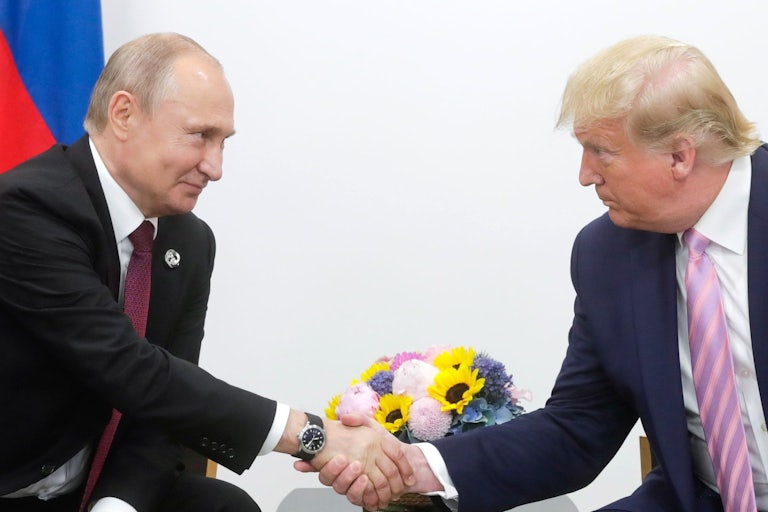
Vladimir Putin and Donald Trump shake hands
Andrew Lichtenstein/Corbis/Getty Images

Bob Woodward shared a warning about Donald Trump in the hours after his election win.

Speaking with CNN’s Anderson Cooper, the longtime journalist was asked about his thoughts on Trump’s election, having interviewed the president-elect more than 20 times. Woodward mentioned Trump’s relationship with Russian President Vladimir Putin.

“I talked a couple of months ago to Dan Coats, the former director of national intelligence under Trump, and I said, what’s going on in this relationship between Trump and Putin? And Dan Coats said, ‘It’s almost, it’s so close. It seems like it might be blackmail,’” Woodward said.

“CIA director Bill Burns said Putin manipulates. He’s professionally trained to do that,” Woodward added. “Putin’s got a plan just to do this exactly, and it’s what he did when Trump was in office previously, and he’s planning it again at playing Trump.”

Woodward’s warning came as Putin himself stayed silent on Trump’s victory, waiting until the next day to congratulate the president-elect in what could be a power play for the Russian leader. Putin’s congratulatory message came on Thursday and didn’t include any acknowledgment of Trump’s promise that he could end the Ukraine War in “24 hours,” and perhaps signaled the opposite.

Last month, Trump tried to avoid a point-blank question about whether he was still speaking with the Russian autocrat even after leaving office, telling Bloomberg editor-in-chief John Micklethwait, “Well, I don’t comment on that, but I will tell you that, if I did, it’s a smart thing.” One week before, an excerpt from Woodward’s book “War” alleged that Trump and Putin still speak frequently.

On Election Day, bomb threats at polling stations around the country seem to be a product of alleged Russian election interference. It seems that with Trump’s return to the White House, the shadow of Putin is not far behind.

Trump Ally Confirms Primary Target in Radical Plan to Slash Budget

Donald Trump has previously said he wants to eliminate the Department of Education.

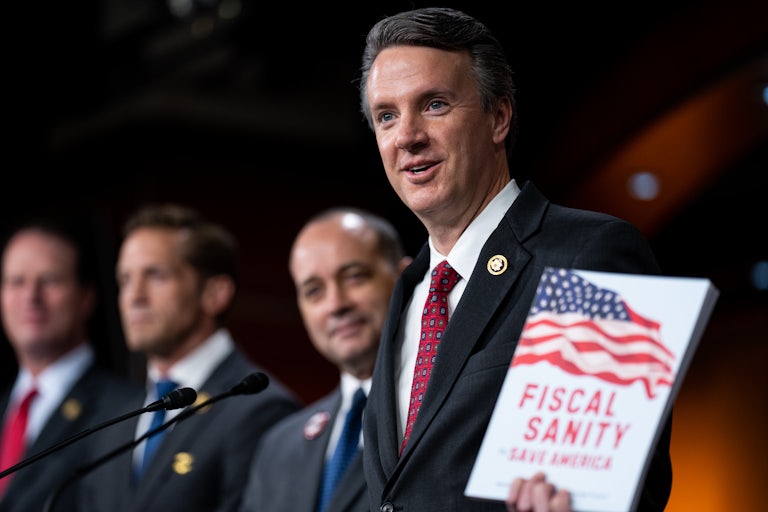
Representative Ben Cline holds up a packet labeled “Fiscal Sanity” while speaking at a microphone
Bill Clark/CQ-Roll Call, Inc/Getty Images
Representative Ben Cline

Incoming Department of Government Efficiency head and world’s richest man Elon Musk has proposed cutting $2 trillion in government spending—more than Congress’s entire discretionary budget. But some of Donald Trump’s key allies don’t see anything wrong with that picture.

In an interview with Fox Business on Friday, Virginia Representative Ben Cline claimed that it “absolutely is” possible to slash that much cash from the budget.

“We can do it, and make sure that we focus funding toward the American people and not toward bureaucracy in Washington,” Cline said.

Just a reminder: Congress’s discretionary budget funds practically the entire executive branch, doling out funding for the military, national security, and federal agencies.

And one cut in particular proved exceedingly uncontroversial for the Virginia congressman: public education.

“Give me one idea in terms of what’s significant that you think, ‘That’s got to go right away?’” asked Fox’s Maria Bartiromo.

“Well let’s just look at the Department of Education and how billions of dollars stay in Washington, funding bureaucrats whose simple goal is to interfere in the decisions about educational choice at local and state levels,” Cline responded.

But that’s not an accurate picture of the DOE. The federal government provides 13.6 percent of funding for public K-12 education across the nation. In Virginia specifically, it spends $2,020 per pupil per year, providing approximately 12 percent of the state’s education funding, according to the Education Data Initiative.

Trump himself has said that his Department of Education plan involves handing the reins and lofty responsibilities of public school administration over to parents, who famously have all the time in the world to oversee educational curricula while simultaneously working jobs and raising their children.

During a rally in Milwaukee in October, the MAGA leader promised that his vision for the nation’s educational system would involve very limited oversight from any government, including the states.

“I figure we’ll have like one person plus a secretary,” the soon-to-be forty-seventh president said at the time. “You’ll have a secretary to a secretary. We’ll have one person plus a secretary and all the person has to do is, ‘Are you teaching English? Are you teaching arithmetic? What are you doing? Reading, writing, and arithmetic. And are you not teaching woke?’”

He also openly admitted that it would, unfortunately, be to the detriment of a great swath of states—particularly poorer ones in the middle of the country.

“We’re going to have 35, like, different ones—Iowa will do good. A lot of the states will do very good. I can think of probably 30, 35 will be do—five will be OK, 10 will be OK. You’ll have four or five that will be terrible, but that’s OK, we have to control it,” Trump told 5,000 people in Indiana, Pennsylvania, in September. “But you’ll have, you’ll have Idaho, you’ll have Idaho will do a great job, no debt, they run a great state.”

But slashing the Department of Education was always part of the agenda. Despite attempts to distance the campaign from Project 2025, Trump allies have outright admitted in the wake of election night that the 920-page Christian nationalist manifesto was actually the blueprint for Trump’s second administration all along.

And it’s not all political smoke and mirrors. When it comes to budget cuts and the economy, experts believe that Trump is more than likely to keep his promises.

“He’s not very movable on trade issues, and he does what he says he’s going to do,” William Alan Reinsch of the Center for Strategic and International Studies told Yahoo! Finance in October, in an assessment of the Republican leader’s 2016 economic agenda.

“I think he means it, and I think he’ll do it,” Reinsch, a former trade lawyer and undersecretary of commerce, said of Trump’s tariff plan on Chinese goods. The outstanding question will be whether or not the courts attempt to block it.

Trump Achieves His Ultimate Election Goal: Avoiding Accountability

Jack Smith is on his way out.

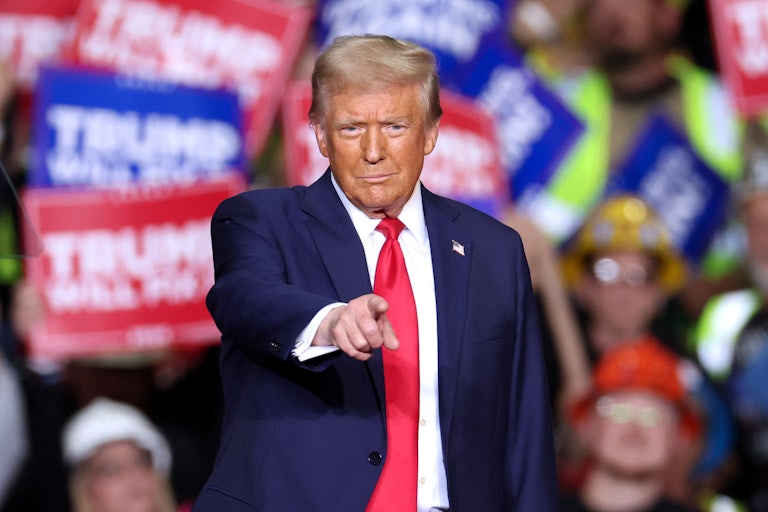
Donald Trump points at the audience during a campaign event
Charly Triballeau/AFP/Getty Images

A federal judge on Friday granted special counsel Jack Smith’s request to vacate the remaining deadlines in Donald Trump’s election interference case.

In a new filing earlier Friday, Smith requested that “the Court vacate the remaining deadlines in the pretrial schedule to afford the Government time to assess this unprecedented circumstance and determine the course going forward consistent with Department of Justice policy.”

Department of Justice policy prohibits the government from pursuing charges against a sitting president. Smith’s request cites that Trump is “expected to be certified as president-elect on Jan. 6, 2025, and inaugurated on Jan. 20, 2025.”

Prosecutors asked for the government to file “a status report or otherwise inform the court of the result of its deliberations” by December 2.

Judge Tanya Chutkan granted Smith’s unopposed request shortly after it was filed.

With this latest development, it seems Trump will escape all culpability for his role in interfering with the certification of the 2020 presidential election and allegedly inciting the January 6 riot at the U.S Capitol.

The same fate is likely for Smith’s other case against Trump, which concerns the president-elect’s alleged mishandling of classified documents during and after his first administration. That case landed in the lap of a pro-Trump judge who dismissed the case—landing her on the short list for Trump’s next attorney general.

As Smith scrambles to wind down his two cases against Trump, it’s worth noting that the former president has promised to fire Smith on his first day in office, and even threatened to have him deported.

This story has been updated.

No, All Latinos Didn’t Vote for Trump Actually. Here’s the Data.

Here’s a more detailed look at how Latinos voted in the 2024 election.

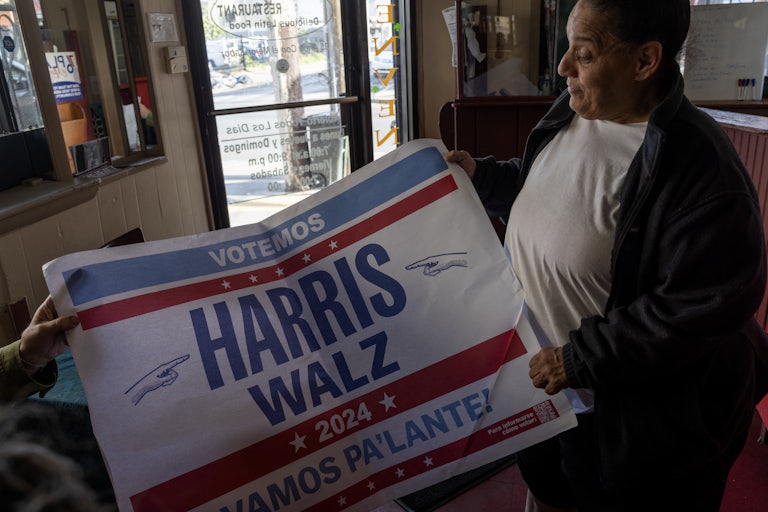
A man holds a large sign that says Votemos Harris Walz
Andrew Lichtenstein/Corbis/Getty Images

Reports of a Latino Democratic exodus may be slightly exaggerated.

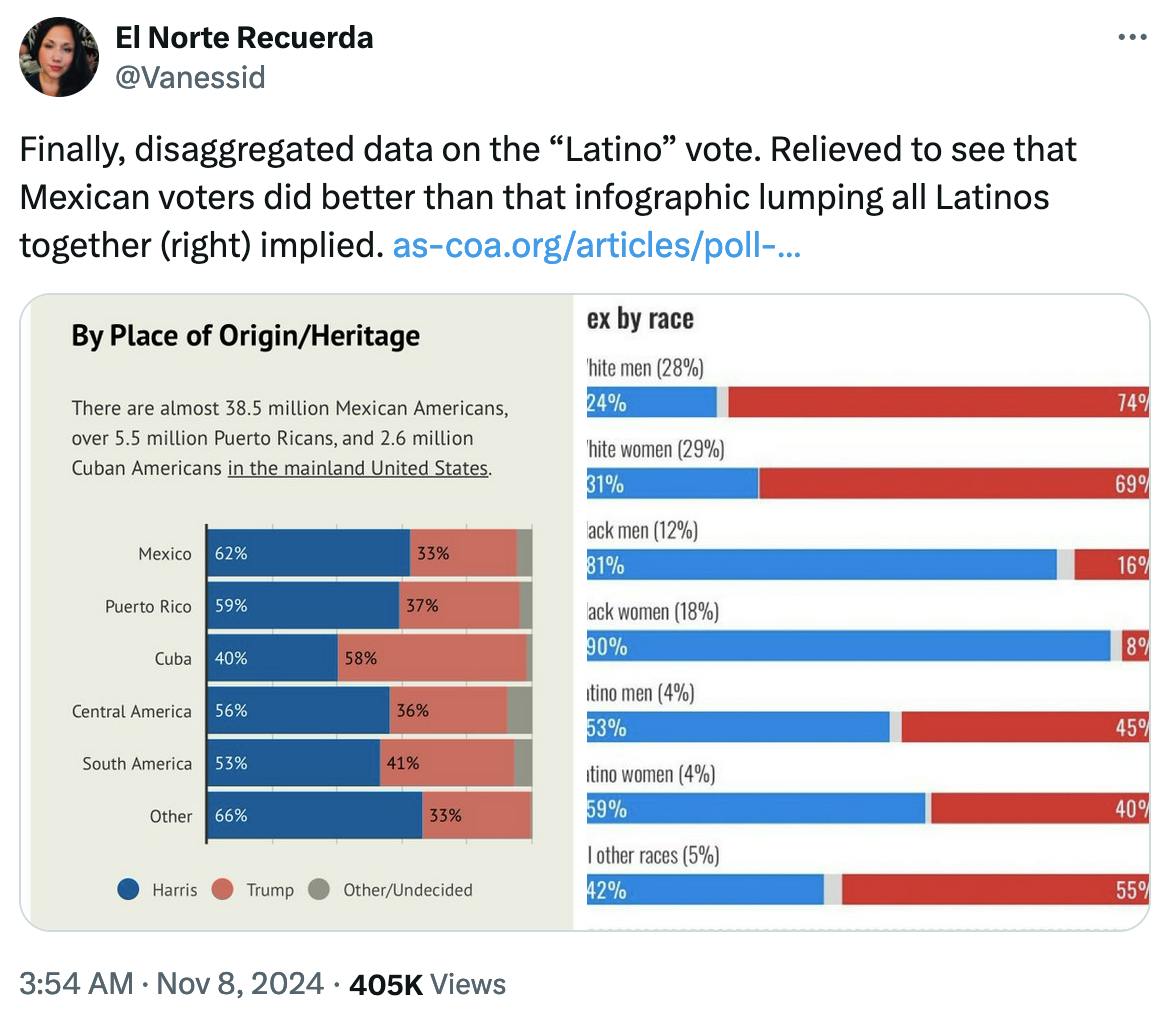
Anxiety was high after exit polls showed that 46 percent of Latinos, and 55 percent of Latino men, voted for Donald Trump. While it is a significant blow—Joe Biden and Hillary Clinton won Latinos at 65 and 66 percent respectively—a more detailed breakdown by heritage offered some pushback to the generalized narrative.

The Americas Society Council of the Americas research showed that of the largest Latino groups in the United States, Cuban Americans were the only one in which over half of voters chose Trump, as they went for him by a decisive 58 percent. Mexican Americans—by far the largest Latino community in the country—only went 33 percent for Trump, with Puerto Ricans at 37 percent and Central Americans at 36 percent.

Twitter screenshot El Norte Recuerda @Vanessid: Finally, disaggregated data on the “Latino” vote. Relieved to see that Mexican voters did better than that infographic lumping all Latinos together (right) implied. https://as-coa.org/articles/poll-
Twitter screenshot

This poll reminds us that, like any group, Latinos are not a monolith. And the “new coalition” that Republicans are celebrating may not be as solid as they think. Democrats just need to sift through the rubble and reevaluate how they message to Latino voters.