Breaking News
Breaking News
from Washington and beyond

Trump Sends Ominous Test Message to Every Federal Worker in Country

What a week.

Donald Trump clasps his hands together in the Capitol
GREG NASH/POOL/AFP/Getty Images

The Trump administration this week began a plan to send email alerts to every single federal government employee from a single email address, confusing and worrying many workers about what’s coming next.

CBS News reports that the Office of Personnel Management, which manages the federal workforce, is testing a new capability that would allow the alerts to be sent to every single employee, about roughly 2.3 million people. Workers at multiple federal agencies initially didn’t recognize the sender, an hr-at-opm-.gov email address, and reported the email as spam.

OPM sent the messages overnight between Thursday and Friday, two officials told CBS.

“This is a new effort under this administration,” one official told CBS.

The effort is so new that even some I.T. offices in federal agencies flagged the email as spam. One anonymous federal employee sent a screenshot to CBS and said their co-workers weren’t sure if the email was legitimate.

“Everyone thought it was spam,” said the employee. “There was a flurry of messages, ‘Is this spam?’”

At a time when the new administration is closing various federal offices and proposing massive cuts to the government under Elon Musk’s “Department of Government Efficiency” initiative, the new system’s potential worries federal employees.

“They had to send this this week, of all weeks? Really?” said CBS’s source. Only agency and department heads had advance notice of the email plan on Thursday, according to OPM officials. Some rank-and-file employees didn’t hear about the new plan until they received the first email, leading to Friday’s confusion.

White House officials didn’t respond to CBS’s questions about what the system will be used for. But looking at past comments from Trump and others close to his administration, the potential is vast and disturbing, with the possibility of upending some of our most critical federal agencies.
More on Trump’s first week in office:

Democratic Senator Ready to Do Dumbest Thing (Vote to Confirm RFK Jr.)

What is Sheldon Whitehouse thinking?

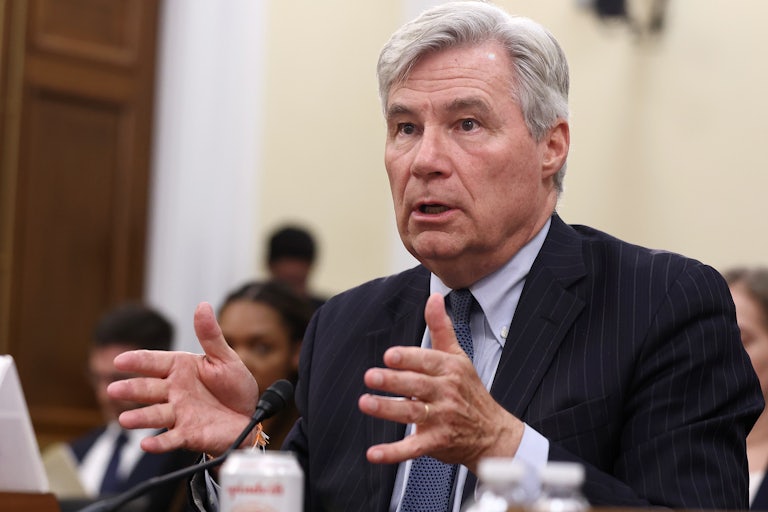
Sen. Sheldon Whitehouse appears before a roundtable discussion on Supreme Court Ethics conducted by Democrats of the House Oversight and Accountability Committee.
Jemal Countess/Getty Images
Senator Sheldon Whitehouse

While it seems likely that the lion’s share of President Donald Trump’s Cabinet nominees are going to sail through their confirmation hearings, the fortunes of three of his picks—Secretary of Defense nominee Pete Hegseth, Director of National Intelligence prospect Tulsi Gabbard, and would-be Department of Health and Human Services head Robert F. Kennedy Jr.—remain somewhat cloudy. Hegseth, of late, has emerged as the likeliest of the three to get over the line.

But according to a fresh report from Talking Points Memo’s Josh Marshall, another may be edging closer: Kennedy Jr. And the reason RFK’s chances have slightly improved have nothing to do with the nominee sanding down his fringe ideas about vaccines and modern medicine, and everything to do with the fact that Rhode Island Democrat Sheldon Whitehouse, while not “confirmed as voting for Kennedy” nevertheless “appears to be actively considering it.”

Naturally, the reasons why, given the high stakes, are both indescribably stupid and yet very typical of the way Washington works. As Marshall reports:

I’m told that there appear to be two reasons: One is that Whitehouse and Kennedy are personal friends. They were law school roommates at UVA and that seems to have been the beginning of a lifelong friendship. There are also specific issues with Rhode Island’s health care system that apparently need regulatory flexibility from HHS. That seems to be a real issue. But it hasn’t been enough of an issue to shift the state’s senior senator, Sen. Jack Reed (D-RI), who remains firmly opposed to Kennedy’s nomination.

Why would it matter if Whitehouse bucks common sense and votes to install RFK in Trump’s Cabinet? As Marshall points out, support for Kennedy among Republican senators is fluid for all the reasons you might expect (not everyone wants to see long-conquered childhood diseases make a comeback in this, the twenty-first century). But Whitehouse’s support may go a long way toward providing some of the fence-sitters some political cover to back Trump’s man.

While there is something so quintessentially American about millions of ordinary people potentially suffering from myriad public health crises because one rich old boy wanted to do a solid for his University of Virginia Law School roommate, it is to be hoped that someone in Democratic leadership sorts this matter out tout de suite.

Trump Promises to Completely Wreck FEMA—and Fast

Donald Trump used a trip to disaster-hit areas to promise the end of the federal disaster assistance agency.

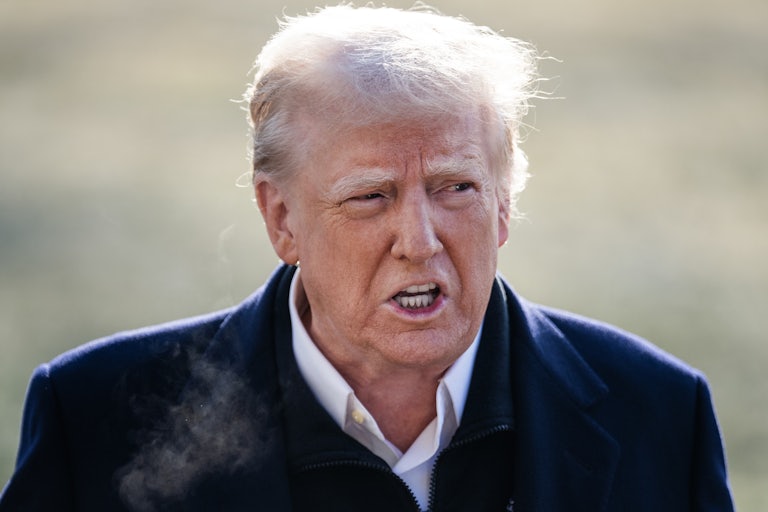
Donald Trump outdoors
MANDEL NGAN/AFP/Getty Images

During his visit to North Carolina Friday, Donald Trump floated the idea of making changes to how the federal government responds to natural disasters—including getting rid of the Federal Emergency Management Agency. 

“We’re looking at the whole concept of FEMA. I like, frankly, the concept when North Carolina gets hit, the governor takes care of it. When Florida gets hit, the governor takes care of it. Meaning the state takes care of it,” Trump told reporters on the tarmac in Asheville, citing the effects of Hurricanes Helene and Milton on the southwestern U.S. last year.

Trump: "We're looking at the whole concept of FEMA. I like, frankly, the concept when North Carolina gets hit, the governor takes care of it. When Florida gets hit, the governor takes care of it. Meaning the state takes care of it ... I'd like to see the states take care of disasters."

[image or embed]

— Aaron Rupar (@atrupar.com) January 24, 2025 at 11:13 AM

Trump also said that disaster aid for North Carolina and California,  both of which happen to be states with Democratic governors, would go directly through his administration rather than FEMA. Later, meeting with local officials during his visit, Trump said he’d be signing an executive order to begin reforming or even getting rid of the agency.

“I think, frankly, FEMA is not good,” Trump said. “FEMA has turned out to be a disaster…. I think we’re going to recommend that FEMA go away.”

Eliminating the agency altogether would require congressional approval, and would result in more than 20,000 federal employees losing their jobs. Trump also discussed getting rid of FEMA on Wednesday in an interview with Fox News’s Sean Hannity, saying that he’d “rather see the states take care of their own problems.” 

But between 2015 and 2024, Republican-led states such as Florida, Texas, and Louisiana received the majority of federal disaster aid. Any cuts to FEMA would end up affecting states that voted for him in the last three presidential elections. Perhaps Trump sees this as an acceptable price for the power to restrict aid to other places whenever he pleases.

Trump Issues Outrageous New Aid Requirement as California Fires Spread

Donald Trump has a new condition on federal assistance to California. It’s all part of a plan to use the country’s largest state for his own political agenda.

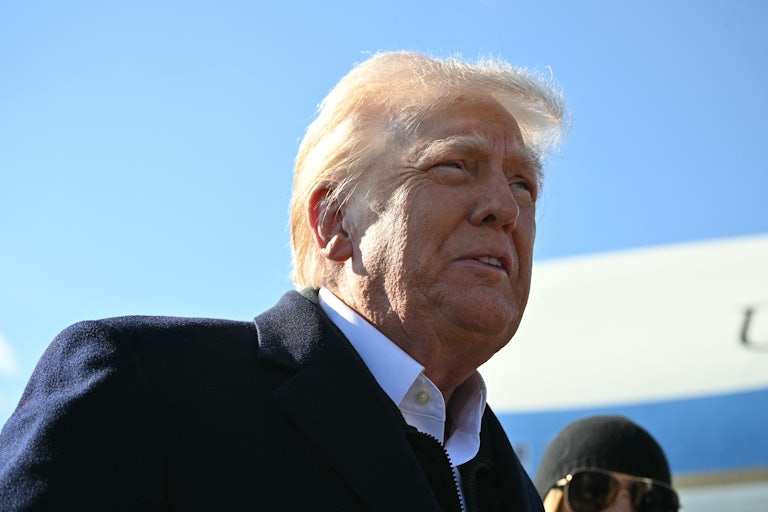
Donald Trump outdoors
Tom Williams/CQ-Roll Call, Inc/Getty Images

Trump still wants to hold California wildfire disaster aid hostage until the state government capitulates to his personal agenda.

Ahead of a planned trip to the state on Friday, a reporter asked the president very directly if he would “withhold funding to Los Angeles because of its sanctuary city policy.”

“I want to see two things in Los Angeles. Voter ID, so that the people have a chance to vote, and I want to see the water be released and come down into Los Angeles and throughout the state,” Trump responded, ignoring the actual question while adding even more conditions to federal aid. “Those are the two things. After that, I will be the greatest president that California has ever seen.”

Trump went on to ramble about the abject beauty of the California terrain before returning to his thesis.

“I want voter ID for the people of California; they all want it, right now.… People want to have voter identification, you want to have proof of citizenship, ideally you have one-day voting … but I just want voter ID as a start, and I want the water to be released, and they’re gonna get a lot of help from the U.S.”

Voter ID law has nothing to do with the wildfires, or with getting federal assistance to California—it’s just one of many demands Republicans want California to meet before they dole out the funds they’ve been dangling over the state.

When asked moments later about the requirement, Trump seemed to imply that there would be no conditions on aid to North Carolina, which is still recovering from Hurricane Helene. But California was a different story: “In California, I have a condition. We want them to have voter ID,” he reiterated.

On Trump’s desire for the water to “come down into Los Angeles”: The president has repeatedly accused the California state government of refusing to send water from Northern California to fight the fires, saying that they’re ignoring Southern California to protect the delta smelt, a kind of fish.

“Los Angeles has massive amounts of water available to it,” Trump said on Tuesday. “All they have to do is turn the valve, and that’s the valve coming back from and down from the Pacific Northwest, where millions of gallons of water a week and a day, even, in many cases, pours into California, goes all through California down to Los Angeles. And they turned it off.”

It’s nowhere near as simple as he describes it, and there is no “valve.” The hydrants were overworked, not shut off. Nor did the smelt have anything to do with the lack of water to the south—high demand and low pressure did. “There’s literally no real connection between the fires in Southern California and delta smelt protections,” said the Center for Biological Diversity’s John Buse.

Donald Trump’s Petty War With Anthony Fauci Just Got Dangerous

The president removed the security detail that has protected the former head of the National Institute of Allergy and Infectious Diseases.

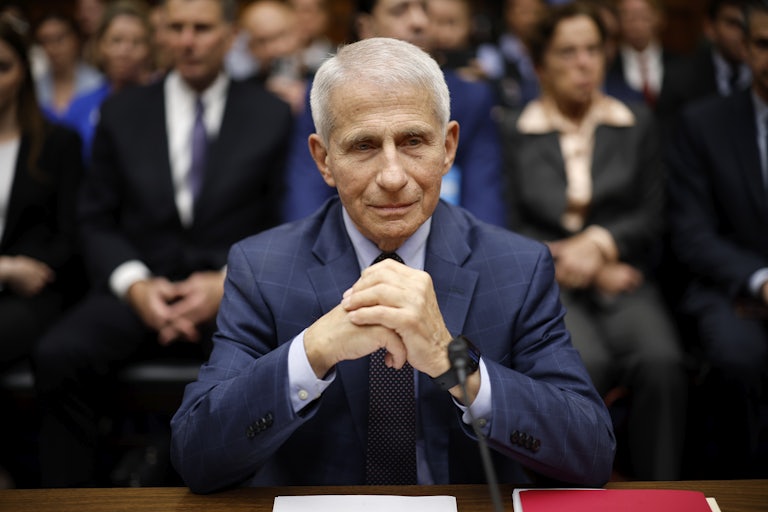
Anthony Fauci clasps his hands while testifying before Congress
Chip Somodevilla/Getty Images
Anthony Fauci

While taking questions from the press at Asheville Airport, in Fletcher, North Carolina, Trump was asked to comment on the removal of the security detail charged with protecting his former head of the National Institute of Allergy and Infectious Diseases.

“You know, when you work for government, at some point your security detail comes off. And you know, you can’t have ’em forever. So I think it’s very standard,” Trump said.

“If it would be for somebody else, you wouldn’t be asking the question,” Trump said. “I think the question is very fair.

“You can’t have a security detail for the rest of your life because you work for government,” Trump added.

Trump’s previous efforts to discredit and demonize Fauci give the removal of his security detail a distinctly more sinister connotation.

As recently as August, Trump shared a picture of Fauci in an orange jumpsuit, during a particularly violent tirade on Truth Social. Biden issued a last-minute pardon for Fauci ahead of Trump’s inauguration Monday, likely crushing Trump’s dreams of seeing the former health official behind bars. Taking away his safety might be the next best thing.

In the past week Trump has pettily removed the security details of his former national security adviser John Bolton and former Secretary of State Mike Pompeo—two administration officials who had openly criticized Trump—despite warnings from the Biden administration that both were still receiving threats against their safety.

In Fauci’s memoir, On Call: A Doctor’s Journey in Public Service, he detailed Trump’s volatile behavior and his abusive treatment of the embattled former health official. He also exposed just how desperate the president was to reopen the country through the embrace of poorly qualified advisers pushing unproven treatments.