Breaking News
Breaking News
from Washington and beyond

DOGE Is Officially in Action—and Already Wreaking Havoc in Government

The Department of Government Efficiency is creating mass confusion across the federal government.

Elon Musk
Marc Piasecki/Getty Images

Elon Musk is already sparking chaos in the federal government, sending representatives from his Department of Government Efficiency to agencies across the federal bureaucracy.

The Washington Post reports that employees from DOGE, which will be headed by Musk and Vivek Ramaswamy, are already beginning to interview federal employees as part of their plan to decrease the size of the federal government. DOGE has interviewed workers at the Treasury Department, the Internal Revenue Service, and the departments of Homeland Security, Veterans Affairs, and Health and Human Services.

Musk and Ramaswamy already have 50 employees working out of the Washington, D.C., offices of Musk’s rocket company, SpaceX, according to the Post, with plans to have 100 people in place by January 20, when Trump is sworn in as president. But their plans are already meeting skepticism from civil servants and members of Congress, including Republicans.

According to two government employees who spoke to the Post, Musk’s and Ramaswamy’s comments about the federal workforce have made them “wary” of the DOGE effort. The pair have cited a controversial Supreme Court ruling, Loper Bright v. Raimondo, that they say will help them enact sweeping budget cuts across the federal government—but the federal bureaucracy seems all but destined for a clash with the fast-moving, “disruptive” culture of Silicon Valley.

However, in recent days, Musk has been tempering his statements on DOGE, conceding that his goal of cutting the federal budget by “at least $2 trillion” probably won’t happen. Plus, since DOGE isn’t an official government agency and Musk and Ramaswamy aren’t actually federal employees, they can’t make any changes themselves. The most they can do is recommend changes and budget cuts to Congress and the president.

Still, Musk and Ramaswamy will at least attempt to make a big show of appearing to be slashing the size of government, and regardless of how it goes, will attempt to claim victory. If there are negative consequences, rest assured that they will find some way to blame somebody else—likely their critics.
Trump Officially Sentenced Just Days Before Becoming President

This is a historic national embarrassment.

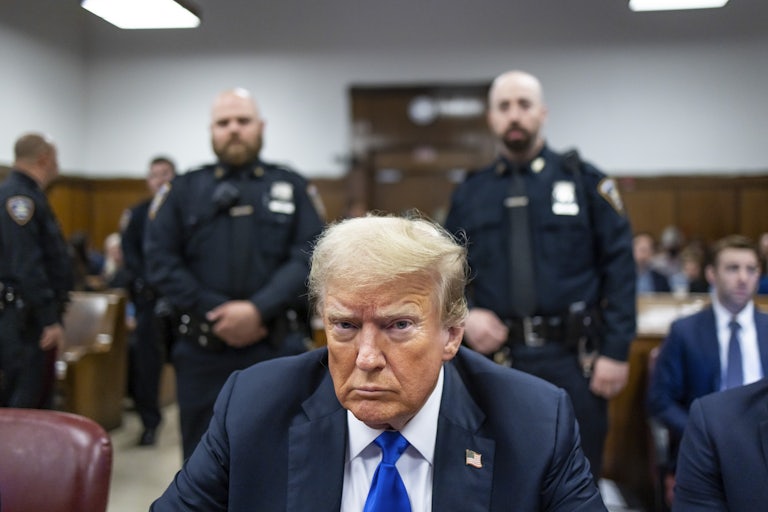
Donald Trump in court
Justin Lane/Pool/Getty Images

President-elect Donald Trump was sentenced Friday morning in his hush-money case, after becoming the first president to be convicted of multiple felonies.

Judge Juan Merchan sentenced Trump to unconditional discharge, or a sentence without imprisonment, fines, or probation, saying that this was the “only lawful sentence” he could pass down.

Merchan made clear that Trump was receiving this sentence only because he is returning to the White House in a few days. It is the legal protection of the office that determined the sentence, not the occupant of the office, Merchan stressed in delivering the sentence.

It’s a whimper of an end for the historic case, in which Trump was convicted on 34 felony counts of falsifying business records to cover up his payments to adult film star Stormy Daniels, with whom he had an affair. Still, it’s a national embarrassment. Trump is now the first convicted felon to be sworn in as president.

Appearing virtually in the courtroom Friday, Trump complained that he did nothing wrong.

“I was the first president in history to be under a gag order. I’m totally innocent. I did nothing wrong,” Trump claimed. “They talk about business records, but they were extremely accurate and I had nothing to do with them.”

Undeterred, Merchan accused Trump’s lawyers of trying to create a “chilling effect” on the Supreme Court in pressing for the sentencing to be waived.

Prosecutor Joshua Steinglass also warned that Trump’s actions during the case were an attack on the rule of law. “Such threats are designed to have a chilling effect, intimidate those who have the responsibility to enforce our laws in the hopes that they will ignore the defendant’s transgressions because they fear [Trump] is too powerful to be subjected to rule of law like the rest of us,” Steinglass argued, according to Lawfare reporter Tyler McBrien.

Trump tried very hard to stop this moment from happening, leaning on his presidential immunity, but to no avail.

“Sir, I wish you godspeed as you pursue your second term in office. Thank you,” Merchan said as the sentencing concluded.

Trump Melts Down Over Hush-Money Sentencing in Bonkers Rant

The Supreme Court rejected Donald Trump’s request to prevent his sentencing.

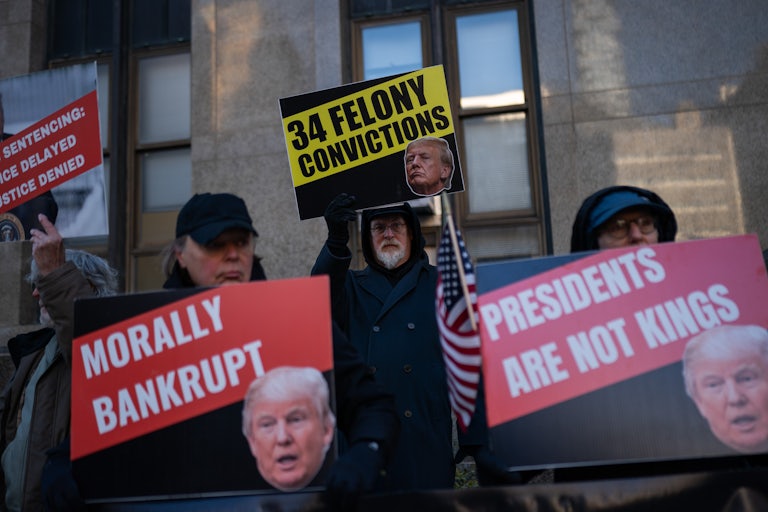
People hold protest signs against Donald Trump outside the Manhattan courthouse
Adam Gray/Getty Images

The Supreme Court shockingly slapped down Donald Trump’s request to block the sentencing for his sole criminal conviction, leaving him with few other options than to finally face the music at the finale of his hush-money trial Friday morning. But Trump’s interpretation of the rejection—which attempted to frame the forthcoming legal comeuppance as something of a fight song—wouldn’t have you think so.

“I appreciate the time and effort of the United States Supreme Court in trying to remedy the great injustice done to me by the highly conflicted ‘Acting Justice,’ who should not have been allowed to try this case,” Trump wrote Thursday night on Truth Social. “Every Legal Scholar stated, unequivocally, that this is a case that should never have been brought. There was no case against me. In other words, I am innocent of all of the Judge’s made up, fake charges.

“This was nothing other than Weaponization of our Justice System against a Political Opponent,” he continued. “It’s called Lawfare, and nothing like this has ever happened in the United States of America, and it should never be allowed to happen again.”

Trump then went on to lament the details of the gag order placed upon him in the case, claiming that preventing him from bashing the characters of witnesses and court staff in the hush-money trial was a violation of his First Amendment rights.

“For the sake and sanctity of the Presidency, I will be appealing this case, and am confident that JUSTICE WILL PREVAIL,” Trump wrote. “The pathetic, dying remnants of the Witch Hunts against me will not distract us as we unite and, MAKE AMERICA GREAT AGAIN!”

The Supreme Court ruled 5–4 on Thursday against Trump, determining that there would be no further delays in processing the president-elect’s criminal conviction. Chief Justice John Roberts and Justice Amy Coney Barrett, a Trump nominee, sided with the court’s three liberal justices in the majority decision. The court issued a brief, one-paragraph statement explaining its two-pronged rationale for rejecting Trump’s request.

“First, the alleged evidentiary violations at President-Elect Trump’s state-court trial can be addressed in the ordinary course on appeal,” the court wrote. “Second, the burden that sentencing will impose on the President-Elect’s responsibilities is relatively insubstantial in light of the trial court’s stated intent to impose a sentence of ‘unconditional discharge’ after a brief virtual hearing.”

Last week, Judge Juan Merchan dealt the final blow to any suggestions of serious consequences for the president-elect. Merchan wrote in his order that “unconditional discharge” had become the “the most viable solution” for Trump, indicating that the incoming president would not be hampered down with fines, court-appointed supervision, or incarceration.

Trump is scheduled to be sentenced at 9:30 a.m. on Friday, with the MAGA leader appearing virtually.

Trump Dealt Major Blow as Judge Cannon’s Ruling Struck Down

Judge Aileen Cannon’s reign of error on Jack Smith continues to be thwarted.

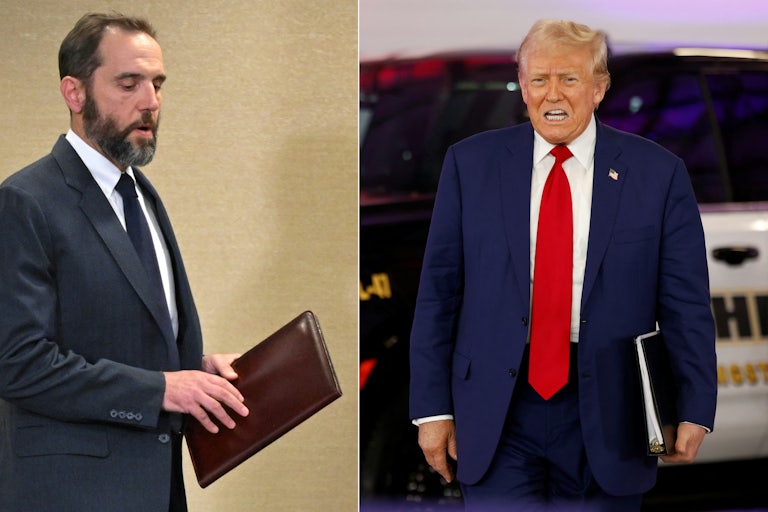
Jack Smith and Donald Trump
Mandel Ngan/Jeff Kowalsky/AFP/Getty Images

An appeals court has denied an emergency motion from two of Donald Trump’s co-defendants to stop the release of a report on the president-elect’s felony classified documents case.

Special counsel Jack Smith’s team had asked the Eleventh Circuit Court of Appeals to overturn Judge Aileen Cannon’s decision blocking the report’s release in favor of Carlos De Oliveira, the property manager of Mar-a-Lago, and Walt Nauta, a Trump aide who was photographed carrying large boxes around the estate. The court agreed with Smith’s side, ruling Thursday that the report could be released after three days.

Cannon previously tossed out the felony classified documents case against Trump by ruling Smith’s appointment was unconstitutional, a move that has been criticized by legal scholars and repeatedly celebrated by Trump.

Lawyers for De Oliveira and Nauta argued that allowing Smith to publish his report was an “improper attempt to remove from the district court the responsibility to oversee and control the flow of information related to a criminal trial over which it presides, and to place that role instead in the hands of the prosecuting authority.”

The lawyers also pushed back on the notion that there was a sense of urgency to get the report published before Trump’s inauguration later this month.

“The only counsel in this case now claiming urgency is the Attorney General, but the government’s brief does not explain this urgency,” the lawyers wrote. “The Attorney General is an office and not an individual: It will continue in perpetuity. The urgency of political activity is a fake urgency.”

Still, their motion to block the release was denied, but the Eleventh Circuit left in place Cannon’s order enjoining its release.

U.S. attorneys said Wednesday that the report would not be made publicly available but would be accessible to members of the House and Senate Judiciary Committees, which the defense lawyers said could lead to possible leaks. Now Attorney General Merrick Garland can publicly release the report from Sunday.

De Oliveira pleaded not guilty to allegedly trying to help Trump delete security footage, and Nauta pleaded not guilty to moving the boxes (a tough one, as again, he was photographed).

Every Senate Democrat Who Backed Most Radical Anti-Immigrant Bill Yet

Here’s the name of every Democratic senator who voted to advance the Laken Riley Act. The bill still needs one final vote.

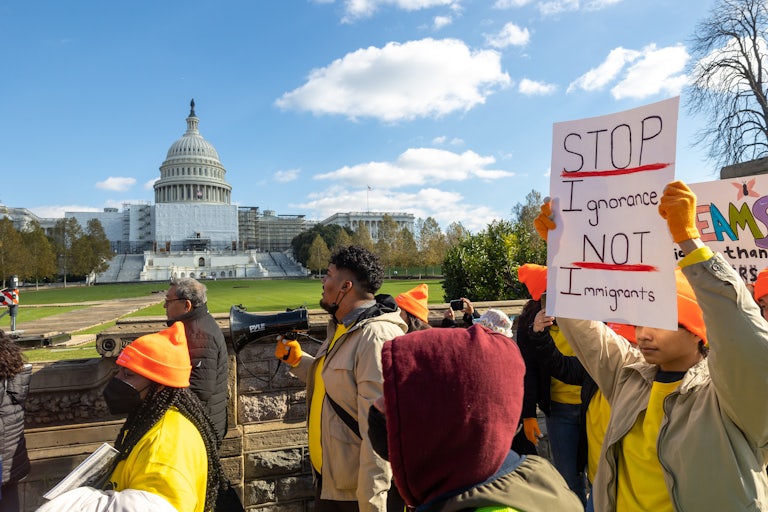
Protesters march outside the Capitol. One holds a sign that reads "Stop Ignorance, not Immigrants."
Nathan Posner/Anadolu Agency/Getty Images

The Senate voted to advance a bill Thursday that would allow the government to detain undocumented immigrants accused of committing nonviolent crimes, following the House’s passage of the bill Wednesday.

The Laken Riley Act advanced by a 84–9 vote in the Senate, with 33 Democrats voting with every Republican in the chamber, despite the fact that the bill doesn’t require a conviction or charge, but merely an arrest, to target an undocumented immigrant. There are also no protections for children or DACA recipients. The House bill saw 48 Democrats join Republicans to pass it, and the Senate version still needs a final vote.

Senate Democrats, like their counterparts in the House, seem to be backing the GOP’s rhetoric demonizing all undocumented immigrants, penalizing them just for being suspected of a crime. With less than two weeks until Donald Trump is sworn into office, many Democrats are already joining Republicans in granting him new powers to carry out his planned mass deportations.

See which Senate Democrats voted to advance the bill below:

  1. Angela Alsobrooks—Maryland
  2. Tammy Baldwin—Wisconsin
  3. Michael Bennet—Colorado
  4. Richard Blumenthal—Connecticut
  5. Lisa Blunt Rochester—Delaware
  6. Maria Cantwell—Washington
  7. Chris Coons—Delaware
  8. Catherine Cortez Masto—Nevada
  9. Tammy Duckworth—Illinois
  10. Dick Durbin—Illinois
  11. John Fetterman—Pennsylvania (co-sponsor)
  12. Ruben Gallego—Arizona (co-sponsor)
  13. Kirsten Gillibrand—New York
  14. Martin Heinrich—New Mexico
  15. John Hickenlooper—Colorado
  16. Tim Kaine—Virginia
  17. Mark Kelly—Arizona
  18. Angus King (independent who caucuses with Democrats)—Maine
  19. Amy Klobuchar—Minnesota
  20. Ben Ray Luján—New Mexico
  21. Jon Ossoff—Georgia
  22. Gary Peters—Michigan
  23. Jack Reed—Rhode Island
  24. Jacky Rosen—Nevada
  25. Chuck Schumer—New York
  26. Jeanne Shaheen—New Hampshire
  27. Elissa Slotkin—Michigan
  28. Chris Van Hollen—Maryland
  29. Mark Warner—Virginia
  30. Raphael Warnock—Georgia
  31. Peter Welch—Vermont
  32. Sheldon Whitehouse—Rhode Island
  33. Ron Wyden—Oregon