Breaking News
Breaking News
from Washington and beyond

IRS Lawyer Ousted as Elon Musk’s DOGE Plans Even More Cuts

DOGE is planning crippling cuts to the IRS—and has shoved a top agency lawyer out in the process.

Elon Musk wears a DOGE t-shirt.
Samuel Corum/Getty Images

Elon Musk’s Department of Government Efficiency is shaking up the Internal Revenue Service, running into resistance from career staff as it seeks sensitive taxpayer information.

The IRS’s top lawyer, William Paul, was removed from his position Thursday despite only having the job for two months. It’s part of DOGE’s plans to cut nearly 20 percent of the tax agency’s staff despite income taxes being due in less than a month. The acting IRS commissioner was told by DOGE to eliminate 18,141 jobs from the agency by May 15, according to The Washington Post.

The largest cuts would come from the tax compliance department, which would lose 8,260 jobs, followed by taxpayer services with 3,247 cuts, followed by information technology. This would only be the first level of cuts, with DOGE signaling even more terminations to come. None of this would help with processing tax returns, but the Trump administration has other concerns: getting the addresses of undocumented immigrants.

The Department of Homeland Security wants the IRS to hand over the addresses of about 700,000 undocumented immigrants, which career employees believe is illegal. Along with Paul’s departure, DOGE’s ongoing purge of the federal workforce has left longtime IRS employees worried. One IRS veteran who had worked at the agency for decades, Doug O’Donnell, left the agency last month.

Musk and DOGE hope to use IRS records in their goal to go after fraud in spending on federal benefits, hoping to check those benefits against tax records. The agency’s staff is concerned about legal protections against the use of such sensitive information, joining their counterparts in other agencies, including the Social Security Administration and the Department of Health and Human Services.

These moves could damage an important government agency, but that may be by design. Conservatives have long opposed the IRS, and Trump has claimed that his tariffs could supplant income tax revenue with his new “External Revenue Service.” It remains to be seen how the government will function with a severely weakened IRS.
Trump Has Delusional Answer for Small Businesses Scared About Tariffs

Donald Trump bragged about some of his Silicon Valley buddies when asked about small businesses.

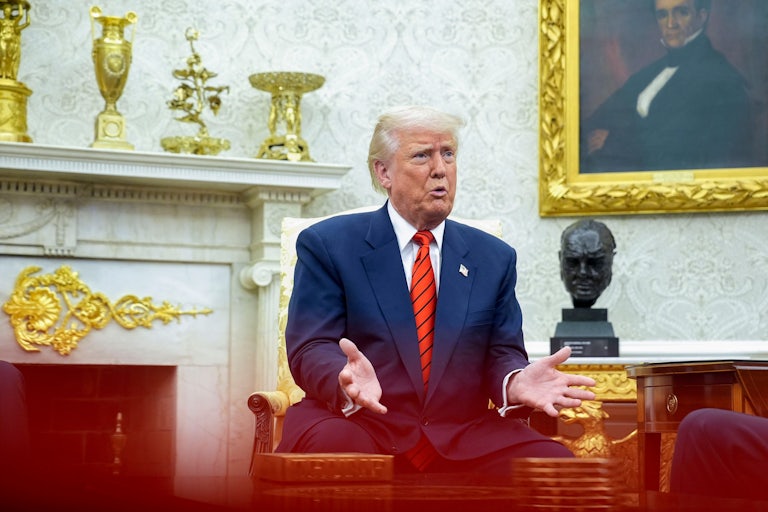
Donald Trump holds his hands out while speaking and sitting in the Oval Office
Yuri Gripas/Abaca/Bloomberg/Getty Images

Donald Trump can only point to big businesses as the potential benefactors of his trade war.

“Many American small-business owners say they are concerned that these tariffs are going to hurt them,” a reporter asked during a White House press conference Thursday. “What’s your message to them?”

“They are gonna be so much richer than they are right now,” the president said. “We have many—yesterday General Motors was in, they want to invest $16 billion—the people from Facebook were in yesterday, they’re going to invest $60 billion by the end of the year.”

Facebook announced in January plans to build a Manhattan-size datacenter in Louisiana to power the company’s latest AI model, Llama 4.

“Other people are talking about numbers,” Trump continued. “Apple, as you know, a few days ago announced a $500 billion investment. They’re going to build their plants in the United States, which as you know, almost all of their plants are in China. Now they’re building in the United States.”

Apple announced in February that it would invest in AI development and silicon engineering, and expand its facilities in Michigan, Texas, California, Arizona, Nevada, Iowa, Oregon, North Carolina, and Washington, as well as build a new factory in Texas. Altogether, the company said it would add as many as 20,000 jobs to the U.S. market over the next four years.

But General Motors, Facebook, and Apple do not count as small businesses.

Nearly half of all private-sector workers are employed by more than 33 million small businesses in the U.S., according to data from the Small Business Administration. The vast majority of companies in the country are, in fact, small—approximately 99.9 percent of them.

Polls show that small-business optimism has plummeted in the wake of Trump’s tariff rollercoaster. The National Federation of Independent Business’s Uncertainty Index recorded its second-highest reading on record in February, marking the smallest number of respondents who believe now is a good time to expand their business since April 2020.

Trump has admitted that his tariffs will destabilize the economy. ​​During an interview with Fox Business’s Maria Bartiromo that aired Sunday, Trump dodged a question on whether the country would dive headlong into a recession, sending stock indexes reeling.

He also floated that the “little disruption” caused by his aggressive trade policies could go on for quite a bit longer, suggesting that Americans should model their economic projections on a 100-year-model—like China—rather than assess his performance on a quarterly basis.

The market, in turn, has tumbled as Trump’s trade war sparks fears of a forthcoming recession. Last week, the Dow dropped 670 points. This week, the slump continued, reacting to Trump’s 25 percent levy on all steel and aluminum imports and the retaliatory tariffs slapped on American goods by countries around the globe in protest.

Still, Trump was quick to ignore the facts and pat himself on the back for what he viewed as the seeding ground for future U.S. growth.

“Look, the reason is two things. Number one, the election, November 5. And the other thing is tariffs, I think probably in that order,” he added Thursday.

Protesters Take Over Trump Tower to Demand Release of Mahmoud Khalil

The NYPD arrested protesters demanding the release of Palestinian activist Mahmoud Khalil.

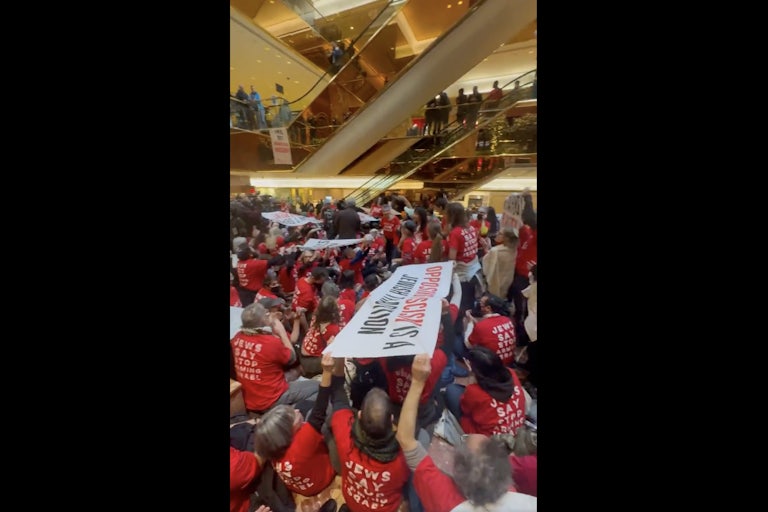
Jewish protesters hold a sit-in in Trump Tower, holding a banner that reads “Opposing Fascism Is a Jewish Tradition” and wearing shirts that read "Jews Say Stop Arming Israel."
Screenshot/X/BreakThrough News

Hundreds of Jewish New Yorkers and allies staged a sit-in at Trump Tower in support of Mahmoud Khalil, the pro-Palestine activist and recent Columbia University graduate who was kidnapped by ICE agents last Saturday night.

Over 300 protesters, many of them affiliated with anti-Zionist organizing group Jewish Voice for Peace, took over the tower around 11:30 a.m. They chanted, “We want justice. You say, how? Bring Mahmoud home now!” and “Fight Nazis, not students.” About 100 protesters were arrested, according to NBC News.

“My grandmother lost her cousins in the Holocaust. I grew up on these stories. We know what happens when authoritarian regimes begin targeting people, begin abducting them at night, separating their families and scapegoating,” JVP spokesperson Sonya Meyerson-Knox told NBC. “And we know that it’s one step from here to losing all right to protest and then further horrors happening, as we have seen too well in our history. We’re calling on everyone to speak up today because otherwise we won’t be able to tomorrow.”

Republican Insists Trump Crashing the Stock Market Is Good, Actually

Senator Tim Sheehy had a pathetic defense for the crumbling stock market.

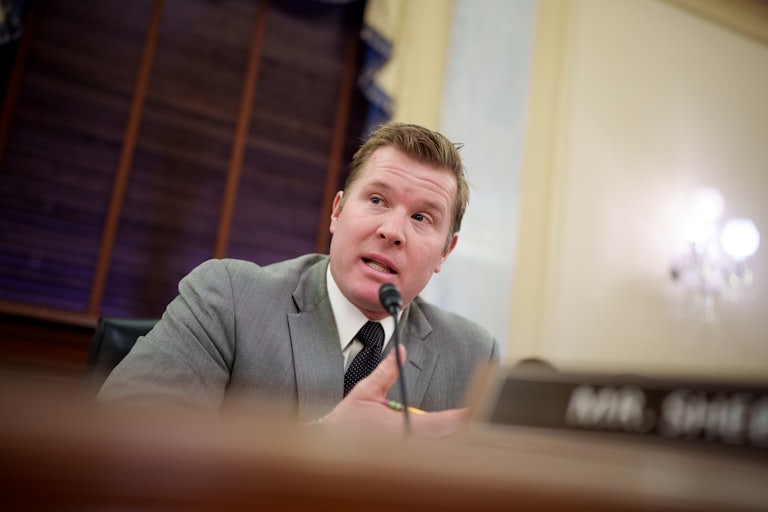
Senator Tim Sheehy speaks into a microphone during a Senate committee hearing
Andrew Harnik/Getty Images

Republicans are trying to spin Donald Trump’s decision to kneecap the U.S. stock market by arguing that the United States doesn’t actually want to have a booming economy.

Montana Senator Tim Sheehy appeared on CNN Wednesday evening, where he was faced with a brutal CNN poll that found a whopping 56 percent of respondents disapproved of Trump’s handling of the economy.

Earlier this week, the stock market plummeted after Trump refused to say that the U.S. wasn’t heading toward a recession caused by his steep tariffs against its closest trading partners.

Sheehy had his own explanation for why Wall Street falling was actually OK.

“Well, first of all the stock market’s been on a sugar high for a long time,” he said.

“There’s a fundamental difference between public spending and private spending. And what we’ve seen over the past several years, past three and a half years specifically, is unprecedented money printing into the market. And to be quite frank, a lot of companies benefited from that,” Sheehy said.

Sheehy claimed that a handful of mega-tech companies had driven the stock market index to an all-time high.

“We all love a good stock market, but the reality is that stock market imbalance didn’t necessarily benefit the smaller, midsize companies and average shareholders across the country,” he said.

And Sheehy knows something about big business. He recently won his seat in Montana thanks to the backing of 12 billionaires, including members of the Walton family and organizations linked to Charles Koch and Stephen Schwarzman, the CEO of Blackstone—which owns the Wyoming oil and gas pipeline company Tallgrass Energy, of which Sheehy’s brother is the president.*

Sheehy insisted Wednesday that the “stock market is not the economy,” and said that “uncertainty” would cause disruptions as Trump attempted to create a new “economic landscape.”

Sheehy’s coping mechanism was similar to that of the dumbest U.S. senator, Tommy Tuberville, who was interviewed on Fox Business Monday.

“People are looking at the stock market like, ‘Hey this is how it’s going to continue to be for months and months and months’—that’s not gonna happen,” Tuberville said. “We were probably over-bloated with the stock market here, for a while.”

* This piece has been updated to clarify who is the CEO of Blackstone.

Trump Gives New Orders to U.S. Military on Panama Canal Takeover

Donald Trump is moving forward on his plans to seize the Panama Canal.

A cargo ship transits through the Panama Canal.
MARTIN BERNETTI/AFP/Getty Images

The Trump administration has asked the U.S. military to draw up options for retaking the Panama Canal. 

President Trump has been pushing for retaking the canal since December, and repeated his desire in a joint address to Congress last week, without any elaboration. The rest of the Trump administration hasn’t attempted to explain what he means, either. 

The military is drawing up options, according to NBC News, that range from a closer partnership with the Panamanian military to soldiers seizing the Panama Canal by force, according to unnamed officials. The use of force depends on how much Panama’s military is willing to work with the United States, the officials told NBC News. 

The commander of U.S. Southern Command, Admiral Alvin Holsey, presented the different strategies to Secretary of Defense Pete Hegseth earlier this week. The plan to use military force against Panama will only be considered if posting additional U.S. military personnel does not accomplish Trump’s goal of “reclaiming” the canal, the officials said.  

Right now, the U.S. has more than 200 troops in the country, including Special Forces units working with Panamanian units to combat internal unrest. Trump claims China has troops in the canal, which Panamanian President José Raúl Mulino denies, as does China. In February, Panama decided not to renew an infrastructure agreement with China, drawing criticism from the country toward the U.S. 

China “firmly opposes the U.S. smearing and undermining the Belt and Road cooperation through means of pressure and coercion,” said Chinese Foreign Ministry spokesperson Lin Jian, referring to the country’s Belt and Road development initiative. 

Later this month, Hegseth is expected to visit Panama, where discussions on increasing U.S. troop presence in the canal zone will take place. The Cabinet secretary is fully on board with Trump’s desire to retake the canal, saying in January that the U.S. has “the right—we retain the right—to do what is necessary to make sure there is free navigation in the Panama Canal.”

The canal is one of the busiest waterways in the world, with most of the cargo passing through heading to or from the U.S. Any disruption or blocking of the canal would have devastating effects on the U.S. as well as the world economy. But Trump has proven during his presidency that his personal wishes outweigh any economic concerns, no matter how absurd.