Breaking News
Breaking News
from Washington and beyond

Putin Suddenly Gives Trump the Middle Finger on Ukraine Peace Talks

Russia has poured cold water on Donald Trump’s efforts to end the war in Ukraine.

Russian President Vladimir Putin sits at a table with his hands folded on top of it
Grigory Sysoyev/AFP/Getty Images

Surprise, surprise: Russia has not turned out to be a reliable negotiating partner in ending the war in Ukraine.

Peace talks between the United States and the world power have seemingly stalled, Reuters reported Tuesday.

The interrupted discussion suggests that the White House and the Kremlin have been unable to broker a new deal since Russian President Vladimir Putin objected to America’s last proposal some two weeks ago.

Moscow “cannot accept” the current proposal to end the war because it fails to address problems that the Kremlin believes to have caused the conflict, Deputy Foreign Minister Sergei Ryabkov said in an interview published Tuesday with a Russian state-sponsored magazine, International Affairs.

“We take the models and solutions proposed by the Americans very seriously, but we can’t accept it all in its current form,” Ryabkov said. “As far as we can see, there is no place in them today for our main demand, namely to solve the problems related to the root causes of this conflict. It is completely absent, and that must be overcome.”

Kremlin spokesman Dmitry Peskov indicated on Tuesday that a breakthrough in talks between the nations “isn’t imminent,” according to PBS.

“The issues that we are discussing in connection with the Ukrainian settlement are quite complex, and they require a lot of additional efforts,” Peskov said during a conference call.

The White House appears to be growing increasingly frustrated with the situation. In a weekend spat more akin to a high school fight than a diplomatic negotiation, Donald Trump told NBC News’s Kristen Welker that he was “pissed off” with Putin over insults the Russian dictator had tossed at Ukrainian President Volodymyr Zelenskiy.

The ordeal inspired Trump to pitch secondary tariffs between 25 and 50 percent on buyers of Russian oil, blaming the nation’s continued efforts to evade an end to the war.

“If Russia and I are unable to make a deal on stopping the bloodshed in Ukraine, and if I think it was Russia’s fault—which it might not be—but if I think it was Russia’s fault, I am going to put secondary tariffs on oil, on all oil coming out of Russia,” Trump said on Sunday.

Trump’s threat followed a call by Putin on Friday in which the Russian ruler demanded a transitional government to be put in place in Ukraine—a threat to Zelenskiy’s leadership, reported Agence France-Presse.

Zelenskiy lambasted Moscow in an address late Sunday, arguing that the Kremlin “blatantly makes a mockery of our partners’ efforts to advance a peace agenda.”

The conflict began when Russian forces crossed the Ukrainian border on February 24, 2022, which Putin tried to justify by falsely claiming that he needed to protect civilians in eastern Ukraine. The U.S. and Russia opened peace discussions at a meeting in Saudi Arabia in February, seeking a conclusion to the three-year war, but from the jump, the assembly conspicuously excluded Ukrainian leadership.

Russia has made a series of demands in order to end the war—which Defense Secretary Pete Hegseth blunderingly signed off on and then gently walked back at a February NATO conference in Munich. At the time, Hegseth said that the administration’s peace talks with Russia had taken several chips “off the table,” including Ukraine’s possible NATO membership (something the military alliance had promised in 2008), the possibility of a U.S. presence in Ukraine to enforce postwar security guarantees, and the end of NATO missions to Ukraine.

Since then, Putin has also insisted on taking complete control of the four Ukrainian regions Russia partially occupies as a result of the war, and that the Ukrainian army be limited going forward.*

European leaders have been watching the negotiations closely. On Tuesday, German Foreign Minister Annalena Baerbock described the deal as a “deadlock” and urged the U.S. not to capitulate to Putin’s “stalling tactics.”

* This article has been updated to clarify how much territory Russia controls.
Trump’s “Liberation Day” Tariffs Are as Extreme as It Gets

Donald Trump is considering tariffs so high there would be a shock to the entire global economy.

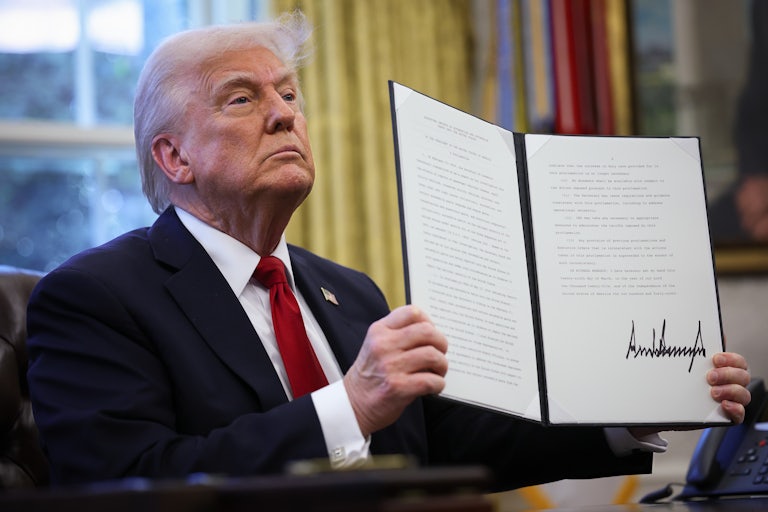
Donald Trump holds up a signed executive order while seated at his desk in the White House.
Win McNamee/Getty Images

Donald Trump’s planned “Liberation Day” Wednesday will bring outrageous tariffs of 20 percent on most goods imported to the U.S., according to officials who spoke with The Washington Post.

Trump announced Sunday that the U.S. will institute reciprocal tariffs on any country that imposes tariffs on American goods, with White House officials saying Monday that any country that treats the U.S. unfairly will also receive tariffs. On Wednesday, there will also be a 25 percent tariff on automobile imports to the United States.

The president will announce his full tariff plan at the White House at 4 p.m. Wednesday, and according to officials, while 20 percent tariffs are under consideration, there is still no final decision about how big or extensive the tariffs will be, and what else they will specifically target.

Tariffs on steel and aluminum of 50 percent have already gone into effect against Canada, up from 25 percent after Canada put a reciprocal 25 percent tariff on electricity exports to the U.S. Other countries are also planning to take action against U.S. tariffs, with the European Union threatening strong retaliatory action of its own, such as measures against U.S. banks and tech companies. South Korea, China, and Japan also plan to work together on regional trade.

All of this will result in higher costs for American consumers and have terrible effects on the U.S. economy. Republicans are openly admitting that things will be worse, while claiming that there will eventually be a payoff. Trump has threatened U.S. automakers, who depend on parts that are affected by the tariffs, against raising their prices. Northern states near the Canadian border stand to suffer from lost imports and higher utility costs. How much will Trump’s “liberation” hurt American wallets?

Karoline Leavitt Pulls a 180 After ICE Admits It Deported Wrong Guy

The White House press secretary is lying out of her mouth.

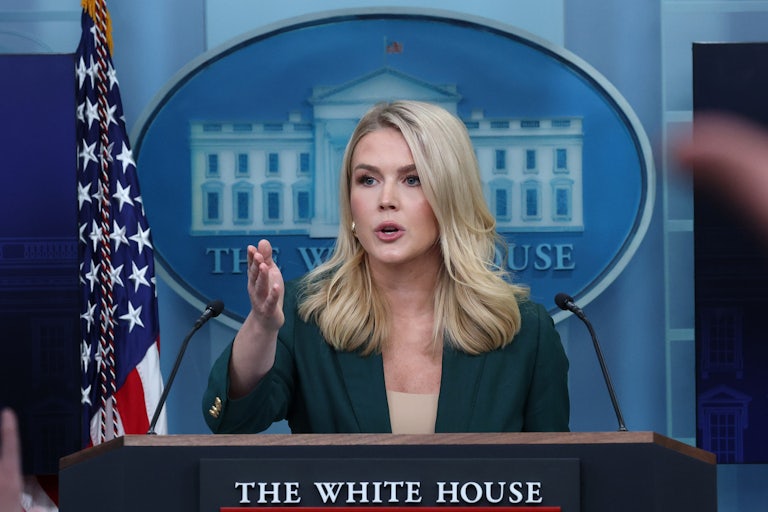
White House press secretary Karoline Leavitt gives a press conference in the press briefing room.
Win McNamee/Getty Images

The Trump administration is continuing to lie about the Venezuelan nationals they deported on claims they were all Tren de Aragua gang members.

Press secretary Karoline Leavitt was asked on Tuesday about the case of Kilmer Armado Abrego Garcia, the Maryland-based Salvadoran national who was deported to El Salvador earlier this month based on a “clerical error.” 

“The administration has expressed a complete confidence in how all the deportations flights to El Salvador were conducted,” a reporter asked Leavitt. “But now that the administration has conceded that there was an error of one Salvadoran national, will there be any reviews conducted, and does the president express any thoughts on the one error that was disclosed in court last night?”  

“Well first of all, the error that you are referring to was based on a clerical error, it was an administrative error. The administration maintains the position that this individual who was deported to El Salvador and will not be returning to our country was a member of the brutal and vicious MS-13 gang,” Leavitt replied. “That is fact number one. Fact number two: We also have credible intelligence proving that this individual was involved in human trafficking. And fact number three: This individual was a member, actually a leader, of the brutal MS-13 gang, which this president has designated as a foreign terrorist organization.” 

Leavitt admits Abrego Garcia’s deportation was a “clerical error” while simultaneously claiming that he is some evil MS-13 mastermind. What’s most likely is that the Trump administration sent another immigrant to rot in a brutal megaprison without any due process.  

“You said you’d seen evidence that this man was a convicted gang member. In what court was he convicted and for what?” a different reporter followed up

“This individual was an MS-13 ring leader. This individual was engaged in human trafficking. And I’m glad you brought up this point again, because if you just saw the headline from insane, failing Atlantic magazine this morning, you would think this individual was father of the year, living in Maryland, living a peaceful life when that couldn’t be further from the truth. They didn’t even mention in the title of that article, or even in the first paragraph, that this individual is an illegal criminal who broke our nation’s immigration laws. He is a leader in the brutal MS-13 gang, and he is involved in human trafficking. And now MS-13 is a designated foreign terrorist organization.” 

Leavitt rambled on spitefully, coming nowhere close to answering the basic question she was asked about which court identified Abrego Garcia as a leader of MS-13.

ICE Logic for Deporting “Gang Members” Is Based on Total Lie

Donald Trump has insisted that certain tattoos signify gang membership.

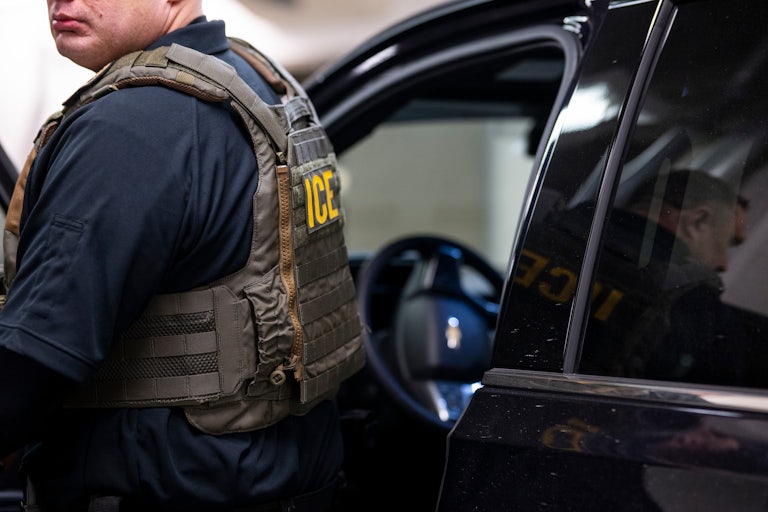
An ICE officer stands next to a car
Christopher Dilts/Bloomberg/Getty Images

As the Trump administration continues to face mounting legal challenges to its mass deportation of alleged members of Tren de Aragua, who were identified over their supposedly incriminating tattoos, experts on the Venezuelan gang said that the group doesn’t have identifying tattoos at all.

To classify individuals as gang members, immigration officials used an “Alien Enemy Validation Guide” that works on a points-based system. Venezuelan nationals over the age of 14 needed to score eight points to be deemed a member of TdA, and according to the guide, tattoos were worth a whopping four points.

But experts on the gang told The New Yorker that tattoos aren’t really a TdA signifier.

“The truth is that a tattoo identifying Tren de Aragua does not exist,” Ronna Rísquez, a Venezuelan journalist who published the definitive book on TdA, told the magazine. “Tren de Aragua does not use any tattoos as a form of gang identification; no Venezuelan gang does.”

Rísquez said that tattoos were by no means a reliable way to determine whether someone was gang-affiliated. “Most young people in Latin America these days have tattoos,” she said, adding that “people get a tattoo because it means something particular to them.”

“This is the first time I’ve ever encountered any reference to the significance of tattoos,” said Andrés Antillano, a criminology professor at the Central University of Venezuela, who spent much of his career studying TdA. He called this thinking “absurd” and “naïve.”

New documents obtained by the American Civil Liberties Union on Sunday showed that the tattoos ICE is using to identify individuals as TdA gang members included a range of innocuous images such as the Jordan “Jumpman” logo, a crown, a train, and a clock, among other things.

Andry José Hernández Romero, a 38-year-old makeup artist, was classified as a member of TdA based on crown tattoos on his wrists that immigration authorities claimed were a “determining factors to conclude reasonable suspicion.” The crowns were adorned with the words “Mom” and “Dad.”

Being identified based on their tattoos has emerged as a through line between the individuals who were deported to a notorious prison in El Salvador on March 15. Representatives for at least three of the people deported last month claimed that their clients were wrongly classified as gang members over their tattoos.

A judge ordered a pause on deportations under the Alien Enemies Act, which was used to remove alleged gang members without due process, and another judge issued a temporary restraining order requiring the government to provide written notice and an opportunity for detainees to apply for protection before deporting them to a third country. Still, the government has continued to remove alleged members of TdA and MS-13.

Now We Know Why Elon Musk’s DOGE Seized That Independent Nonprofit

The Department of Government Efficiency is trying to claim the multimillion-dollar real estate assets of the U.S. Institute of Peace.

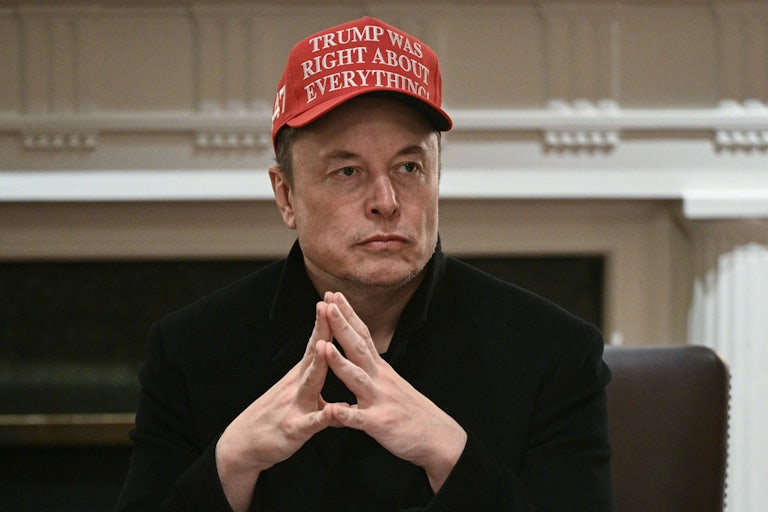
Elon Musk
BRENDAN SMIALOWSKI/AFP/Getty Images

It looks like Elon Musk’s Department of Government Efficiency is trying to award itself a $500 million building from one of the organizations it targeted.

Wired reports that DOGE is trying to transfer the United States Institute of Peace’s headquarters to the government’s General Services Administration free of charge. DOGE took over the USIP last month after a standoff with law enforcement and fired the agency’s 10 board members, despite the fact that it’s an independent nonprofit organization and is not part of the executive branch of government.

On Friday, most of the nonprofit’s employees received termination notices, despite a pending lawsuit from USIP officials against DOGE, President Trump, former USIP President Kenneth Jackson, and other administration officials. The institute was denied a temporary restraining order in federal court last month, although U.S. District Court Judge Beryl Howell criticized DOGE’s takeover of the nonprofit.

Last week, DOGE staffer Nate Cavanaugh replaced Jackson as acting president, according to court documents, and the lawsuit states that Cavanaugh was ordered to transfer USIP’s assets, including its headquarters, to the GSA. The lawsuit also cites a letter from Russell Vought, the head of the office of Office of Management and Budget and an author of Project 2025, seeking the transfer of the building at no cost.

Judge Howell will decide whether to allow the asset transfer in court Tuesday, according to Wired. But Vought and DOGE’s desire for the institute’s assets raise questions about their intentions for the building, which has a prime location near the Potomac River and the National Mall.