Breaking News
Breaking News
from Washington and beyond

European Union Issues Grim Warning Over Trump’s Looming Tariffs

The European Union is ready to put up a fight against Donald Trump.

Ursula von der Leyen speaks to Donald Trump while sitting next to him at the World Economic Forum
Jim Watson/AFP/Getty Images

Donald Trump’s global tariff “Liberation Day” begins April 2—but European officials say that they have their own hand to play in the U.S. president’s trade war.

“Europe has not started this confrontation,” European Commission President Ursula von der Leyen told lawmakers Tuesday at a European Parliament session in Strasbourg, France. “We do not necessarily want to retaliate, but if it is necessary, we have a strong plan to retaliate and we will use it.

“Europe holds a lot of cards, from trade to technology to the size of our market. But this strength is also built on our readiness to take firm counter measures if necessary. All instruments are on the table,” von der Leyen said.

The European Union is composed of 27 member countries, several of which have stood as America’s longest and strongest allies, including France, Germany, and Spain.

After Trump announced forthcoming aluminum and steel tariffs on the continental bloc, the EU said it would impose a $26 billion levy on imported U.S. goods.

Trump has also managed to shut American companies out of other deals with the international coalition, including the European Union’s $800 billion defense spending plan. That followed revelations that Canada and Portugal were similarly wobbling on whether to buy American when restocking their military arsenals.

But beyond nickels and dimes, Trump’s whiplash tariffs and his decision to spark a global trade war have critically damaged America’s image on the international stage, wrecking the nation’s relationships with its long-standing allies.

Even America’s northern neighbor has had enough: On Thursday, Canadian Prime Minister Mark Carney announced that his country’s cozy relationship with the U.S. had come to an end and that Canada would wean itself off American products and services “at speeds we haven’t seen in generations.”

But the EU is waiting to assess the impact of Trump’s tariffs before issuing more retaliatory tariffs, though von der Leyen is reportedly consulting with member states about another round—worth $18 billion—that would cover steel, aluminum, poultry, beef, seafood, and nuts, per The Guardian.

“So many Europeans feel utterly disheartened by the announcement from the United States,” von der Leyen said. “This is the largest and most prosperous trade relationship worldwide. We would all be better off if we could find a constructive solution.”

Cory Booker’s Marathon Anti-Trump Senate Floor Speech Passes 15 Hours

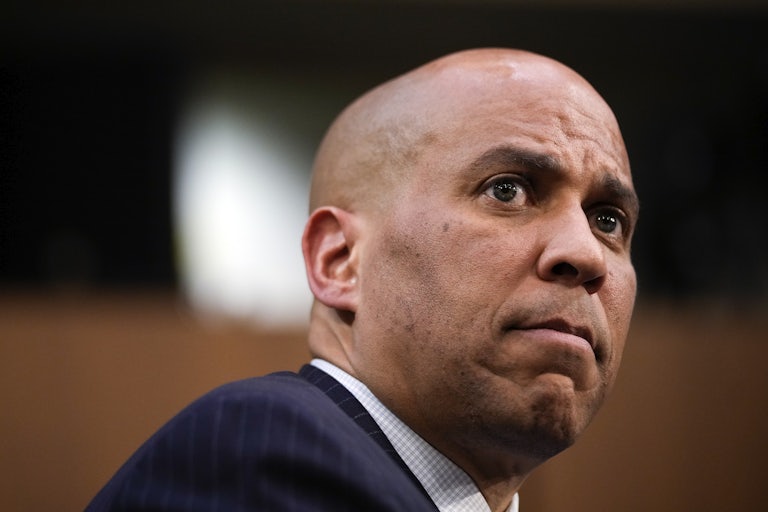
Senator Cory Booker is holding a filibuster-like speech to protest Donald Trump’s reckless overhaul of the federal government.

Senator Cory Booker
Drew Angerer/Getty Images

Senator Cory Booker is in hour 15 of a Senate floor “filibuster” at the time of this writing. He started the marathon speech in protest of Trump at 7 p.m. on Monday.  

While technically not an official filibuster—since no legislation is being blocked—the New Jersey Democrat’s lengthy speech will likely disrupt the Senate’s schedule if it goes past noon. 

While he covered everything from 9/11 to the New York Giants, Booker used the majority of his speech to excoriate President Trump and the outsize influence of Elon Musk and DOGE, who he says have displayed a “complete disregard for the rule of law, the Constitution, and the needs of the American people.”

This speech is one of the more aggressive anti-Trump actions that the Democratic Party has taken, and is certainly a louder, more direct demonstration than the protest signs some Democratic lawmakers held up at the State of the Union. Booker has been helped along at multiple points of his speech by Senators Chuck Schumer, Elizabeth Warren, Chris Murphy, and others. Booker also read personal accounts from both citizens and noncitizens living in fear of things like Musk and Trump’s cuts to Social Security or ICE detainment. 

“Today, 73 million Americans count on Social Security. Millions more than that are planning on those benefits they earn being there for them. You heard from that first letter I read that people are really worried. Forty percent of people who rely on Social Security—40 percent—have no other source of income,” Booker said, around 2 a.m. on Monday night. “You don’t fix America by throwing seniors, or veterans, or Americans with disabilities under the bus. That’s not how we do things.… Social Security is not the government’s money to spend. It’s the hard-earned savings of working Americans, and it belongs to Americans. The president and Elon Musk need to keep their hands off of it. It’s not theirs to take.” Neither Musk nor Trump have commented on Booker’s speech. 

The record for longest official filibuster is still held by legendary racist Strom Thurmond, who railed against the Civil Rights Act of 1957 for 24 hours and 18 minutes.

Luigi Mangione Faces Death Penalty Thanks to Trump’s Attorney General

Attorney General Pam Bondi wants the most extreme punishment possible for Mangione after he was charged with murdering the UnitedHealthcare CEO.

Luigi Mangione sits in court.
Curtis Means/Pool/Getty Images

Attorney General Pam Bondi has ordered New York prosecutors to seek the death penalty for Luigi Mangione, the alleged UnitedHealthcare CEO shooter.

“Luigi Mangione’s murder of Brian Thompson — an innocent man and father of two young children — was a premeditated, cold-blooded assassination that shocked America,” Bondi wrote in a statement on Tuesday. “After careful consideration, I have directed federal prosecutors to seek the death penalty in this case as we carry out President Trump’s agenda to stop violent crime and Make America Safe Again.”

Mangione was charged with first-degree murder “in furtherance of an act of terrorism” by state prosecutors. He has pleaded not guilty to all state charges.

Mangione has a history of severe back pain and noted in an alleged manifesto that the U.S. has the “most expensive healthcare system in the world” but “ranks #42 in life expectancy.”

“United [Healthcare] is the [indecipherable] largest company in the US by market cap, behind only Apple, Google, Walmart. It has grown and grown, but [h]as our life expectancy? No the reality is, these [indecipherable] have simply gotten too powerful, and they continue to abuse our country for immense profit because the American public has allowed them to get away with it,” he wrote. The U.S. actually ranks even lower in life expectancy at sixtieth in the world. It is by far the most expensive.

A jury trial date has not been set.

This story has been updated.

Republicans Brazenly Change Tune on Trump’s Tariffs

Republicans are now just admitting that Donald Trump’s tariffs will suck.

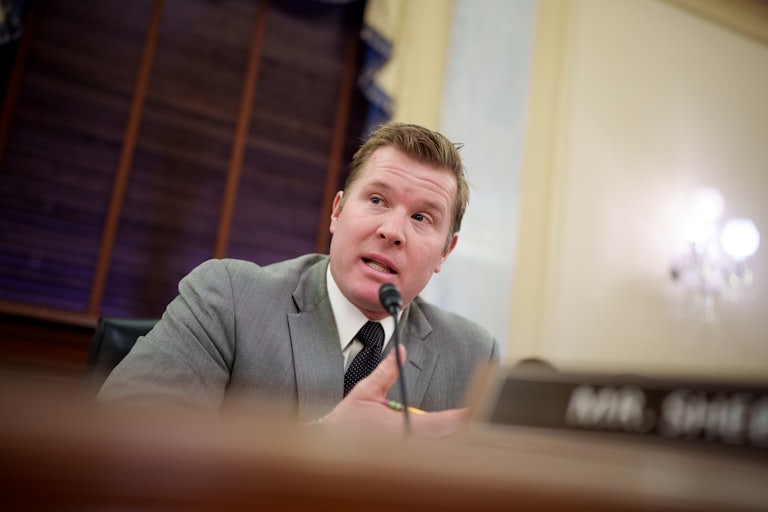
Senator Tim Sheehy speaks into a microphone during a Senate committee hearing
Andrew Harnik/Getty Images

Republicans are finally admitting that Donald Trump’s tariff plan will hurt Americans.

CNN anchor Kaitlan Collins probed Montana Senator Tim Sheehy’s thoughts on the country’s economic trajectory in an interview Monday, highlighting that 95 percent of his state’s imported goods come from Canada, Mexico, or China.

“Is this going to hurt people in your state, do you think?” asked Collins.

“There’s absolutely going to be short-term pain,” Sheehy said. “I mean, if you’re going to remodel your house to make it better in the end, it’s gonna be really annoying in the short-term when your house is getting remodeled, and there’s drywall dust everywhere and there’s workers in your living room.”

But knowing that the president’s plan won’t bode well for his constituents isn’t enough for Sheehy to pull his support.

“The reality is that remodel has got to happen in order to make things stronger and more stable in the back end,” Sheehy added.

Other Republican lawmakers have similarly conceded that Trump’s plan will be a painful transition. Alabama Senator Tommy Tuberville told Fox Business Monday that Trump’s plan would be a “slow pain” before “the gain” of potential stateside manufacturing jobs, while Oklahoma Senator James Lankford echoed Sheehy’s construction metaphor.

“I feel like in some ways in the economy this is kind of like a kitchen remodel or a bath remodel,” Lankford told CNN on Sunday. “It’s going to be noisy for a little while, but we all know where we’re headed: trying to reduce the prices for Americans and increase jobs.”

Trump has dubbed April 2, the date his tariffs go into effect, “Liberation Day.” But the president’s casual disregard for how his economic plan will affect American wallets was on full display over the weekend, when he told NBC News’s Kristin Welker that he “couldn’t care less” if American autoworkers raised the prices of their cars as a result of his tariffs.

“I hope they raise their prices, because if they do, people are gonna buy American-made cars. We have plenty,” Trump told NBC.

It was one of the first instances in which Trump has openly acknowledged the imminent damage.

Since he was on the campaign trail, Trump has repeatedly attempted to spin the tariff pitch, claiming that it will be foreign countries who pay the difference on the rising cost of goods rather than Americans. But economists have pointed out that’s not how tariffs work. Instead, Trump’s global tariff war is expected to affect just about every sector of life for the average American.

Products that will see prices rise include groceries such as avocados, maple syrup, ground beef, cherry tomatoes, sugar, bananas, nuts, cooking oil, squash, cucumbers, strawberries, and pineapples. Trump’s tariff-related executive orders have also had immediate ramifications for countless other business sectors, raising the price on everything from liquor to gas.

Children’s toys, shoes, beer and alcohol, and crude oil were all hit in Trump’s 25 percent tariff hike on Canada and Mexico, alongside an additional 10 percent tariff on China. Car manufacturers BMW, Audi, Nissan, and Mazda were also affected, as was American-owned Ford. And every industry that relies on lumber, aluminum, and steel—from artisan goods to construction—will see mark-ups as the materials themselves become more costly.

The rising cost of screws, for instance, has already started to affect supply chains for American companies that make everything from “car parts to appliances and football helmets to lawn mowers,” reported The Wall Street Journal.

Trump Has a New “Buyout” Offer for Select Federal Workers

Trump is back to begging federal employees to quit their jobs.

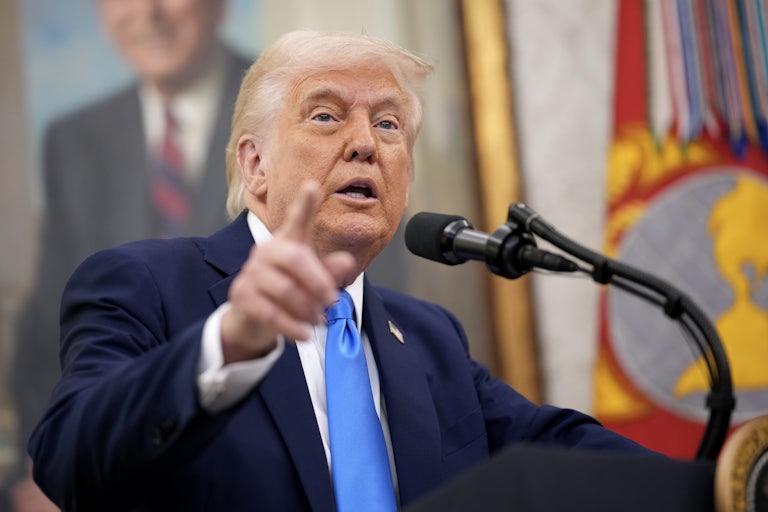
Donald Trump points a finger while speaking at a podium.
Andrew Harnik/Getty Images

The Trump administration is reviving its “deferred resignation” program as an incentive for federal workers in the Department of Housing and Urban Development to leave their jobs.

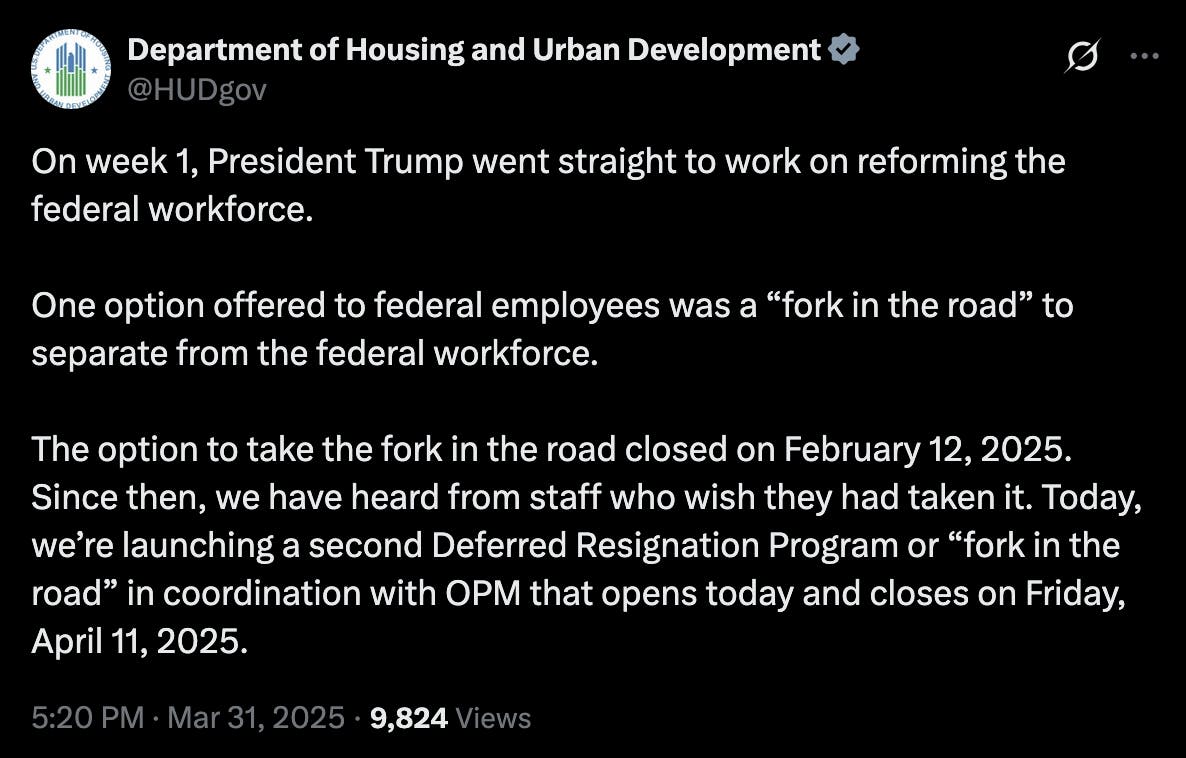
The department announced the move Monday in a post on X, saying that it will extend the resignation offer until April 11 in coordination with the Office of Personnel Management, which has recently been taken over by Elon Musk’s Department of Government Efficiency. The post claimed that 7.4 percent of HUD workers took the offer the first time around. Under the initial program’s terms, workers would be able to resign but still receive pay through September.

X screenshot Department of Housing and Urban Development @HUDgov On week 1, President Trump went straight to work on reforming the federal workforce. One option offered to federal employees was a “fork in the road” to separate from the federal workforce. The option to take the fork in the road closed on February 12, 2025. Since then, we have heard from staff who wish they had taken it. Today, we’re launching a second Deferred Resignation Program or “fork in the road” in coordination with OPM that opens today and closes on Friday, April 11, 2025.

The resignation offer faced a number of legal challenges in the initial weeks of the Trump administration and caused ripple effects in several agencies, even hindering the president’s mass deportation efforts. HUD has already experienced several cuts, including a $1 billion affordable housing program that maintains livable residences for low-income residents and another that provides necessary supplemental disaster relief.

Now it seems that the Trump administration is still desperate to cut the budget, probably to offset the fact that DOGE is actually costing the government as much as $500 billion in revenue. Will any HUD workers take the offer this time around?

More on Trump’s overhaul of the federal government: