Breaking News
Breaking News
from Washington and beyond

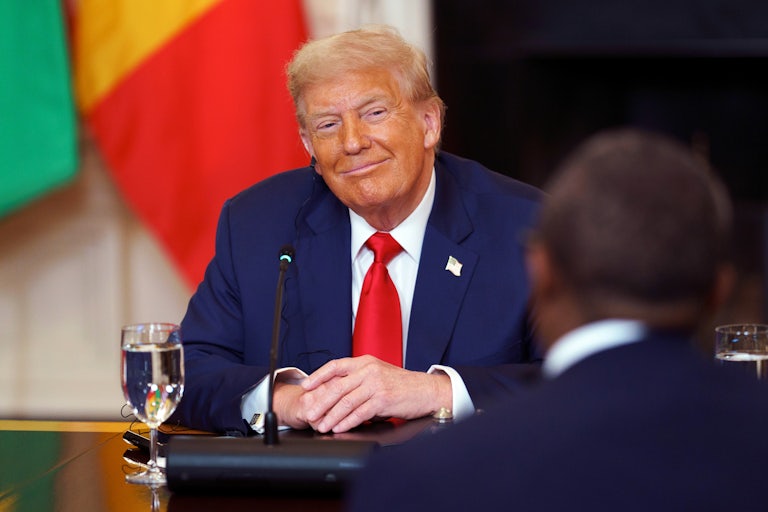
Trump Asks African Leaders to Tell Him Who They Are

Donald Trump asked the leaders at the meeting to state their name and country.

Donald Trump zones out at a meeting with African leaders.
Win McNamee/Getty Images

At the beginning of Trump’s Wednesday “multilateral lunch” event to discuss commercial opportunities with five West African leaders, Trump asked his guests to say “a few words to the press.” But as the first spoke, Trump changed his mind, interrupting him to ask the heads of state to just state their name and country.

“Perhaps we can start with you, please,” Trump said at the beginning of the meeting, motioning to Mauritanian President Mohamed Ould Ghazouani. “Great gentleman, by the way.”

Ghazouani introduced himself, thanking Trump for hosting the leaders and applauding his supposed peace efforts. As he described Mauritania’s strategic location and investment opportunities, such as rare earth minerals, Trump—himself not known for brevity—began to grow impatient as Ghazouani’s remarks had gone on for about seven minutes.

An irked Trump gave the Mauritanian leader the wrap-it-up gesture, shook his head, and threw up his hands. Catching this, Ghazouani said, “I don’t want to spend too much time on this,” before Trump cut him off.

“But I appreciate it very much, I appreciate it,” Trump went on. “Maybe we’re going to have to go a little bit quicker than this, because we have a whole schedule.”

Trump then proposed that the African heads of state just state “your name and your country.”

It was not the only awkward exchange of the event, as Trump would go on to compliment the president of Liberia, a country whose official language is English, on his English speaking, and welcome an offer from the president of Senegal to build a golf course where Trump could “show off [his] skills.”
Trump Crashes Out Over Question About Chaotic Ukraine Aid Pause

Donald Trump appeared to glitch a little when asked about reports that he didn’t know Defense Secretary Pete Hegseth had ordered the pause.

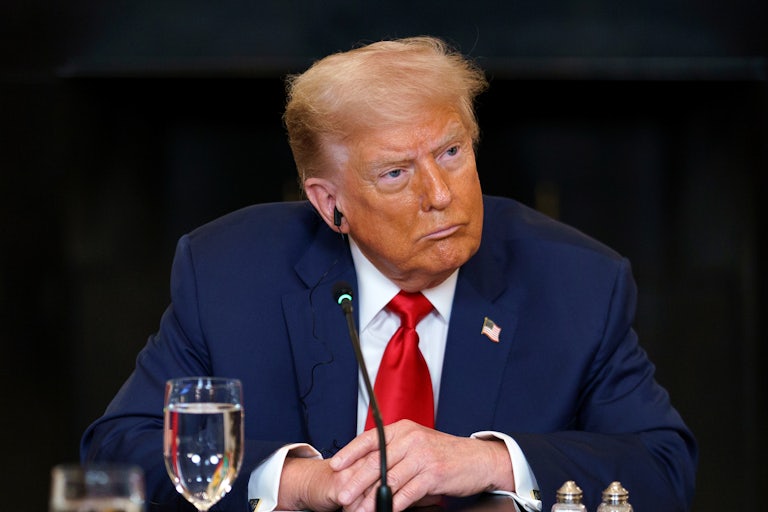
Donald Trump frowns while sitting at a table during a meeting with African leaders at the White House
Will Oliver/EPA/Bloomberg/Getty Images

The president is not concerned that his underlings are independently intervening in American foreign policy without any authorization to do so.

Speaking with reporters in the State Dining Room Wednesday, Donald Trump said that he hadn’t given much attention to a CNN report that Defense Secretary Pete Hegseth had independently halted a weapons shipment to Ukraine last week.

“Sir, yesterday you said you were not sure who ordered the munitions halted to Ukraine—have you since been able to figure that out?” asked a reporter.

“Well I haven’t thought about it,” Trump said. “Because we’re looking at Ukraine right now and munitions. But no, I have not gone into it.”

“What does it say that such a big decision could be made inside your government without you knowing?” the reporter pressed.

“I would know. If a decision is made, I will know. I would be the first to know,” Trump responded. The president, per his own confession on Tuesday, did not know who had made the decision.

Practically everyone was blindsided by news of the halted shipment, including officials in the White House, the State Department, Congress, Kyiv, and America’s European allies, setting off a mad dash within the administration to explain the unexpected directive.

Trump told Ukrainian President Volodymyr Zelenskiy on Friday that he was “not responsible” for the canceled shipment, telling the war-battered leader that he had directed a review of U.S. stockpiles but did not order the freeze, according to sources that spoke with The Guardian. The president reiterated that point during a Cabinet meeting Tuesday, telling reporters that he didn’t know who authorized the move.

The White House has refused to confirm that Hegseth was behind the stalled delivery. But even if Hegseth has become the convenient fall guy for the serious foreign policy flub, Trump still doesn’t look good. The White House is stuck in a P.R. nightmare: Either paint its Pentagon chief as a rogue agent, or expose the president’s obliviousness to the inner machinations of his own team and its foreign policy agenda.

Regardless, it’s not the first time that Hegseth has intervened in U.S. foreign policy without Trump’s express approval: In February, the Pentagon chief executed the same flub, pausing a weapons shipment to Ukraine despite the fact that Trump had announced the flow would continue.

Trump Humiliates Himself With Idiotic Question to Liberian President

Donald Trump had the cringiest response to remarks from the president of Liberia.

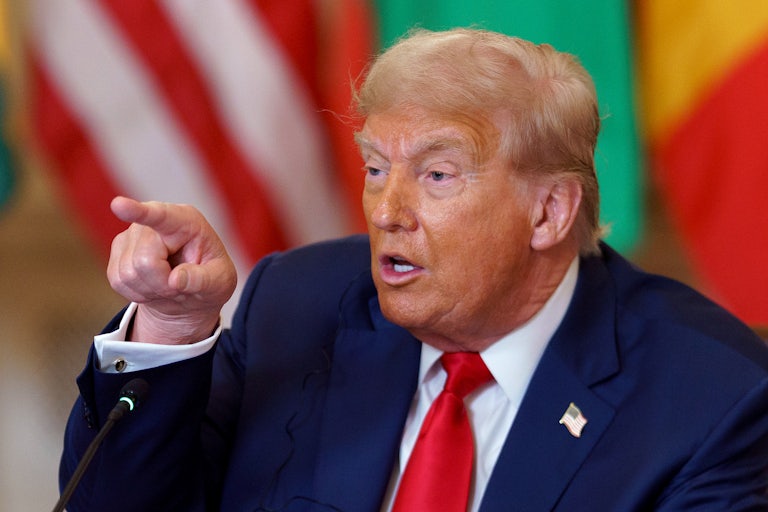
Donald Trump points while speaking during a meeting with African leaders at the White House
Will Oliver/EPA/Bloomberg/Getty Images

Donald Trump humiliated himself Wednesday in front of several leaders of African states by revealing just how little he knows about their countries.

During a meeting with leaders from Gabon, Guinea-Bissau, Liberia, Mauritania, and Senegal, as part of a multiday summit to discuss “commercial opportunities,” Trump attempted to pay a compliment to Liberian President Joseph Boakai—but fell completely flat.

“Such good English, such beautiful—where did you learn to speak so beautifully?” Trump asked. “Where were you educated? Where? In Liberia?”

“Yes, sir,” Boakai answered.

“Well, that’s very interesting. It’s beautiful English. I have people at this table [that] can’t speak nearly as well,” Trump said.

Trump to the President of Liberia: "Such good English. Where did you learn to speak so beautifully?" English is the official language of Liberia...

[image or embed]

— The Bulwark (@thebulwark.com) July 9, 2025 at 1:34 PM

It would clearly surprise Trump to learn that English is the official language of Liberia.

Trump’s condescending compliment reveals only his own ignorance—but one can hardly be surprised. There are some of us who still remember his “shithole countries” comment.

Liberia has already been severely affected by Trump’s dissolution of the U.S. Agency for Internal Development. Liberia previously received an average of $527.6 million in aid annually between 2014 and 2023. Most of that went toward funding 48 percent of Liberia’s fragile health care system. In 2025, the small West African nation was intended to receive $443 million, but it has now seen $290 million of that funding cut.

Additionally, two weeks ago, Health Secretary Robert F. Kennedy announced that the U.S. would no longer fund a global vaccine program called GAVI, which supplies vaccines to poor children around the world.

In a statement Monday, Liberia said the “high-level Summit aims to deepen diplomatic ties, advance shared economic goals, and enhance security cooperation between the United States and select African nations.” Now the country may be considering accepting immigrants as part of Trump’s massive deportation scheme.

Senegalese President Resorts to Bribing Trump in Trade Meeting

Foreign leaders are now just openly bribing the president of the United States.

Donald Trump smiles in a meeting with African leaders.
Will Oliver/EPA/Bloomberg/Getty Images

Senegalese President Bassirou Diomaye Faye used a tried and true method to curry favor with President Donald Trump: shameless flattery.

“I know you are a tremendous golf player. Golf requires concentration and precision—qualities that also make for a great leader,” Faye said during Trump’s meeting of African leaders on Wednesday. “Senegal has exceptional opportunities to offer, including in the area of tourism. So, perhaps an investment could be made in a golf course in Senegal. It would just be six hours by flight from New York, from Miami, from Europe, or from the Gulf, and that would be an opportunity for you to show off your skills on the golf course too.”

Trump seemed tickled.

“Nice, that’s some way to show off my skills. It’s a long trip to show off my skill. But that’s really nice. And he’s led a very interesting life,” Trump said, responding to Faye. “He looks like a very young person; he’s a little older than he looks. But a fantastic job. He was treated very unfairly by his government, and he prevailed, so congratulations on that.”

Faye, who went from political prisoner in 2023 to the first opposition candidate to win the presidency since 1960, made comments reminiscent of the “luxury jet” that the Qatari government so graciously gifted to Trump (although in that case, Trump asked for the jet first). It’s alarming that the sitting president is susceptible to even the most basic levels of flattery—and that foreign leaders everywhere can tell.

Trump’s Commerce Secretary Will Get Rich Off These Budget Cuts

Howard Lutnick has ties to companies that gather weather data.

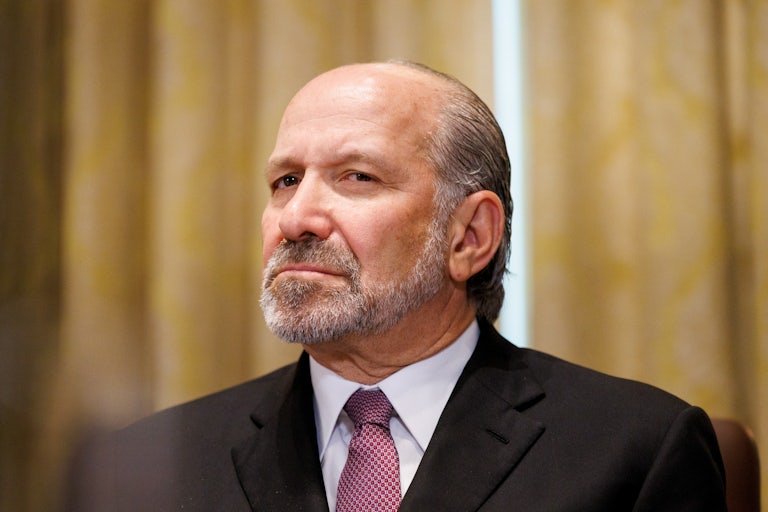
Commerce Secretary Howard Lutnick sits in Donald Trump’s Cabinet meeting
Aaron Schwartz/CNP/Bloomberg/Getty Images

At least one person in the Trump administration stands to make a fortune at the National Weather Service’s deathbed.

Commerce Secretary Howard Lutnick oversees the National Oceanic and Atmospheric Administration and its subsidiary, the National Weather Service. But until recently, he also ran a financial firm, Cantor Fitzgerald (which he placed under the stewardship of his two twentysomething sons), that invests in companies vying to replace the weather agencies’ labor.

Cantor owns a controlling interest in BGC Group, which created a weather derivatives desk in 2023 to analyze its clients’ climate-related financial exposure. Cantor is also invested in a satellite company that photographs natural disasters and weather events in real time. Lutnick is especially close to that project—he helped the company go public in 2022.

Lutnick’s most recent ethics filing revealed that he is still in the process of selling off his shares in the company. Securities and Exchange Commission filings obtained by the Associated Press indicate that Lutnick’s stakes aren’t going far—instead, he’s been transferring them to one of his sons.

Lutnick isn’t the only one with outside interests in nixing the agency. Donald Trump’s pick to run NOAA, Neil Jacobs, has been an enthusiastic advocate for privatizing the department’s work. He was previously employed by Panasonic Weather Solutions, one such company collecting weather data. And Trump’s nominee for another NOAA post, Taylor Jordan, is a K-Street lobbyist “with a roster of weather-related clients,” according to the Associated Press.

Trump has been attacking the country’s public weather-monitoring systems since he was on the campaign trail, promising to dismantle NOAA since Hurricane Helene devastated the South.

In February, then-DOGE chief Elon Musk sized down NOAA’s Office of Space Commerce, which is responsible for imposing regulations on two of Musk’s largest assets: SpaceX and Starlink. Musk laid off a third of the office’s staff.

Two months later, the administration proposed formal plans to eviscerate the rest of NOAA’s budget. In internal documents obtained by CNN, the White House claimed that the agency’s myriad weather-related programs were “misaligned with the … expressed will of the American people.”

Nixing NOAA was the brainchild of Project 2025. On page 664, the Christian nationalist manifesto argued that the agency “should be dismantled and many of its functions eliminated, sent to other agencies, privatized, or placed under the control of states and territories.”

But losing NOAA and its federally funded research would have immediate ramifications for the average American. It would effectively privatize weather forecasts, forcing U.S. citizens to pay for weather subscriptions to replace what currently feels commonplace, for instance national weather alert systems for emergencies such as flash flooding, tornadoes, extreme heat, and earthquakes.

The White House’s machinations against the weather agency have come under increased scrutiny since Texas faltered in notifying Kerr County residents of an oncoming flash flood over the weekend. It’s unclear if federal cuts played a role in how local and state authorities responded to the event, but the communication failure produced one of the deadliest natural disasters in U.S. history, killing at least 119 people across central Texas, with 173 people still missing.

“The Weather Service did a good job with the information you had here. I don’t think the staffing cuts contributed to this,” Andy Hazelton, one of the recently laid-off NOAA climate scientists, told the BBC. “But this is the kind of event we can see more of if the cuts to NOAA continue, if you make the models worse or have the staffing levels lower.”

Permanently ending access to public weather notifications could be the beginning of many more disasters down the line, as Americans would be cornered into paying for another subscription or unknowingly putting themselves at risk.

“It’s the most insidious aspect of this: Are we really talking about making weather products available only to those who can afford it?” Rick Spinrad, a former NOAA administrator under President Joe Biden, told the Associated Press. “Basically turning the weather service into a subscription streaming service? As a taxpayer, I don’t want to be in the position of saying, ‘I get a better weather forecast because I’m willing to pay for it.’”