Breaking News
Breaking News
from Washington and beyond

“Quiet Piggy”: Trump Snaps at Female Reporter Asking About Epstein

Donald Trump is clearly still pissed about the attention on Jeffrey Epstein, even if he’s pretending he’s fine with the vote in Congress.

Donald Trump yells while aboard Air Force One.
Roberto Schmidt/Getty Images

Donald Trump snapped at a reporter late last week when she asked him about the Jeffrey Epstein files, appearing to insult her appearance.

The president was asked on Friday aboard Air Force One about his name showing up in many of Epstein’s emails and correspondence released by the House Oversight Committee, and how Epstein said Trump “knew about the girls.” Trump tried to deflect, saying that reporters should be looking into how much time Larry Summers and Bill Clinton spent with Epstein.

When a reporter asked him, “If there’s nothing incriminating in the files, sir, why not—,” Trump shut her down.

“Quiet! Quiet piggy!” Trump said to the Bloomberg reporter.

Trump is known for insulting reporters, usually calling them “fake news,” but it seems the Epstein revelations have pushed him into schoolyard territory. After months of calling the Epstein files in the government’s possession a hoax and trying to delay or block their release, Trump is now faced with the fact that Congress is expected to vote for their disclosure.

If Epstein stays in the news cycle much longer, Trump may resort to even more childish antics. But then again, it’s not really a huge departure from his usual self. One thing is for sure: The files must contain some damaging material to provoke this kind of reaction.
“It’s OK With Me”: Trump Considers Bombing Mexico

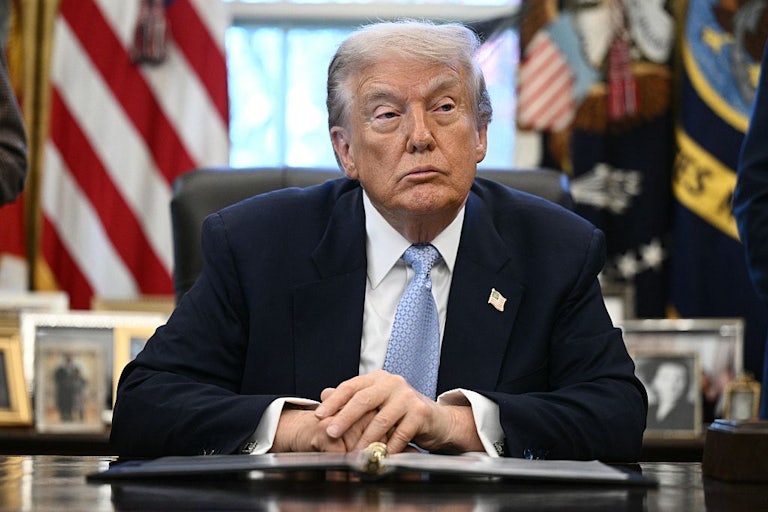
Donald Trump says he might take his bombings in the Caribbean Sea to the “land corridor” next.

Donald Trump sits at his desk in the Oval Office of the White House.
BRENDAN SMIALOWSKI/AFP/Getty Images

Donald Trump is open to the possibility of launching attacks on Mexico to stop the flow of drugs, he told reporters in the White House Monday.

“It’s OK with me,” Trump said. “Whatever we have to do to stop drugs. Mexico is, look, I looked at Mexico City over the weekend, some big problems over there.”

Trump bragged about his bombing campaign across the Caribbean Sea and in the Pacific Ocean next to Central America, claiming that it had reduced the drug flow into the U.S. by 85 percent.

“We have almost no drugs coming into our country by the sea, by, you know, the waterways, and you know why, OK? I mean, it’s pretty obvious. Would I do that on the land corridor?” Trump said, making a positive gesture. When a reporter asked if he would need Mexico’s permission, the president was dismissive.

“I wouldn’t answer that question. I’ve been speaking to Mexico. They know how I stand. We’re losing hundreds of thousands of people to drugs. So now we’ve stopped the waterways. We know every route,” Trump said, claiming that the government knows where “every druglord” lives. He said that he’d be proud to go to Congress and claimed that he would have the support of Republicans and Democrats “unless they’re crazy.”

“I am not happy with Mexico,” Trump said, concluding the press session.

The Trump administration has bombed dozens of boats south of the United States without providing evidence that they are trafficking drugs, or providing the names of people killed in the strikes. In some cases, the dead and injured were fishermen whom the U.S. declined to prosecute.

The strikes have been condemned by multiple countries, with some even opting to stop sharing drug-trafficking intelligence with the U.S. out of fear that it would be used for more bombings without transparency. Even Republicans have spoken out against the strikes. But if Trump decides to strike Mexico, that could change, as some Republicans have been egging on the president to bomb the country for years.

Trump himself told advisers in his first presidential term that he wanted to “bomb the drugs” in Mexico, and even devised plans to invade the country before beginning his second term. Will he follow through, or is this just the ravings of a man experiencing cognitive decline?

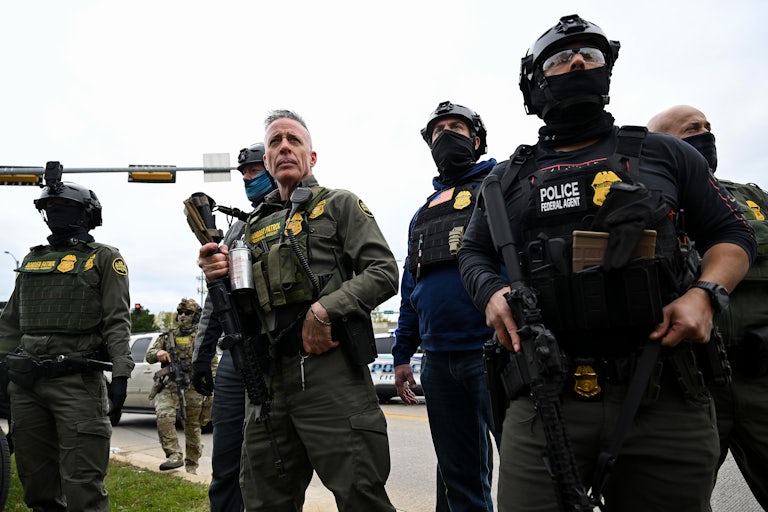
Trump’s Border Patrol Boss Asks Random Brown Man if He Speaks English

This is how racial profiling works in Trump’s America.

Border Patrol chief Greg Bovino walks with five masked officers.
Joshua Lott/The Washington Post/Getty Images
Border Patrol chief Greg Bovino

Border Patrol chief Greg Bovino was seen on video asking a random brown-skinned man standing at a bus stop in Chicago if he spoke English. 

“You speak English?” Bovino asks, pointing at the man, who looks obviously uncomfortable. He gives no response, and Bovino switches to Spanish. 

“No demands made.  It was a very casual conversation that ended with the arrest of this illegal alien,” Bovino posted on X in the comment section of the video. “Chicago will continue to see Title 8 immigration enforcement. All illegal aliens should self deport immediately via the CBP Home app.” 

Bovino has been often criticized for his brutal and wanton tactics, which include using tear gas and pepper balls against peaceful protesters. 

“This is the lie they want you to believe; that you can refuse to answer and walk away but we know that’s not true,” Cato Institute Immigration Studies director David Bier wrote in response to Bovino. “We’ve seen them arresting people for doing exactly that.” 

Bovino’s approach in the clip also aligns with the Department of Homeland Security’s policy of racial profiling, which it has fought in court to preserve. 

“Apparent ethnicity can be a factor supporting reasonable suspicion in appropriate circumstances—for instance, if agents know that the members of a criminal organization under investigation are disproportionately members of one ethnic group—even if it would not be relevant in other circumstances,” the Trump administration wrote in a Supreme Court request that was later granted, clearing the way for racial profiling. “And, in context, officers might reasonably rely on the fact that someone exclusively speaks Spanish to support reasonable suspicion that the person is here illegally.” 

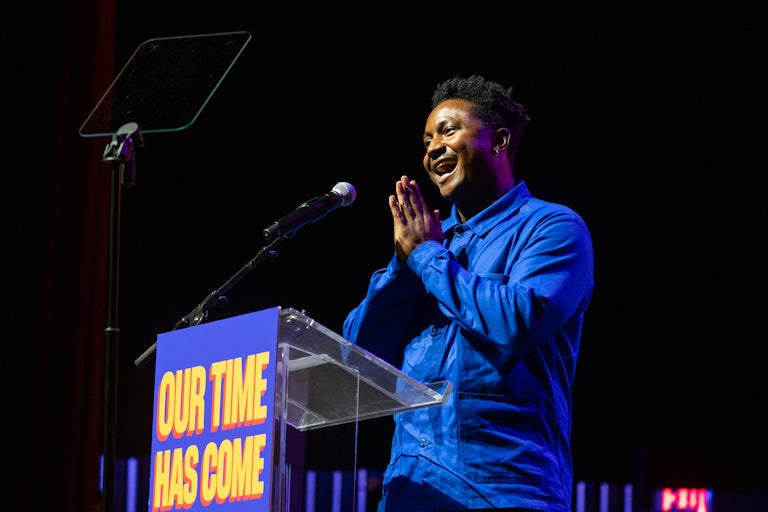
Chi Ossé, Mamdani Ally, Files Paperwork to Take On Hakeem Jeffries

Ossé, who led a rally in support of Zohran Mamdani, now wants to oust the House minority leader.

Chi Ossé smiles and puts his hand together in a prayer gesture at a podium that reads "Our Time Has Come."
Christian Monterrosa/Bloomberg/Getty Images
Chi Ossé, New York City Council member, during a campaign rally with Zohran Mamdani, on October 13

House Minority Leader Hakeem Jeffries has a new primary challenger: New York City Council member Chi Ossé, an ally of Mayor-elect Zohran Mamdani.

Ossé filed paperwork Monday to run in New York 8th congressional district, which covers part of east and south Brooklyn. In a statement, Ossé said, “The Democratic Party’s leadership is not only failing to effectively fight back against Donald Trump, they have also failed to deliver a vision that we can all believe in.”

The council member is 27 years old and supported Mamdani in the Democratic mayoral primary, leading a rally and canvassing for him. Like Mamdani, Ossé has a large social media following and is seeking to capitalize on public frustration with Democratic leadership, joining other young candidates launching primary challenges across the country.

Ossé enters the race with some name recognition in New York City, having been featured in The New Yorker, GQ, and New York magazine. But according to Axios, Mamdani won’t be offering any public support to Ossé to ensure that Jeffries and other leading New York Democrats don’t oppose his policies as mayor.

Still, the upstart candidate could build upon not only Mamdani’s example but also that of Representative Alexandria Ocasio-Cortez, who in 2018 defeated a member of the Democratic leadership at only 27 to enter Congress, representing the nearby New York 14th district. Ossé will have to rally the support of Jeffries’s many critics who see the congressman as ineffectual in leading Democrats against Donald Trump and the Republican Party. The question is whether Brooklynites agree.

ICE Agents Raid a Church With No Explanation

Operation “Charlotte’s Web” continues.

Masked officials stand next to a line of cars.
Ryan Murphy/Getty Images
Department of Homeland Security investigations officers in Charlotte, North Carolina, on November 16

The arrival of masked federal agents at a church in Charlotte, North Carolina, on Saturday sent some worshippers fleeing into the woods while children sobbed inside, witnesses told The Charlotte Observer

The ICE agents, who mobbed a group of church members doing yard work, did not ask any questions or make any attempt to identify themselves before arresting one man. The Observer did not report the name of the church.

The church’s pastor, who told The Observer he did not want to identify himself, said that agents threatened to arrest other church members, and were physically aggressive. “Right now, everybody is scared. Everybody,” he said. “One of these guys with immigration, he say he was going to arrest one of the other guys in the church. He pushed him.”

Fifteen-year-old Miguel Vazquez was one of the people who took off running when federal agents arrived. “I thought, ‘Wait, why am I running? I’m a citizen,’” Vazquez said. 

As some of the men outside fled, the women and children inside the church reportedly cried out of fear that their loved ones had been arrested.

The Department of Homeland Security claimed that the U.S. Border Patrol, which has been favored over Immigration and Customs Enforcement by the Trump administration for its more aggressive law enforcement tactics, made 130 arrests in Charlotte on Saturday and Sunday. The DHS claimed that detainees had criminal records, including a variety of infractions, but they have not released the names or paperwork relating to the arrests.  

As part of its tactlessly named Operation “Charlotte’s Web,” masked agents in paramilitary gear have kidnapped people from a number of public locations in Charlotte, including restaurants, grocery stores, Home Depot parking lots, and now churches. In January, Trump directed ICE to target immigrants in previously protected areas considered “sensitive locations,” including churches, and in April, a federal judge gave him the greenlight.

On Saturday, Charlotte residents took to the streets to protest the presence of federal law enforcement.