Breaking News
Breaking News
from Washington and beyond

Trump Accidentally Lets Slip Plan to Rename Kennedy Center

Donald Trump wants to rename the Kennedy Center after himself after doing everything he could to destroy it.

Donald Trump in a Kennedy Center balcony, speaking and pointing at the camera below. The shot makes him seem like a dictator.
JIM WATSON/AFP/Getty Images
Donald Trump at the Kennedy Center in March

President Donald Trump “accidentally” let slip on Thursday the next target for Trumpification: the Kennedy Center.

“You have a big event on Friday at the Trump-Kennedy Center—op, excuse me. The Kennedy Center,” Trump said with a laugh.

“Pardon me, such a terrible mistake,” he continued, grinning.

Trump’s “terrible mistake” came during a speech at the U.S. Institute of Peace for the signing of a peace agreement between Rwanda and the Democratic Republic of Congo. Coincidentally, the Institute of Peace is the latest building that the president has stamped his name on, even in the midst of a legal battle over who owns the building.

The president is gearing up for a big weekend, with the storied arts institution hosting the World Cup draw on Saturday and then the annual Kennedy Center Honors on Sunday. Trump may receive a special peace prize from FIFA Saturday, and is hosting Sunday’s ceremony—after personally taking over the job of selecting the Kennedy Center’s honorees, one usually done by a bipartisan council.

Trump has already brought financial ruin to the Kennedy Center, and is angling to bring aesthetic ruin as well. If he has his way, reputational ruin won’t be far behind.
Trump Is Now Denying Visas to People Who Worked in Content Moderation

If an H-1B visa applicant or one of their loved ones worked in content moderation, such as fact-checking, the State Department has said to consider the application ineligible.

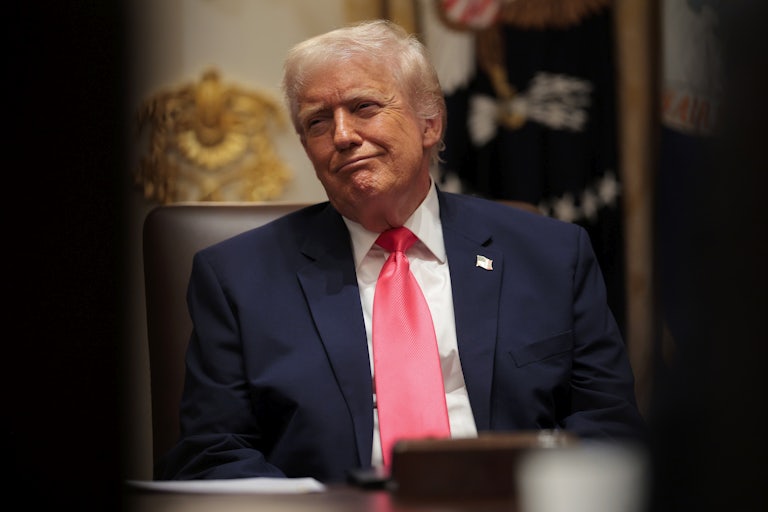
Donald Trump smiles while sitting in a Cabinet meeting
Chip Somodevilla/Getty Images

The Trump administration may revoke H-1B visa eligibility from people who worked in content moderation, fact-checking, and online safety. Their family members would lose visa status as well. 

A cable, dated Tuesday, obtained by Reuters moves U.S. consular officers to increase vetting for these individuals by looking into their résumés and LinkedIn profile pages. 

“If you uncover evidence an applicant was responsible for, or complicit in, censorship or attempted censorship of protected expression in the United States, you should pursue a finding that the applicant is ineligible,” the cable said. This includes working at “social media or financial services companies involved in the suppression of protected expression.”

“You must thoroughly explore their employment histories to ensure no participation in such activities,” the cable read.

The State Department, however, made it sound more like they were going after liberal cyberbullies more than free speech suppressors.

“We do not support aliens coming to the United States to work as censors muzzling Americans,” a spokesperson said. “In the past, the President himself was the victim of this kind of abuse when social media companies locked his accounts. He does not want other Americans to suffer this way. Allowing foreigners to lead this type of censorship would both insult and injure the American people.”  

It’s hard to believe that the State Department is saying that about Donald Trump, who is infamous for his willingness to publicly verbally abuse people online. The policy, however, is very believable, as it aligns with the larger arc of the administration’s free speech suppression efforts, from disappearing Rümeysa Öztürk for writing an op-ed to requiring universities to vet for pro-Palestinian social media posts before awarding student visas.  

Trump Nearly Has a Stroke Trying to Pronounce Names of African Leaders

Donald Trump struggled to pronounce the names of the Rwandan and Congolese presidents.

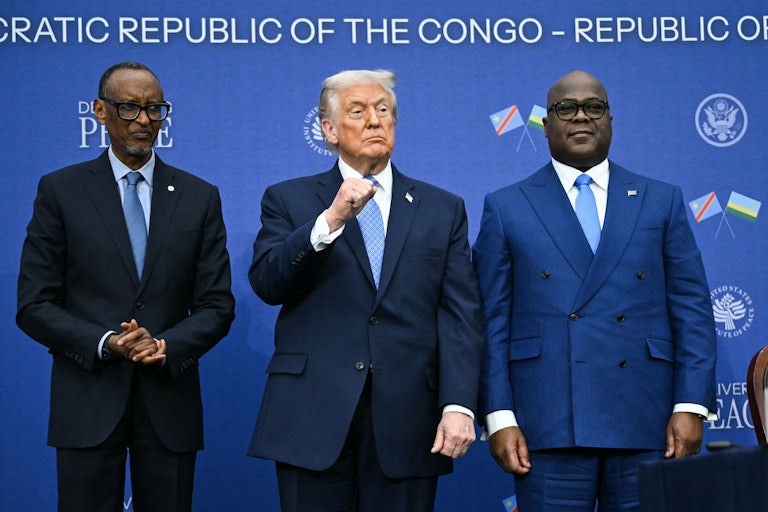
Donald Trump raises his fist while standing in between Rwandan President Paul Kagame and Democratic Republic of Congo President Felix Tshisekedi
ANDREW CABALLERO-REYNOLDS/AFP/Getty Images
Trump with (from left) Rwandan President Paul Kagame and Democratic Republic of Congo President Felix Tshisekedi

Donald Trump insulted the presidents of two countries right before signing a peace deal when he introduced the duo as “courageous leaders”—but couldn’t follow the flattery up with the correct pronunciation of their names.

The U.S. president couldn’t wrap his mouth around the name of Congolese President Felix Tshisekedi or Rwandan President Paul Kagame as the trio met in Washington Thursday to advance a peace deal that could cap 30 years of violence between the brother nations.

“I want to thank the two courageous leaders—they are courageous leaders, they really are courageous leaders, great people. President Ja-secky-theh-eh, of the Democratic Republic of the Congo,” Trump wheezed.

He then introduced Kagame, whose name he spilled out as “President Keh-goo-may.”

Tshisekedi’s name is pronounced Chi-sek-ed-dee. Kagame’s is pronounced Kah-gah-may.

Trump opted to fully skirt attempting Tshisekedi’s name when his speech required it a second time, instead referring to him as “president of DRC.”

It’s far from the first time that Trump has butchered a foreign name. Last month, he messed up the pronunciation of Kazakhstan, a decades-long U.S. ally, while seated right next to the country’s president.

During a White House dinner with Central Asian leaders, Trump claimed that “Ka-ZACK-a-stan” had joined the Abraham Accords, adding a syllable and stressing the wrong one in the country’s name while announcing supposedly new diplomatic ties between Kazakhstan (which is actually pronounced Kahz-uck-stan) and Israel.

And in 2017, Trump famously remarked on the nonexistent country of “Nambia” during a conference with African leaders.

But don’t be fooled: Trump does have a knack for language—so long as it’s the version he made up. When English proves too difficult for the president, he frequently turns to his own inventive terms, such as “bigly” (an abbreviation of big league), “ana-nomish” (an attempt to pronounce anonymous), and “covfefe,” which still no one has been able to decipher.

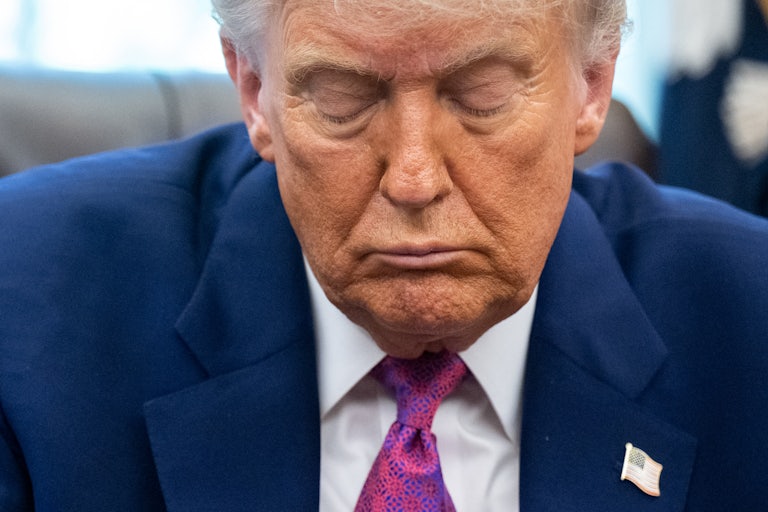
Trump, 79, Falls Asleep Again During Peace Agreement Signing

Donald Trump was bragging about this Rwanda-DRC peace agreement minutes before he began to doze off.

Donald Trump falls alseep
SAUL LOEB/AFP/Getty Images
Donald Trump at an Oval Office meeting in June

Days after Donald Trump fell asleep during a televised Cabinet meeting, the president on Thursday again dozed off during a ceremony to mark the signing of a peace agreement between Rwanda and the Democratic Republic of the Congo.

Trump was visibly closing his eyes as Rwandan President Paul Kagame spoke from the podium at the ceremony inside the U.S. Institute of Peace building, his hands clasped and his head drooping while he sat at a table to the left. Trump continued to doze after Kagame concluded his remarks and DRC President Félix Tshisekedi made his way to the podium, trying in vain to pay attention to each speaker.

Thankfully for the 79-year-old Trump, the two leaders spoke for less than 15 minutes, much shorter than Tuesday’s two-hour Cabinet meeting. One would think he’d be able to last longer at an event with more press, especially international outlets, at a building that he took over with questionable legality and plastered his name on.

Last week, The New York Times reported about Trump’s physical and mental decline, angering the president. But if he keeps falling asleep during public appearances, he really has nothing to argue about, especially considering the untold reasons why he needed an MRI and extra tests at his last doctor’s visit.

Vance Sent 2:30 a.m. Text as Officials Tried to Cover Up Signalgate

Vice President JD Vance texted the Signal group after all their messages about bombing Yemen were leaked.

JD Vance gives a thumbs up
Brett Carlsen/Getty Images

JD Vance hit up his buddies in the Signal chat used to coordinate bombing Yemen with a late-night plea for companionship—hours after the chat’s existence was revealed to the public by Atlantic editor Jeff Goldberg.

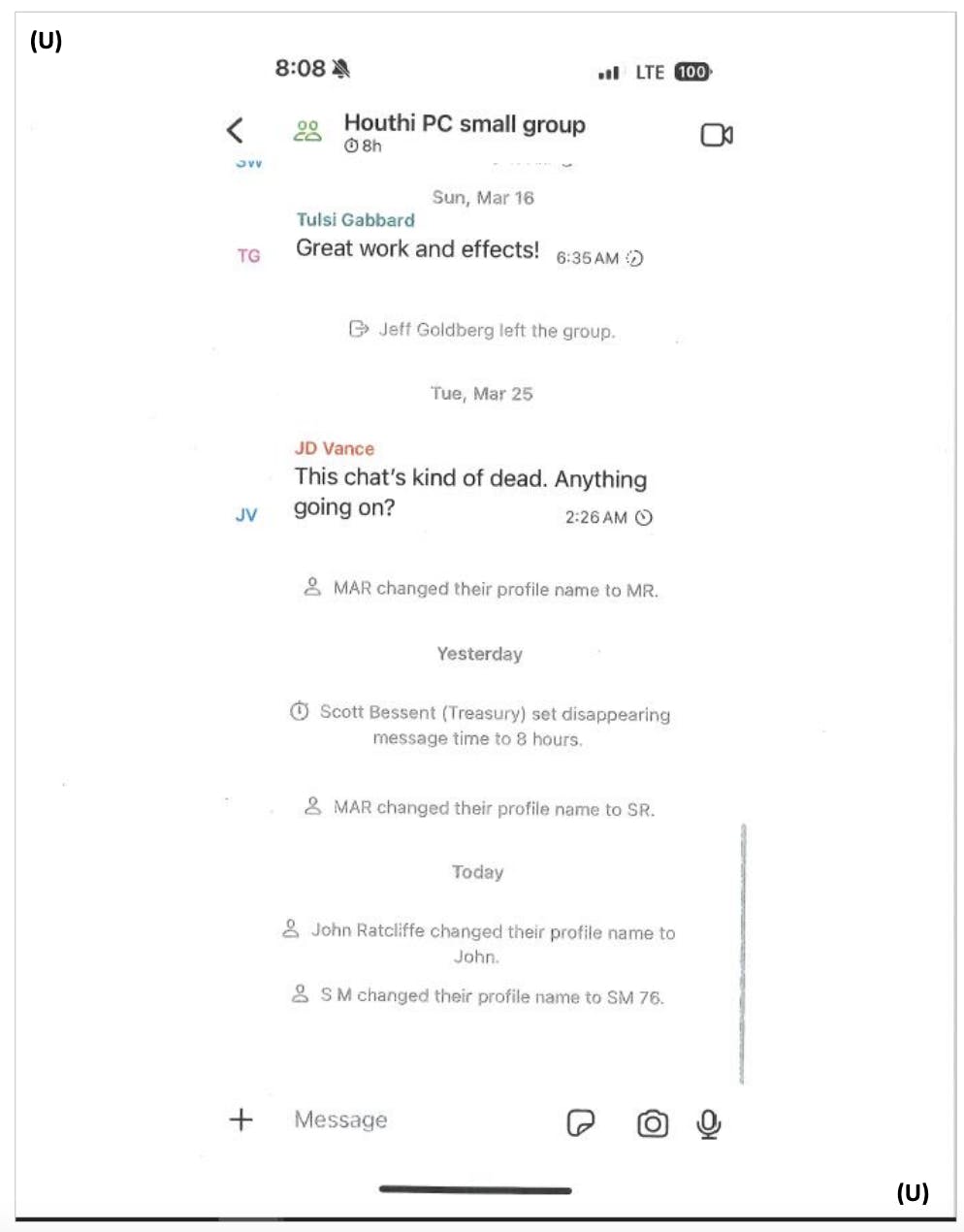
“This chat’s kind of dead,” Vance texted at 2:26 a.m. “Anything going on?”

Screenshot of Signalgate messages on March 25
Department of Defense Inspector General report

A report from the Pentagon inspector general released Thursday reveals new details about what the chat’s members did in the days and hours after March 24, when Goldberg published that Defense Secretary Pete Hegseth had inadvertently texted him classified information about the Trump administration’s war plans.

The vice president’s “u up?”-style message, which we are generously reading as a joke, was sent in the wee hours of the morning of March 25.

Where Vance chose to make light of the possible treason, Treasury Secretary Scott Bessent appeared to have another aim: to cover the group’s tracks. According to the screenshot, Bessent shortened the time it would take for messages to disappear from the chat to eight hours. Goldberg reported that the messages had previously been set to disappear after either one or four weeks, already a potential violation of federal law.

Other officials changed their profile names: Secretary of State Marco Rubio changed his screen name from “MAR” to “MR,” CIA Director John Ratfcliffe shortened his name to simply “John,” and deputy chief of staff Sephen Miller, “S M,” changed his name to “SM 76.”

It’s unclear why these obviously identifiable (and already identified) officials would change their names, or attempt to make their messages disappear faster—the photo of the chat from the report was taken on March 27, leaving only a day for fast-deleting messages to be sent and then erased—but they obviously were scrambling.